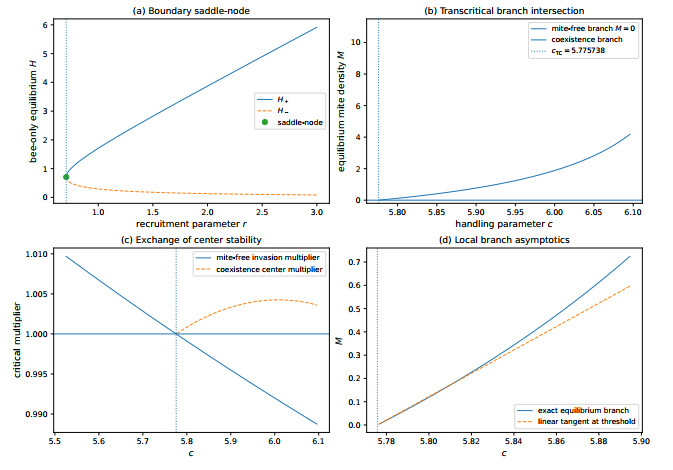
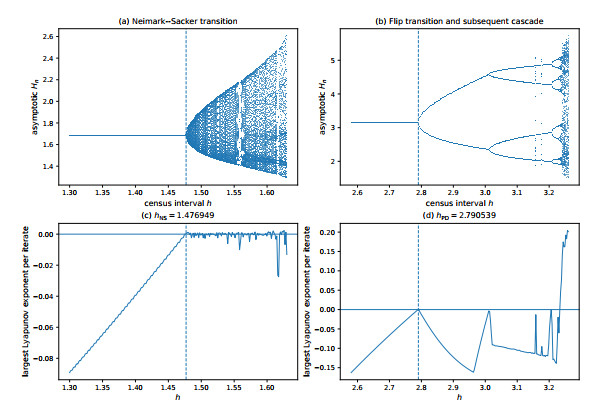
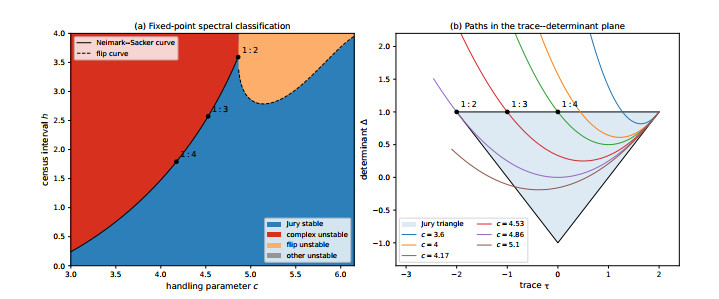
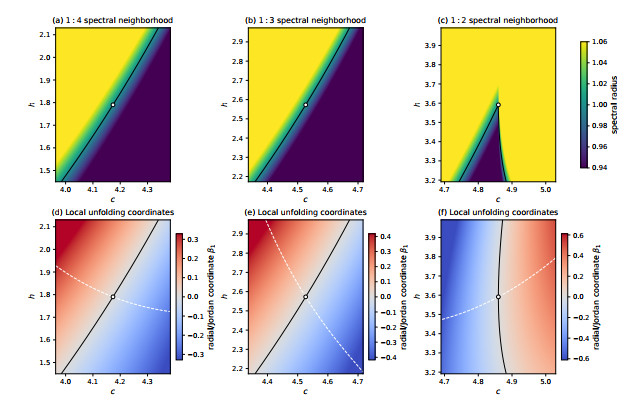
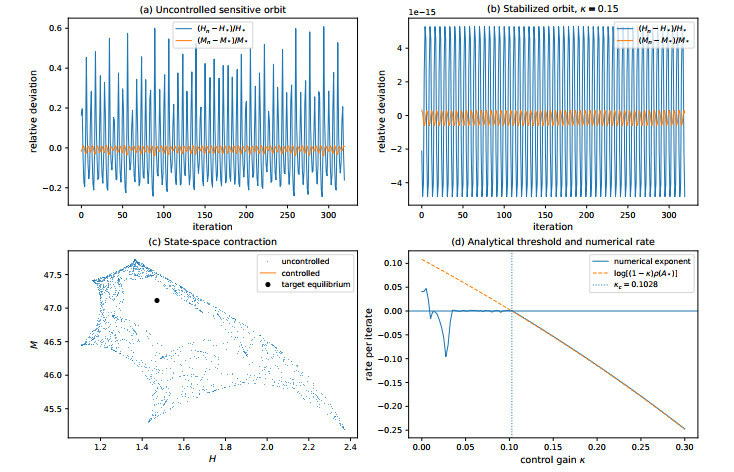
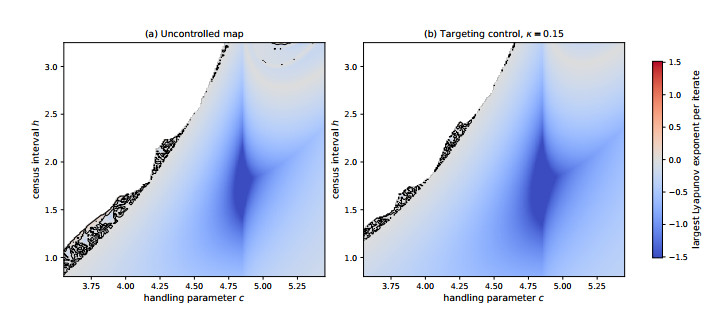
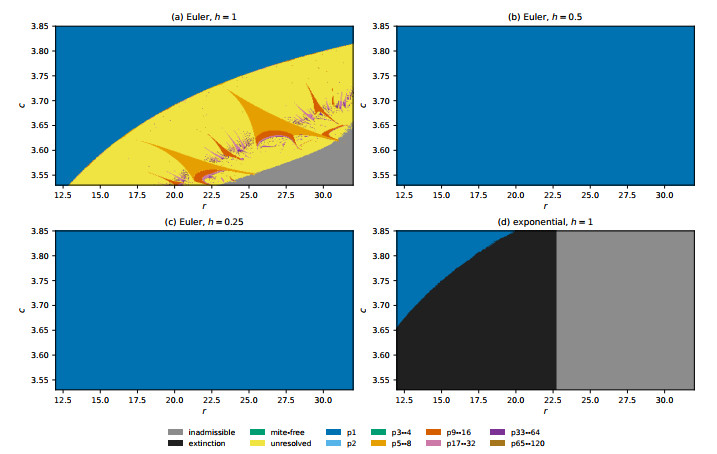
We extend a previously studied two-dimensional honeybee–Varroa destructor census model by introducing a capacity-limited mite-removal term. For the continuous system, positivity and dissipativity are established, while for the forward Euler map, a conditional invariant simplex and coexistence equilibria are characterized. Boundary analysis distinguishes saddle-node creation of bee-only equilibria from a transcritical mite-invasion threshold. At coexistence, variation of the census interval produces nondegenerate supercritical Neimark–Sacker and period-doubling bifurcations. Two-parameter analysis identifies candidate 1:2, 1:3, and 1:4 strong resonances and their nondegeneracy indicators. An equilibrium-targeting correction provides a local stabilization boundary. Comparisons across census intervals and discretization schemes reveal scheme-dependent global dynamics. The results therefore provide a theoretical bifurcation framework, not a calibrated prediction of colony dynamics.
Citation: Asifa Tassaddiq, Muhammad Sajjad Shabbir, Rabab Alharbi, Dalal Khalid Almutairi, Rizwan Ahmed, JungYoon Kim, Younhyun Jung, Jawad Khan. Bifurcation structure, resonance dynamics, and stabilization in a capacity-limited honeybee–varroa map[J]. AIMS Mathematics, 2026, 11(10): 33745-33767. doi: 10.3934/math.20261319
We extend a previously studied two-dimensional honeybee–Varroa destructor census model by introducing a capacity-limited mite-removal term. For the continuous system, positivity and dissipativity are established, while for the forward Euler map, a conditional invariant simplex and coexistence equilibria are characterized. Boundary analysis distinguishes saddle-node creation of bee-only equilibria from a transcritical mite-invasion threshold. At coexistence, variation of the census interval produces nondegenerate supercritical Neimark–Sacker and period-doubling bifurcations. Two-parameter analysis identifies candidate 1:2, 1:3, and 1:4 strong resonances and their nondegeneracy indicators. An equilibrium-targeting correction provides a local stabilization boundary. Comparisons across census intervals and discretization schemes reveal scheme-dependent global dynamics. The results therefore provide a theoretical bifurcation framework, not a calibrated prediction of colony dynamics.

| [1] |
G. DeGrandi-Hoffman, R. Curry, A mathematical model of Varroa mite (Varroa destructor Anderson and Trueman) and honeybee (Apis mellifera L.) population dynamics, Int. J. Acarol., 30 (2024), 259–274. https://doi.org/10.1080/01647950408684393 doi: 10.1080/01647950408684393

|
| [2] |
M. A. Ibrahim, A. Dénes, A mathematical model for the spread of Varroa mites in honeybee populations: two simulation scenarios with seasonality, Heliyon, 8 (2022), e10648. https://doi.org/10.1016/j.heliyon.2022.e10648 doi: 10.1016/j.heliyon.2022.e10648
|
| [3] |
S. J. Martin, The role of Varroa and viral pathogens in the collapse of honeybee colonies: a modelling approach, J. Appl. Ecol., 38 (2001), 1082–1093. https://doi.org/10.1046/j.1365-2664.2001.00662.x doi: 10.1046/j.1365-2664.2001.00662.x
|
| [4] |
Y. Kang, K. Blanco, T. Davis, Y. Wang, G. DeGrandi-Hoffman, Disease dynamics of honeybees with Varroa destructor as parasite and virus vector, Math. Biosci., 275 (2016), 71–92. https://doi.org/10.1016/j.mbs.2016.02.012 doi: 10.1016/j.mbs.2016.02.012
|
| [5] |
M. A. Becher, V. Grimm, P. Thorbek, J. Horn, P. J. Kennedy, J. L. Osborne, BEEHAVE: a systems model of honeybee colony dynamics and foraging to explore multifactorial causes of colony failure, J. Appl. Ecol., 51 (2014), 470–482. https://doi.org/10.1111/1365-2664.12222 doi: 10.1111/1365-2664.12222
|
| [6] |
K. Messan, M. M. Rodriguez, J. Chen, G. DeGrandi-Hoffman, Y. Kang, Population dynamics of Varroa mite and honeybee: effects of parasitism with age structure and seasonality, Ecol. Modell., 440 (2021), 109359. https://doi.org/10.1016/j.ecolmodel.2020.109359 doi: 10.1016/j.ecolmodel.2020.109359
|
| [7] |
J. Chen, G. DeGrandi-Hoffman, V. Ratti, Y. Kang, Review on mathematical modeling of honeybee population dynamics, Math. Biosci. Eng., 18 (2021), 9606–9650. https://doi.org/10.3934/mbe.2021471 doi: 10.3934/mbe.2021471
|
| [8] |
F. Huancas, A. Coronel, E. Lozada, J. Torres, Mathematical modeling of population dynamics of pollinators: a survey, Biology, 14 (2025), 1308. https://doi.org/10.3390/biology14091308 doi: 10.3390/biology14091308
|
| [9] |
I. R. Abell, T. P. Le, J. A. Flegg, C. M. Baker, Modelling the spread and management of Varroa destructor in naive european honeybee populations, J. Theor. Biol., 622 (2026), 112329. https://doi.org/10.1016/j.jtbi.2025.112329 doi: 10.1016/j.jtbi.2025.112329
|
| [10] |
W. A. Mangum, Analysis of a population biology model describing the interaction between the parasitic mite and the honey bee using nonlinear difference equations, Nat. Resour. Model., 11 (1998), 117–130. https://doi.org/10.1111/j.1939-7445.1998.tb00303.x doi: 10.1111/j.1939-7445.1998.tb00303.x
|
| [11] |
S. Martin, A population model for the ectoparasitic mite Varroa jacobsoni in honey bee colonies, Ecol. Modell., 109 (1998), 267–281. https://doi.org/10.1016/S0304-3800(98)00059-3 doi: 10.1016/S0304-3800(98)00059-3
|
| [12] |
S. Karmakar, N. Pal, Complex dynamical behaviors of a honeybee-mite model in parameter plane, Physica D, 468 (2024), 134300. https://doi.org/10.1016/j.physd.2024.134300 doi: 10.1016/j.physd.2024.134300
|
| [13] |
Q. Lai, L. Yang, G. Chen, Two-dimensional discrete memristive oscillatory hyperchaotic maps with diverse dynamics, IEEE Trans. Ind. Electron., 72 (2025), 969–979. https://doi.org/10.1109/TIE.2024.3417974 doi: 10.1109/TIE.2024.3417974
|
| [14] |
Q. Lai, C. Zhu, X. W. Zhao, X. Sun, J. Hua, A unified framework for generating 4-D discrete memristive hyperchaotic maps with complex dynamics and application to encryption, IEEE Internet Things J., 12 (2025), 40934–40943. https://doi.org/10.1109/JIOT.2025.3590465 doi: 10.1109/JIOT.2025.3590465
|
| [15] |
M. Spivak, G. S. Reuter, Varroa destructor infestation in untreated honey bee colonies selected for hygienic behavior, J. Econ. Entomol., 94 (2001), 326–331. https://doi.org/10.1603/0022-0493-94.2.326 doi: 10.1603/0022-0493-94.2.326
|
| [16] |
C. Schöning, S. Gisder, S. Geiselhardt, I. Kretschmann, K. Bienefeld, M. Hilker, et al., Evidence for damage-dependent hygienic behaviour towards Varroa destructor-parasitised brood in the western honey bee, Apis mellifera, J. Exp. Biol., 215 (2012), 264–271. https://doi.org/10.1242/jeb.062562 doi: 10.1242/jeb.062562
|
| [17] |
L. I. de Guzman, T. E. Rinderer, A. M. Frake, M. J. Kirrane, Brood removal influences fall of Varroa destructor in honey bee colonies, J. Apic. Res., 54 (2015), 216–225. https://doi.org/10.1080/00218839.2015.1117294 doi: 10.1080/00218839.2015.1117294
|
| [18] |
S. K. Cheruiyot, H. M. G. Lattorff, R. Kahuthia-Gathu, J. P. Mbugi, E. Muli, Varroa-specific hygienic behavior of Apis mellifera scutellata in Kenya, Apidologie, 49 (2018), 439–449. https://doi.org/10.1007/s13592-018-0570-6 doi: 10.1007/s13592-018-0570-6
|
| [19] |
K. Wagoner, M. Spivak, A. Hefetz, T. Reams, O. Rueppell, Stock-specific chemical brood signals are induced by Varroa and deformed wing virus and elicit hygienic response in the honey bee, Sci. Rep., 9 (2019), 8753. https://doi.org/10.1038/s41598-019-45008-2 doi: 10.1038/s41598-019-45008-2
|
| [20] |
L. Sprau, K. Traynor, P. Rosenkranz, Honey bees (Apis mellifera) preselected for Varroa sensitive hygiene discriminate between live and dead Varroa destructor and inanimate objects, Sci. Rep., 13 (2023), 10340. https://doi.org/10.1038/s41598-023-37356-x doi: 10.1038/s41598-023-37356-x
|
| [21] |
W. W. Wanore, C. W. W. Pirk, A. A. Yusuf, W. Ayalew, B. T. Nganso, Fending for thyself: honey bees from Ethiopia inflict physical damage on Varroa destructor, Ecol. Evol., 15 (2025), e72660. https://doi.org/10.1002/ece3.72660 doi: 10.1002/ece3.72660
|
| [22] |
J. d. F. Santos, F. C. Coelho, P. A. Bliman, Behavioral modulation of infestation by Varroa destructor in bee colonies: implications for colony stability, PLoS ONE, 11 (2016), e0160465. https://doi.org/10.1371/journal.pone.0160465 doi: 10.1371/journal.pone.0160465
|
| [23] |
B. Mukogawa, J. C. Nieh, The Varroa paradox: infestation levels and hygienic behavior in feral scutellata-hybrid and managed Apis mellifera ligustica honey bees, Sci. Rep., 14 (2024), 1148. https://doi.org/10.1038/s41598-023-51071-7 doi: 10.1038/s41598-023-51071-7
|
| [24] |
L. Sprau, K. Traynor, B. Gessler, M. Hasselmann, P. Rosenkranz, Mite non-reproduction is not a consequence of the brood removal behavior of Varroa sensitive hygiene honey bee colonies (Apis mellifera), Ecol. Evol., 14 (2024), e11595. https://doi.org/10.1002/ece3.11595 doi: 10.1002/ece3.11595
|
| [25] | Y. A. Kuznetsov, Elements of applied bifurcation theory, New York: Springer, 2004. https://doi.org/10.1007/978-1-4757-3978-7 |
| [26] |
Y. A. Kuznetsov, H. G. E. Meijer, Numerical normal forms for codimension-two bifurcations of fixed points with at most two critical eigenvalues, SIAM J. Sci. Comput., 26 (2005), 1932–1954. https://doi.org/10.1137/030601508 doi: 10.1137/030601508
|
| [27] |
W. Govaerts, R. K. Ghaziani, Y. A. Kuznetsov, H. G. E. Meijer, Numerical methods for two-parameter local bifurcation analysis of maps, SIAM J. Sci. Comput., 29 (2007), 2644–2667. https://doi.org/10.1137/060653858 doi: 10.1137/060653858
|
| [28] | S. Wiggins, Introduction to applied nonlinear dynamical systems and chaos, New York: Springer, 2003. https://doi.org/10.1007/b97481 |
| [29] |
Q. Jin, F. G. Yuan, Y. Ren, Auto-parametric resonance of flexible viscoelastic beams under interaction between longitudinal and transverse modes, Chaos Solitons Fract., 174 (2023), 113880. https://doi.org/10.1016/j.chaos.2023.113880 doi: 10.1016/j.chaos.2023.113880
|
| [30] | E. Hairer, G. Wanner, S. P. Norsett, Solving ordinary differential equations Ⅰ: nonstiff problems, Berlin: Springer, 1993. https://doi.org/10.1007/978-3-540-78862-1 |
| [31] | S. Elaydi, An introduction to difference equations, New York: Springer, 2005. https://doi.org/10.1007/0-387-27602-5 |
| [32] |
E. Ott, C. Grebogi, J. A. Yorke, Controlling chaos, Phys. Rev. Lett., 64 (1990), 1196–1199. https://doi.org/10.1103/PhysRevLett.64.1196 doi: 10.1103/PhysRevLett.64.1196
|
| [33] |
G. Benettin, L. Galgani, A. Giorgilli, J. M. Strelcyn, Lyapunov characteristic exponents for smooth dynamical systems and for hamiltonian systems: a method for computing all of them. Part 1: theory, Meccanica, 15 (1980), 9–20. https://doi.org/10.1007/BF02128236 doi: 10.1007/BF02128236
|
Figures(7) / Tables(2)

Asifa Tassaddiq, Muhammad Sajjad Shabbir, Rabab Alharbi, Dalal Khalid Almutairi, Rizwan Ahmed, JungYoon Kim, Younhyun Jung, Jawad Khan. Bifurcation structure, resonance dynamics, and stabilization in a capacity-limited honeybee–varroa map[J]. AIMS Mathematics, 2026, 11(10): 33745-33767. doi: 10.3934/math.20261319





 DownLoad: