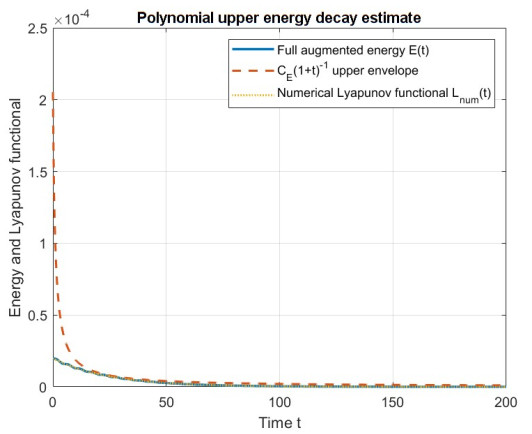
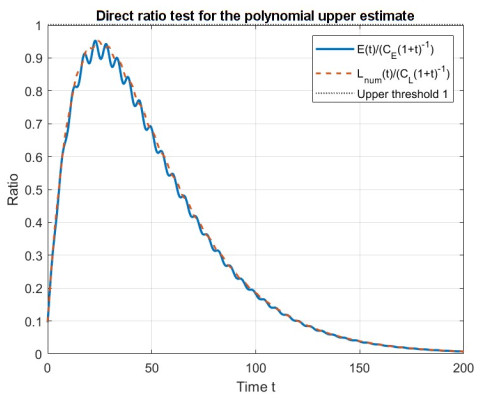
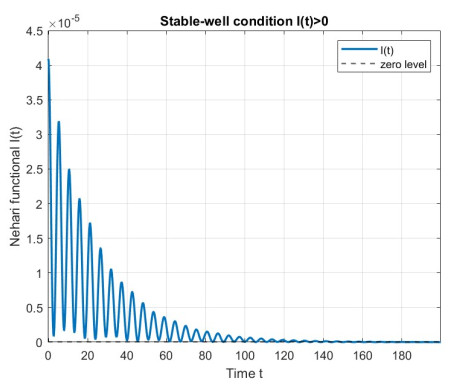
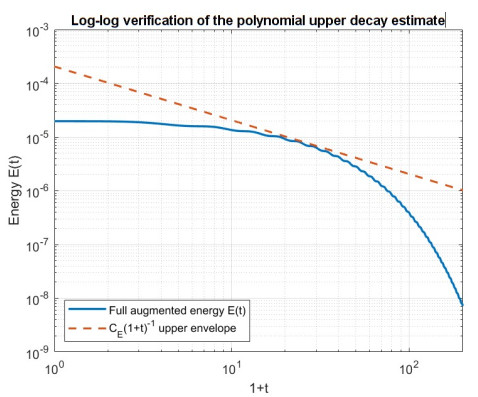
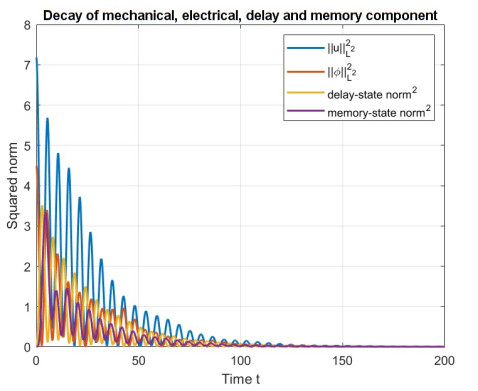
This paper investigates a coupled piezoelectric beam model that incorporates a Kilbas-Saigo-Mittag-Leffler (KSML) spectral operator, tempered fractional memory, cross-coupled time delays, and logarithmic nonlinearities. The bidirectional delay structure captures the interaction between mechanical and electrical signals as they travel through sensors, amplifiers, and feedback controllers, while the multiscale KSML kernel describes both short-time elastic responses and long-term memory effects in piezoelectric materials. The spectral kernel is shown to be positive, bounded, and self-adjoint with explicit asymptotics; accordingly, the elastic stiffness is decomposed into a classical coercive part and the hereditary KSML correction, and the regularized logarithmic potential is treated through an exact-primitive error identity of order $ \mathcal O(\varepsilon_0) $. Under suitable assumptions on the model parameters and initial data, we establish local well-posedness with a blow-up alternative, prove invariance of the stable potential well and global existence for data satisfying $ \mathcal E(0) < \mathfrak d $ and $ \mathcal I(0) > 0 $, and derive the polynomial upper decay estimate $ \mathcal E(t)\le C/(1+t) $ with all constants explicit. Numerical experiments confirm the polynomial energy envelope in the stable regime against an a priori constant computed only from the data, without any fitting to the computed solution. These findings provide a mathematical framework for analyzing more general feedback configurations in piezoelectric systems.
Citation: Zahid Ullah, Jianghao Hao, Ahmed Bchatnia, Iqra Kanwal, Luqman Bashir. Polynomial stability of coupled piezoelectric beam systems via Kilbas-Saigo-Mittag-Leffler operators and cross-coupled delayed feedback[J]. AIMS Mathematics, 2026, 11(10): 33293-33332. doi: 10.3934/math.20261303
This paper investigates a coupled piezoelectric beam model that incorporates a Kilbas-Saigo-Mittag-Leffler (KSML) spectral operator, tempered fractional memory, cross-coupled time delays, and logarithmic nonlinearities. The bidirectional delay structure captures the interaction between mechanical and electrical signals as they travel through sensors, amplifiers, and feedback controllers, while the multiscale KSML kernel describes both short-time elastic responses and long-term memory effects in piezoelectric materials. The spectral kernel is shown to be positive, bounded, and self-adjoint with explicit asymptotics; accordingly, the elastic stiffness is decomposed into a classical coercive part and the hereditary KSML correction, and the regularized logarithmic potential is treated through an exact-primitive error identity of order $ \mathcal O(\varepsilon_0) $. Under suitable assumptions on the model parameters and initial data, we establish local well-posedness with a blow-up alternative, prove invariance of the stable potential well and global existence for data satisfying $ \mathcal E(0) < \mathfrak d $ and $ \mathcal I(0) > 0 $, and derive the polynomial upper decay estimate $ \mathcal E(t)\le C/(1+t) $ with all constants explicit. Numerical experiments confirm the polynomial energy envelope in the stable regime against an a priori constant computed only from the data, without any fitting to the computed solution. These findings provide a mathematical framework for analyzing more general feedback configurations in piezoelectric systems.

| [1] | H. T. Banks, R. C. Smith, Y. Wang, Smart material structures: Modelling, estimation and control, Wiley, New York, 1996. |
| [2] |
N. W. Hagood, W. H. Chung, A. Von Flotow, Modeling of piezoelectric actuator dynamics for active structural control, J. Intell. Mater. Syst. Struct., 1 (1990), 327–354. https://doi.org/10.1177/1045389X9000100305 doi: 10.1177/1045389X9000100305

|
| [3] | J. Yang, An introduction to the theory of piezoelectricity, Springer, New York, 2005. https://doi.org/10.1007/b101799 |
| [4] |
A. J. A. Ramos, C. S. L. Goncalves, S. S. Correa Neto, Exponential stability and numerical treatment for piezoelectric beams with magnetic effect, ESAIM Math. Model. Numer. Anal., 52 (2018), 255–274. https://doi.org/10.1051/m2an/2018004 doi: 10.1051/m2an/2018004
|
| [5] |
A. J. A. Ramos, M. M. Freitas, D. S. A. Junior, S. S. Jesus, T. R. S. Moura, Equivalence between exponential stabilization and boundary observability for piezoelectric beams, Z. Angew. Math. Phys., 70 (2019), 1–14. https://doi.org/10.1007/s00033-019-1106-2 doi: 10.1007/s00033-019-1106-2
|
| [6] |
A. J. A. Ramos, M. M. Freitas, D. S. Almeida Junior, Pullback dynamics of Lamé systems with time-dependent weak damping, Nonlinear Anal. Real World Appl., 75 (2024), 103982. https://doi.org/10.1016/j.nonrwa.2023.103982 doi: 10.1016/j.nonrwa.2023.103982
|
| [7] |
A. Kong, C. Nonato, W. Liu, M. J. D. Santos, C. Raposo, Equivalence between exponential stabilization and observability inequality for magnetic effected piezoelectric beams, Discrete Cont. Dyn.-B, 27 (2022), 2959–2978. https://doi.org/10.3934/dcdsb.2021168 doi: 10.3934/dcdsb.2021168
|
| [8] |
M. Akil, A. Soufyane, Y. Belhamadia, Stabilization results of piezoelectric beams with partial viscous dampings and under Lorenz gauge condition, Appl. Math. Optim., 87 (2023), 1–38. https://doi.org/10.1007/s00245-022-09935-3 doi: 10.1007/s00245-022-09935-3
|
| [9] |
M. Liu, I. Dassios, F. Milano, On the stability analysis of systems of neutral delay differential equations, Circ. Syst. Signal Pr., 38 (2019), 1639–1653. https://doi.org/10.1007/s00034-018-0943-0 doi: 10.1007/s00034-018-0943-0
|
| [10] |
P. L. Dattori da Silva, T. F. Ma, E. M. Maravi-Percca, P. N. Seminario-Huertas, A non-homogeneous weakly damped Lamé system with time-dependent delay, Math. Method. Appl. Sci., 46 (2023), 8793–8805. https://doi.org/10.1002/mma.9017 doi: 10.1002/mma.9017
|
| [11] |
Z. Ullah, J. Hao, A. Bchatnia, A. Aziz, Global solution, decay and blow-up of a viscoelastic Kirchhoff system with logarithmic nonlinearity and acoustic fractional delay boundary conditions, Axioms, 15 (2026), 728. https://doi.org/10.3390/axioms15100728 doi: 10.3390/axioms15100728
|
| [12] | H. Yüksekkaya, E. Piskin, M. M. Kafini, A. M. Al-Mahdi, Well-posedness and exponential stability for the logarithmic Lamé system with a time-delay, Appl. Anal., 2023. https://doi.org/10.1080/00036811.2023.2196993 |
| [13] | B. Feng, C. A. Raposo, C. A. Nonato, A. Soufyane, Analysis of exponential stabilization for Rao-Nakra sandwich beam with time-varying weight and time-varying delay, Math. Control Relat. Fields, 2022. https://doi.org/10.3934/mcrf.2022011 |
| [14] |
M. Kafini, S. A. Messaoudi, Local existence and blow up of solutions to a logarithmic nonlinear wave equation with delay, Appl. Anal., 99 (2020), 530–547. https://doi.org/10.1080/00036811.2018.1504029 doi: 10.1080/00036811.2018.1504029
|
| [15] |
S. A. Messaoudi, A. Fareh, N. Doudi, Well-posedness and exponential stability in a wave equation with a strong damping and a strong delay, J. Math. Phys., 57 (2016), 111501. https://doi.org/10.1063/1.4966551 doi: 10.1063/1.4966551
|
| [16] |
S. A. Messaoudi, M. M. Al-Gharabli, A general stability result for a nonlinear wave equation with infinite memory, Appl. Math. Lett., 26 (2013), 1082–1086. https://doi.org/10.1016/j.aml.2013.06.002 doi: 10.1016/j.aml.2013.06.002
|
| [17] |
A. M. Al-Mahdi, Stability results of a viscoelastic plate equation with past history and a logarithmic nonlinearity, Bound. Value Probl., 2020 (2020), 1–20. https://doi.org/10.1186/s13661-020-01382-9 doi: 10.1186/s13661-020-01382-9
|
| [18] | M. M. Al-Gharabli, A. M. Al-Mahdi, S. A. Messaoudi, General and optimal decay result for a viscoelastic plate equation with a logarithmic nonlinearity, Math. Method. Appl. Sci., 44 (2021), 10646–10658. |
| [19] |
A. Peyravi, General stability and exponential growth for a class of semi-linear wave equations with logarithmic source and memory terms, Appl. Math. Optim., 81 (2020), 545–561. https://doi.org/10.1007/s00245-018-9508-7 doi: 10.1007/s00245-018-9508-7
|
| [20] |
Z. Ullah, J. Hao, L. Bashir, I. Kanwal, Stability and dynamics of fractionally damped piezoelectric beams with time-delayed coupling and logarithmic source, Commun. Nonlinear Sci. Numer. Simul., 163 (2026), 1–20. https://doi.org/10.1016/j.cnsns.2026.110575 doi: 10.1016/j.cnsns.2026.110575
|
| [21] | A. Guesmia, S. A. Messaoudi, A general stability result in a Timoshenko system with infinite memory, Math. Comput. Model., 52 (2010), 705–716. |
| [22] |
M. I. Mustafa, Optimal decay rates for the viscoelastic wave equation, Math. Methods Appl. Sci., 41 (2018), 164–170. https://doi.org/10.1002/mma.4604 doi: 10.1002/mma.4604
|
| [23] |
F. Alili, A. Amara, K. Zennir, Existence and stability results for fractional fully hybrid elastic beam equation: Caputo-like formulation, Math. Method. Appl. Sci., 48 (2025), 13839–13853. https://doi.org/10.1002/mma.11146 doi: 10.1002/mma.11146
|
| [24] | B. Tellab, Existence and stability results for the solution of neutral fractional integro-differential equation with nonlocal conditions, Tamkang J. Math., 53 (2022). https://doi.org/10.5556/j.tkjm.53.2022.3550 |
| [25] |
R. Garra, R. Garrappa, The Prabhakar or three-parameter Mittag-Leffler function: Theory and application, Commun. Nonlinear Sci. Numer. Simul., 56 (2018), 314–329. https://doi.org/10.1016/j.cnsns.2017.08.018 doi: 10.1016/j.cnsns.2017.08.018
|
| [26] |
Z. Ullah, J. Hao, S. T. M. Thabet, T. Moulahi, Exponential stabilization and finite time blow-up in a fractional thermal piezoelectric beam with delay, Sci. Rep., 16 (2026), 6479. https://doi.org/10.1038/s41598-026-37381-6 doi: 10.1038/s41598-026-37381-6
|
| [27] | Z. Ullah, J. Hao, L. Bashir, M. F. Aslam, Nonlinear, damped and strongly delayed wave equation, study of exponential decay and blow-up phenomena, Differ. Equ. Dyn. Syst., 2025, 1–20. https://doi.org/10.1007/s12591-025-00740-2 |
| [28] | A. A. Kilbas, H. M. Srivastava, J. J. Trujillo, Theory and applications of fractional differential equations, North-Holland Math. Stud., Elsevier, Amsterdam, 204 (2006). |
| [29] | A. M. Mathai, H. J. Haubold, Fractional and multivariable calculus: Model building and optimization problems, Springer, 2017. https://doi.org/10.1007/978-3-319-59993-9 |
| [30] |
A. A. Kilbas, M. Saigo, R. K. Saxena, Generalized Mittag-Leffler function and generalized fractional calculus operators, Integr. Transf. Spec. F., 15 (2004), 31–43. https://doi.org/10.1080/10652460310001600717 doi: 10.1080/10652460310001600717
|
| [31] | R. Gorenflo, A. A. Kilbas, F. Mainardi, S. V. Rogosin, Mittag-Leffler functions, related topics and applications, Springer, Berlin, 2014. https://doi.org/10.1007/978-3-662-43930-2 |
| [32] | R. Garra, R. Gorenflo, F. Mainardi, G. Tomovski, Fractional relaxation and time-fractional diffusion of distributed order, Fract. Calc. Appl. Anal., 17 (2014), 431–442. |
| [33] | M. Kirane, R. Aounallah, L. Jlali, General decay and blowing-up solutions of a nonlinear wave equation with nonlocal in time damping and infinite memory, Math. Methods Appl. Sci., 2025. https://doi.org/10.1002/mma.10777 |
| [34] | R. A. Adams, J. J. F. Fournier, Sobolev spaces, 2 Eds., Academic Press, Amsterdam, 2003. |
| [35] | H. Brezis, Functional analysis, Sobolev spaces and partial differential equations, Springer, New York, 2011. https://doi.org/10.1007/978-0-387-70914-7 |
Figures(7) / Tables(6)

Zahid Ullah, Jianghao Hao, Ahmed Bchatnia, Iqra Kanwal, Luqman Bashir. Polynomial stability of coupled piezoelectric beam systems via Kilbas-Saigo-Mittag-Leffler operators and cross-coupled delayed feedback[J]. AIMS Mathematics, 2026, 11(10): 33293-33332. doi: 10.3934/math.20261303





 DownLoad: