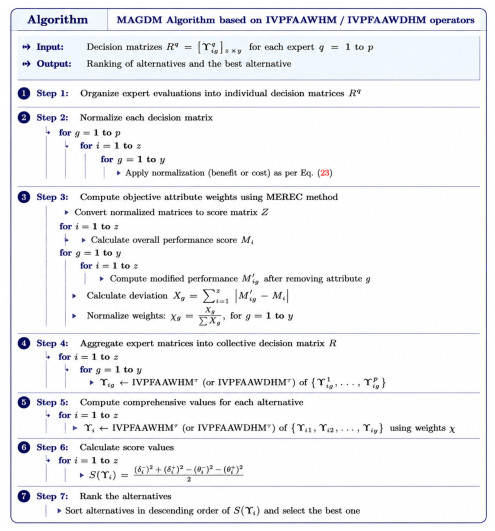
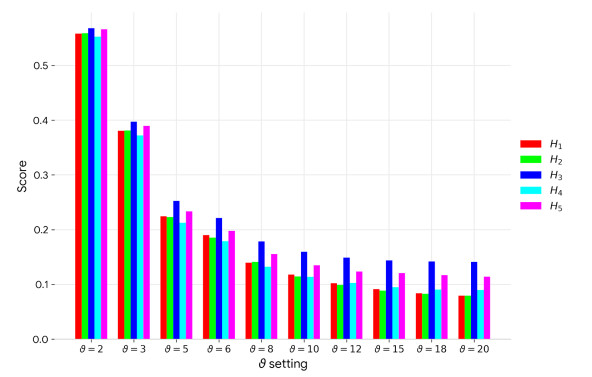
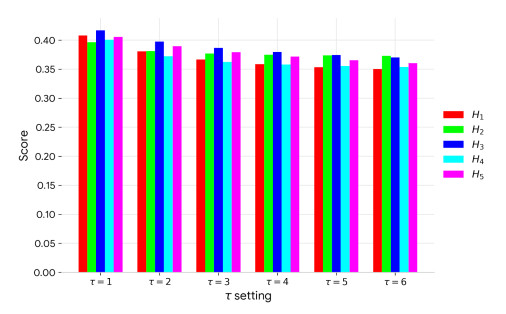
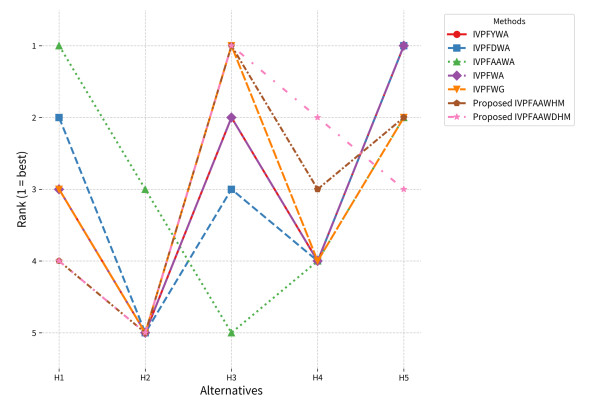
Selecting optimal smart healthcare systems is a complex multi-attribute group decision-making (MAGDM) problem characterized by multiple conflicting criteria and inherent uncertainty in expert judgments. Traditional approaches often struggle to adequately model intercriteria relationships and flexible information aggregation under such vagueness. This paper develops a novel MAGDM framework based on interval-valued Pythagorean fuzzy sets (IVPFSs). To effectively aggregate uncertain information, several new aggregation operators are proposed by integrating Aczel–Alsina (AA) operations with the Hamy mean and its dual form. The fundamental mathematical properties of these operators, including idempotency, monotonicity, and boundedness, are rigorously established. A systematic MAGDM methodology is constructed using the proposed operators, where criteria weights are objectively determined using the measurement of alternatives and ranking according to compromise solution (MEREC) method. Its practicality and effectiveness are demonstrated through a real-world case study on smart healthcare system selection. Sensitivity analysis confirms the stability of the ranking results with respect to the AA and Hamy mean parameters. Comparative analysis with existing methods further highlights the superiority of the proposed approach in capturing intercriteria dependencies and providing more balanced and reliable rankings.
Citation: Amjid Khan, Jawad Ali, Suhad Ali Osman Abdallah, Ioan-Lucian Popa. Interval-valued Pythagorean fuzzy Aczel–Alsina Hamy mean operators for multi-attribute group decision-making with smart healthcare application[J]. AIMS Mathematics, 2026, 11(10): 33183-33237. doi: 10.3934/math.20261300
Selecting optimal smart healthcare systems is a complex multi-attribute group decision-making (MAGDM) problem characterized by multiple conflicting criteria and inherent uncertainty in expert judgments. Traditional approaches often struggle to adequately model intercriteria relationships and flexible information aggregation under such vagueness. This paper develops a novel MAGDM framework based on interval-valued Pythagorean fuzzy sets (IVPFSs). To effectively aggregate uncertain information, several new aggregation operators are proposed by integrating Aczel–Alsina (AA) operations with the Hamy mean and its dual form. The fundamental mathematical properties of these operators, including idempotency, monotonicity, and boundedness, are rigorously established. A systematic MAGDM methodology is constructed using the proposed operators, where criteria weights are objectively determined using the measurement of alternatives and ranking according to compromise solution (MEREC) method. Its practicality and effectiveness are demonstrated through a real-world case study on smart healthcare system selection. Sensitivity analysis confirms the stability of the ranking results with respect to the AA and Hamy mean parameters. Comparative analysis with existing methods further highlights the superiority of the proposed approach in capturing intercriteria dependencies and providing more balanced and reliable rankings.

| [1] |
S. Zhu, Z. Liu, Distance measures of picture fuzzy sets and interval-valued picture fuzzy sets with their applications, AIMS Math., 8 (2023), 29817–29848. https://doi.org/10.3934/math.20231525 doi: 10.3934/math.20231525

|
| [2] |
S. P. Wan, H. Wu, J. Y. Dong, An integrated method for complex heterogeneous multi-attribute group decision-making and application to photovoltaic power station site selection, Expert Syst. Appl., 242 (2024), 122456. https://doi.org/10.1016/j.eswa.2023.122456 doi: 10.1016/j.eswa.2023.122456
|
| [3] |
S. Zhu, Y. Li, P. Balaji, A. Thiyagarajan, R. Aluvalu, Z. Liu, An improved interval-valued picture fuzzy TOPSIS approach based on new divergence measures for risk assessment, Comput. Model. Eng. Sci., 144 (2025), 2099–2121. https://doi.org/10.32604/cmes.2025.068734 doi: 10.32604/cmes.2025.068734
|
| [4] |
J. Jin, X. Yang, H. Du, D. Pamucar, A novel interval-valued intuitionistic fuzzy distance measure incorporating min/max interaction terms, J. Contemp. Decis. Sci., 2 (2026), 84–96. https://doi.org/10.67334/cds21202610 doi: 10.67334/cds21202610
|
| [5] |
S. P. Wan, S. Z. Gao, J. Y. Dong, Trapezoidal cloud based heterogeneous multi-criterion group decision-making for container multimodal transport path selection, Appl. Soft Comput., 154 (2024), 111374. https://doi.org/10.1016/j.asoc.2024.111374 doi: 10.1016/j.asoc.2024.111374
|
| [6] |
S. P. Wan, J. Yan, J. Y. Dong, Y. Gao, A dual-similarity based consensus reaching process in quality function deployment with heterogeneous linguistic preference relations, Eng. Appl. Artif. Intell., 163 (2026), 113051. https://doi.org/10.1016/j.engappai.2025.113051 doi: 10.1016/j.engappai.2025.113051
|
| [7] |
L. A. Zadeh, Fuzzy sets, Inf. Control, 8 (1965), 338–353. https://doi.org/10.1016/S0019-9958(65)90241-X doi: 10.1016/S0019-9958(65)90241-X
|
| [8] |
R. E. Bellman, L. A. Zadeh, Decision-making in a fuzzy environment, Manage. Sci., 17 (1970), B141–B273. https://doi.org/10.1287/mnsc.17.4.B141 doi: 10.1287/mnsc.17.4.B141
|
| [9] |
R. R. Yager, Fuzzy decision making including unequal objectives, Fuzzy Sets Syst., 1 (1978), 87–95. https://doi.org/10.1016/0165-0114(78)90010-6 doi: 10.1016/0165-0114(78)90010-6
|
| [10] |
R. R. Yager, Aggregation operators and fuzzy systems modeling, Fuzzy Sets Syst., 67 (1994), 129–145. https://doi.org/10.1016/0165-0114(94)90082-5 doi: 10.1016/0165-0114(94)90082-5
|
| [11] |
Z. Liu, S. Zhu, Y. Huang, T. Senapati, X. Li, W. F. Mbasso, et al., A unified parametric divergence operator for Fermatean fuzzy environment and its applications in machine learning and intelligent decision-making, Comput. Model. Eng. Sci., 145 (2025), 2157–2188. https://doi.org/10.32604/cmes.2025.072352 doi: 10.32604/cmes.2025.072352
|
| [12] |
K. T. Atanassov, Intuitionistic fuzzy sets, Fuzzy Sets Syst., 20 (1986), 87–96. https://doi.org/10.1016/S0165-0114(86)80034-3 doi: 10.1016/S0165-0114(86)80034-3
|
| [13] |
R. R. Yager, Pythagorean membership grades in multicriteria decision making, IEEE Trans. Fuzzy Syst., 22 (2013), 958–965. https://doi.org/10.1109/TFUZZ.2013.2278989 doi: 10.1109/TFUZZ.2013.2278989
|
| [14] |
A. Adak, D. Pamucar, W. Ali, Solving pythagorean fuzzy assignment problems in management: a framework based on spherical distance measures, Manage. Sci. Adv., 3 (2026), 84–95. https://doi.org/10.31181/msa31202636 doi: 10.31181/msa31202636
|
| [15] |
M. Tahir, K. Kfueit, M. Rasheed, A. Hanan, M. I. Shahid, Pythagorean soft sets and hypersoft sets: a comprehensive framework for advanced uncertainty modeling in decision making, Spectr. Decis. Mak. Appl., 4 (2025), 1–26. https://doi.org/10.31181/sdmap41202761 doi: 10.31181/sdmap41202761
|
| [16] |
S. Turgay, B. Torkul, A. Aydin, F. Özyurt, A novel decomposed pythagorean fuzzy CODAS framework for precision customer segmentation in complex market environments, Intell. Syst. Res. Appl. J., 2 (2026), 160–198. https://doi.org/10.59543/r8xsq450 doi: 10.59543/r8xsq450
|
| [17] |
Z. Yu, D. Wang, A. M. Kassim, S. Zhu, Z. Liu, An extended interval-valued pythagorean fuzzy VIKOR approach with logarithmic distance measures for service quality evaluation of university library, J. Math., 2025 (2025), 9966857. https://doi.org/10.1155/jom/9966857 doi: 10.1155/jom/9966857
|
| [18] |
S. Zhu, Z. Liu, S. Letchmunan, G. Ulutagay, K. Ullah, Novel distance measures on complex picture fuzzy environment: applications in pattern recognition, medical diagnosis and clustering, J. Appl. Math. Comput., 71 (2025), 1743–1775. https://doi.org/10.1007/s12190-024-02293-z doi: 10.1007/s12190-024-02293-z
|
| [19] |
X. Zhang, Multicriteria pythagorean fuzzy decision analysis: a hierarchical qualiflex approach with the closeness index-based ranking methods, Inf. Sci., 330 (2016), 104–124. https://doi.org/10.1016/j.ins.2015.10.012 doi: 10.1016/j.ins.2015.10.012
|
| [20] |
M. Palanikumar, N. Kausar, Research on the redefined square root interval-valued normal pythagorean fuzzy multi-attribute decision-making model based on aggregation operators, Spectr. Oper. Res., 2025. https://doi.org/10.31181/sor58 doi: 10.31181/sor58
|
| [21] |
X. Peng, Y. Yang, Fundamental properties of interval-valued pythagorean fuzzy aggregation operators, Int. J. Intell. Syst., 31 (2016), 444–487. https://doi.org/10.1002/int.21790 doi: 10.1002/int.21790
|
| [22] |
H. Garg, A novel accuracy function under interval-valued pythagorean fuzzy environment for solving multicriteria decision making problem, J. Intell. Fuzzy Syst., 31 (2016), 529–540. https://doi.org/10.3233/IFS-162165 doi: 10.3233/IFS-162165
|
| [23] | K. Rahman, A. Ali, M. S. A. Khan, Some interval-valued pythagorean fuzzy weighted averaging aggregation operators and their application to multiple attribute decision making, Punjab Univ. J. Math., 50 (2018), 113–129. |
| [24] |
K. Rahman, S. Abdullah, M. Shakeel, M. S. A. Khan, M. Ullah, Interval-valued pythagorean fuzzy geometric aggregation operators and their application to group decision making problem, Cogent Math., 4 (2017), 1338638. https://doi.org/10.1080/23311835.2017.1338638 doi: 10.1080/23311835.2017.1338638
|
| [25] |
S. Nawaz, A. Razaq, G. Alhamzi, A. W. Baidar, Enhancing travel advisory zones for autonomous vehicles using interval-valued pythagorean fuzzy yager-based decision-making, Sci. Rep., 16 (2026), 5381. https://doi.org/10.1038/s41598-025-31126-7 doi: 10.1038/s41598-025-31126-7
|
| [26] |
K. Rahman, S. Abdullah, M. S. A. Khan, Some interval-valued pythagorean fuzzy einstein weighted averaging aggregation operators and their application to group decision making, J. Intell. Syst., 29 (2019), 393–408. https://doi.org/10.1515/jisys-2017-0212 doi: 10.1515/jisys-2017-0212
|
| [27] |
G. Alhamzi, S. Javaid, U. Shuaib, A. Razaq, H. Garg, A. Razzaque, Enhancing interval-valued pythagorean fuzzy decision-making through dombi-based aggregation operators, Symmetry, 15 (2023), 765. https://doi.org/10.3390/sym15030765 doi: 10.3390/sym15030765
|
| [28] |
A. Hussain, K. Ullah, M. Mubasher, T. Senapati, S. Moslem, Interval-valued pythagorean fuzzy information aggregation based on Aczel–Alsina operations and their application in multiple attribute decision making, IEEE Access, 11 (2023), 34575–34594. https://doi.org/10.1109/ACCESS.2023.3244612 doi: 10.1109/ACCESS.2023.3244612
|
| [29] |
T. Senapati, G. Chen, R. R. Yager, Aczel–alsina aggregation operators and their application to intuitionistic fuzzy multiple attribute decision making, Int. J. Intell. Syst., 37 (2022), 1529–1551. https://doi.org/10.1002/int.22684 doi: 10.1002/int.22684
|
| [30] |
T. Senapati, G. Chen, R. Mesiar, R. R. Yager, Novel Aczel–Alsina operations-based interval-valued intuitionistic fuzzy aggregation operators and their applications in multiple attribute decision-making process, Int. J. Intell. Syst., 37 (2022), 5059–5081. https://doi.org/10.1002/int.22751 doi: 10.1002/int.22751
|
| [31] |
A. Hussain, K. Ullah, M. N. Alshahrani, M. S. Yang, D. Pamucar, Novel Aczel–Alsina operators for pythagorean fuzzy sets with application in multi-attribute decision making, Symmetry, 14 (2022), 940. https://doi.org/10.3390/sym14050940 doi: 10.3390/sym14050940
|
| [32] |
M. Naeem, Y. Khan, S. Ashraf, W. Weera, B. Batool, A novel picture fuzzy Aczel–Alsina geometric aggregation information: application to determining the factors affecting mango crops, AIMS Math., 7 (2022), 12264–12288. https://doi.org/10.3934/math.2022681 doi: 10.3934/math.2022681
|
| [33] | J. Gul, H. Zhu, B. Naz, Z. Khan, R. Jan, F. Hussain, et al., Complex pythagorean fuzzy Aczel–Alsina weighted heronian mean operators and their applications in MCDM, Spectr. Oper. Res., 20276. https://doi.org/10.31181/sor202778 |
| [34] |
A. K. Adak, S. Jovcic, D. Bozanic, D. Marinkovic, Selection of optimal stock for business investment using pythagorean fuzzy Aczel–Alsina cocoso-method, J. Contemp. Decis. Sci., 2 (2026), 287–304. https://doi.org/10.67334/cds21202621 doi: 10.67334/cds21202621
|
| [35] | S. E. Takahasi, T. Hara, M. Uchiyama, A refinement of various mean inequalities, J. Inequal. Appl., 1998 (1998), 932025. |
| [36] |
L. Wu, J. Wang, H. Gao, Models for competiveness evaluation of tourist destination with some interval-valued intuitionistic fuzzy hamy mean operators, J. Intell. Fuzzy Syst., 36 (2019), 5693–5709. https://doi.org/10.3233/JIFS-181545 doi: 10.3233/JIFS-181545
|
| [37] |
P. Liu, X. Liu, Linguistic intuitionistic fuzzy hamy mean operators and their application to multiple-attribute group decision making, IEEE Access, 7 (2019), 127728–127744. https://doi.org/10.1109/ACCESS.2019.2937854 doi: 10.1109/ACCESS.2019.2937854
|
| [38] |
Z. Li, G. Wei, M. Lu, Pythagorean fuzzy hamy mean operators in multiple attribute group decision making and their application to supplier selection, Symmetry, 10 (2018), 505. https://doi.org/10.3390/sym10100505 doi: 10.3390/sym10100505
|
| [39] |
J. Qin, Interval type-2 fuzzy hamy mean operators and their application in multiple criteria decision making, Granul. Comput., 2 (2017), 249–269. https://doi.org/10.1007/s41066-017-0041-x doi: 10.1007/s41066-017-0041-x
|
| [40] |
J. Wang, G. Wei, J. Lu, F. E. Alsaadi, T. Hayat, C. Wei, et al., Some $q$-rung orthopair fuzzy hamy mean operators in multiple attribute decision-making and their application to enterprise resource planning systems selection, Int. J. Intell. Syst., 34 (2019), 2429–2458. https://doi.org/10.1002/int.22155 doi: 10.1002/int.22155
|
| [41] |
J. Aczél, C. Alsina, Characterizations of some classes of quasilinear functions with applications to triangular norms and to synthesizing judgements, Aeq. Math., 25 (1982), 313–315. https://doi.org/10.1007/BF02189626 doi: 10.1007/BF02189626
|
| [42] |
T. Senapati, A. R. Mishra, A. Saha, V. Simic, P. Rani, R. Ali, Construction of interval-valued pythagorean fuzzy Aczel–Alsina aggregation operators for decision making: a case study in emerging it software company selection, Sādhanā, 47 (2022), 255. https://doi.org/10.1007/s12046-022-02002-1 doi: 10.1007/s12046-022-02002-1
|
| [43] |
M. Keshavarz-Ghorabaee, M. Amiri, E. K. Zavadskas, Z. Turskis, J. Antucheviciene, Determination of objective weights using a new method based on the removal effects of criteria (MEREC), Symmetry, 13 (2021), 525. https://doi.org/10.3390/sym13040525 doi: 10.3390/sym13040525
|
| [44] |
H. Garg, A novel improved accuracy function for interval valued Pythagorean fuzzy sets and its applications in the decision-making process, Int. J. Intell. Syst., 32 (2017), 1247–1260. https://doi.org/10.1002/int.21898 doi: 10.1002/int.21898
|
Figures(4) / Tables(10)

Amjid Khan, Jawad Ali, Suhad Ali Osman Abdallah, Ioan-Lucian Popa. Interval-valued Pythagorean fuzzy Aczel–Alsina Hamy mean operators for multi-attribute group decision-making with smart healthcare application[J]. AIMS Mathematics, 2026, 11(10): 33183-33237. doi: 10.3934/math.20261300





 DownLoad: