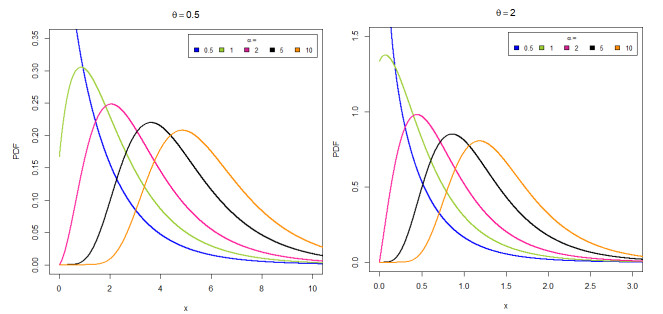
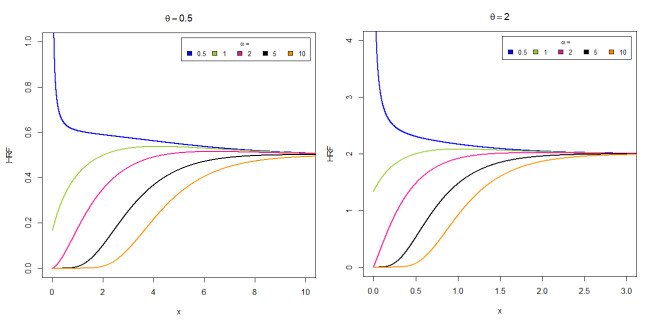
This study presents a new two-parameter lifetime model, the exponentiated modified Lindley distribution, which extends the flexibility of the traditional modified Lindley distribution. The proposed model was constructed using an exponentiation approach that introduces an additional shape parameter, allowing it to accommodate a wide variety of data patterns and hazard rate behaviors. Comprehensive analytical properties were investigated, including moments and reliability characteristics, along with several parameter estimation methods. In addition to classical estimation techniques, a Bayesian estimation procedure was developed for the exponentiated modified Lindley distribution, as well as a bootstrap approach for constructing confidence intervals for the model parameters. A simulation study was conducted to assess the efficiency and robustness of the proposed estimators. Furthermore, applications to real datasets demonstrated that the proposed model provides an improved fit compared to conventional lifetime distributions. These results indicate that the exponentiated modified Lindley distribution is a valuable addition to the class of continuous distributions, offering enhanced adaptability for modeling reliability, survival, and other forms of asymmetric data encountered in applied statistics.
Citation: Ammar M. Sarhan, Asamh Saleh M. Al Luhayb, Reid Alotaibi, M. E. Sobh. The exponentiated modified Lindley distribution with diverse biomedical and epidemiological applications[J]. AIMS Mathematics, 2026, 11(1): 2313-2340. doi: 10.3934/math.2026093
This study presents a new two-parameter lifetime model, the exponentiated modified Lindley distribution, which extends the flexibility of the traditional modified Lindley distribution. The proposed model was constructed using an exponentiation approach that introduces an additional shape parameter, allowing it to accommodate a wide variety of data patterns and hazard rate behaviors. Comprehensive analytical properties were investigated, including moments and reliability characteristics, along with several parameter estimation methods. In addition to classical estimation techniques, a Bayesian estimation procedure was developed for the exponentiated modified Lindley distribution, as well as a bootstrap approach for constructing confidence intervals for the model parameters. A simulation study was conducted to assess the efficiency and robustness of the proposed estimators. Furthermore, applications to real datasets demonstrated that the proposed model provides an improved fit compared to conventional lifetime distributions. These results indicate that the exponentiated modified Lindley distribution is a valuable addition to the class of continuous distributions, offering enhanced adaptability for modeling reliability, survival, and other forms of asymmetric data encountered in applied statistics.

| [1] |
M. Alizadeh, S. F. Bagheri, E. B. Samani, S. Ghobadi, S. Nadarajah, Exponentiated power Lindley power series class of distributions: theory and applications, Commun. Stat.–Simul. Comput., 47 (2018), 2499–2531. https://doi.org/10.1080/03610918.2017.1350270 doi: 10.1080/03610918.2017.1350270

|
| [2] |
H. M. Almongy, E. M. Almetwally, H. M. Aljohani, A. S. Alghamdi, E. H. Hafez, A new extended Rayleigh distribution with applications of COVID-19 data, Results Phys., 23 (2021), 104012. https://doi.org/10.1016/j.rinp.2021.104012 doi: 10.1016/j.rinp.2021.104012
|
| [3] |
R. A. Bantan, Z. Ahmad, F. Khan, M. Elgarhy, Z. Almaspoor, G. G. Hamedani, et al., Predictive modeling of the COVID-19 data using a new version of the flexible Weibull model and machine learning techniques, Math. Biosci. Eng., 20 (2023), 2847–2873. https://doi.org/10.3934/mbe.2023134 doi: 10.3934/mbe.2023134
|
| [4] |
C. Chesneau, L. Tomy, J. Gillariose, A new modified Lindley distribution with properties and applications, J. Stat. Manag. Syst., 24 (2021), 1383–1403. https://doi.org/10.1080/09720510.2020.1824727 doi: 10.1080/09720510.2020.1824727
|
| [5] | A. C. Davison, D. V. Hinkley, Bootstrap methods and their application, Cambridge University Press, 1997. |
| [6] |
B. Efron, Bootstrap methods: another look at the jackknife, Ann. Statist., 7 (1979), 1–26. https://doi.org/10.1214/aos/1176344552 doi: 10.1214/aos/1176344552
|
| [7] |
B. Efron, Better bootstrap confidence intervals, J. Am. Stat. Assoc., 82 (1987), 171–185. https://doi.org/10.2307/2289144 doi: 10.2307/2289144
|
| [8] |
J. Gillariose, L. Tomy, F. Jamal, C. Chesneau, The Marshall–Olkin modified Lindley distribution: properties and applications, J. Reliab. Stat. Stud., 13 (2020), 177–198. https://doi.org/10.13052/jrss0974-8024.1319 doi: 10.13052/jrss0974-8024.1319
|
| [9] | A. J. Gross, V. Clark, Survival distributions: reliability applications in the biomedical sciences, John Wiley & Sons, 1975. |
| [10] | R. D. Gupta, D. Kundu, Theory & methods: generalized exponential distributions, Australian & New Zealand J. Stat., 41 (1999), 173–188. https://doi.org/10.1111/1467-842X.00072 |
| [11] |
M. Hashempour, M. Alizadeh, H. M. Yousof, A new Lindley extension: estimation, risk assessment and analysis under bimodal right skewed precipitation data, Ann. Data Sci., 11 (2024), 1919–1958. https://doi.org/10.1007/s40745-023-00485-1 doi: 10.1007/s40745-023-00485-1
|
| [12] | J. G. Kalbfleisch, Probability and statistical inference, Vol. 2, New York: Springer, 1985. |
| [13] |
O. Kharazmi, D. Kumar, S. Dey, Power modified Lindley distribution: properties, classical and Bayesian estimation, and regression model with applications, Aust. J. Stat., 52 (2023), 71–95. https://doi.org/10.17713/ajs.v52i3.1386 doi: 10.17713/ajs.v52i3.1386
|
| [14] |
G. S. Mudholkar, D. K. Srivastava, Exponentiated Weibull family for analyzing bathtub failure-rate data, IEEE Trans. Reliab., 42 (1993), 299–302. https://doi.org/10.1109/24.229504 doi: 10.1109/24.229504
|
| [15] |
A. M. Sarhan, J. Apaloo, Exponentiated modified Weibull extension distribution, Reliab. Eng. Syst. Safe., 112 (2013), 137–144. https://doi.org/10.1016/j.ress.2012.10.013 doi: 10.1016/j.ress.2012.10.013
|
| [16] |
A. M. Sarhan, A. Abd EL-Baset, I. A. Alasbahi, Exponentiated generalized linear exponential distribution, Appl. Math. Model., 37 (2013), 2838–2849. https://doi.org/10.1016/j.apm.2012.06.019 doi: 10.1016/j.apm.2012.06.019
|
| [17] |
A. M. Sarhan, D. Kundu, Generalized linear failure rate distribution, Commun. Stat.-Theory Methods, 38 (2009), 642–660. https://doi.org/10.1080/03610920802272414 doi: 10.1080/03610920802272414
|
| [18] |
Z. Shah, A. Ali, M. Hamraz, D. M. Khan, Z. Khan, M. El-Morshedy, et al., A new member of T–X family with applications in different sectors, J. Math., 2022 (2022), 1453451. https://doi.org/10.1155/2022/1453451 doi: 10.1155/2022/1453451
|
| [19] |
L. Tomy, V. G, C. Chesneau, The sine modified Lindley distribution, Math. Comput. Appl., 26 (2021), 81. https://doi.org/10.3390/mca26040081 doi: 10.3390/mca26040081
|
| [20] |
S. Zacks, Estimating the shift to wear-out of systems having exponential-Weibull life distributions, Oper. Res., 32 (1984), 741–749. https://doi.org/10.1287/opre.32.3.741 doi: 10.1287/opre.32.3.741
|
Figures(13) / Tables(8)

Ammar M. Sarhan, Asamh Saleh M. Al Luhayb, Reid Alotaibi, M. E. Sobh. The exponentiated modified Lindley distribution with diverse biomedical and epidemiological applications[J]. AIMS Mathematics, 2026, 11(1): 2313-2340. doi: 10.3934/math.2026093





 DownLoad: