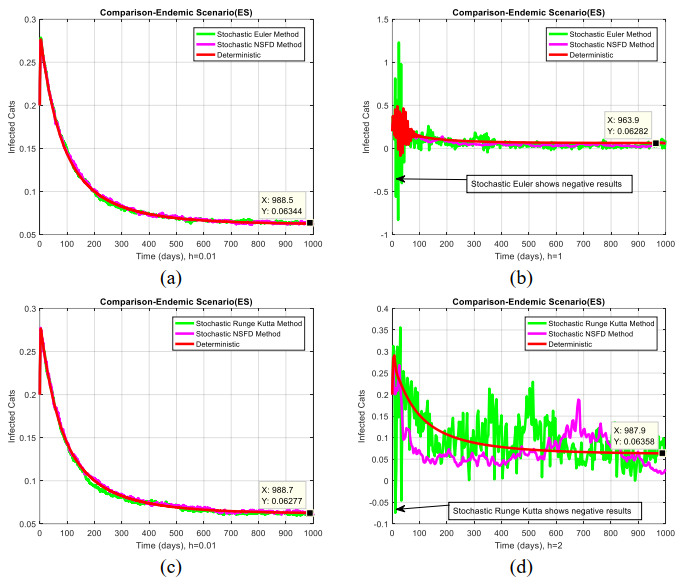
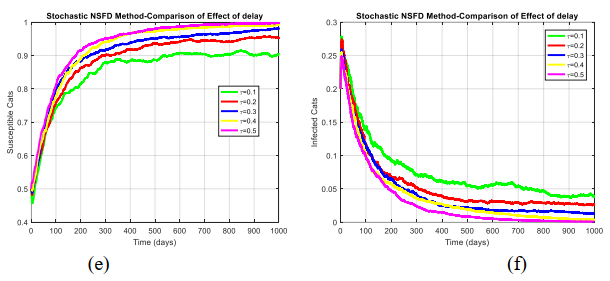
According to the World Health Organization (WHO), toxoplasmosis affects more than 60% of the global population. The prevalence of this infection is particularly high in hot, humid, and low-altitude regions, as such environments favor the survival of oocysts in the ecosystem. In this study, we investigated the transmission dynamics of toxoplasmosis using a stochastic model with an implicit delay effect approach. The host populations were divided into compartments representing susceptible cats $ S\left(t\right) $, infected cats $ {I}_{c}\left(t\right) $, recovered cats $ {V}_{R}\left(t\right) $, susceptible mice $ {S}_{m}\left(t\right) $, infected mice $ {I}_{m}\left(t\right) $, and the number of oocysts in the environment $ O\left(t\right) $. In the delayed deterministic model, fundamental mathematical properties such as positivity, boundedness, existence, and uniqueness of solutions were established. Furthermore, the local and global stability of the steady states were analyzed using second-order stability conditions. In the stochastic delayed formulation, we investigated the positivity, boundedness, extinction, and persistence of the infection under random environmental fluctuations. To address the nonlinear complexity of the proposed system, several computational methods were employed, including the Euler–Maruyama, stochastic Euler, stochastic Runge–Kutta, and the stochastic non-standard finite difference (SNSFD) schemes. A comparative numerical analysis demonstrated that the SNSFD scheme preserves the qualitative features of the continuous model and remains stable under large time steps, confirming its suitability for modeling biologically realistic epidemic dynamics.
Citation: Ali Raza, Mansoor Alsulami, Eman Ghareeb Rezk. A stochastic model incorporating an implicit delay effect for toxoplasmosis: Evaluation of intervention policies for public health[J]. AIMS Mathematics, 2026, 11(1): 2255-2278. doi: 10.3934/math.2026091
According to the World Health Organization (WHO), toxoplasmosis affects more than 60% of the global population. The prevalence of this infection is particularly high in hot, humid, and low-altitude regions, as such environments favor the survival of oocysts in the ecosystem. In this study, we investigated the transmission dynamics of toxoplasmosis using a stochastic model with an implicit delay effect approach. The host populations were divided into compartments representing susceptible cats $ S\left(t\right) $, infected cats $ {I}_{c}\left(t\right) $, recovered cats $ {V}_{R}\left(t\right) $, susceptible mice $ {S}_{m}\left(t\right) $, infected mice $ {I}_{m}\left(t\right) $, and the number of oocysts in the environment $ O\left(t\right) $. In the delayed deterministic model, fundamental mathematical properties such as positivity, boundedness, existence, and uniqueness of solutions were established. Furthermore, the local and global stability of the steady states were analyzed using second-order stability conditions. In the stochastic delayed formulation, we investigated the positivity, boundedness, extinction, and persistence of the infection under random environmental fluctuations. To address the nonlinear complexity of the proposed system, several computational methods were employed, including the Euler–Maruyama, stochastic Euler, stochastic Runge–Kutta, and the stochastic non-standard finite difference (SNSFD) schemes. A comparative numerical analysis demonstrated that the SNSFD scheme preserves the qualitative features of the continuous model and remains stable under large time steps, confirming its suitability for modeling biologically realistic epidemic dynamics.

| [1] | Wikipedia, Toxoplasmosis—Acute Phase, Wikipedia Foundation, 2025. Available from: https://en.wikipedia.org/wiki/Toxoplasmosis#Acute. |
| [2] | National Center for Biotechnology Information (NCBI), Toxoplasmosis Review Article, National Library of Medicine, 2025. Available from: https://www.ncbi.nlm.nih.gov/pmc/articles/PMC9227424/. |
| [3] |
D. F. Aranda, R. J. Villanueva, A. J. Arenas, G. C. G. Parra, Mathematical modeling of toxoplasmosis disease in varying size populations, Comput. Math. Appl., 56 (2008), 690–696. https://doi.org/10.1016/j.camwa.2008.01.008 doi: 10.1016/j.camwa.2008.01.008

|
| [4] |
Sullivan, F. Agusto, S. Bewick, C. Su, S. Lenhart, X. Zhao, A mathematical model for within-host Toxoplasma gondii invasion dynamics, Math. Biosci. Eng., 9 (2012), 647–662. https://doi.org/10.3934/mbe.2012.9.647 doi: 10.3934/mbe.2012.9.647
|
| [5] |
Y. Peng, X. Jia, C. Liu, S. Guo, Dynamics of a model of toxoplasmosis disease in cats and humans with varying population sizes, Math. Comput. Simulat., 144 (2018), 52–59. https://doi.org/10.1016/j.matcom.2017.06.007 doi: 10.1016/j.matcom.2017.06.007
|
| [6] |
J. D. Ferreira, L. M. Echeverry, C. A. P. Rincón, Stability and bifurcation in epidemic models describing the transmission of toxoplasmosis in human and cat populations, Math. Method. Appl. Sci., 40 (2017), 5575–5592. https://doi.org/10.1002/mma.4410 doi: 10.1002/mma.4410
|
| [7] |
A. Raza, E. Rocha, E. Fadhal, R. H. Ibrahim, E. Afkar, M. Bilal, The effect of delay techniques on a Lassa fever epidemic model, Complexity, 2024 (2024), 2075354. https://doi.org/10.1155/2024/2075354 doi: 10.1155/2024/2075354
|
| [8] |
Z. U. A. Zafar, N. Ali, D. Baleanu, Dynamics and numerical investigations of a fractional-order model of toxoplasmosis in the population of humans and cats, Chaos Soliton. Fract., 151 (2021), 111261. https://doi.org/10.1016/j.chaos.2021.111261 doi: 10.1016/j.chaos.2021.111261
|
| [9] |
Z. U. A. Zafar, C. Tunç, N. Ali, G. Zaman, P. Thounthong, Dynamics of an arbitrary order model of toxoplasmosis ailment in human and cat inhabitants, J. Taibah Univ. Sci., 15 (2021), 882–896. https://doi.org/10.1080/16583655.2021.1990603 doi: 10.1080/16583655.2021.1990603
|
| [10] |
A. Raza, M. S. Arif, M. Rafiq, A reliable numerical analysis for stochastic dengue epidemic model with incubation period of virus, Adv. Differ. Equ., 2019 (2019), 1–19. https://doi.org/10.1186/s13662-019-1958-y doi: 10.1186/s13662-019-1958-y
|
| [11] | E. K. Keating, B. E. Brittany, Toxoplasma gondii: A mathematical model of its transfer between cats and the environment, SIAM Undergrad. Res. Online, 11 (2018), 270–284. |
| [12] | Y. Liu, C. Li, Dynamic study of mathematical models on antibiotics and immunologic adjuvant against toxoplasmosis, WSEAS Trans. Math., 11 (2012), 456–463. |
| [13] |
A. B. Marinović, M. Opsteegh, H. Deng, A. W. Suijkerbuijk, P. F. van Gils, J. van der Giessen, Prospects of toxoplasmosis control by cat vaccination, Epidemics, 30 (2020), 100380. https://doi.org/10.1016/j.epidem.2019.100380 doi: 10.1016/j.epidem.2019.100380
|
| [14] |
G. G. Parra, A. J. Arenas, B. C. Charpentier, S. Sultana, Mathematical modeling of toxoplasmosis with multiple hosts, vertical transmission, and cat vaccination, Comput. Appl. Math., 42 (2023), 88. https://doi.org/10.1007/s40314-023-02237-6 doi: 10.1007/s40314-023-02237-6
|
| [15] | Li, Y. Pei, X. Liang, D. Fang, A stochastic toxoplasmosis spread model between cat and oocyst with jumps process, Commun. Math. Biol. Neurosci., 2016 (2016), 18. |
Figures(3) / Tables(3)

Ali Raza, Mansoor Alsulami, Eman Ghareeb Rezk. A stochastic model incorporating an implicit delay effect for toxoplasmosis: Evaluation of intervention policies for public health[J]. AIMS Mathematics, 2026, 11(1): 2255-2278. doi: 10.3934/math.2026091





 DownLoad: