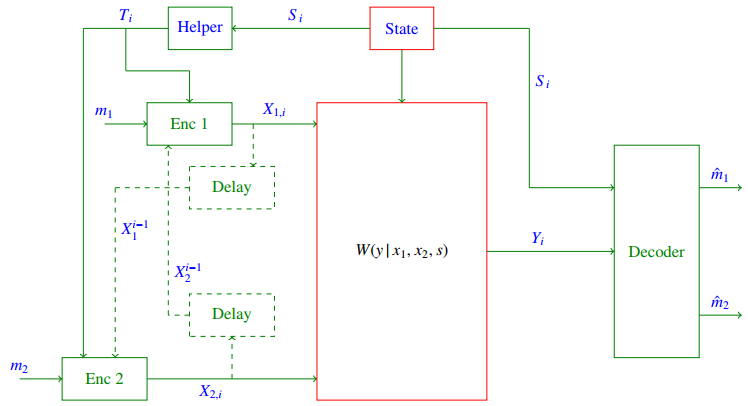
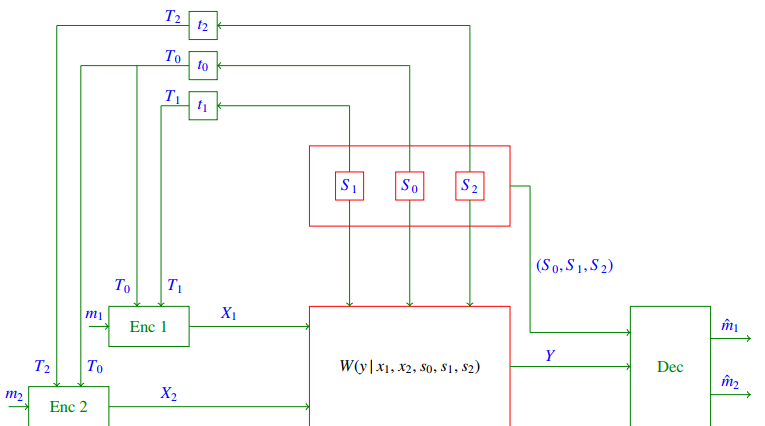
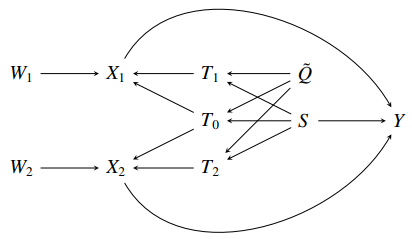
A two-to-one memoryless state-dependent multiple-access channel is studied in a setting where helpers that observe the state sequence causally provide rate-limited (lossy) causal descriptions of it to the encoders. It is shown that, when the receiver is cognizant of the channel state, the optimal causal descriptions take the form of scalar symbol-by-symbol quantizers whose descriptions of the current state do not depend on the past states. This holds irrespective of whether the description is provided to both encoders (the "common description" architecture), to one of the encoders (the "one-sided description" architecture), or whether different descriptions are provided to the different encoders (the "general" architecture). In fact, in the common description architecture, it also holds when the encoders can crib. Thus, the prevalent assumption that the receiver is cognizant of the channel state greatly simplifies the design of the state quantizer.
Citation: Amos Lapidoth, Baohua Ni. Causal state quantization with or without cribbing for the MAC with a state-cognizant receiver[J]. AIMS Mathematics, 2025, 10(7): 15821-15840. doi: 10.3934/math.2025709
A two-to-one memoryless state-dependent multiple-access channel is studied in a setting where helpers that observe the state sequence causally provide rate-limited (lossy) causal descriptions of it to the encoders. It is shown that, when the receiver is cognizant of the channel state, the optimal causal descriptions take the form of scalar symbol-by-symbol quantizers whose descriptions of the current state do not depend on the past states. This holds irrespective of whether the description is provided to both encoders (the "common description" architecture), to one of the encoders (the "one-sided description" architecture), or whether different descriptions are provided to the different encoders (the "general" architecture). In fact, in the common description architecture, it also holds when the encoders can crib. Thus, the prevalent assumption that the receiver is cognizant of the channel state greatly simplifies the design of the state quantizer.

| [1] |
A. Lapidoth, L. Wang, State-dependent DMC with a causal helper, IEEE T. Inform. Theory, 70 (2023), 3162–3174. https://doi.org/10.1109/TIT.2023.3305539 doi: 10.1109/TIT.2023.3305539

|
| [2] |
C. E. Shannon, Channels with side information at the transmitter, IBM J. Res. Dev., 2 (1958), 289–293. https://doi.org/10.1147/rd.24.0289 doi: 10.1147/rd.24.0289
|
| [3] | A. Lapidoth, Y. Steinberg, The multiple access channel with causal and strictly causal side information at the encoders, In: International Zurich Seminar on Communications (IZS 2010), Eidgenössische Technische Hochschule, 2010, 13–16. https://doi.org/10.3929/ethz-a-005997126 |
| [4] |
A. Lapidoth, Y. Steinberg, The multiple-access channel with causal side information: Common state, IEEE T. Inform. Theory, 59 (2012), 32–50. https://doi.org/10.1109/TIT.2012.2216096 doi: 10.1109/TIT.2012.2216096
|
| [5] |
A. Lapidoth, Y. Steinberg, The multiple-access channel with causal side information: Double state, IEEE T. Inform. Theory, 59 (2012), 1379–1393. https://doi.org/10.1109/TIT.2012.2230214 doi: 10.1109/TIT.2012.2230214
|
| [6] |
A. Lapidoth, Y. Steinberg, The state-dependent channel with a rate-limited cribbing helper, Entropy, 26 (2024), 570. https://doi.org/10.3390/e26070570 doi: 10.3390/e26070570
|
| [7] |
F. Willems, E. Van der Meulen, The discrete memoryless multiple-access channel with cribbing encoders, IEEE T. Inform. Theory, 31 (1985), 313–327. https://doi.org/10.1109/TIT.1985.1057042 doi: 10.1109/TIT.1985.1057042
|
| [8] |
H. Asnani, H. H. Permuter, Multiple-access channel with partial and controlled cribbing encoders, IEEE T. Inform. Theory, 59 (2013), 2252–2266. https://doi.org/10.1109/TIT.2012.2231462 doi: 10.1109/TIT.2012.2231462
|
| [9] | S. I. Bross, A. Lapidoth, The state-dependent multiple-access channel with states available at a cribbing encoder, In: 2010 IEEE 26-th Convention of Electrical and Electronics Engineers in Israel, 2010, 000665–000669. https://doi.org/10.1109/EEEI.2010.5662131 |
| [10] | A. Somekh-Baruch, S. Shamai, S. Verdú, Cooperative multiple access encoding with states available at one transmitter, In: 2007 IEEE International Symposium on Information Theory, 2007, 1556–1560. https://doi.org/10.1109/ISIT.2007.4557443 |
| [11] |
W. Yang, Y. Liang, S. Shamai, H. V. Poor, State-dependent Gaussian multiple access channels: New outer bounds and capacity results, IEEE T. Inform. Theory, 64 (2018), 7866–7882. https://doi.org/10.1109/TIT.2018.2839643 doi: 10.1109/TIT.2018.2839643
|
| [12] |
L. Dikstein, H. H. Permuter, S. Shamai, MAC with action-dependent state information at one encoder, IEEE T. Inform. Theory, 61 (2015), 173–188. https://doi.org/10.1109/TIT.2014.2372769 doi: 10.1109/TIT.2014.2372769
|
| [13] |
S. P. Kotagiri, J. N. Laneman, Multiaccess channels with state known to some encoders and independent messages, EURASIP J. Wirel. Comm., 2008 (2008), 1–14. https://doi.org/10.1155/2008/450680 doi: 10.1155/2008/450680
|
| [14] | A. El Gamal, Y.-H. Kim, Network information theory, Cambridge University Press, 2011. https://doi.org/10.1017/CBO9781139030687 |
| [15] | A. Zaidi, S. Shamai, On cooperative multiple access channels with delayed CSI, In: 2013 IEEE International Symposium on Information Theory, 2013,982–986. https://doi.org/10.1109/ISIT.2013.6620373 |
Figures(3)

Amos Lapidoth, Baohua Ni. Causal state quantization with or without cribbing for the MAC with a state-cognizant receiver[J]. AIMS Mathematics, 2025, 10(7): 15821-15840. doi: 10.3934/math.2025709





 DownLoad: