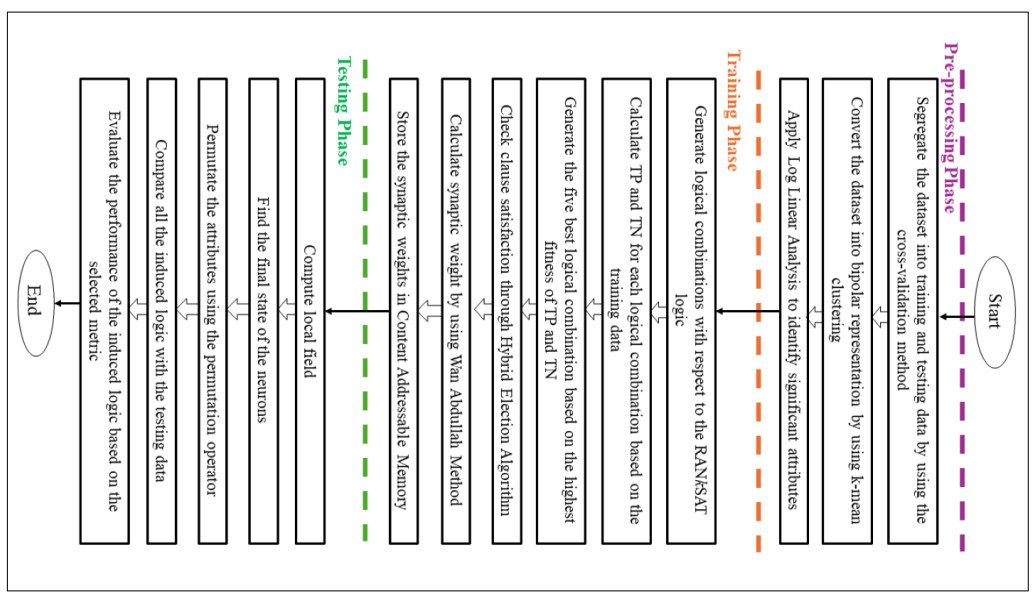
A specific field of data extraction termed "logic mining" is important for retrieving insightful information from intricate datasets by generating logical representations. These logical frameworks are explainable and significant for knowledge-driven technologies in computational optimization. However, existing logic mining models suffer from key limitations, including inadequate attribute selection, rigid logical rule structures, inefficient training processes, and storage constraints that often lead to overfitting. To address these challenges, this study proposed an explainable logic mining framework that integrated four key components: At first, a log-linear based attribute selection method to identify significant features; second, a non-systematic higher-order logic structure using random k satisfiability (for k $ \le $ 3) to enhance flexibility; after that, a multi-objective hybrid election algorithm for efficient and adaptive training; and, finally, an expanded retrieval phase employing a permutation operator to optimize the synaptic weight space in the discrete Hopfield neural network. The proposed framework was validated through comparative analyses against eight baseline models using real-world multidisciplinary datasets. Performance was rigorously evaluated across four evaluation metrics, where the experimental results demonstrated that the proposed model achieved a maximum accuracy of 97.73%, a precision of 100%, a specificity of 99.17%, and a matthews correlation coefficient (MCC) of 0.95 across 20 real-world datasets. Moreover, the proposed model's efficiency was also statistically validated through Nemenyi's post-hoc test and Cohen's d effect sizes, confirming its superior classification capability, stability, and reliability in logic-based knowledge.
Citation: Syed Anayet Karim, Mohd Shareduwan Mohd Kasihmuddin, Sowmitra Das, Nur Ezlin Zamri, Akib Jayed Islam, Alyaa Alway, Deepak Kumar Chowdhury. An explainable logic mining framework with multi-objective metaheuristic algorithm for knowledge extraction in discrete Hopfield neural network[J]. AIMS Mathematics, 2025, 10(12): 29342-29379. doi: 10.3934/math.20251289
A specific field of data extraction termed "logic mining" is important for retrieving insightful information from intricate datasets by generating logical representations. These logical frameworks are explainable and significant for knowledge-driven technologies in computational optimization. However, existing logic mining models suffer from key limitations, including inadequate attribute selection, rigid logical rule structures, inefficient training processes, and storage constraints that often lead to overfitting. To address these challenges, this study proposed an explainable logic mining framework that integrated four key components: At first, a log-linear based attribute selection method to identify significant features; second, a non-systematic higher-order logic structure using random k satisfiability (for k $ \le $ 3) to enhance flexibility; after that, a multi-objective hybrid election algorithm for efficient and adaptive training; and, finally, an expanded retrieval phase employing a permutation operator to optimize the synaptic weight space in the discrete Hopfield neural network. The proposed framework was validated through comparative analyses against eight baseline models using real-world multidisciplinary datasets. Performance was rigorously evaluated across four evaluation metrics, where the experimental results demonstrated that the proposed model achieved a maximum accuracy of 97.73%, a precision of 100%, a specificity of 99.17%, and a matthews correlation coefficient (MCC) of 0.95 across 20 real-world datasets. Moreover, the proposed model's efficiency was also statistically validated through Nemenyi's post-hoc test and Cohen's d effect sizes, confirming its superior classification capability, stability, and reliability in logic-based knowledge.

| [1] |
A. Mansour, F. Harahsheh, K. W. Wazani, M. khasawneh, B. B. AlTaher, The influence of social media, big data, and data mining on the evolution of organizational behavior: Empirical study in jordanian telecommunication sector, Int. J. Data Netw. Sci., 8 (2024), 1929–1940. https://dx.doi.org/10.5267/j.ijdns.2024.1.020 doi: 10.5267/j.ijdns.2024.1.020

|
| [2] |
K. Dhanushkodi, A. Bala, N. Kodipyaka, V. Shreyas, Customer behaviour analysis and predictive modelling in supermarket retail: A comprehensive data mining approach, IEEE Access, 13 (2024), 2945–2957. https://dx.doi.org/10.1109/ACCESS.2024.3407151 doi: 10.1109/ACCESS.2024.3407151
|
| [3] |
Q. Ge, X. Lu, R. Jiang, Y. Zhang, X. Zhuang, Data mining and machine learning in HIV infection risk research: An overview and recommendations, Artif. Intell. Med., 153 (2024), 102887. https://dx.doi.org/10.1016/j.artmed.2024.102887 doi: 10.1016/j.artmed.2024.102887
|
| [4] |
W. Bao, Y. Cao, Y. Yang, H. Che, J. Huang, S. Wen, Data-driven stock forecasting models based on neural networks: A review, Inf. Fusion, 113 (2025), 102616. https://dx.doi.org/10.1016/j.inffus.2024.102616 doi: 10.1016/j.inffus.2024.102616
|
| [5] |
V. K. Gugulothu, S. Balaji, Retraction Note: An early prediction and classification of lung nodule diagnosis on CT images based on hybrid deep learning techniques, Multimed. Tools Appl., 83 (2024), 88555. https://dx.doi.org/10.1007/s11042-024-20019-y doi: 10.1007/s11042-024-20019-y
|
| [6] |
X. Shu, Y. Ye, Knowledge discovery: Methods from data mining and machine learning, Soc. Sci. Res., 110 (2023), 102817. https://dx.doi.org/10.1016/j.ssresearch.2022.102817 doi: 10.1016/j.ssresearch.2022.102817
|
| [7] |
B. Guan, D. Wang, D. Shu, S. Zhu, X. Ji, B. Sun, Data-driven casting defect prediction model for sand casting based on random forest classification algorithm, China Foundry, 21 (2024), 137–146. https://dx.doi.org/10.1007/s41230-024-3090-1 doi: 10.1007/s41230-024-3090-1
|
| [8] |
E. I. Elsedimy, S. M. M. AboHashish, F. Algarni, New cardiovascular disease prediction approach using support vector machine and quantum-behaved particle swarm optimization, Multimed. Tools Appl., 83 (2024), 23901–23928. https://dx.doi.org/10.1007/s11042-023-16194-z doi: 10.1007/s11042-023-16194-z
|
| [9] |
M. A. Bülbül, Optimization of artificial neural network structure and hyperparameters in hybrid model by genetic algorithm: IOS–android application for breast cancer diagnosis/prediction, J. Supercomput., 80 (2024), 4533–4553. https://dx.doi.org/10.1007/s11227-023-05635-z doi: 10.1007/s11227-023-05635-z
|
| [10] |
T. Bezdan, M. Zivkovic, N. Bacanin, I. Strumberger, E. Tuba, M. Tuba, Multi-objective task scheduling in cloud computing environment by hybridized bat algorithm, J. Intell. Fuzzy Syst., 42 (2021), 411–423. https://dx.doi.org/10.3233/JIFS-219200 doi: 10.3233/JIFS-219200
|
| [11] |
J. J. Hopfield, D. W. Tank, "Neural" computation of decisions in optimization problems, Biol. Cybern., 52 (1985), 141–152. https://dx.doi.org/10.1007/BF00339943 doi: 10.1007/BF00339943
|
| [12] |
N. A. Rusdi, M. S. M. Kasihmuddin, N. A. Romli, G. Manoharam, M. A. Mansor, Multi-unit discrete Hopfield neural network for higher order supervised learning through logic mining: Optimal performance design and attribute selection, J. King Saud Univ. Comput. Inf. Sci., 35 (2023), 101554. https://dx.doi.org/10.1016/j.jksuci.2023.101554 doi: 10.1016/j.jksuci.2023.101554
|
| [13] |
C. Wang, Y. Li, Q. Deng, Discrete-time fractional-order local active memristor-based Hopfield neural network and its FPGA implementation, Chaos Solitons Fract., 193 (2025), 116053. https://dx.doi.org/10.1016/j.chaos.2025.116053 doi: 10.1016/j.chaos.2025.116053
|
| [14] |
W. A. T. W. Abdullah, Logic programming on a neural network, Int. J. Intell. Syst., 7 (1992), 513–519. https://dx.doi.org/10.1002/int.4550070604 doi: 10.1002/int.4550070604
|
| [15] |
A. Alway, N. E. Zamri, S. A. Karim, M. A. Mansor, M. S. M. Kasihmuddin, M. M. Bazuhair, Major 2 satisfiability logic in discrete Hopfield neural network, Int. J. Comput. Math., 99 (2022), 924–948. https://dx.doi.org/10.1080/00207160.2021.1939870 doi: 10.1080/00207160.2021.1939870
|
| [16] |
G. Manoharam, A. M. Kassim, S. Abdeen, M. S. M. Kasihmuddin, N. A. Rusdi, N. A. Romli, et al., Special major 1, 3 satisfiability logic in discrete Hopfield neural networks, AIMS Mathematics, 9 (2024), 12090–12127. https://dx.doi.org/10.3934/math.2024591 doi: 10.3934/math.2024591
|
| [17] |
S. A. Karim, N. E. Zamri, A. Alway, M. S. M. Kasihmuddin, A. I. M. Ismail, M. A. Mansor, et al., Random satisfiability: A higher-order logical approach in discrete Hopfield neural network, IEEE Access, 9 (2021) 50831–50845. https://dx.doi.org/10.1109/ACCESS.2021.3068998 doi: 10.1109/ACCESS.2021.3068998
|
| [18] |
X. Jiang, M. S. M. Kasihmuddin, Y. Guo, Y. Gao, M. A. Mansor, N. E. Zamri, et al., J-type random 2, 3 satisfiability: A higher-order logical rule in discrete Hopfield neural network, Evol. Intel., 17 (2024), 3317–3336. https://dx.doi.org/10.1007/s12065-024-00936-5 doi: 10.1007/s12065-024-00936-5
|
| [19] |
Y. Gao, M. S. M. Kasihmuddin, J. Chen, C. Zheng, N. A. Romli, M. A. Mansor, et al., Binary ant colony optimization algorithm in learning random satisfiability logic for discrete Hopfield neural network, Appl. Soft Comput., 166 (2024), 112192. https://dx.doi.org/10.1016/j.asoc.2024.112192 doi: 10.1016/j.asoc.2024.112192
|
| [20] |
A. Alway, N. E. Zamri, M. A. Mansor, M. S. M. Kasihmuddin, S. Z. M. Jamaludin, M. F. Marsani, A novel hybrid exhaustive search and data preparation technique with multi-objective discrete Hopfield neural network, Decis. Anal. J., 9 (2023), 100354. https://dx.doi.org/10.1016/j.dajour.2023.100354 doi: 10.1016/j.dajour.2023.100354
|
| [21] |
N. E. Zamri, M. A. Mansor, M. S. M. Kasihmuddin, S. S. Sidik, A. Alway, N. A. Romli, et al., A modified reverse-based analysis logic mining model with weighted random 2 satisfiability logic in discrete Hopfield neural network and multi-objective training of modified niched genetic algorithm, Expert Syst. Appl., 240 (2024), 122307. https://dx.doi.org/10.1016/j.eswa.2023.122307 doi: 10.1016/j.eswa.2023.122307
|
| [22] |
S. Sathasivam, W. A. T. W. Abdullah, Logic mining in neural network: Reverse analysis method, Computing, 91 (2011), 119–133. https://dx.doi.org/10.1007/s00607-010-0117-9 doi: 10.1007/s00607-010-0117-9
|
| [23] |
S. Z. M. Jamaludin, N. S. Sa'ari, M. S. M. Kasihmuddin, M. F. Marsani, N. E. Zamri, S. A. Azhar, et al., Artificial bee colony for logic mining in credit scoring, Malays. J. Fundam. Appl. Sci., 18 (2022), 654–673. https://dx.doi.org/10.11113/mjfas.v18n6.2661 doi: 10.11113/mjfas.v18n6.2661
|
| [24] |
S. Z. M. Jamaludin, M. A. Mansor, A. Baharum, M. S. M. Kasihmuddin, H. A. Wahab, M. F. Marsani, Modified 2 satisfiability reverse analysis method via logical permutation operator, Comput. Mater. Contin., 74 (2023), 2853–2870. https://dx.doi.org/10.32604/cmc.2023.032654 doi: 10.32604/cmc.2023.032654
|
| [25] |
M. S. M. Kasihmuddin, S. Z. M. Jamaludin, M. A. Mansor, H. A. Wahab, S. M. S. Ghadzi, Supervised learning perspective in logic mining, Mathematics, 10 (2022), 915. https://dx.doi.org/10.3390/math10060915 doi: 10.3390/math10060915
|
| [26] |
S. Z. M. Jamaludin, N. A. Romli, M. S. M. Kasihmuddin, A. Baharum, M. A. Mansor, M. F. Marsani, Novel logic mining incorporating log-linear approach, J. King Saud Univ. Comput. Inf. Sci., 34 (2022), 9011–9027. https://dx.doi.org/10.1016/j.jksuci.2022.08.026 doi: 10.1016/j.jksuci.2022.08.026
|
| [27] |
J. Ma, The stability of the generalized Hopfield networks in randomly asynchronous mode, Neural Netw., 10 (1997), 1109–1116. https://dx.doi.org/10.1016/S0893-6080(97)00026-9 doi: 10.1016/S0893-6080(97)00026-9
|
| [28] |
S. Lopez-Ruiz, C. I. Hernández-Castellanos, K. Rodriguez-Vazquez, Multi-objective optimization of neural network with stochastic directed search, Expert Syst. Appl., 237 (2024), 121535. https://dx.doi.org/10.1016/j.eswa.2023.121535 doi: 10.1016/j.eswa.2023.121535
|
| [29] |
S. A. Karim, M. S. M. Kasihmuddin, S. Sathasivam, M. A. Mansor, S. Z. M. Jamaludin, M. R. Amin, A novel multi-objective hybrid election algorithm for higher-order random satisfiability in discrete Hopfield neural network, Mathematics, 10 (2022), 1963. https://dx.doi.org/10.3390/math10121963 doi: 10.3390/math10121963
|
| [30] |
S. M. E. Saryazdi, A. Etemad, A. Shafaat, A. M. Bahman, Data-driven performance analysis of a residential building applying artificial neural network (ANN) and multi-objective genetic algorithm (GA), Building and Environment, 225 (2022), 109633. https://dx.doi.org/10.1016/j.buildenv.2022.109633 doi: 10.1016/j.buildenv.2022.109633
|
| [31] |
O. Ramos-Figueroa, M. Quiroz-Castellanos, E. Mezura-Montes, R. Kharel, Variation operators for grouping genetic algorithms: A review, Swarm Evol. Comput., 60 (2021), 100796. https://dx.doi.org/10.1016/j.swevo.2020.100796 doi: 10.1016/j.swevo.2020.100796
|
| [32] |
V. V. Starovoitov, Yu. I. Golub, Comparative study of quality estimation of binary classification, Informatics, 17 (2020), 87–101. https://dx.doi.org/10.37661/1816-0301-2020-17-1-87-101 doi: 10.37661/1816-0301-2020-17-1-87-101
|
| [33] |
J. Dou, Y. Song, G. Wei, Y. Zhang, Fuzzy information decomposition incorporated and weighted Relief-F feature selection: When imbalanced data meet incompletion, Inform. Sci., 584 (2022), 417–432. https://dx.doi.org/10.1016/j.ins.2021.10.057 doi: 10.1016/j.ins.2021.10.057
|
| [34] |
K. Jha, S. Saha, Incorporation of multimodal multiobjective optimization in designing a filter-based feature selection technique, Appl. Soft Comput., 98 (2021), 106823. https://dx.doi.org/10.1016/j.asoc.2020.106823 doi: 10.1016/j.asoc.2020.106823
|
| [35] |
I. Maruotto, F. K. Ciliberti, P. Gargiulo, M. Recenti, Feature selection in healthcare datasets: Towards a generalizable solution, Comput. Biol. Med., 196 (2025), 110812. https://dx.doi.org/10.1016/j.compbiomed.2025.110812 doi: 10.1016/j.compbiomed.2025.110812
|
| [36] |
M. Hossin, M. N. Sulaiman, A review on evaluation metrics for data classification evaluations, Int. J. Data Min. Knowl. Manag. Process, 5 (2015), 1. https://dx.doi.org/10.5121/ijdkp.2015.5201 doi: 10.5121/ijdkp.2015.5201
|
| [37] |
J. B. Brown, Classifiers and their metrics quantified, Mol. Inform., 37 (2018), 1700127. https://dx.doi.org/10.1002/minf.201700127 doi: 10.1002/minf.201700127
|
| [38] |
D. Brzezinski, J. Stefanowski, R. Susmaga, I. Szczech, On the dynamics of classification measures for imbalanced and streaming data, IEEE Trans. Neural Netw. Learn. Syst., 31 (2019), 2868–2878. https://dx.doi.org/10.1109/TNNLS.2019.2899061 doi: 10.1109/TNNLS.2019.2899061
|
| [39] |
Q. Zhu, On the performance of Matthews correlation coefficient (MCC) for imbalanced dataset, Pattern Recognit. Lett., 136 (2020), 71–80. https://dx.doi.org/10.1016/j.patrec.2020.03.030 doi: 10.1016/j.patrec.2020.03.030
|
| [40] |
N. Singh, P. Singh, A hybrid ensemble-filter wrapper feature selection approach for medical data classification, Chemom. Intell. Lab. Syst., 217 (2021), 104396. https://dx.doi.org/10.1016/j.chemolab.2021.104396 doi: 10.1016/j.chemolab.2021.104396
|
| [41] |
A. Luque, A. Carrasco, A. Martín, A. de las Heras, The impact of class imbalance in classification performance metrics based on the binary confusion matrix, Pattern Recogn., 91 (2019), 216–231. https://dx.doi.org/10.1016/j.patcog.2019.02.023 doi: 10.1016/j.patcog.2019.02.023
|
| [42] |
S. Z. M. Jamaludin, M. T. Ismail, M. S. M. Kasihmuddin, M. A. Mansor, S. N. F. M. A. Antony, A. A. Makhul, Modelling benign ovarian cyst risk factors and symptoms via log-linear model, Pertanika J. Sci. Technol., 29 (2021), 2199–2216. https://dx.doi.org/10.47836/pjst.29.3.26 doi: 10.47836/pjst.29.3.26
|
| [43] |
S. Z. M. Jamaludin, M. S. M. Kasihmuddin, A. I. M. Ismail, M. A. Mansor, M. F. M. Basir, Energy-based logic mining analysis with Hopfield neural network for recruitment evaluation, Entropy, 23 (2021), 40. https://dx.doi.org/10.3390/e23010040 doi: 10.3390/e23010040
|
| [44] |
N. E. Zamri, M. A. Mansor, M. S. M. Kasihmuddin, A. Alway, S. Z. M. Jamaludin, S. A. Alzaeemi, Amazon employees resources access data extraction via clonal selection algorithm and logic mining approach, Entropy, 22 (2020), 596. https://dx.doi.org/10.3390/e22060596 doi: 10.3390/e22060596
|
| [45] |
Q. Lai, P. Chen, Unveiling node relationships for traffic forecasting: A self-supervised approach with MixGT, Inf. Fusion, 120 (2025), 103070. https://dx.doi.org/10.1016/j.inffus.2025.103070 doi: 10.1016/j.inffus.2025.103070
|
| [46] |
A. Tharwat, Classification assessment methods, Appl. Comput. Inform., 17 (2021), 168–192. https://dx.doi.org/10.1016/j.aci.2018.08.003 doi: 10.1016/j.aci.2018.08.003
|
| [47] |
M. Dorrich, M. Fan, A. M. Kist, Impact of mixed precision techniques on training and inference efficiency of deep neural networks, IEEE Access, 11 (2023), 57627–57634. https://dx.doi.org/10.1109/ACCESS.2023.3284388 doi: 10.1109/ACCESS.2023.3284388
|
| [48] |
P. Stoica, P. Babu, Pearson–Matthews correlation coefficients for binary and multinary classification, Signal Process., 222 (2024), 109511. https://dx.doi.org/10.1016/j.sigpro.2024.109511 doi: 10.1016/j.sigpro.2024.109511
|
| [49] |
D. Chicco, G. Jurman, A statistical comparison between Matthews correlation coefficient (MCC), prevalence threshold, and Fowlkes–Mallows index, J. Biomed. Inform., 144 (2023), 104426. https://dx.doi.org/10.1016/j.jbi.2023.104426 doi: 10.1016/j.jbi.2023.104426
|
| [50] |
P. Thölke, Y. J. Mantilla-Ramos, H. Abdelhedi, C. Maschke, A. Dehgan, Y. Harel, et al., Class imbalance should not throw you off balance: Choosing the right classifiers and performance metrics for brain decoding with imbalanced data, NeuroImage, 277 (2023), 120253. https://dx.doi.org/10.1016/j.neuroimage.2023.120253 doi: 10.1016/j.neuroimage.2023.120253
|
| [51] | J. Demšar, Statistical comparisons of classifiers over multiple datasets, J. Mach. Learn. Res., 7 (2006), 1–30. |
| [52] |
M. Georgiou, G. Morison, N. Smith, Z. Tieges, S. Chastin, Mechanisms of impact of blue spaces on human health: A systematic literature review and meta-analysis, Int. J. Environ. Res. Public Health, 18 (2021), 2486. https://dx.doi.org/10.3390/ijerph18052486 doi: 10.3390/ijerph18052486
|
| [53] | J. Cohen, Statistical power analysis for the behavioral sciences, 2 Eds., New York: Routledge, 2013. https://dx.doi.org/10.4324/9780203771587 |
| [54] |
M. Ma, S. Chen, L. Zheng, Novel adaptive parameter fractional-order gradient descent learning for stock selection decision support systems, Eur. J. Oper. Res., 324 (2025), 276–289. https://dx.doi.org/10.1016/j.ejor.2025.01.013 doi: 10.1016/j.ejor.2025.01.013
|
| [55] |
M. Ma, L. Zheng, J. Yang, A novel improved trigonometric neural network algorithm for solving price-dividend functions of continuous-time one-dimensional asset-pricing models, Neurocomputing, 435 (2021), 151–161. https://dx.doi.org/10.1016/j.neucom.2021.01.012 doi: 10.1016/j.neucom.2021.01.012
|
| [56] |
Y. Jiang, S. Zhu, S. Wen, C. Mu, Reachable set estimation of memristive inertial neural networks, IEEE Trans. Circuits Syst. Ⅱ, 72 (2025), 903–907. https://dx.doi.org/10.1109/TCSII.2025.3572855 doi: 10.1109/TCSII.2025.3572855
|
| [57] |
N. A. Rusdi, N. E. Zamri, M. S. M. Kasihmuddin, N. A. Romli, G. Manoharam, S. Abdeen, et al., Synergizing intelligence and knowledge discovery: Hybrid black hole algorithm for optimizing discrete Hopfield neural network with negative-based systematic satisfiability, AIMS Mathematics, 9 (2024), 29820–29882. https://dx.doi.org/10.3934/math.20241444 doi: 10.3934/math.20241444
|
| [58] |
N. A. Romli, N. F. S. Zulkepli, M. S. M. Kasihmuddin, S. A. Karim, S. Z. M. Jamaludin, N. A. Rusdi, et al., An optimized logic mining method for data processing through higher-order satisfiability representation in discrete Hopfield neural network, Appl. Soft Comput., 184 (2025), 113759. https://dx.doi.org/10.1016/j.asoc.2025.113759 doi: 10.1016/j.asoc.2025.113759
|
Figures(7) / Tables(11)

Syed Anayet Karim, Mohd Shareduwan Mohd Kasihmuddin, Sowmitra Das, Nur Ezlin Zamri, Akib Jayed Islam, Alyaa Alway, Deepak Kumar Chowdhury. An explainable logic mining framework with multi-objective metaheuristic algorithm for knowledge extraction in discrete Hopfield neural network[J]. AIMS Mathematics, 2025, 10(12): 29342-29379. doi: 10.3934/math.20251289





 DownLoad: