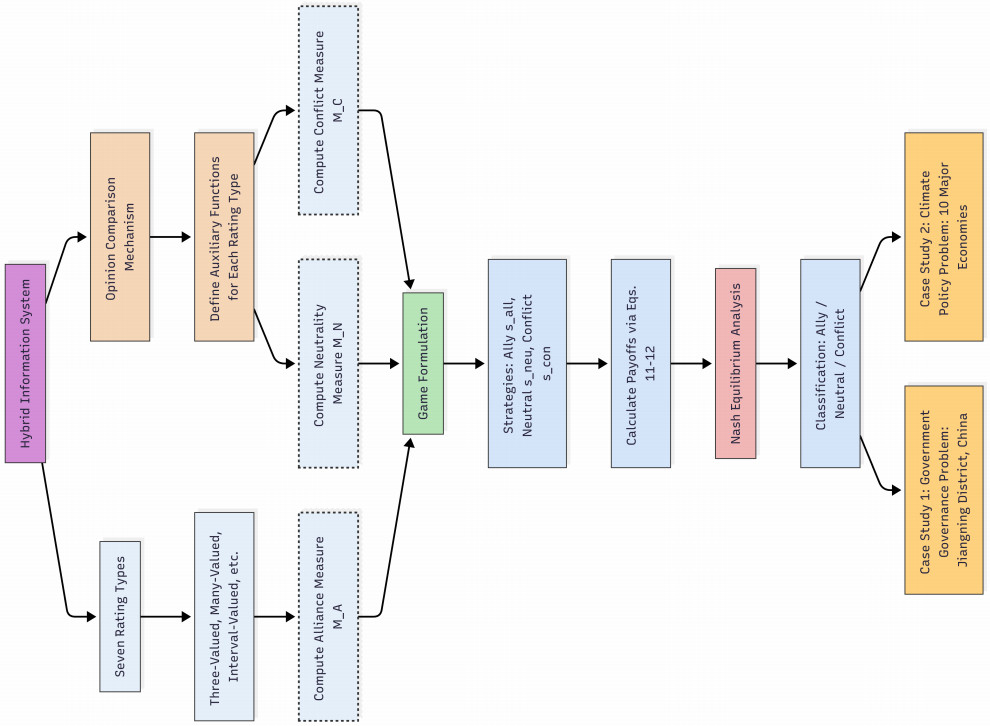
We aimed to design a novel conflict analysis model that incorporates a hybrid information system and gameplay between the involved parties or players. In a hybrid information system, the decision maker can express his opinion from multiple data sets based on his expertise, experience, level of hesitancy, and risk factors involved. From this multiscale data, we carefully compared all players' opinions and designed three measures determining the degree of alliance, neutrality, and conflict. Based on game theory principles, we measured each player's gain for three actions/strategies: Go in alliance, remain neutral, or go against the other player. Based on the highest gains, the players were classified as allies, neutral, or in conflict (Nash equilibrium). With the power of careful multiscale opinions and bilateral study of all three possible scenarios, the proposed model has many advantages in accurately modeling conflict scenarios. A detailed comparative analysis confirms the practical use of the proposed framework.
Citation: Akrash Tasawar, M. G. Abbas Malik. A novel conflict analysis model based on multi-scale information with game theoretic approach[J]. AIMS Mathematics, 2025, 10(10): 24514-24547. doi: 10.3934/math.20251087
We aimed to design a novel conflict analysis model that incorporates a hybrid information system and gameplay between the involved parties or players. In a hybrid information system, the decision maker can express his opinion from multiple data sets based on his expertise, experience, level of hesitancy, and risk factors involved. From this multiscale data, we carefully compared all players' opinions and designed three measures determining the degree of alliance, neutrality, and conflict. Based on game theory principles, we measured each player's gain for three actions/strategies: Go in alliance, remain neutral, or go against the other player. Based on the highest gains, the players were classified as allies, neutral, or in conflict (Nash equilibrium). With the power of careful multiscale opinions and bilateral study of all three possible scenarios, the proposed model has many advantages in accurately modeling conflict scenarios. A detailed comparative analysis confirms the practical use of the proposed framework.

| [1] |
L. Boulaasair, H. Bouzahir, N. S. Rao, D. Santina, N. Mlaiki, Mathematical analysis of competitive dynamics between two regional areas, J. Inequal. Appl., 2025 (2025), 71. https://doi.org/10.1186/s13660-025-03326-2 doi: 10.1186/s13660-025-03326-2

|
| [2] |
Z. Pawlak, An inquiry into the anatomy of conflicts, Inf. Sci., 109 (1998), 65–78. https://doi.org/10.1016/S0020-0255(97)10072-X doi: 10.1016/S0020-0255(97)10072-X
|
| [3] |
B. Sun, W. Ma, H. Zhao, Rough set-based conflict analysis model and method over two universes, Inf. Sci., 372 (2016), 111–125. https://doi.org/10.1016/j.ins.2016.08.030 doi: 10.1016/j.ins.2016.08.030
|
| [4] | N. Azam, J. Yao, Game-theoretic rough sets for feature selection, In: Rough sets and intelligent systems – Professor Zdzisław Pawlak in memoriam, 43 (2013), 61–78. https://doi.org/10.1007/978-3-642-30341-8_5 |
| [5] |
N. Azam, J. Yao, Game-theoretic rough sets for recommender systems, Knowl. Based Syst., 72 (2014), 96–107. https://doi.org/10.1016/j.knosys.2014.08.030 doi: 10.1016/j.knosys.2014.08.030
|
| [6] |
Z. Bashir, S. Mahnaz, M. G. Abbas Malik, Conflict resolution using game theory and rough sets, Int. J. Intell. Syst., 36 (2021), 237–259. https://doi.org/10.1002/int.22298 doi: 10.1002/int.22298
|
| [7] |
Z. Bashir, A. Wahab, T. Rashid, Three-way decision with conflict analysis approach in the framework of fuzzy set theory, Soft Comput., 26 (2022), 309–326. https://doi.org/10.1007/s00500-021-06509-3 doi: 10.1007/s00500-021-06509-3
|
| [8] | K. Leyton-Brown, Y. Shoham, Essentials of game theory: A concise multidisciplinary introduction, Cham: Springer, 2008. https://doi.org/10.1007/978-3-031-01545-8 |
| [9] | J. S. Liu, X. Z. Wang, B. Y. Zhang, Ranking of interval numbers, Chinese J. Eng. Math., 18 (2001), 103–109. |
| [10] |
G. Lang, D. Miao, M. Cai, Three-way decision approaches to conflict analysis using decision-theoretic rough set theory, Inf. Sci., 406 (2017), 185–207. https://doi.org/10.1016/j.ins.2017.04.030 doi: 10.1016/j.ins.2017.04.030
|
| [11] |
G. Lang, Three-way conflict analysis: Alliance, conflict, and neutrality reducts of three-valued situation tables, Cogn. Comput., 14 (2022), 2040–2053. https://doi.org/10.1007/s12559-021-09905-x doi: 10.1007/s12559-021-09905-x
|
| [12] |
X. Li, Y. Yang, H. Yi, Q. Yu, Conflict analysis based on three-way decision for trapezoidal fuzzy information systems, Int. J. Mach. Learn. Cybern., 13 (2022), 929–945. https://doi.org/10.1007/s13042-021-01427-0 doi: 10.1007/s13042-021-01427-0
|
| [13] | Z. Pawlak, On conflicts, Int. J. Man-Mach. Stud., 21 (1984), 127–134. https://doi.org/10.1016/S0020-7373(84)80062-0 |
| [14] |
Z. Pawlak, Some remarks on conflict analysis, Eur. J. Oper. Res., 166 (2005), 649–654. https://doi.org/10.1016/j.ejor.2003.09.038 doi: 10.1016/j.ejor.2003.09.038
|
| [15] | S. Ramanna, J. F. Peters, A. Skowron, Approaches to conflict dynamics based on rough sets, Fundam. Inform., 75 (2007), 453–468. |
| [16] | V. Torra, Hesitant fuzzy sets, Int. J. Intell. Syst., 25 (2010), 529–539. https://doi.org/10.1002/int.20418 |
| [17] |
R. R. Yager, A. M. Abbasov, Pythagorean membership grades, complex numbers, and decision-making, Int. J. Intell. Syst., 28 (2013), 436–452. https://doi.org/10.1002/int.21584 doi: 10.1002/int.21584
|
| [18] |
Y. Yao, Three-way decisions with probabilistic rough sets, Inf. Sci., 180 (2010), 341–353. https://doi.org/10.1016/j.ins.2009.09.021 doi: 10.1016/j.ins.2009.09.021
|
| [19] |
H. L. Yang, Y. Wang, Z. L. Guo, Three-way conflict analysis based on hybrid situation tables, Inf. Sci., 628 (2023), 522–541. https://doi.org/10.1016/j.ins.2023.02.006 doi: 10.1016/j.ins.2023.02.006
|
| [20] |
F. Xu, M. Cai, H. Song, J. Dai, The selection of feasible strategies is based on the consistency measurement of cliques, Inf. Sci., 583 (2022), 33–55. https://doi.org/10.1016/j.ins.2021.10.080 doi: 10.1016/j.ins.2021.10.080
|
| [21] |
J. Luo, M. Hu, G. Lang, X. Yang, K. Qin, Three-way conflict analysis based on alliance and conflict functions, Inf. Sci., 594 (2022), 322–359. https://doi.org/10.1016/j.ins.2022.01.067 doi: 10.1016/j.ins.2022.01.067
|
| [22] |
G. Lang, J. Luo, Y. Yao, Three-way conflict analysis: A unification of models based on rough sets and formal concept analysis, Knowl. Based Syst., 194 (2020), 105556. https://doi.org/10.1016/j.knosys.2020.105556 doi: 10.1016/j.knosys.2020.105556
|
| [23] |
G. Lang, D. Miao, H. Fujita, Three-way group conflict analysis based on Pythagorean fuzzy set theory, IEEE Trans. Fuzzy Syst., 28 (2019), 447–461. https://doi.org/10.1109/TFUZZ.2019.2908123 doi: 10.1109/TFUZZ.2019.2908123
|
| [24] |
L. W. Suo, H. L. Yang, Three-way conflict analysis based on incomplete situation tables: A tentative study, Int. J. Approx. Reason., 145 (2022), 51–74. https://doi.org/10.1016/j.ijar.2022.03.004 doi: 10.1016/j.ijar.2022.03.004
|
| [25] |
H. L. Yang, S. Y. Xue, Y. H. She, General three-way decision models on incomplete information tables, Inf. Sci., 605 (2022), 136–158. https://doi.org/10.1016/j.ins.2022.05.002 doi: 10.1016/j.ins.2022.05.002
|
| [26] |
Y. Yao, Three-way conflict analysis: Reformulations and extensions of the Pawlak model, Knowl. Based Syst., 180 (2019), 26–37. https://doi.org/10.1016/j.knosys.2019.05.016 doi: 10.1016/j.knosys.2019.05.016
|
| [27] |
Z. Gillani, Z. Bashir, S. Aquil, A game theoretic conflict analysis model with linguistic assessments and two levels of game play, Inf. Sci., 677 (2024), 120840. https://doi.org/10.1016/j.ins.2024.120840 doi: 10.1016/j.ins.2024.120840
|
| [28] |
T. Wang, B. Huang, H. Li, D. Liu, H. Yu, Three-way decision for probabilistic linguistic conflict analysis via compounded risk preference, Inf. Sci., 631 (2023), 65–90. https://doi.org/10.1016/j.ins.2023.02.067 doi: 10.1016/j.ins.2023.02.067
|
| [29] |
X. Li, X. Wang, G. Lang, H. Yi, Conflict analysis based on the three-way decision for triangular fuzzy information systems, Int. J. Approx. Reason., 132 (2021), 88–106. https://doi.org/10.1016/j.ijar.2020.12.004 doi: 10.1016/j.ijar.2020.12.004
|
| [30] |
A. Fahmi, A. Khan, T. Abdeljawad, A novel approach to group decision-making using generalized bipolar neutrosophic sets, PLoS One, 20 (2025), e0317746. https://doi.org/10.1371/journal.pone.0317746 doi: 10.1371/journal.pone.0317746
|
| [31] |
Y. Yao, The superiority of three-way decisions in probabilistic rough set models, Inf. Sci., 181 (2011), 1080–1096. https://doi.org/10.1016/j.ins.2010.11.019 doi: 10.1016/j.ins.2010.11.019
|
| [32] |
X. Zhang, J. Chen, Three-hierarchical three-way decision models for conflict analysis: A qualitative improvement and a quantitative extension, Inf. Sci., 587 (2022), 485–514. https://doi.org/10.1016/j.ins.2021.12.012 doi: 10.1016/j.ins.2021.12.012
|
| [33] |
H. Zhi, J. Qi, T. Qian, R. Ren, Conflict analysis under one-vote veto based on an approximate three-way concept lattice, Inf. Sci., 516 (2020), 316–330. https://doi.org/10.1016/j.ins.2019.12.065 doi: 10.1016/j.ins.2019.12.065
|
| [34] |
X. Li, X. Wei, Z. Qian, A probability-measure-based approach to ranking fuzzy numbers via three-way decision and its application to conflict analysis, Fuzzy Sets Syst., 465 (2023), 108539. https://doi.org/10.1016/j.fss.2023.108539 doi: 10.1016/j.fss.2023.108539
|
| [35] | Y. Fan, J. Qi, L. Wei, A conflict analysis model based on three-way decisions, In: Rough sets, 11103 (2018), 522–532. https://doi.org/10.1007/978-3-319-99368-3_41 |
| [36] |
T. P. Benko, B. Pi, Q. Li, M. Feng, M. Perc, H. B. Vošner, Evolutionary games for cooperation in open data management, Appl. Math. Comput., 496 (2025), 129364. https://doi.org/10.1016/j.amc.2025.129364 doi: 10.1016/j.amc.2025.129364
|
| [37] | J. Von Neumann, O. Morgenstern, Theory of games and economic behavior, Princeton University Press, 1944. |
| [38] |
L. Tran, L. Duckstein, Comparison of fuzzy numbers using a fuzzy distance measure, Fuzzy Sets Syst., 130 (2002), 331–341. https://doi.org/10.1016/S0165-0114(01)00195-6 doi: 10.1016/S0165-0114(01)00195-6
|
| [39] |
H. Yi, H. Zhang, X. Li, Y. Yang, Three-way conflict analysis based on hesitant fuzzy information systems, Int. J. Approx. Reason., 139 (2021), 12–27. https://doi.org/10.1016/j.ijar.2021.09.002 doi: 10.1016/j.ijar.2021.09.002
|
| [40] |
J. Du, S. Liu, Y. Liu, J. Yi, A novel approach to three-way conflict analysis and resolution with Pythagorean fuzzy information, Inf. Sci., 584 (2022), 65–88. https://doi.org/10.1016/j.ins.2021.10.051 doi: 10.1016/j.ins.2021.10.051
|
| [41] | UNFCCC, United nations framework convention on climate change, United Nations, 2024. |
| [42] | European Climate, Infrastructure and Environment Executive Agency, Renewables 2023: Analysis and forecast to 2028, 2024. |
| [43] | World Resources Institute, Climate watch: NDC data, 2025. |
| [44] | H. O. Portner, D. C. Roberts, M. M. B. Tignor, E. Poloczanska, K. Mintenbeck, A. Alegria, et al., Climate change 2022: Impacts, adaptation and vulnerability, Cambridge University Press, 2023. https://doi.org/10.1017/9781009325844 |
| [45] | Notre Dame Global Adaptation Initiative, ND-GAIN Country Index, University of Notre Dame, 2023. |
| [46] | International Energy Agency, Government Energy Spending Tracker, IEA, 2023. |
| [47] | OECD, OECD inventory of support measures for fossil fuels 2024: Policy trends up to 2023, Paris: OECD Publishing, 2024. https://doi.org/10.1787/87dc4a55-en |
Figures(4) / Tables(21)

Akrash Tasawar, M. G. Abbas Malik. A novel conflict analysis model based on multi-scale information with game theoretic approach[J]. AIMS Mathematics, 2025, 10(10): 24514-24547. doi: 10.3934/math.20251087





 DownLoad: