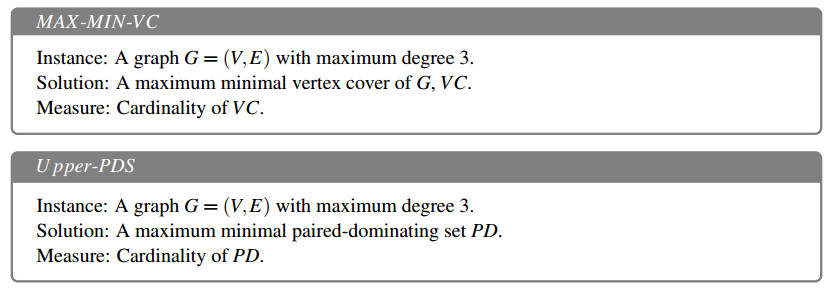
A set $ PD\subseteq V(G) $ in a graph $ G $ is a paired dominating set if every vertex $ v\notin PD $ is adjacent to a vertex in $ PD $ and the subgraph induced by $ PD $ contains a perfect matching. A paired dominating set $ PD $ of $ G $ is minimal if there is no proper subset $ PD'\subset PD $ which is a paired dominating set of $ G $. A minimal paired dominating set of maximum cardinality is called an upper paired dominating set, denoted by $ \Gamma_{pr}(G) $-set. Denote by $ Upper $-$ PDS $ the problem of computing a $ \Gamma_{pr}(G) $-set for a given graph $ G $. Michael et al. showed the APX-completeness of $ Upper $-$ PDS $ for bipartite graphs with $ \Delta = 4 $ [
Citation: Huiqin Jiang, Pu Wu, Jingzhong Zhang, Yongsheng Rao. Upper paired domination in graphs[J]. AIMS Mathematics, 2022, 7(1): 1185-1197. doi: 10.3934/math.2022069
A set $ PD\subseteq V(G) $ in a graph $ G $ is a paired dominating set if every vertex $ v\notin PD $ is adjacent to a vertex in $ PD $ and the subgraph induced by $ PD $ contains a perfect matching. A paired dominating set $ PD $ of $ G $ is minimal if there is no proper subset $ PD'\subset PD $ which is a paired dominating set of $ G $. A minimal paired dominating set of maximum cardinality is called an upper paired dominating set, denoted by $ \Gamma_{pr}(G) $-set. Denote by $ Upper $-$ PDS $ the problem of computing a $ \Gamma_{pr}(G) $-set for a given graph $ G $. Michael et al. showed the APX-completeness of $ Upper $-$ PDS $ for bipartite graphs with $ \Delta = 4 $ [

| [1] | G. Ausiello, M. Protasi, A. Marchettispaccamela, G. Gambosi, P. Crescenzi, V. Kann, Complexity and Approximation: Combinatorial Optimization Problems and Their Approximability Properties, Springer-Verlag, Berlin, 1999. |
| [2] | C. Bazgan, L. Brankovic, K. Casel, H. Fernau, On the complexity landscape of the domination chain, In: Proceedings of the Second International Conference on Algorithms and Discrete Applied Mathematics, 2016, 61–72. |
| [3] | J. A. Bondy, U. S. R. Murty, Graph theory with applications, USA, 1976. |
| [4] |
L. Chen, C. Lu, Z. Zeng, Labelling algorithms for paired-domination problems in block and interval graphs, J. Comb. Optim., 19 (2010), 457–470. doi: 10.1007/s10878-008-9177-6. doi: 10.1007/s10878-008-9177-6

|
| [5] |
E. J. Cockayne, O. Favaron, C. M. Mynhardt, Paired-domination in claw-free cubic graphs, Graphs Combinatorics, 20 (2004), 447–456. doi: 10.1007/s00373-004-0577-9. doi: 10.1007/s00373-004-0577-9
|
| [6] |
P. Dorbec, S. Gravier, M. A. Henning, Paired-domination in generalized claw-free graphs, J. Comb. Optim., 14 (2007), 1–7. doi: 10.1007/s10878-006-9022-8. doi: 10.1007/s10878-006-9022-8
|
| [7] |
P. Dorbec, M. A. Henning, J. Mccoy, Upper total domination versus upper paired-domination, Quaestiones Mathematicae, 30 (2007), 1–12. doi: 10.2989/160736007780205693. doi: 10.2989/160736007780205693
|
| [8] | M. R. Garey, D. S. Johnson, Computers and intractability: A guide to the theory of NP-completeness, WH Freeman & Co., New York, 1979. |
| [9] |
T. W. Haynes, P. J. Slater, Paired-domination in graphs, Networks, 32 (1998), 199–206. doi: 10.1002/(SICI)1097-0037(199810)32:3<199::AID-NET4>3.0.CO;2-F. doi: 10.1002/(SICI)1097-0037(199810)32:3<199::AID-NET4>3.0.CO;2-F
|
| [10] |
M. A. Henning, P. Dorbec, Upper paired-domination in claw-free graphs, J. Comb. Optim., 22 (2011), 235–251. doi: 10.1007/s10878-009-9275-0. doi: 10.1007/s10878-009-9275-0
|
| [11] |
M. A. Henning, D. Pradhan, Algorithmic aspects of upper paired-domination in graphs, Theor. Comput. Sci., 804 (2020), 98–114. doi: 10.1016/j.tcs.2019.10.045. doi: 10.1016/j.tcs.2019.10.045
|
| [12] |
C. Lu, B. Wang, K. Wang, Y. Wu, Paired-domination in claw-free graphs with minimum degree at least three, Discrete Appl. Math., 257 (2019), 250–259. doi: 10.1016/j.dam.2018.09.005. doi: 10.1016/j.dam.2018.09.005
|
| [13] |
S. Mishra, K. Sikdar, On the hardness of approximating some NP-optimization problems related to minimum linear ordering problem, Rairo-Theor. Inf. Appl., 35 (2001), 287–309. doi: 10.1051/ita:2001121. doi: 10.1051/ita:2001121
|
| [14] |
A. Pandey, B. S. Panda, Domination in some subclasses of bipartite graphs, Discrete Appl. Math., 252 (2015), 169–180. doi: 10.1007/978-3-319-14974-5_17. doi: 10.1007/978-3-319-14974-5_17
|
| [15] |
C. H. Papadimitriou, M. Yannakakis, Optimization, approximation, and complexity classes, J. Comput. Syst. Sci., 43 (1991), 425–440. doi: 10.1016/0022-0000(91)90023-X. doi: 10.1016/0022-0000(91)90023-X
|
| [16] |
D. Pradhan, B. S. Panda, Computing a minimum paired-dominating set in strongly orderable graphs, Discrete Appl. Math., 253 (2018), 37–50. doi: 10.1016/j.dam.2018.08.022. doi: 10.1016/j.dam.2018.08.022
|
| [17] |
H. Qiao, L. Kang, M. Cardei, D. Du, Paired-domination of trees, J. Global Optim., 25 (2003), 43–54. doi: 10.1023/A:1021338214295. doi: 10.1023/A:1021338214295
|
| [18] | D. B. West, Introduction to graph theory, 2nd ed., Prentice Hall, USA, 2001. |


Figures(5)

Huiqin Jiang, Pu Wu, Jingzhong Zhang, Yongsheng Rao. Upper paired domination in graphs[J]. AIMS Mathematics, 2022, 7(1): 1185-1197. doi: 10.3934/math.2022069





 DownLoad: