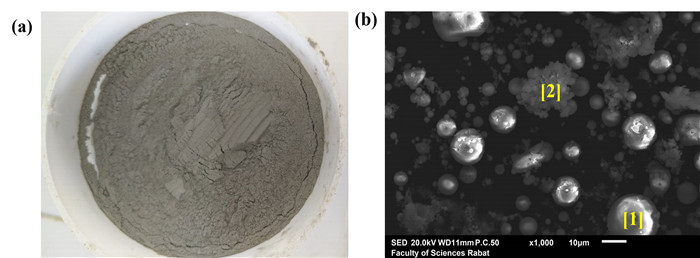
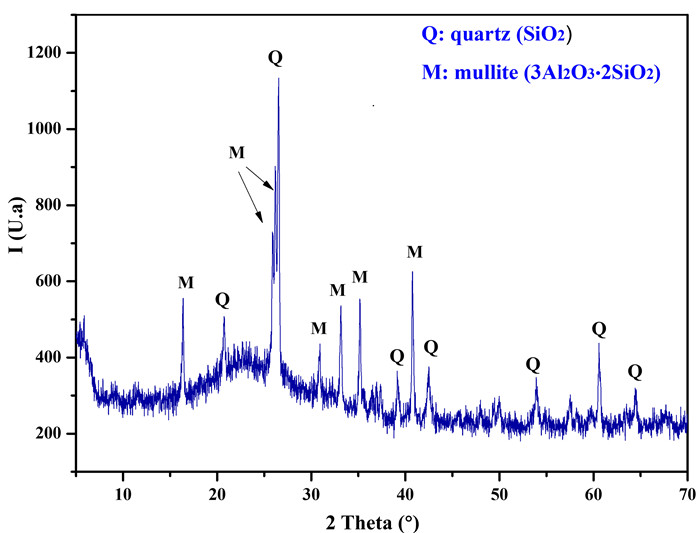
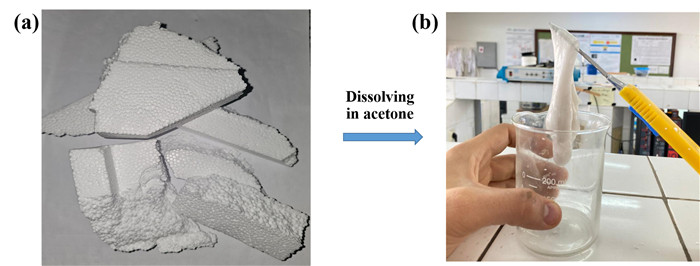
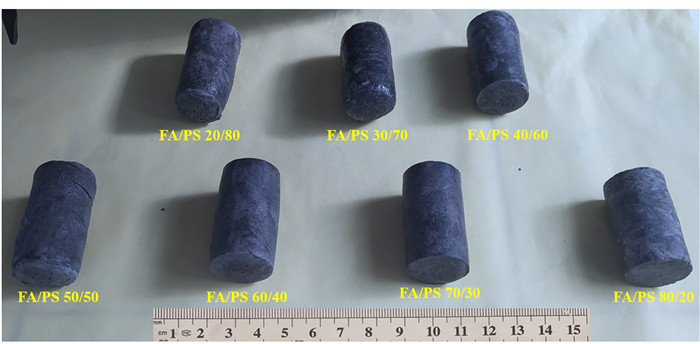
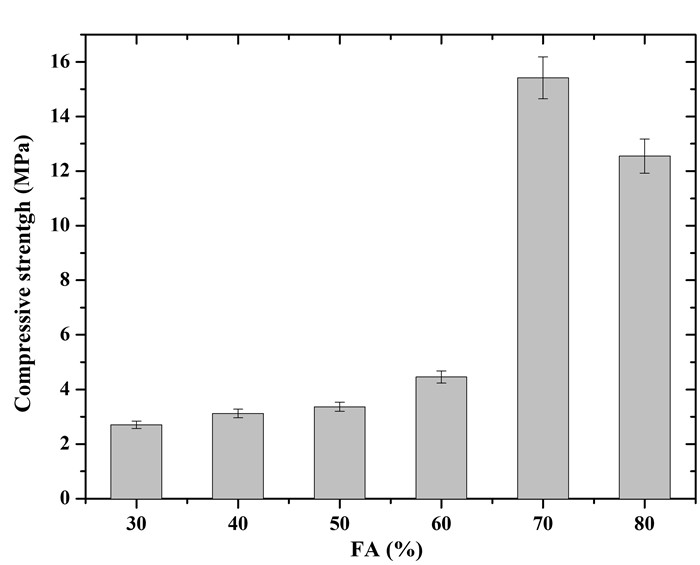
In the context of developing sustainable materials and promoting environmental protection through the valorization of solid wastes, a thermoplastic composite was fabricated using coal fly ash (FA) and expanded polystyrene (EPS) waste. FA was employed as the reinforcing filler, while EPS waste, dissolved in acetone, served as the polymer matrix. Composites were prepared by incorporating varying weight fractions of FA, ranging from 20 to 80 wt.%, into the polystyrene matrix via compression molding. The resulting materials were thoroughly characterized to evaluate their mineralogical, physicochemical, mechanical, and microstructural properties. The findings indicated that an optimal composite composition containing 70 wt.% fly ash and 30 wt.% polystyrene matrix exhibited a compressive strength up to 15 MPa. In this study, we not only present a novel composite material but also address environmental concerns by contributing to the reduction of solid and plastic waste pollution.
Citation: Saleh Eladaoui, Mouad El Mouzahim, El Mehdi Eddarai, Mustapha El Kanzaoui, Abdelkbir Bellaouchou, Ratiba Boussen. Development and characterization of a polymer composite based on coal fly ash and expanded polystyrene waste: Toward sustainable valorization[J]. AIMS Materials Science, 2026, 13(2): 187-204. doi: 10.3934/matersci.2026011
In the context of developing sustainable materials and promoting environmental protection through the valorization of solid wastes, a thermoplastic composite was fabricated using coal fly ash (FA) and expanded polystyrene (EPS) waste. FA was employed as the reinforcing filler, while EPS waste, dissolved in acetone, served as the polymer matrix. Composites were prepared by incorporating varying weight fractions of FA, ranging from 20 to 80 wt.%, into the polystyrene matrix via compression molding. The resulting materials were thoroughly characterized to evaluate their mineralogical, physicochemical, mechanical, and microstructural properties. The findings indicated that an optimal composite composition containing 70 wt.% fly ash and 30 wt.% polystyrene matrix exhibited a compressive strength up to 15 MPa. In this study, we not only present a novel composite material but also address environmental concerns by contributing to the reduction of solid and plastic waste pollution.

| [1] |
Hsissou R, Seghiri R, Benzekri Z, et al. (2021) Polymer composite materials: A comprehensive review. Compos Struct 262: 113640. https://doi.org/10.1016/j.compstruct.2021.113640 doi: 10.1016/j.compstruct.2021.113640

|
| [2] |
Aljabri NM, Lai Z, Hadjichristidis N, et al. (2017) Renewable aromatics from the degradation of polystyrene under mild conditions. J Saudi Chem Soc 21: 983–989. http://dx.doi.org/10.1016/j.jscs.2017.05.005 doi: 10.1016/j.jscs.2017.05.005
|
| [3] |
Kumar V, Khan A, Rabnawaz M, et al. (2022) Efficient depolymerization of polystyrene with table salt and oxidized copper. ACS Sustainable Chem. Eng 10: 6493–6502. https://doi.org/10.1021/acssuschemeng.1c08400 doi: 10.1021/acssuschemeng.1c08400
|
| [4] |
Koksal F, Mutluay E, Gencel O, et al. (2020) Characteristics of isolation mortars produced with expanded vermiculite and waste expanded polystyrene. Constr Build Mater 236: 117789. https://doi.org/10.1016/j.conbuildmat.2019.117789 doi: 10.1016/j.conbuildmat.2019.117789
|
| [5] |
Ferrándiz-Mas V, Bond T, García-Alcocel E, et al. (2014) Lightweight mortars containing expanded polystyrene and paper sludge ash. Constr Build Mater 61: 285–292. https://doi.org/10.1016/j.conbuildmat.2014.03.028 doi: 10.1016/j.conbuildmat.2014.03.028
|
| [6] |
Fernando PLN, Jayasinghe MTR, Jayasinghe C, et al. (2017) Structural feasibility of expanded polystyrene (EPS) based lightweight concrete sandwich wall panels. Constr Build Mater 139: 45–51. https://doi.org/10.1016/j.conbuildmat.2017.02.027 doi: 10.1016/j.conbuildmat.2017.02.027
|
| [7] |
Poletto M, Dettenborn J, Zeni M, et al. (2011) Characterization of composites based on expanded polystyrene wastes and wood flour. Waste Manag 31: 779–784. https://doi.org/10.1016/j.wasman.2010.10.027 doi: 10.1016/j.wasman.2010.10.027
|
| [8] |
Jimenez-Francisco M, Caamal-Canche JA, Carrillo JG, et al. (2018) Performance assessment of a composite material based on kraft paper and a resin formulated with expanded polystyrene waste: A case study from Mexico. J Polym Environ 26: 1573–1580. https://doi.org/10.1007/s10924-017-1073-7 doi: 10.1007/s10924-017-1073-7
|
| [9] |
Adeniyi AG, Abdulkareem SA, Adeyanju CA, et al. (2023) Mechanical and morphological analyses of flamboyant seed pod biochar/aluminium filings reinforced hybrid polystyrene composite. J Indian Acad Wood Sci 20: 28–36. https://doi.org/10.1007/s13196-023-00311-4 doi: 10.1007/s13196-023-00311-4
|
| [10] |
Adeniyi AG, Abdulkareem SA, Ighalo JO, et al. (2021) Microstructural and mechanical properties of the plantain fiber/local clay microstructural and mechanical properties of the plantain fiber/local clay filled hybrid polystyrene composites. Mech Adv Mater Struct 29: 7104–7114. https://doi.org/10.1080/15376494.2021.1992692 doi: 10.1080/15376494.2021.1992692
|
| [11] |
Masri T, Ounis H, Sedira L, et al. (2018) Characterization of new composite material based on date palm leaflets and expanded polystyrene wastes. Constr Build Mater 164: 410–418. https://doi.org/10.1016/j.conbuildmat.2017.12.197 doi: 10.1016/j.conbuildmat.2017.12.197
|
| [12] |
George A, Abdulkareem SA, Chizitere E, et al. (2022) Development and characterization of microstructural and mechanical properties of hybrid polystyrene composites filled with kaolin and expanded polyethylene powder. Results Eng 14: 100423. https://doi.org/10.1016/j.rineng.2022.100423 doi: 10.1016/j.rineng.2022.100423
|
| [13] |
Taurino R, Bondioli F, Messori M (2023) Use of different kinds of waste in the construction of new polymer composites: Review. Mater Today Sustain 21: 100298. https://doi.org/10.1016/j.mtsust.2022.100298 doi: 10.1016/j.mtsust.2022.100298
|
| [14] |
Das O, Babu K, Shanmugam V, et al. (2022) Natural and industrial wastes for sustainable and renewable polymer composites. Renew Sustain Energy Rev 158: 112054. https://doi.org/10.1016/j.rser.2021.112054 doi: 10.1016/j.rser.2021.112054
|
| [15] |
Mathapati M, Amate K, Durga Prasad C, et al. (2022) A review on fly ash utilization. Mater Today Proc 50: 1535–1540. https://doi.org/10.1016/j.matpr.2021.09.106 doi: 10.1016/j.matpr.2021.09.106
|
| [16] |
Yao ZT, Ji XS, Sarker PK, et al. (2015) A comprehensive review on the applications of coal fly ash. Earth-Science Rev 141: 105–121. https://doi.org/10.1016/j.earscirev.2014.11.016 doi: 10.1016/j.earscirev.2014.11.016
|
| [17] |
Nagrockienė D, Rutkauskas A (2019) The effect of fly ash additive on the resistance of concrete to alkali silica reaction. Constr Build Mater 201: 599–609. https://doi.org/10.1016/j.conbuildmat.2018.12.225 doi: 10.1016/j.conbuildmat.2018.12.225
|
| [18] |
Li J, Li X, Liang S, et al. (2021) Preparation of water-permeable bricks derived from fly ash by autoclaving. Constr Build Mater 271: 121556. https://doi.org/10.1016/j.conbuildmat.2020.121556 doi: 10.1016/j.conbuildmat.2020.121556
|
| [19] |
Sheng G, Li Q, Zhai J (2012) Investigation on the hydration of CFBC fly ash. Fuel 98: 61–66. https://doi.org/10.1016/j.fuel.2012.02.008 doi: 10.1016/j.fuel.2012.02.008
|
| [20] |
Moukannaa S, Bagheri A, Benzaazoua M, et al. (2020) Elaboration of alkali activated materials using a non-calcined red clay from phosphate mines amended with fly ash or slag: A structural study. Mater Chem Phys 256: 123678. https://doi.org/10.1016/j.matchemphys.2020.123678 doi: 10.1016/j.matchemphys.2020.123678
|
| [21] |
Nath DCD, Bandyopadhyay S, Yu A, et al. (2009) Structure-property interface correlation of fly ash-isotactic polypropylene composites. J Mater Sci 44: 6078–6089. https://doi.org/10.1007/s10853-009-3839-3 doi: 10.1007/s10853-009-3839-3
|
| [22] | ASTM International (1999) Standard test method for water absorption, bulk density, apparent porosity, and apparent specific gravity of fired whiteware products. ASTM C373-14, 88: 1–2. |
| [23] |
Zhang L, Zhou M, Meng F, et al. (2025) Recent advances in chemiresistive gas sensor for acetone detection: Focus on room temperature. TrAC Trends Anal Chem 187: 118213. https://doi.org/10.1016/j.trac.2025.118213 doi: 10.1016/j.trac.2025.118213
|
| [24] |
Bicer A, Kar F (2017) Thermal and mechanical properties of gypsum plaster mixed with expanded polystyrene and tragacanth. Therm Sci Eng Prog 1: 59–65. https://doi.org/10.1016/j.tsep.2017.02.008 doi: 10.1016/j.tsep.2017.02.008
|
| [25] |
Hittini W, Abu-Jdayil B, Mourad AH (2019) Development of date pit–polystyrene thermoplastic heat insulator material: Mechanical properties. J Thermoplast Compos Mater 2019: 697627. https://doi.org/10.1155/2019/1697627 doi: 10.1155/2019/1697627
|
| [26] |
Li Z, Zhang Q, Cui J, et al. (2025) Ecofriendly flame-retardant polystyrene composites: Exploiting the synergistic effects of phytic acid, polyethyleneimine, and expandable graphite. Materials 18: 4038. https://doi.org/10.3390/ma18184308 doi: 10.3390/ma18184308
|
| [27] |
Nciri N, Shin T, Cho N (2020) Towards the use of waste expanded polystyrene as potential modifier for flexible road pavements. Mater Today Proc 24: 763–771. https://doi.org/10.1016/j.matpr.2020.04.384 doi: 10.1016/j.matpr.2020.04.384
|
| [28] |
Maurya AK, Gogoi R, Manik G (2021) Study of the moisture mitigation and toughening effect of fly-ash particles on sisal fiber-reinforced hybrid polypropylene composites. J Polym Environ 29: 2321–2336. https://doi.org/10.1007/s10924-021-02043-3 doi: 10.1007/s10924-021-02043-3
|
| [29] |
Ge JC, Lee ES, Kim DJ, et al. (2023) Preparation of waste PP/fly ash/waste stone powder composites and evaluation of their mechanical properties. Materials 16: 3687. https://doi.org/10.3390/ma16103687 doi: 10.3390/ma16103687
|
| [30] |
Almusawi A, Lachat R, Atcholi KE et al. (2017) Manufacturing and characterisation of thermoplastic composite of hemp shives and recycled expanded polystyrene. AIP Conf Proc 1914: 170001. https://doi.org/10.1063/1.5016784 doi: 10.1063/1.5016784
|
| [31] |
Adeniyi AG, Abdulkareem S, Ighalo JO, et al. (2020) Morphological and thermal properties of polystyrene composite reinforced with biochar from elephant grass (Pennisetum purpureum). J Thermoplast Compos Mater 35: 1532–1547. https://doi.org/10.1177/0892705720939169 doi: 10.1177/0892705720939169
|
| [32] |
Pramoda KP, Lim QF, Chen S (2018) Synergistic effects of fillers on recycled polystyrene composites. Polym Bull 75: 1185–1195. https://doi.org/10.1007/s00289-017-2085-0 doi: 10.1007/s00289-017-2085-0
|
| [33] |
Mumbach GD, Bolzan A, Antonio R, et al. (2020) A closed-loop process design for recycling expanded polystyrene waste by dissolution and polymerization. Polymer 209: 122940. https://doi.org/10.1016/j.polymer.2020.122940 doi: 10.1016/j.polymer.2020.122940
|
| [34] |
Cunha RDS, Mumbach GD, Antonio R, et al. (2021) A comprehensive investigation of waste expanded polystyrene recycling by dissolution technique combined with nanoprecipitation. Environ Nanotechnol Monit Manage 16: 100470. https://doi.org/10.1016/j.enmm.2021.100470 doi: 10.1016/j.enmm.2021.100470
|
| [35] |
Chaudhary AK, Vijayakumar RP (2020) Studies on biological degradation of polystyrene by pure fungal cultures. Environ Dev Sustain 22: 4495–4508. https://doi.org/10.1007/s10668-019-00394-5 doi: 10.1007/s10668-019-00394-5
|
| [36] |
Albunia AR, Musto P, Guerra G (2006) FTIR spectra of pure helical crystalline phases of syndiotactic polystyrene. Polymer 47: 234–242. https://doi.org/10.1016/j.polymer.2005.10.135 doi: 10.1016/j.polymer.2005.10.135
|
| [37] |
Iqbal A, Sattar H, Haider R, et al. (2019) Synthesis and characterization of pure phase zeolite 4A from coal fly ash. J Clean Prod 219: 258–267. https://doi.org/10.1016/j.jclepro.2019.02.066 doi: 10.1016/j.jclepro.2019.02.066
|
| [38] |
Zhang Z, Wang H, Provis JL (2012) Quantitative study of the reactivity of fly ash in geopolymerization by FTIR. J Sustain Cem Mater 1: 154–166. https://doi.org/10.1080/21650373.2012.752620 doi: 10.1080/21650373.2012.752620
|
Figures(11) / Tables(2)

Saleh Eladaoui, Mouad El Mouzahim, El Mehdi Eddarai, Mustapha El Kanzaoui, Abdelkbir Bellaouchou, Ratiba Boussen. Development and characterization of a polymer composite based on coal fly ash and expanded polystyrene waste: Toward sustainable valorization[J]. AIMS Materials Science, 2026, 13(2): 187-204. doi: 10.3934/matersci.2026011





 DownLoad: