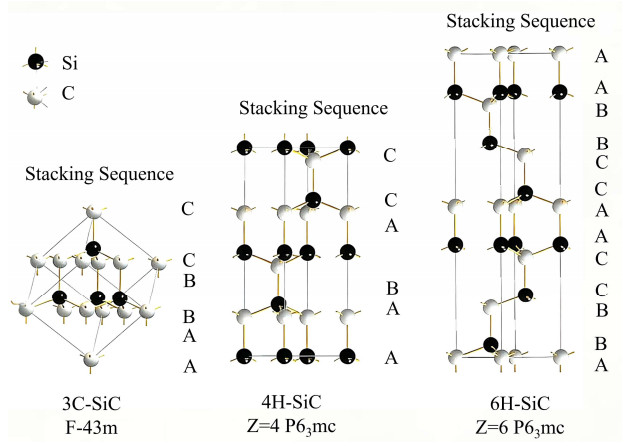
Silicon carbide (SiC), a leading third-generation wide-bandgap semiconductor, exhibits exceptional electrical, thermal, and mechanical properties, including a high breakdown field, superior thermal conductivity, and remarkable environmental stability, making it indispensable for high-power electronics, high-temperature applications, and advanced composites. This review systematically outlines recent advances in SiC materials, with an emphasis on crystal structure characteristics, innovative synthesis routes, and cross-disciplinary applications. The polytypism of SiC and structure—property correlations governing its band structure and carrier mobility—are elucidated. A comparative analysis is then provided on controllable preparation strategies for micro/nano SiC powders, highlighting emerging eco-friendly and low-temperature synthesis pathways. Furthermore, the mechanisms underlying SiC's performance in structural ceramics, catalytic supports, microwave absorption, and supercapacitors are comprehensively discussed, with particular attention paid to its wide-temperature stability and interface enhancement effects. Finally, prevailing challenges in scalable synthesis and defect control are addressed, along with several promising research directions: (1) defect-engineered quantum sensing platforms; (2) low-carbon manufacturing using biomass-derived carbon sources; and (3) deep integration of SiC power devices with smart grid architectures. This review aims to provide theoretical insights and technical guidance for the multi-scale design and application of SiC materials in the fields of new energy and quantum technologies.
Citation: Aoyi Dong, Shaoyi Shen, Jialin Wang, Xinxin Liu, Bibo Han, Song Wu, Xinhua Zheng, Yaguang Sun, Shikai Liu. Advances in synthesis strategies and multifunctional applications of silicon carbide materials[J]. AIMS Materials Science, 2025, 12(5): 1069-1091. doi: 10.3934/matersci.2025050
Silicon carbide (SiC), a leading third-generation wide-bandgap semiconductor, exhibits exceptional electrical, thermal, and mechanical properties, including a high breakdown field, superior thermal conductivity, and remarkable environmental stability, making it indispensable for high-power electronics, high-temperature applications, and advanced composites. This review systematically outlines recent advances in SiC materials, with an emphasis on crystal structure characteristics, innovative synthesis routes, and cross-disciplinary applications. The polytypism of SiC and structure—property correlations governing its band structure and carrier mobility—are elucidated. A comparative analysis is then provided on controllable preparation strategies for micro/nano SiC powders, highlighting emerging eco-friendly and low-temperature synthesis pathways. Furthermore, the mechanisms underlying SiC's performance in structural ceramics, catalytic supports, microwave absorption, and supercapacitors are comprehensively discussed, with particular attention paid to its wide-temperature stability and interface enhancement effects. Finally, prevailing challenges in scalable synthesis and defect control are addressed, along with several promising research directions: (1) defect-engineered quantum sensing platforms; (2) low-carbon manufacturing using biomass-derived carbon sources; and (3) deep integration of SiC power devices with smart grid architectures. This review aims to provide theoretical insights and technical guidance for the multi-scale design and application of SiC materials in the fields of new energy and quantum technologies.

| [1] |
Yang F, Chen YH, Hai WX, et al. (2025) Research progress on high-thermal-conductivity silicon carbide ceramics. Ceram Int 51: 4095–4109. https://doi.org/10.1016/j.ceramint.2024.11.408 doi: 10.1016/j.ceramint.2024.11.408

|
| [2] |
An QL, Chen J, Ming WW, et al. (2021) Machining of SiC ceramic matrix composites: A review. Chin J Aeronaut 34: 540–567. https://doi.org/10.1016/j.cja.2020.08.001 doi: 10.1016/j.cja.2020.08.001
|
| [3] |
Yu Z, Lv X, Mao K, et al. (2020) Role of in-situ formed free carbon on electromagnetic absorption properties of polymer-derived SiC ceramics. J Adv Ceram 9: 617–628. https://doi.org/10.1007/s40145-020-0401-x doi: 10.1007/s40145-020-0401-x
|
| [4] |
She X, Huang AQ, Lucía O, et al. (2017) Review of silicon carbide power devices and their applications. IEEE Trans Ind Electron 64: 8193–8205. https://doi.org/10.1109/TIE.2017.2652401 doi: 10.1109/TIE.2017.2652401
|
| [5] |
Wang YY, Dong S, Li XT, et al. (2022) Synthesis, properties, and multifarious applications of SiC nanoparticles: A review. Ceram Int 48: 8882–8913. https://doi.org/10.1016/j.ceramint.2021.12.208 doi: 10.1016/j.ceramint.2021.12.208
|
| [6] |
Shi B, Ramones AI, Liu Y, et al. (2023) A review of silicon carbide MOSFETs in electrified vehicles: Application, challenges, and future development. IET Power Electron 16: 2103–2120. https://doi.org/10.1049/pel2.12524 doi: 10.1049/pel2.12524
|
| [7] |
Hsiao TC, Tsao S (2012) Synthesis and purification of silicon carbide powders for crystal growth. Mater Sci Forum 717–720: 37–40. https://doi.org/10.4028/www.scientific.net/MSF.717-720.37 doi: 10.4028/www.scientific.net/MSF.717-720.37
|
| [8] | Wang L, Hu XB, Xu XG, et al. (2007) Synthesis of high purity SiC powder for high-resistivity SiC single crystals growth. J Mater Sci Technol 23: 118–122. https://www.jmst.org/EN/Y2007/V23/I01/118 |
| [9] |
Singh S, Chaudhary T, Khanna G (2022) Recent advancements in wide band semiconductors (SiC and GaN) technology for future devices. Silicon 14: 5793–5800. https://doi.org/10.1007/s12633-021-01362-3 doi: 10.1007/s12633-021-01362-3
|
| [10] | Kimoto T, Cooper JA (2014) Fundamentals of Silicon Carbide Technology: Growth, Characterization, Devices and Applications, New York: John Wiley & Sons. https://doi.org/10.1002/9781118313534 |
| [11] |
Wang JC, Liu P, Fu XZ, et al. (2009) Relationship between oxygen defects and the photocatalytic property of ZnO nanocrystals in nafion membranes. Langmuir 25: 1218–1223. https://doi.org/10.1021/la803370z doi: 10.1021/la803370z
|
| [12] |
Chen PC, Miao WC, Ahmed T, et al. (2022) Defect inspection techniques in SiC. Nanoscale Res Lett 17: 30. https://doi.org/10.1186/s11671-022-03672-w doi: 10.1186/s11671-022-03672-w
|
| [13] |
Soltys LM, Mironyuk IF, Mykytyn IM, et al. (2023) Synthesis and properties of silicon carbide. Phys Chem Solid Stat 24: 5–16. https://doi.org/10.15330/pcss.24.1.5-16 doi: 10.15330/pcss.24.1.5-16
|
| [14] |
Morkoc H, Strite S, Gao GB, et al. (1994) Large-band-gap SiC, III-V nitride, and II-VI ZnSe-based semiconductor device technologies. J Appl Phys 76: 1363–1398. https://doi.org/10.1063/1.358463 doi: 10.1063/1.358463
|
| [15] |
El Mendili Y, Orberger B, Chateigner D, et al. (2020) Insight into the structural, elastic and electronic properties of a new orthorhombic 6O-SiC polytype. Sci Rep 10: 7562. https://doi.org/10.1038/s41598-020-64415-4 doi: 10.1038/s41598-020-64415-4
|
| [16] |
Bhatnagar M, Baliga BJ (1993) Comparison of 6H-SiC, 3C-SiC, and Si for power devices. IEEE Trans Electron Devices 40: 645–655. https://doi.org/10.1109/16.199372 doi: 10.1109/16.199372
|
| [17] |
Eom JH, Kim YW, Song IH, et al. (2007) Microstructure and properties of porous silicon carbide ceramics fabricated by carbothermal reduction and subsequent sintering process. Mater Sci Eng A 464: 129–134. https://doi.org/10.1016/j.msea.2007.03.076 doi: 10.1016/j.msea.2007.03.076
|
| [18] |
Presser V, Nickel KG (2008) Silica on silicon carbide. Crit Rev Solid State 33: 1–99. https://doi.org/10.1080/10408430701718914 doi: 10.1080/10408430701718914
|
| [19] | Goldberg Y, Levinshtein M, Rumyantsev S (2001) Silicon carbide, In: Levinshtein ME, Rumyantsev SL, Shur MS, Properties of Advanced Semiconductor Materials: GaN, AIN, InN, BN, SiC, SiGe, New York: John Wiley & Sons, 93–146. |
| [20] |
Morkoç H, Strite S, Gao GB, et al. (1994) Large-band-gap SiC, III-V nitride, and II-VI ZnSe-based semiconductor device technologies. J Appl Phys 6: 1363–1398. https://doi.org/10.1063/1.358463 doi: 10.1063/1.358463
|
| [21] |
Papanasam E, Kumar BP, Chanthini B, et al. (2022) A comprehensive review of recent progress, prospect and challenges of silicon carbide and its applications. Silicon 14: 12887–12900. https://doi.org/10.1007/s12633-022-01998-9 doi: 10.1007/s12633-022-01998-9
|
| [22] |
Lavric H, Zajec P, Drobnic K, et al. (2025) Challenges for large-scale deployment of WBG in power electronics. Inf Midem-J Microelectron Electron Compon Mater 55: 3–23. https://doi.org/10.33180/InfMIDEM2025.101 doi: 10.33180/InfMIDEM2025.101
|
| [23] |
Sun KD, Wang TT, Gong WB, et al. (2022) Synthesis and potential applications of silicon carbide nanomaterials/nanocomposites. Ceram Int 48: 32571–32587. https://doi.org/10.1016/j.ceramint.2022.07.204 doi: 10.1016/j.ceramint.2022.07.204
|
| [24] |
Gao SB, Jiang SN, Wang S, et al. (2020) Recycle of silicon slurry cutting waste to prepare high purity SiC by salt-assisted carbothermic reduction. J Clean Prod 272: 122566. https://doi.org/10.1016/j.jclepro.2020.122566 doi: 10.1016/j.jclepro.2020.122566
|
| [25] |
Lu PF, Jin ZH, Cui YB, et al. (2021) Effect of raw material particle size on synthesis of silicon carbide. CIESC J 72: 2300–2308. https://doi.org/10.11949/0438-1157.20200981 doi: 10.11949/0438-1157.20200981
|
| [26] |
Mukasyan AS, Lin YC, Rogachev AS, et al. (2013) Direct combustion synthesis of silicon carbide nanopowder from the elements. J Am Ceram Soc 96: 111–117. https://doi.org/10.1111/jace.12107 doi: 10.1111/jace.12107
|
| [27] |
Kirakosyan H, Nazaretyan K, Amirkhanyan N, et al. (2024) A novel pathway of solution combustion synthesis of silicon carbide and SiC based composite whiskers. AIP Conf Proc 2989: 040009. https://doi.org/10.1063/5.0189204 doi: 10.1063/5.0189204
|
| [28] |
Han LJ, Chen SL, Li HH, et al. (2024) Rapid and inexpensive synthesis of liter-scale SiC aerogels. Nat Commun 15: 6959. https://doi.org/10.1038/s41467-024-51278-w doi: 10.1038/s41467-024-51278-w
|
| [29] | Han LJ, Zhang HK, Yang X, et al. (2025) Combustion co-synthesis of nano SiC and purified Si3N4 powders by coupling strong and weak exothermic reactions. Ind Chem Mater 12. https://doi.org/10.1039/d5im00191a |
| [30] |
Karim GA, Ghosh A, Rao R, et al. (2021) Biomorphic SiC: Porous SiC and ultrafine SiC powder formation through biomimicking route. Adv Appl Ceram 120: 24–31. https://doi.org/10.1080/17436753.2020.1842106 doi: 10.1080/17436753.2020.1842106
|
| [31] |
Cui H, Zheng Y, Ma J, et al. (2017) Effect of different silicon sources on rattan-based silicon carbide ceramic prepared by one-step pyrolysis. J Wood Sci 63: 95–103. https://doi.org/10.1007/s10086-016-1594-z doi: 10.1007/s10086-016-1594-z
|
| [32] |
Amirthan G, Udayakumar A, Prasad VVB, et al. (2009) Synthesis and characterization of Si/SiC ceramics prepared using cotton fabric. Ceram Int 35: 967–973. https://doi.org/10.1016/j.ceramint.2008.04.014 doi: 10.1016/j.ceramint.2008.04.014
|
| [33] |
Alweendo ST, Johnson OT, Shongwe MB, et al. (2019) Synthesis, optimization and characterization of silicon carbide (SiC) from rice husk. Procedia Manuf 35: 962–967. https://doi.org/10.1016/j.promfg.2019.06.042 doi: 10.1016/j.promfg.2019.06.042
|
| [34] |
Do TKK, Nguyen CT, Huynh NM (2024) Effect of temperature on the ability to synthesize SiC from rice husks. Mater Res Express 11: 055510. https://doi.org/10.1088/2053-1591/ad4981 doi: 10.1088/2053-1591/ad4981
|
| [35] |
Li JW, Tian JM, Dong LM (2000) Synthesis of SiC precursors by a two-step sol-gel process and their conversion to SiC powders. J European Ceram Soc 20: 1853–1857. https://doi.org/10.1016/s0955-2219(00)00055-8 doi: 10.1016/s0955-2219(00)00055-8
|
| [36] |
Najafi A, Golestani-Fard F, Rezaie HR, et al. (2021) Sol-gel synthesis and characterization of SiC–B4C nano powder. Ceram Int 47: 6376–6387. https://doi.org/10.1016/j.ceramint.2020.10.218 doi: 10.1016/j.ceramint.2020.10.218
|
| [37] |
Cerneaux S, Xiong X, Simon GP, et al. (2007) Sol–gel synthesis of SiC–TiO2 nanoparticles for microwave processing. Nanotechnology 18: 055708. https://doi.org/10.1088/0957-4484/18/5/055708 doi: 10.1088/0957-4484/18/5/055708
|
| [38] |
Xie W, Möbus G, Zhang SW (2011) Molten salt synthesis of silicon carbide nanorods using carbon nanotubes as templates. J Mater Chem 21: 18325–18330. https://doi.org/10.1039/c1jm13186a doi: 10.1039/c1jm13186a
|
| [39] |
Wang FC, Zhao L, Fang W, et al. (2015) Synthesis and characterization of silicon carbide nanowires from lignin-phenolic resin and silicon powder with an in-situ formed molten salt as catalyst. New Carbon Mater 30: 222–229. https://doi.org/10.1016/s1872-5805(15)60187-1 doi: 10.1016/s1872-5805(15)60187-1
|
| [40] |
Pang ZY, Li X, Zhang XQ, et al. (2022) Molten salt electrosynthesis of silicon carbide nanoparticles and their photoluminescence property. Trans Nonferrous Met Soc China 32: 3790–3800. https://doi.org/10.1016/s1003-6326(22)66058-8 doi: 10.1016/s1003-6326(22)66058-8
|
| [41] |
Fedorov R, Lederle F, Li MJ, et al. (2021) Formation of titanium nitride, titanium carbide, and silicon carbide surfaces by high power femtosecond laser treatment. ChemPlusChem 86: 1231–1242. https://doi.org/10.1002/cplu.202100118 doi: 10.1002/cplu.202100118
|
| [42] |
Wu Q, Yu S, Zhong H, et al. (2018) Preparation of silicon carbide coating by chemical vapor deposition by using hexamethyldisilylamine precursor. Surf Coat Tech 334: 78–83. https://doi.org/10.1016/j.surfcoat.2017.11.017. doi: 10.1016/j.surfcoat.2017.11.017
|
| [43] |
Bertran E, Viera G, Martínez E, et al. (2000) Surface analysis of nanostructured ceramic coatings containing silicon carbide nanoparticles produced by plasma modulation chemical vapour deposition. Thin Solid Films 377: 495–500. https://doi.org/10.1016/S0040-6090(00)01374-2 doi: 10.1016/S0040-6090(00)01374-2
|
| [44] |
Zhang WL, Chen Y, Dong YM, et al. (2025) Advances in preparation techniques for high-purity silicon carbide ceramics. Int J Appl Ceram Technol 22: e70012. https://doi.org/10.1111/ijac.70012 doi: 10.1111/ijac.70012
|
| [45] |
Herzallah H, Elsayd A, Shash A, et al. (2020) Effect ofcarbon nanotubes (CNTs) and silicon carbide (SiC) on mechanical properties of pure Al manufactured by powder metallurgy. J Mater Res Technol-JMRT 9: 1948–1954. https://doi.org/10.1016/j.jmrt.2019.12.027 doi: 10.1016/j.jmrt.2019.12.027
|
| [46] |
Dong X, Ren Y, Wang Y, et al. (2024) Research progress of pressureless sintered silicon carbide bulletproof ceramic materials. Bull Chin Ceram Soc 43: 2225–2240. https://doi.org/10.1080/17436753.2019.1574285 doi: 10.1080/17436753.2019.1574285
|
| [47] |
Liu QA, Han WB, Han JC (2010) Influence of SiCnp content on the microstructure and mechanical properties of ZrB2-SiC nanocomposite. Scr Mater 63: 581–584. https://doi.org/10.1016/j.scriptamat.2010.06.005 doi: 10.1016/j.scriptamat.2010.06.005
|
| [48] |
Mikociak D, Rudawski A, Blazewicz S (2018) Mechanical and thermal properties of C/C composites modified with SiC nanofiller. Mater Sci Eng A-Struct Mater Prop Microstruct Process 716: 220–227. https://doi.org/10.1016/j.msea.2018.01.048 doi: 10.1016/j.msea.2018.01.048
|
| [49] |
Efe GC, Ipek M, Zeytin S, et al. (2012) An investigation of the effect of SiC particle size on Cu-SiC composites. Compos Part B Eng 43: 1813–1822. https://doi.org/10.1016/j.compositesb.2012.01.006 doi: 10.1016/j.compositesb.2012.01.006
|
| [50] |
Zhu JW, Jiang WM, Li GY, et al. (2020) Microstructure and mechanical properties of SiCnp/Al6082 aluminum matrix composites prepared by squeeze casting combined with stir casting. J Mater Process Technol 283: 116699. https://doi.org/10.1016/j.jmatprotec.2020.116699 doi: 10.1016/j.jmatprotec.2020.116699
|
| [51] |
Bazzar M, Ghaemy M (2013) 1, 2, 4-Triazole and quinoxaline based polyimide reinforced with neat and epoxide-end capped modified SiC nanoparticles: Study thermal, mechanical and photophysical properties. Compos Sci Technol 86: 101–108. https://doi.org/10.1016/j.compscitech.2013.07.005 doi: 10.1016/j.compscitech.2013.07.005
|
| [52] |
Duong-Viet C, Ba H, El-Berrichi Z, et al. (2016) Silicon carbide foam as a porous support platform for catalytic applications. New J Chem 40: 4285–4299. https://doi.org/10.1039/c5nj02847g doi: 10.1039/c5nj02847g
|
| [53] |
Silva CG, Passos FB, da Silva VT (2019) Influence ofthe support on the activity of a supported nickel-promoted molybdenum carbide catalyst for dry reforming of methane. J Catal 375: 507–518. https://doi.org/10.1016/j.jcat.2019.05.024 doi: 10.1016/j.jcat.2019.05.024
|
| [54] |
Elamin MM, Muraza O, Malaibari Z, et al. (2015) Microwave assisted growth of SAPO-34 on β-SiC foams for methanol dehydration to dimethyl ether. Chem Eng J 274: 113–122. https://doi.org/10.1016/j.cej.2015.03.118 doi: 10.1016/j.cej.2015.03.118
|
| [55] |
Park KS, Son M, Park MJ, et al. (2018) Adjusted interactions of nickel nanoparticles with cobalt-modified MgAl2O4-SiC for an enhanced catalytic stability during steam reforming of propane. Appl Catal A-Gen 549: 117–133. https://doi.org/10.1016/j.apcata.2017.09.031 doi: 10.1016/j.apcata.2017.09.031
|
| [56] |
Liu CY, Yu DW, Kirk DW, et al. (2017) Electromagnetic wave absorption of silicon carbide based materials. RSC Adv 7: 595–605. https://doi.org/10.1039/c6ra25142k doi: 10.1039/c6ra25142k
|
| [57] |
Hu W, Wang L, Wu Q, et al. (2014) Preparation, characterization and microwave absorption properties of bamboo-like β-SiC nanowhiskers by molten-salt synthesis. J Mater Sci Mater Electron 25: 5302–5308. https://doi.org/10.1007/s10854-014-2305-4 doi: 10.1007/s10854-014-2305-4
|
| [58] |
Chiu SC, Yu HC, Li YY (2010) High electromagnetic wave absorption performance of silicon carbide nanowires in the gigahertz range. J Phys Chem C 114: 1947–1952. https://doi.org/10.1021/jp905127t doi: 10.1021/jp905127t
|
| [59] |
Hou Y, Cheng LF, Zhang YI, et al. (2017) Electrospinning of Fe/SiC hybrid fibers for highly efficient microwave absorption. ACS Appl Mater Interfaces 9: 7265–7271. https://doi.org/10.1021/acsami.6b15721 doi: 10.1021/acsami.6b15721
|
| [60] |
Ojha GP, Kang GW, Kuk YS, et al. (2022) Silicon carbide nanostructures as potential carbide material for electrochemical supercapacitors: A review. Nanomaterials 13: 150. https://doi.org/10.3390/nano13010150 doi: 10.3390/nano13010150
|
| [61] |
Abdel Maksoud MIA, Fahim RA, Shalan AE, et al. (2020) Advanced materials and technologies for supercapacitors used in energy conversion and storage: A review. Environ Chem Lett 19: 375–439. https://doi.org/10.1007/s10311-020-01075-w doi: 10.1007/s10311-020-01075-w
|
| [62] |
Perez-Chavez M, Esquivel-Castro TA, Rodriguez-Gonzalez C, et al. (2025) A Graphene/SiO2/MnO/Graphene-SiC composite electrode printed on tinned steel for the fabrication of supercapacitors with high energy density. J Mater Sci-Mater Electron 36: 1670. https://doi.org/10.1007/s10854-025-15751-6 doi: 10.1007/s10854-025-15751-6
|
| [63] |
Liu YW, Li GH, Huan L, et al. (2024) Advancements in silicon carbide-based supercapacitors: Materials, performance, and emerging applications. Nanoscale 16: 504–526. https://doi.org/10.1039/d3nr05050e doi: 10.1039/d3nr05050e
|
| [64] |
Alper JP, Kim MS, Vincent M, et al. (2013) Silicon carbide nanowires as highly robust electrodes for micro-supercapacitors. J Power Sources 230: 298–302. https://doi.org/10.1016/j.jpowsour.2012.12.085 doi: 10.1016/j.jpowsour.2012.12.085
|
| [65] |
Gu L, Wang YW, Fang YJ, et al. (2013) Performance characteristics of supercapacitor electrodes made of silicon carbide nanowires grown on carbon fabric. J Power Sources 243: 648–653. https://doi.org/10.1016/j.jpowsour.2013.06.050 doi: 10.1016/j.jpowsour.2013.06.050
|
| [66] |
Beke D, Szekrényes Z, Pálfi D, et al. (2013) Silicon carbide quantum dots for bioimaging. J Mater Res 28: 205–209. https://doi.org/10.1557/jmr.2012.296 doi: 10.1557/jmr.2012.296
|
| [67] |
Botsoa J, Lysenko V, Géloën A, et al. (2008) Application of 3C-SiC quantum dots for living cell imaging. Appl Phys Lett 92: 173902. https://doi.org/10.1063/1.2919731 doi: 10.1063/1.2919731
|
| [68] |
Attalla R, Ling CSN, Selvaganapathy PR (2018) Silicon carbide nanoparticles as an effective bioadhesive to bond collagen containing composite gel layers for tissue engineering applications. Adv Healthcare Mater 7: 1701385. https://doi.org/10.1002/adhm.201701385 doi: 10.1002/adhm.201701385
|
| [69] |
Zhang XN, Chen YQ, Xie ZP, et al. (2010) Shape and doping enhanced field emission properties of quasialigned 3C-SiC nanowires. J Phys Chem C 114: 8251–8255. https://doi.org/10.1021/jp101067f doi: 10.1021/jp101067f
|
| [70] |
Wu XL, Fan JY, Qiu T, et al. (2005) Experimental evidence for the quantum confinement effect in 3C-SiC nanocrystallites. Phys Rev Lett 94: 026102. https://doi.org/10.1103/PhysRevLett.94.026102 doi: 10.1103/PhysRevLett.94.026102
|
| [71] |
Benfadel K, Kaci S, Hamidouche F, et al. (2021) Development of an antireflection layer using a lds based on β-SiC nanoparticles. Silicon 13: 1751–1763. https://doi.org/10.1007/s12633-020-00551-w doi: 10.1007/s12633-020-00551-w
|
| [72] |
Zhang G, Cheng Y, Chou JP, et al. (2020) Material platforms for defect qubits and single-photon emitters. Appl Phys Rev 7: 031308. https://doi.org/10.1063/5.0006075 doi: 10.1063/5.0006075
|
| [73] |
Fisher P, Zappacosta A, Fuhrmann J, et al. (2025) High-resolution nanoscale AC quantum sensing in CMOS compatible SiC. Nano Lett 25: 11626–11631. https://doi.org/10.1021/acs.nanolett.5c02515 doi: 10.1021/acs.nanolett.5c02515
|
| [74] |
Capan I (2025) Defects in silicon carbide as quantum qubits: Recent advances in defect engineering. Appl Sci 15: 5606. https://doi.org/10.3390/app15105606 doi: 10.3390/app15105606
|
| [75] |
Kraus H, Simin D, Kasper C, et al. (2017) Three-dimensional proton beam writing of optically active coherent vacancy spins in silicon carbide. Nano Lett 17: 2865–2870. https://doi.org/10.1021/acs.nanolett.6b05395 doi: 10.1021/acs.nanolett.6b05395
|
| [76] |
Roccaforte F, Alquier D, Kimoto T, et al. (2024) Silicon carbide materials and devices: Power electronics and innovative applications. Mater Sci Semicond Process 182: 108675. https://doi.org/10.1016/j.mssp.2024.108675 doi: 10.1016/j.mssp.2024.108675
|
| [77] |
Lekavicius I, Myers-Ward RL, Pennachio DJ, et al. (2022) Orders of magnitude improvement in coherence of silicon-vacancy ensembles in isotopically purified 4H-SiC. PRX Quantum 3: 010343. https://doi.org/10.1103/PRXQuantum.3.010343 doi: 10.1103/PRXQuantum.3.010343
|
Figures(6) / Tables(2)

Aoyi Dong, Shaoyi Shen, Jialin Wang, Xinxin Liu, Bibo Han, Song Wu, Xinhua Zheng, Yaguang Sun, Shikai Liu. Advances in synthesis strategies and multifunctional applications of silicon carbide materials[J]. AIMS Materials Science, 2025, 12(5): 1069-1091. doi: 10.3934/matersci.2025050





 DownLoad: