Ensuring safety in educational and industrial laboratories is vital due to the inherent risks associated with hazardous materials and machinery. Although mobile robots can automate physical monitoring, traditional vision systems lack the semantic reasoning required to evaluate regulatory compliance and physical accessibility. To address this limitation, we present an automated mobile robotic inspection framework designed for preliminary visual screening, semantic mapping, and automated safety compliance auditing of indoor safety assets. By integrating 2D LiDAR-based SLAM with a multimodal large language model (MLLM, specifically GPT-4o-mini), the system operates on an asynchronous architecture in which local edge hardware manages spatial mapping and data acquisition while offloading visual reasoning to the cloud. Operating as an intelligent decision-support tool for facility managers, the system evaluates essential safety assets, such as fire extinguishers, first-aid kits, and emergency exits, against a multi-tier evaluation framework measuring clipped asset availability ($ C_{\text{asset}} $), regulatory rule compliance ($ C_{\text{rule}} $), and physical accessibility. Validated across four real-world FabLab operational scenarios ranging from complete equipment absence to obstructed exit pathways, the system demonstrated $ 100\% $ visual perception accuracy while successfully generating automated compliance reports and hazard warnings. Furthermore, spatial error analysis confirms the efficacy of decoupling high-level MLLM semantic classification from LiDAR-driven physical localization. Rather than replacing certified human inspectors, this work demonstrates the potential of MLLMs to deliver transparent, reliable preliminary safety auditing and automated compliance reporting in laboratory environments.
Citation: Osama Moh'd Alia, Tareq Alhmiedat, A'aeshah Alhakamy, Ashraf M. Marei, Fady Alnajjar, Saleh Albelwi, Ziyad Alenzi, Manimurugan Shanmuganathan. RoboAudit: Automated indoor safety compliance auditing via MLLM-guided semantic mapping[J]. Journal of Industrial and Management Optimization, 2026, 22(12): 6739-6773. doi: 10.3934/jimo.2026225
Ensuring safety in educational and industrial laboratories is vital due to the inherent risks associated with hazardous materials and machinery. Although mobile robots can automate physical monitoring, traditional vision systems lack the semantic reasoning required to evaluate regulatory compliance and physical accessibility. To address this limitation, we present an automated mobile robotic inspection framework designed for preliminary visual screening, semantic mapping, and automated safety compliance auditing of indoor safety assets. By integrating 2D LiDAR-based SLAM with a multimodal large language model (MLLM, specifically GPT-4o-mini), the system operates on an asynchronous architecture in which local edge hardware manages spatial mapping and data acquisition while offloading visual reasoning to the cloud. Operating as an intelligent decision-support tool for facility managers, the system evaluates essential safety assets, such as fire extinguishers, first-aid kits, and emergency exits, against a multi-tier evaluation framework measuring clipped asset availability ($ C_{\text{asset}} $), regulatory rule compliance ($ C_{\text{rule}} $), and physical accessibility. Validated across four real-world FabLab operational scenarios ranging from complete equipment absence to obstructed exit pathways, the system demonstrated $ 100\% $ visual perception accuracy while successfully generating automated compliance reports and hazard warnings. Furthermore, spatial error analysis confirms the efficacy of decoupling high-level MLLM semantic classification from LiDAR-driven physical localization. Rather than replacing certified human inspectors, this work demonstrates the potential of MLLMs to deliver transparent, reliable preliminary safety auditing and automated compliance reporting in laboratory environments.

| [1] |
F. Rubio, F. Valero, C. Llopis-Albert, A review of mobile robots: concepts, methods, theoretical framework, and applications, Int. J. Adv. Robot. Syst., 16 (2019), 1729881419839596. https://doi.org/10.1177/1729881419839596 doi: 10.1177/1729881419839596
|
| [2] |
Y. L. Zhao, Y. T. Hong, H. P. Huang, Comprehensive performance evaluation between visual SLAM and LiDAR SLAM for mobile robots: theories and experiments, Appl. Sci., 14 (2024), 3945. https://doi.org/10.3390/app14093945 doi: 10.3390/app14093945
|
| [3] |
R. Alqobali, M. Alshmrani, R. Alnasser, A. Rashidi, T. Alhmiedat and O. M. Alia, A survey on robot semantic navigation systems for indoor environments, Appl. Sci., 14 (2024), 286. https://doi.org/10.3390/app14010089 doi: 10.3390/app14010089
|
| [4] |
R. Alqobali, R. Alnasser, A. Rashidi, M. Alshmrani, T. Alhmiedat, A real-time semantic map production system for indoor robot navigation, Sensors, 24 (2024), 6691. https://doi.org/10.3390/s24206691 doi: 10.3390/s24206691
|
| [5] |
T. Alhmiedat, O. M. D. Alia, Utilizing a deep neural network for robot semantic classification in indoor environments, Sci. Rep., 15 (2025), 21937. https://doi.org/10.1038/s41598-025-07921-7 doi: 10.1038/s41598-025-07921-7
|
| [6] |
A. Alotaibi, H. Alatawi, A. Binnouh, L. Duwayriat, T. Alhmiedat, O. M. Alia, Deep learning-based vision systems for robot semantic navigation: an experimental study, Technologies, 12 (2024), 157. https://doi.org/10.3390/technologies12090157 doi: 10.3390/technologies12090157
|
| [7] |
N. Yokoyama, S. Ha, D. Batra, J. Wang, B. Bucher, VLFM: Vision-language frontier maps for zero-shot semantic navigation, Proc. IEEE Int. Conf. Robot. Autom., 2024, 42–48. https://doi.org/10.1109/ICRA57147.2024.10610712 doi: 10.1109/ICRA57147.2024.10610712
|
| [8] |
Z. Alenzi, E. Alenzi, M. Alqasir, M. Alruwaili, T. Alhmiedat, O. M. Alia, A semantic classification approach for indoor robot navigation, Electronics, 11 (2022), 2063. https://doi.org/10.3390/electronics11132063 doi: 10.3390/electronics11132063
|
| [9] |
Y. Kim, D. Kim, J. Choi, J. Park, N. Oh, D. Park, A survey on integration of large language models with intelligent robots, Intell. Serv. Robot., 17 (2024), 1091–1107. https://doi.org/10.1007/s11370-024-00550-5 doi: 10.1007/s11370-024-00550-5
|
| [10] |
H. Pan, S. Huang, J. Yang, J. Mi, K. Li, X. You, et al., Recent advances in robot navigation via large language models: a review, https://doi.org/10.13140/RG.2.2.35284.41603 |
| [11] |
D. Shah, M. R. Equi, B. Osiński, F. Xia, B. Ichter, S. Levine, Navigation with large language models: semantic guesswork as a heuristic for planning, Proc. Mach. Learn. Res., 229 (2023), 2683–2699. Available from: https://proceedings.mlr.press/v229/shah23c.html. |
| [12] |
B. Yu, Q. Yuan, K. Li, H. Kasaei, M. Cao, Co-NavGPT: multirobot cooperative visual semantic navigation using vision language models, IEEE Robot. Autom. Lett., 11 (2026), 2122–2129. https://doi.org/10.1109/LRA.2025.3645650 doi: 10.1109/LRA.2025.3645650
|
| [13] |
D. Shah, B. Osiński, B. Ichter, S. Levine, LM-Nav: robotic navigation with large pre-trained models of language, vision, and action, Proc. Mach. Learn. Res., 205 (2023), 492–504. Available from: https://proceedings.mlr.press/v205/shah23b.html. |
| [14] |
F. Xie, S. Schwertfeger, H. Blum, osmAG-LLM: zero-shot open-vocabulary object navigation via semantic maps and large language models reasoning, arXiv preprint arXiv: 2507.12753, https://doi.org/10.48550/arXiv.2507.12753 |
| [15] |
X. Pan, J. Perando, Enhancing robotic navigation with large language models, Electron. Imaging, 37 (2025), 105. https://doi.org/10.2352/EI.2025.37.15.AVM-105 doi: 10.2352/EI.2025.37.15.AVM-105
|
| [16] |
T. Wang, J. Fan, P. Zheng, An LLM-based vision and language cobot navigation approach for human-centric smart manufacturing, J. Manuf. Syst., 75 (2024), 299–305. https://doi.org/10.1016/j.jmsy.2024.04.020 doi: 10.1016/j.jmsy.2024.04.020
|
| [17] |
X. Yu, H. Zhang, Y. Duan, X. Wang, An optimized convolutional neural network based on multi-strategy grey wolf optimizer to identify crop diseases and pests, Displays, 92 (2026), 103341. https://doi.org/10.1016/j.displa.2026.103341 doi: 10.1016/j.displa.2026.103341
|
| [18] |
S. Liu, Z. Zeng, T. Ren, F. Li, H. Zhang, J. Yang, et al., Grounding DINO: marrying DINO with grounded pre-training for open-set object detection, arXiv preprint arXiv: 2303.05499, https://doi.org/10.48550/arXiv.2303.05499 |
| [19] |
C. Zhang, D. Han, Y. Qiao, J. U. Kim, S. H. Bae, S. Lee, et al., Faster segment anything: towards lightweight SAM for mobile applications, arXiv preprint arXiv: 2306.14289, https://doi.org/10.48550/arXiv.2306.14289 |
| [20] |
L. Nanwani, K. Gupta, A. Mathur, S. Agrawal, A. H. Abdul Hafez, K. M. Krishna, Open-set 3D semantic instance maps for vision language navigation – O3D-SIM, Adv. Robot., 38 (2024), 1378–1391. https://doi.org/10.1080/01691864.2024.2395926 doi: 10.1080/01691864.2024.2395926
|
| [21] |
M. Yuan, L. Wang, S. L. Waslander, OpenNav: open-world navigation with multimodal large language models, Proc. IEEE/RSJ Int. Conf. Intell. Robots Syst., 2025. https://doi.org/10.1109/IROS60139.2025.11247593 doi: 10.1109/IROS60139.2025.11247593
|
| [22] |
M. Staniaszek, T. Flatscher, J. Rowell, H. Niu, W. Liu, Y. You, et al., Autoinspect: towards long-term autonomous industrial inspection, IEEE Trans. Field Robot., 2 (2025), 529–548. https://doi.org/10.1109/TFR.2025.3586831 doi: 10.1109/TFR.2025.3586831
|
| [23] |
Y. Wang, H. Luo, W. Fang, An integrated approach for automatic safety inspection in construction: domain knowledge with multimodal large language model, Adv. Eng. Inform., 65 (2025), 103246. https://doi.org/10.1016/j.aei.2025.103246 doi: 10.1016/j.aei.2025.103246
|
| [24] |
R. Hussain, D. Lee, M. S. Abbas, S. F. A. Zaidi, A. Pedro, C. Park, Vision-language model-based intelligent assistant for onsite construction safety inspection, Autom. Constr., 182 (2026), 106728. https://doi.org/10.1016/j.autcon.2025.106728 doi: 10.1016/j.autcon.2025.106728
|
| [25] |
D. Hu, V. J. Gan, Semantic navigation for automated robotic inspection and indoor environment quality monitoring, Autom. Constr., 170 (2025), 105949. https://doi.org/10.1016/j.autcon.2024.105949 doi: 10.1016/j.autcon.2024.105949
|
| [26] |
S. H. Allu, I. Kadosh, T. Summers, Y. Xiang, A modular robotic system for autonomous exploration and semantic updating in large-scale indoor environments, arXiv preprint arXiv: 2409.15493, https://doi.org/10.48550/arXiv.2409.15493 |
| [27] |
General Directorate of Civil Defense, Civil defense regulations, 2025. Available from: https://998.gov.sa/English/CivilDefenseLists/Pages/civil-defense-lists.aspx. |
| [28] |
Department of Civil Engineering, Fahad Bin Sultan University, Laboratory safety manual, 2025. Available from: https://fbsu.edu.sa/PDF/Laboratory-Safety-Manual.pdf. |
| [29] |
King Saud University, College of Science, Safety guide in the laboratories, 2025. |
| [30] |
F. Xie, J. Zhang, S. Schwertfeger, Intelligent LiDAR navigation: leveraging external information and semantic maps with LLM as copilot, Proc. IEEE/RSJ Int. Conf. Intell. Robots Syst., 2025. https://doi.org/10.1109/IROS60139.2025.11246069 doi: 10.1109/IROS60139.2025.11246069
|
| [31] |
A. Zhang, J. Ji, Research on navigation methods based on LLMs, arXiv preprint arXiv: 2504.15600, https://doi.org/10.48550/arXiv.2504.15600 |
| [32] |
Z. Zhong, Y. He, P. Li, F. Yu, F. Ma, A language-driven navigation strategy integrating semantic maps and large language models, Proc. IEEE/RSJ Int. Conf. Intell. Robots Syst., 2024. https://doi.org/10.1109/IROS58592.2024.10802631 doi: 10.1109/IROS58592.2024.10802631
|
| [33] |
F. Lotfi, F. Faraji, N. Kakodkar, T. Manderson, D. Meger, G. Dudek, Constrained robotic navigation on preferred terrains using LLMs and speech instruction: exploiting the power of adverbs, Experimental Robotics (ISER 2023), 30 (2024), 118–128. https://doi.org/10.1007/978-3-031-63596-0_11. doi: 10.1007/978-3-031-63596-0_11
|
| [34] |
E. Latif, 3P-LLM: probabilistic path planning using large language model for autonomous robot navigation, arXiv preprint arXiv: 2403.18778, https://doi.org/10.48550/arXiv.2403.18778 |
| [35] |
Z. Chen, Z. Su, C. Chesser, C. Bourlon, W. Sheng, Intelligent indoor navigation for home robots based on large language models, Proc. IEEE Int. Conf. Autom. Sci. Eng., 2025. https://doi.org/10.1109/CASE58245.2025.11163777 doi: 10.1109/CASE58245.2025.11163777
|
| [36] |
A. N. Kravtsov, B. S. Goryachkin, Integration of large language models for autonomous navigation of a mobile robot, Proc. Int. Youth Conf. Radio Electron., Electr. Power Eng. (REEPE), 2025. https://doi.org/10.1109/REEPE63962.2025.10971154 doi: 10.1109/REEPE63962.2025.10971154
|
| [37] |
T. Wang, J. Fan, P. Zheng, R. Yan, L. Wang, Vision-language model-based human-guided mobile robot navigation in an unstructured environment for human-centric smart manufacturing, Engineering, 62 (2026), 229–239. https://doi.org/10.1016/j.eng.2025.04.028 doi: 10.1016/j.eng.2025.04.028
|
| [38] |
Y. Qiao, W. Lyu, H. Wang, Z. Wang, Z. Li, Y. Zhang, et al., Open-Nav: exploring zero-shot vision-and-language navigation in continuous environment with open-source LLMs, Proc. IEEE Int. Conf. Robot. Autom. (ICRA), 2025. https://doi.org/10.1109/ICRA55743.2025.11127584 doi: 10.1109/ICRA55743.2025.11127584
|
| [39] |
P. Doma, A. Arab, X. Xiao, LLM-enhanced path planning: safe and efficient autonomous navigation with instructional inputs, arXiv preprint arXiv: 2412.02655, https://doi.org/10.48550/arXiv.2412.02655 |
| [40] |
N. Dengler, T. Zaenker, F. Verdoja, M. Bennewitz, Online object-oriented semantic mapping and map updating, Proc. Eur. Conf. Mob. Robots (ECMR), 2021. https://doi.org/10.1109/ECMR50962.2021.9568817 doi: 10.1109/ECMR50962.2021.9568817
|
| [41] |
M. Narayana, A. Kolling, L. Nardelli, P. Fong, Lifelong update of semantic maps in dynamic environments, Proc. IEEE/RSJ Int. Conf. Intell. Robots Syst., 2020. https://doi.org/10.1109/IROS45743.2020.9341516 doi: 10.1109/IROS45743.2020.9341516
|
 jimo-22-12-225-s001.pdf |
 |

Figures(17) / Tables(10)
Osama Moh'd Alia, Tareq Alhmiedat, A'aeshah Alhakamy, Ashraf M. Marei, Fady Alnajjar, Saleh Albelwi, Ziyad Alenzi, Manimurugan Shanmuganathan. RoboAudit: Automated indoor safety compliance auditing via MLLM-guided semantic mapping[J]. Journal of Industrial and Management Optimization, 2026, 22(12): 6739-6773. doi: 10.3934/jimo.2026225

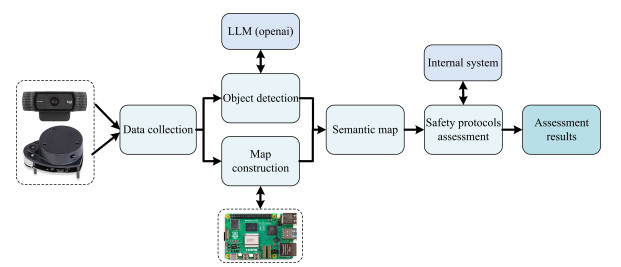
Overall architecture of the proposed robot-based FabLab safety inspection system, integrating data collection, object detection, semantic mapping, rule-based assessment, and compliance reporting
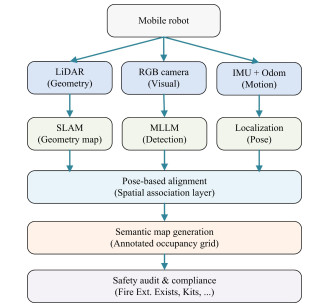
Sensor fusion pipeline of the proposed robotic system, combining LiDAR-based geometric mapping, RGB-based semantic detection, and pose information for safety-oriented semantic map generation
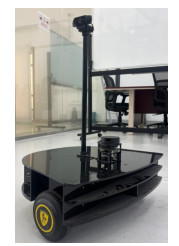
Developed two-wheel-drive mobile robot platform equipped with an RGB camera, LiDAR sensor, wheel encoders, gyroscope, and onboard processing unit for automated FabLab safety inspection
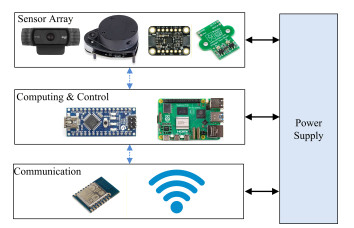
Hardware architecture of the developed robotic system, showing the integration of sensing, computing, control, communication, and power-supply components
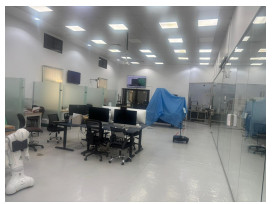
Real-world FabLab experimental testbed used to evaluate the proposed robotic safety inspection system under different compliance scenarios
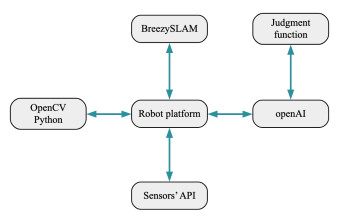
Software implementation of the developed system, illustrating the interaction between the robot platform, sensor APIs, SLAM module, image processing, OpenAI integration, and rule-based judgment function
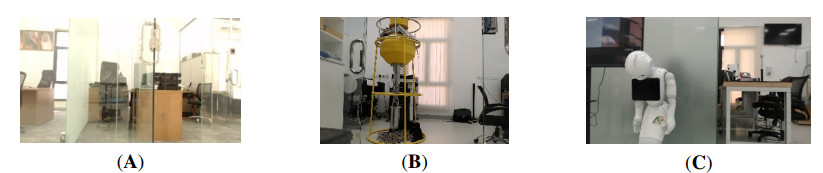
Representative images captured in Scenario 1, showing the FabLab environment with safety equipment intentionally removed to evaluate non-compliance detection
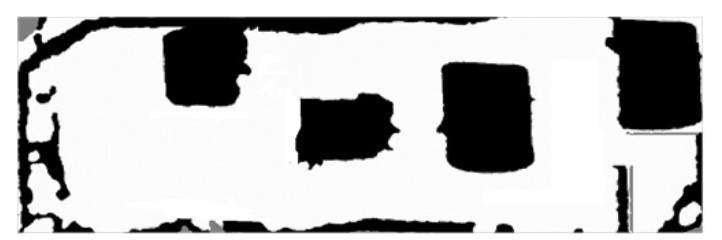
Constructed semantic map for Scenario 1, showing no annotated safety equipment detections due to the intentional absence of safety items
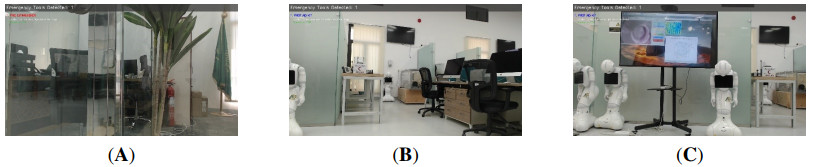
Representative images captured in Scenario 2, showing a partially compliant FabLab environment with limited safety equipment available for detection and assessment
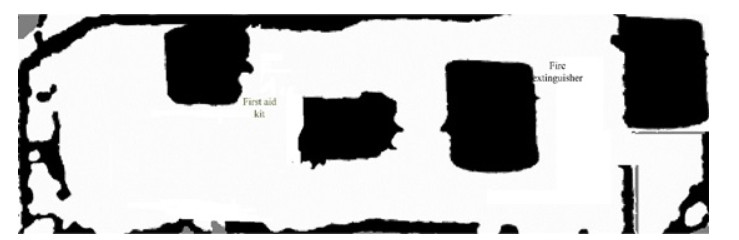
Constructed semantic map for Scenario 2, showing annotated safety equipment detections in the partially compliant FabLab environment
Original images captured from the FabLab environment in Scenario 3, provided as input to the MLLM-based system
Annotated perception outputs generated for Scenario 3, highlighting detected fire extinguishers in red, first-aid kits in blue, and emergency exits in green
Constructed semantic map for Scenario 3, showing annotated safety equipment detections in the fully compliant FabLab environment
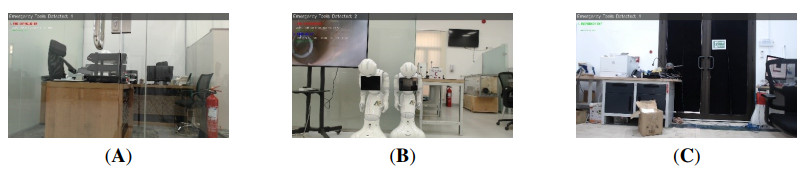
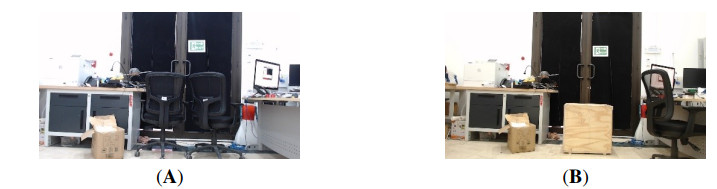
Original images captured in Scenario 4, showing emergency exits intentionally obstructed by chairs and a box to evaluate accessibility assessment capabilities
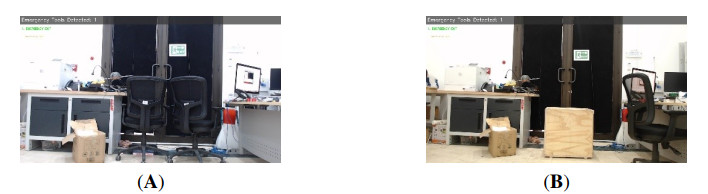
Labeled perception outputs generated for Scenario 4, highlighting detected emergency exits and the visual obstructions affecting their accessibility
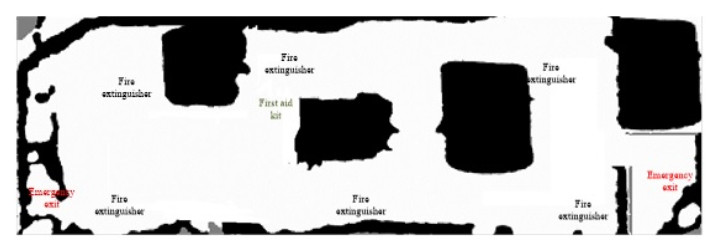
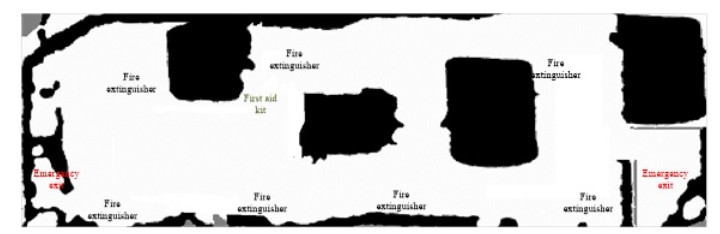
Constructed semantic map for Scenario 4, showing annotated safety equipment and spatial locations in the FabLab environment with obstructed exits
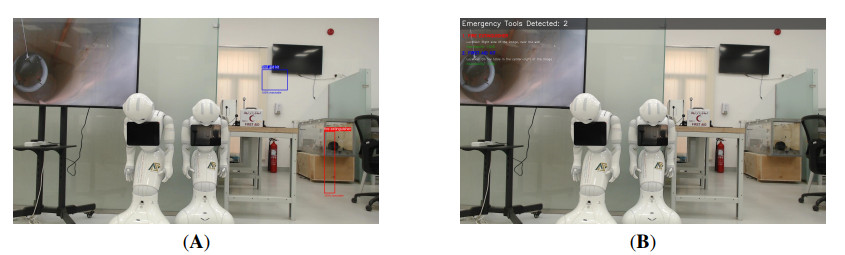
Illustration of the MLLM's role as a semantic classifier rather than a primary localizer: (A) visual localization inaccuracy due to 2D perspective bounding cues; (B) successful semantic identification of emergency equipment despite inaccurate spatial bounding



 DownLoad: