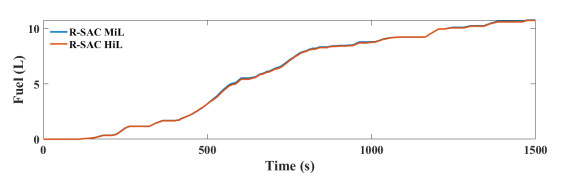
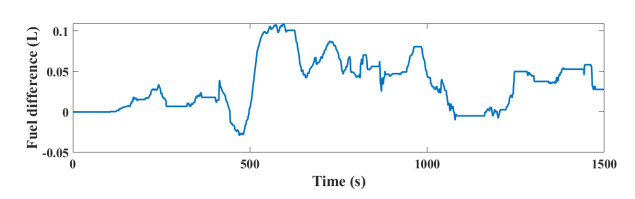
Energy management of multi-mode power-split hybrid mining trucks requires economical power allocation under coupled component constraints. This study developed a refined distributional soft actor-critic (R-SAC)-based energy management strategy that integrates established distributional learning refinements with state-dependent real-time interval mapping. The policy is trained offline, and its normalized outputs are converted into engine operating commands and powertrain-mode decisions subject to modeled component limits. On an unseen evaluation cycle, starting from a common initial state of charge (SOC) of 55.00%, R-SAC consumes 10.766 L of fuel and ends at SOC 49.83%. Actual fuel consumption is reduced by 8.1%, 4.9%, and 4.1% relative to rule-based energy management, equivalent consumption minimization, and PPO-MASK, respectively. Under a common nominal energy-equivalence convention, its equivalent fuel consumption is 11.255 L, the lowest among the four evaluated strategies. Hardware-in-the-loop implementation on an automotive-grade controller yields final absolute differences of 0.01 percentage points in SOC and 0.028 L in fuel consumption relative to offline simulation. These results support the fuel-saving potential of the integrated strategy and the consistency of its embedded implementation under the tested conditions.
Citation: Xinxin Zhao, Xingrui Wen, Menglei Liu, Jingliang Duan, Lifang Zheng, Nasser Lashgarian Azad. Refined distributional soft actor-critic approach for optimal energy management in hybrid mining trucks[J]. Journal of Industrial and Management Optimization, 2026, 22(12): 6709-6738. doi: 10.3934/jimo.2026224
Energy management of multi-mode power-split hybrid mining trucks requires economical power allocation under coupled component constraints. This study developed a refined distributional soft actor-critic (R-SAC)-based energy management strategy that integrates established distributional learning refinements with state-dependent real-time interval mapping. The policy is trained offline, and its normalized outputs are converted into engine operating commands and powertrain-mode decisions subject to modeled component limits. On an unseen evaluation cycle, starting from a common initial state of charge (SOC) of 55.00%, R-SAC consumes 10.766 L of fuel and ends at SOC 49.83%. Actual fuel consumption is reduced by 8.1%, 4.9%, and 4.1% relative to rule-based energy management, equivalent consumption minimization, and PPO-MASK, respectively. Under a common nominal energy-equivalence convention, its equivalent fuel consumption is 11.255 L, the lowest among the four evaluated strategies. Hardware-in-the-loop implementation on an automotive-grade controller yields final absolute differences of 0.01 percentage points in SOC and 0.028 L in fuel consumption relative to offline simulation. These results support the fuel-saving potential of the integrated strategy and the consistency of its embedded implementation under the tested conditions.

| [1] |
Y. Li, H. He, A. Khajepour, Y. Chen, W. Huo, H. Wang, Deep reinforcement learning for intelligent energy management systems of hybrid-electric powertrains: Recent advances, Open Issues, and Prospects, IEEE Trans. Transp. Electrific., 10 (2024), 9877–9903. https://doi.org/10.1109/TTE.2024.3377809 doi: 10.1109/TTE.2024.3377809
|
| [2] |
X. Tang, J. Chen, Y. Qin, T. Liu, K. Yang, A. Khajepour, et al., Reinforcement learning-based energy management for hybrid power systems: State-of-the-art survey, review, and perspectives, Chin. J. Mech. Eng., 37 (2024), 43. https://doi.org/10.1186/s10033-024-01026-4 doi: 10.1186/s10033-024-01026-4
|
| [3] |
A. S. Mohammed, S. M. Atnaw, A. O. Salau, J. N. Eneh, Review of optimal sizing and power management strategies for fuel cell/battery/super capacitor hybrid electric vehicles, Energy Rep., 9 (2023), 2213–2228. https://doi.org/10.1016/j.egyr.2023.01.042 doi: 10.1016/j.egyr.2023.01.042
|
| [4] |
D. Shi, S. Wang, Y. Cai, L. Chen, Stochastic predictive energy management of power split hybrid electric bus for real-world driving cycles, IEEE Access, 6 (2018), 61700–61713. https://doi.org/10.1109/ACCESS.2018.2876147 doi: 10.1109/ACCESS.2018.2876147
|
| [5] |
B. HomChaudhuri, R. Lin, P. Pisu, Hierarchical control strategies for energy management of connected hybrid electric vehicles in Urban roads, Transp. Res. Part C Emerg. Technol., 62 (2016), 70–86. https://doi.org/10.1016/j.trc.2015.11.013 doi: 10.1016/j.trc.2015.11.013
|
| [6] |
M. A. Hannan, F. Azidin, A. Mohamed, Hybrid electric vehicles and their challenges: A review, Renew. Sustain. Energy Rev., 29 (2014), 135–150. https://doi.org/10.1016/j.rser.2013.08.097 doi: 10.1016/j.rser.2013.08.097
|
| [7] |
J. Peng, H. He, R. Xiong, Rule based energy management strategy for a series–parallel plug-in hybrid electric bus optimized by dynamic programming, Appl. Energy, 185 (2017), 1633–1643. https://doi.org/10.1016/j.apenergy.2015.12.031 doi: 10.1016/j.apenergy.2015.12.031
|
| [8] |
S. Zhang, X. Hu, S. Xie, Z. Song, L. Hu, C. Hou, Adaptively coordinated optimization of battery aging and energy management in plug-in hybrid electric buses, Appl. Energy, 256 (2019), 113891. https://doi.org/10.1016/j.apenergy.2019.113891 doi: 10.1016/j.apenergy.2019.113891
|
| [9] |
H. Li, A. Ravey, A. N'Diaye, A. Djerdir, Online adaptive equivalent consumption minimization strategy for fuel cell hybrid electric vehicle considering power sources degradation, Energy Convers. Manage., 192 (2019), 133–149. https://doi.org/10.1016/j.enconman.2019.03.090 doi: 10.1016/j.enconman.2019.03.090
|
| [10] |
F. Zhang, X. Hu, R. Langari, D. Cao, Energy management strategies of connected HEVs and PHEVs: Recent progress and outlook, Prog. Energy Combust. Sci., 73 (2019), 235–256. https://doi.org/10.1016/j.pecs.2019.04.002 doi: 10.1016/j.pecs.2019.04.002
|
| [11] |
C. M. Martinez, X. Hu, D. Cao, E. Velenis, B. Gao, M. Wellers, Energy management in plug-in hybrid electric vehicles: Recent progress and a connected vehicles perspective, IEEE Trans. Veh. Technol., 66 (2017), 4534–4549. https://doi.org/10.1109/TVT.2016.2582721 doi: 10.1109/TVT.2016.2582721
|
| [12] |
R. C. Hsu, C. Liu, D. Chan, A reinforcement-learning-based assisted power management with QoR provisioning for human–electric hybrid bicycle, IEEE Trans. Ind. Electron., 59 (2011), 3350–3359. https://doi.org/10.1109/TIE.2011.2141092 doi: 10.1109/TIE.2011.2141092
|
| [13] |
V. Mnih, K. Kavukcuoglu, D. Silver, Human-level control through deep reinforcement learning, Nature, 518 (2015), 529–533. https://doi.org/10.1038/nature14236 doi: 10.1038/nature14236
|
| [14] |
J. Hwangbo, J. Lee, A. Dosovitskiy, Learning agile and dynamic motor skills for legged robots, Sci. Robot., 4 (2019), 5872. https://doi.org/10.1126/scirobotics.aau5872 doi: 10.1126/scirobotics.aau5872
|
| [15] |
Y. Li, H. He, Deep reinforcement learning-based energy management for hybrid electric vehicles, morgan & claypool publishers, 2022. https://doi.org/10.1007/978-3-031-79206-9 |
| [16] |
A. Perera, P. Kamalaruban, Applications of reinforcement learning in energy systems, Renew. Sustain. Energy Rev., 137 (2021), 110618. https://doi.org/10.1016/j.rser.2020.110618 doi: 10.1016/j.rser.2020.110618
|
| [17] |
B. Xu, F. Malmir, Z. Filipi, Real-time reinforcement learning optimized energy management for a 48V mild hybrid electric vehicle, 2019. https://doi.org/10.4271/2019-01-1208 |
| [18] |
T. Liu, Y. Zou, D. Liu, F. Sun, Reinforcement learning of adaptive energy management with transition probability for a hybrid electric tracked vehicle, IEEE Trans. Ind. Electron., 62 (2015), 7837–7846. https://doi.org/10.1109/TIE.2015.2475419 doi: 10.1109/TIE.2015.2475419
|
| [19] |
Y. Zou, T. Liu, D. Liu, F. Sun, Reinforcement learning-based real-time energy management for a hybrid tracked vehicle, Appl. Energy, 171 (2016), 372–382. https://doi.org/10.1016/j.apenergy.2016.03.082 doi: 10.1016/j.apenergy.2016.03.082
|
| [20] |
J. Wu, H. He, J. Peng, Y. Li, Z. Li, Continuous reinforcement learning of energy management with deep q network for a power split hybrid electric bus, Appl. Energy, 222 (2018), 799–811. https://doi.org/10.1016/j.apenergy.2018.03.104 doi: 10.1016/j.apenergy.2018.03.104
|
| [21] |
Y. Li, H. He, A. Khajepour, H. Wang, J. Peng, Energy management for a power-split hybrid electric bus via deep reinforcement learning with terrain information, Appl. Energy, 255 (2019), 113762. https://doi.org/10.1016/j.apenergy.2019.113762 doi: 10.1016/j.apenergy.2019.113762
|
| [22] |
C. Qi, C. Song, F. Xiao, S. Song, Generalization ability of hybrid electric vehicle energy management strategy based on reinforcement learning method, Energy, 250 (2022), 123826. https://doi.org/10.1016/j.energy.2022.123826 doi: 10.1016/j.energy.2022.123826
|
| [23] |
C. Qi, Y. Zhu, C. Song, Hierarchical reinforcement learning based energy management strategy for hybrid electric vehicle, Energy, 238 (2022), 121703. https://doi.org/10.1016/j.energy.2021.121703 doi: 10.1016/j.energy.2021.121703
|
| [24] |
A. Biswas, P. G. Anselma, A. Emadi, Real-time optimal energy management of multimode hybrid Eelectric powertrain with online trainable asynchronous advantage actor–critic algorithm, IEEE Trans. Transp. Electrific., 8 (2022), 2676–2694. https://doi.org/10.1109/TTE.2021.3138330 doi: 10.1109/TTE.2021.3138330
|
| [25] |
J. Xu, Z. Li, G. Du, Q. Liu, L. Gao, Y. Zhao, A transferable energy management strategy for hybrid electric vehicles via dueling deep deterministic policy gradient, Green Energy Intell. Transp., 1 (2022), 100018. https://doi.org/10.1016/j.geits.2022.100018 doi: 10.1016/j.geits.2022.100018
|
| [26] |
J. Hong, T. Zhang, Z. Zhang, H. Zhang, Investigation of energy management strategy for a novel electric-hydraulic hybrid vehicle: Self-adaptive electric-hydraulic ratio, Energy, 278 (2023), 127582. https://doi.org/10.1016/j.energy.2023.127582 doi: 10.1016/j.energy.2023.127582
|
| [27] |
K. Wang, R. Yang, Y. Zhou, W. Huang, S. Zhang, Design and improvement of SD3-based energy management strategy for a hybrid electric urban bus, Energies, 15 (2022), 5878. https://doi.org/10.3390/en15165878 doi: 10.3390/en15165878
|
| [28] |
X. Tang, J. Zhang, D. Pi, X. Lin, L. M. Grzesiak, X. Hu, Battery health-aware and deep reinforcement learning-based energy management for naturalistic data-driven driving scenarios, IEEE Trans. Transp. Electrific., 8 (2022), 948–964. https://doi.org/10.1109/TTE.2021.3107143 doi: 10.1109/TTE.2021.3107143
|
| [29] |
Z. Pan, D. Lei, L. Wang, A knowledge-based two-population optimization algorithm for distributed energy-efficient parallel machines scheduling, IEEE Trans. Cybern., 52 (2022), 5051–5063. https://doi.org/10.1109/TCYB.2020.3026571 doi: 10.1109/TCYB.2020.3026571
|
| [30] |
H. Wang, B. R. Sarker, J. Li, J. Li, Adaptive scheduling for assembly job shop with uncertain assembly times based on dual Q-learning, Int. J. Prod. Res., 59 (2021), 5867–5883. https://doi.org/10.1080/00207543.2020.1794075 doi: 10.1080/00207543.2020.1794075
|
| [31] |
F. Zhao, J. Zhou, L. Wang, H. Sang, A hierarchical optimization algorithm with dual-cache synced tuning mechanism for distributed flexible job shop scheduling problem, IEEE Trans. Cybern., 56 (2026), 5477–5490. https://doi.org/10.1109/TCYB.2025.3644904 doi: 10.1109/TCYB.2025.3644904
|
| [32] |
Q. Zhou, J. Li, B. Shuai, Multi-step reinforcement learning for model-free predictive energy management of an electrified off-highway vehicle, Appl. Energy, 255 (2019), 113755. https://doi.org/10.1016/j.apenergy.2019.113755 doi: 10.1016/j.apenergy.2019.113755
|
| [33] |
X. Ma, H. Liu, L. Han, N. Yang, Q. Fan, C. Xiang, Intelligent energy management for hybrid electric vehicles based on data-driven real-time dynamic programming, Energy, 354 (2026), 140973. https://doi.org/10.1016/j.energy.2026.140973 doi: 10.1016/j.energy.2026.140973
|
| [34] |
F. Li, M. Li, Y. Wu, H. Li, Y. Song, Z. Huang, Safe reinforcement learning energy management for hybrid electric vehicles: A supervisory action assessment and correction approach, J. Clean. Prod., 544 (2026), 147720. https://doi.org/10.1016/j.jclepro.2026.147720 doi: 10.1016/j.jclepro.2026.147720
|
| [35] |
Z. E. Liu, Q. Zhou, Y. Li, S. Shuai, H. Xu, Safe deep reinforcement learning-based constrained optimal control scheme for HEV energy management, IEEE Trans. Transp. Electrific., 9 (2023), 4278–4293. https://doi.org/10.1109/TTE.2023.3240430 doi: 10.1109/TTE.2023.3240430
|
| [36] |
C. Li, B. Zhang, G. Chen, J. Huang, Z. Dong, Large language model-assisted autonomous bidding for battery energy storage systems: An agentic approach for smart power industrial decision-making, IEEE Trans. Autom. Sci. Eng., 2026. https://doi.org/10.1109/TASE.2026.3740512 doi: 10.1109/TASE.2026.3740512
|
| [37] |
J. Duan, W. Wang, L. Xiao, J. Gao, S. E. Li, C. Liu, et al., Distributional soft actor-critic with three refinements, IEEE Trans. Pattern Anal. Mach. Intell., 47 (2025), 3935–3946. https://doi.org/10.1109/TPAMI.2025.3537087 doi: 10.1109/TPAMI.2025.3537087
|
| [38] |
T. Haarnoja, A. Zhou, P. Abbeel, S. Levine, Soft actor-critic: Off-policy maximum entropy deep reinforcement learning with a stochastic actor, Proc. Mach. Learn. Res., 80 (2018), 1861–1870. https://proceedings.mlr.press/v80/haarnoja18b.html |
| [39] |
H. Markgraf, S. Sawant, H. Krasowski, L. Schäfer, S. Gros, M. Althoff, Safe reinforcement learning using action projection: Safeguard the policy or the environment? Trans. Mach. Learn. Res., 2026. https://openreview.net/forum?id = DDrGSEYxGU |
| [40] |
J. Wen, S. Kumar, R. Gummadi, D. Schuurmans, Characterizing the gap between actor-critic and policy gradient, Proc. Mach. Learn. Res., 139 (2021), 11101–11111. https://proceedings.mlr.press/v139/wen21b.html |
| [41] |
R. Sauermann, F. Kirschbaum, O. Nelles, Optimization of fuel consumption for rule-based energy management strategies of hybrid electric vehicles: SOC compensation methods, IEEE Access, 12 (2024), 112594–112604. https://doi.org/10.1109/ACCESS.2024.3443190 doi: 10.1109/ACCESS.2024.3443190
|
| [42] |
A. Garg, K. Kazunari, T. Pulles, Energy, 2006 IPCC Guidelines for National Greenhouse Gas Inventories, 2006. Available from: https://www.ipcc-nggip.iges.or.jp/public/2006gl/pdf/2_Volume2/V2_1_Ch1_Introduction.pdf. |
 jimo-22-12-224-s001.pdf |
 |



Figures(18) / Tables(6)
Xinxin Zhao, Xingrui Wen, Menglei Liu, Jingliang Duan, Lifang Zheng, Nasser Lashgarian Azad. Refined distributional soft actor-critic approach for optimal energy management in hybrid mining trucks[J]. Journal of Industrial and Management Optimization, 2026, 22(12): 6709-6738. doi: 10.3934/jimo.2026224

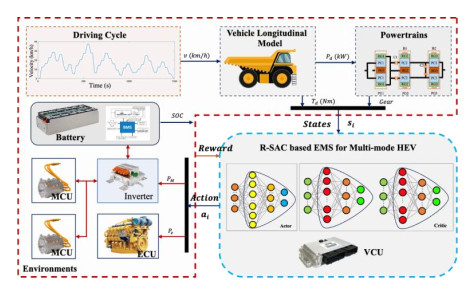
Architecture of the investigated system
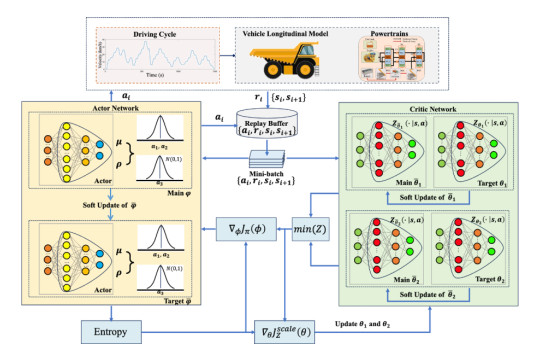
Schematic framework of the offline training of the R-SAC-based EMS
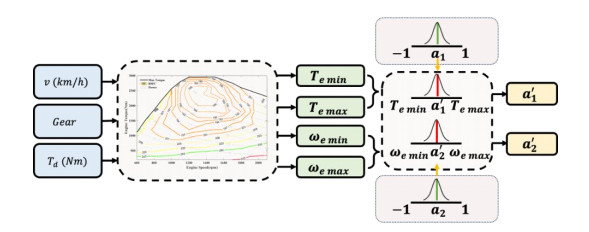
Architecture diagram of the real-time specific interval mapping algorithm
Schematic of the proposed R-SAC-based EMS framework
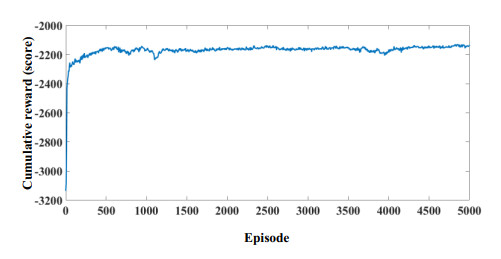
Accumulated training reward of R-SAC
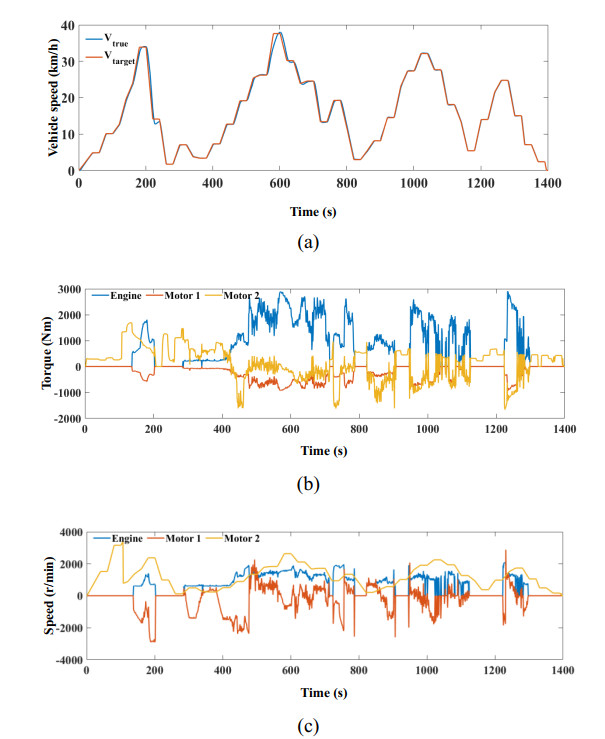
Results of R-SAC under driving Cycle 1. (a) Vehicle speed. (b) Torque of power devices. (c) Speed of power devices
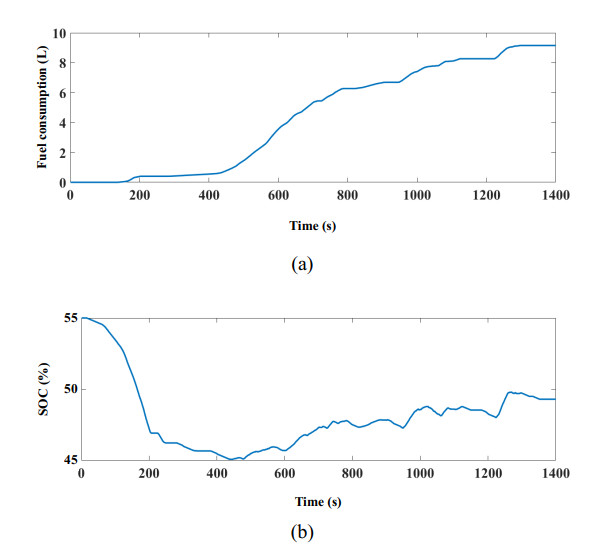
Fuel consumption and SOC under R-SAC for Cycle 1. (a) Cumulative fuel consumption. (b) SOC (%)
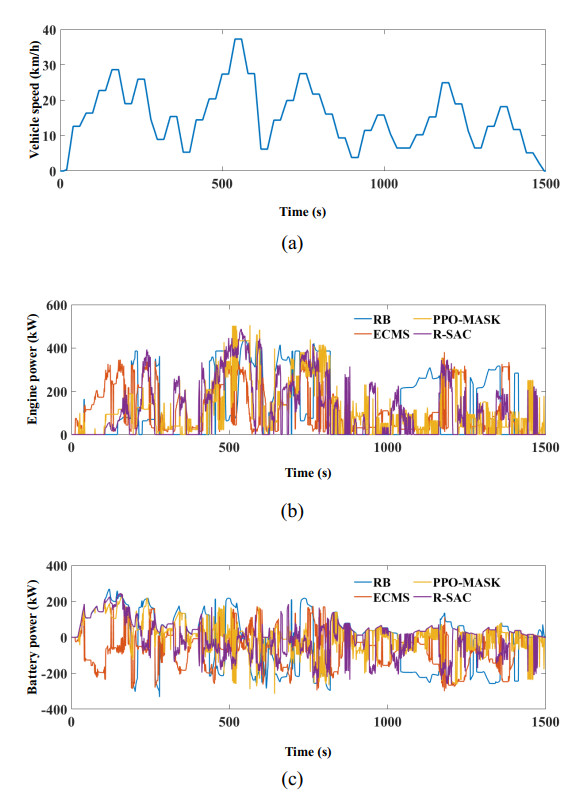
Energy allocation comparison of four algorithms under driving Cycle 2. (a) Vehicle speed. (b) Power of engine. (c) Power of battery
Mode transition process comparison among four algorithms under driving Cycle 2
Engine operating points on the brake-specific fuel consumption map for the four strategies under Cycle 2
Distribution of engine operating points by brake-specific fuel consumption under Cycle 2
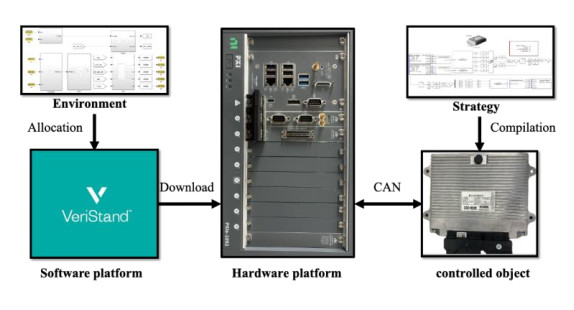
Overall architecture of the hardware-in-the-loop real-time simulation platform
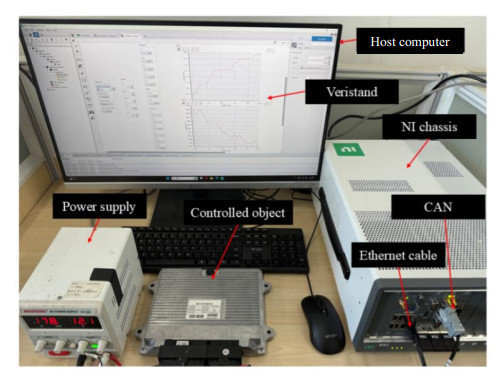
Hardware-in-the-loop test bench for the R-SAC energy management strategy
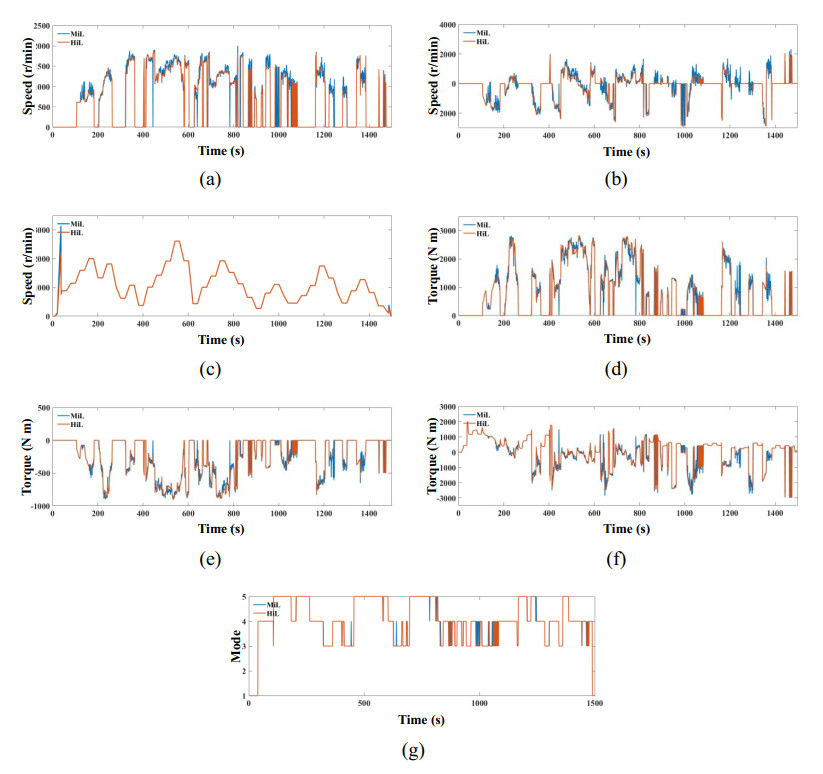
Comparison curves of mode switching and power operation states under offline simulation and hardware-in-the-loop testing. (a) Engine speed. (b) Motor 1 speed. (c) Motor 2 speed. (d) Engine torque. (e) Motor 1 torque. (f) Motor 2 torque. (g) Mode
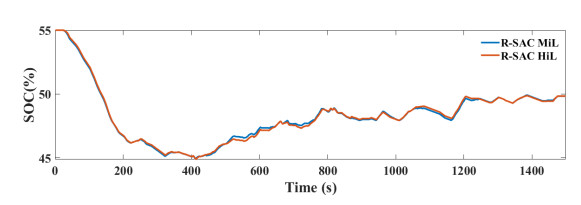
SOC (%) under offline simulation and HIL testing
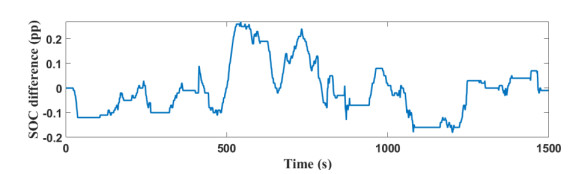
Signed SOC difference between offline simulation and HIL testing
Fuel consumption under offline (MiL) and HIL (HiL) execution of the R-SAC policy
Signed cumulative-fuel difference between offline simulation and HIL testing (L)



 DownLoad: