We study time-consistent investment for a protected defined contribution pension plan with random relative risk aversion in a correlated Heston–Cox–Ingersoll–Ross (CIR) market. The framework combines stochastic contributions, inflation, an inflation-linked life annuity guarantee, Heston variance, and a CIR short rate. Under an imposed common $ \sqrt{V_t} $ local spanning structure for the inflation and contribution loadings, the contribution and guarantee claims are replicated with a stock, a nominal bond, and an indexed bond before the pension account is reduced to real auxiliary wealth. This replication and the reduction in protected wealth are conditional on that structure, while the variance component driven by $ W_3 $ remains unspanned. A monetary certainty-equivalent criterion and spike deviation analysis conditionally verify an equilibrium continuation system and its feedback strategy. For a general risk aversion distribution, the aggregate feedback satisfies a fixed-point condition rather than an existence result; local classical existence is established only for the finite two-point system on a stopped positive state rectangle. For a degenerate risk aversion distribution, variance–rate correlation generates a $ \sqrt{vr} $ term that precludes the standard affine Riccati ansatz under the stated nondegeneracy conditions. The numerical parameter studies use specified model inputs rather than a data calibration. They show that the preference dispersion changes effective risk aversion and portfolio exposures, while variance–rate dependence changes nominal bond hedging. The resulting strategy supplies stock, nominal bond, indexed bond, and cash allocations for the protected pension account.
Citation: Yang Jiang, Yong He, Yulei Chen. Random-risk-aversion pension investment under correlated Heston–CIR dynamics[J]. Journal of Industrial and Management Optimization, 2026, 22(12): 6668-6708. doi: 10.3934/jimo.2026223
We study time-consistent investment for a protected defined contribution pension plan with random relative risk aversion in a correlated Heston–Cox–Ingersoll–Ross (CIR) market. The framework combines stochastic contributions, inflation, an inflation-linked life annuity guarantee, Heston variance, and a CIR short rate. Under an imposed common $ \sqrt{V_t} $ local spanning structure for the inflation and contribution loadings, the contribution and guarantee claims are replicated with a stock, a nominal bond, and an indexed bond before the pension account is reduced to real auxiliary wealth. This replication and the reduction in protected wealth are conditional on that structure, while the variance component driven by $ W_3 $ remains unspanned. A monetary certainty-equivalent criterion and spike deviation analysis conditionally verify an equilibrium continuation system and its feedback strategy. For a general risk aversion distribution, the aggregate feedback satisfies a fixed-point condition rather than an existence result; local classical existence is established only for the finite two-point system on a stopped positive state rectangle. For a degenerate risk aversion distribution, variance–rate correlation generates a $ \sqrt{vr} $ term that precludes the standard affine Riccati ansatz under the stated nondegeneracy conditions. The numerical parameter studies use specified model inputs rather than a data calibration. They show that the preference dispersion changes effective risk aversion and portfolio exposures, while variance–rate dependence changes nominal bond hedging. The resulting strategy supplies stock, nominal bond, indexed bond, and cash allocations for the protected pension account.

| [1] |
K. Marx, Capital: A Critique of Political Economy, London: Princeton University Press, 1976. |
| [2] |
I. Gough, The Political Economy of the Welfare State, 1 Eds., London: Red Globe Press, 1979. https://doi.org/10.1007/978-1-349-16122-5}}{{https://doi.org/10.1007/978-1-349-16122-5 |
| [3] |
I. Bakker, Social reproduction and the constitution of a gendered political economy, New Polit. Econ., 12 (2007), 541–556. https://doi.org/10.1080/13563460701661561 doi: 10.1080/13563460701661561
|
| [4] |
K. Marx, Critique of the Gotha Programme, London: Lawrence & Wishart Progress Publishersin, 1989. |
| [5] |
J. F. Boulier, S. Huang, G. Taillard, Optimal management under stochastic interest rates: The case of a protected defined contribution pension fund, Insur. Math. Econ., 28 (2001), 173–189. https://doi.org/10.1016/S0167-6687(00)00073-1 doi: 10.1016/S0167-6687(00)00073-1
|
| [6] |
G. Deelstra, M. Grasselli, P. F. Koehl, Optimal investment strategies in the presence of a minimum guarantee, Insur. Math. Econ., 33 (2003), 189–207. https://doi.org/10.1016/S0167-6687(03)00153-7 doi: 10.1016/S0167-6687(03)00153-7
|
| [7] |
N. Han, M. Hung, Optimal asset allocation for DC pension plans under inflation, Insur. Math. Econ., 51 (2012), 172–181. https://doi.org/10.1016/j.insmatheco.2012.03.003 doi: 10.1016/j.insmatheco.2012.03.003
|
| [8] |
P. Boyle, M. Hardy, Guaranteed annuity options, ASTIN Bull., 33 (2003), 125–152. https://doi.org/10.2143/AST.33.2.503687 doi: 10.2143/AST.33.2.503687
|
| [9] |
A. J. G. Cairns, D. Blake, K. Dowd, Stochastic lifestyling: Optimal dynamic asset allocation for defined contribution pension plans, J. Econ. Dyn. Control, 30 (2006), 843–877. https://doi.org/10.1016/j.jedc.2005.03.009 doi: 10.1016/j.jedc.2005.03.009
|
| [10] |
B. Fine, Financialization from a Marxist perspective, Int. J. Polit. Econ., 42 (2013), 47–66. https://doi.org/10.2753/IJP0891-1916420403 doi: 10.2753/IJP0891-1916420403
|
| [11] |
C. Lapavitsas, Financialised capitalism: Crisis and financial expropriation, Hist. Mater., 17 (2009), 114–148. https://doi.org/10.1163/156920609X436153 doi: 10.1163/156920609X436153
|
| [12] |
P. Langley, In the eye of the perfect storm: The final salary pensions crisis and financialisation of Anglo-American capitalism, New Polit. Econ., 9 (2004), 539–558. https://doi.org/10.1080/1356346042000311164 doi: 10.1080/1356346042000311164
|
| [13] |
H. Zhu, A. Walker, Pension system reform in China: Who gets what pensions, Soc. Policy Adm., 52 (2018), 1410–1424. https://doi.org/10.1111/spol.12368 doi: 10.1111/spol.12368
|
| [14] |
S. L. Heston, A closed-form solution for options with stochastic volatility with applications to bond and currency options, Rev. Financ. Stud., 6 (1993), 327–343. https://doi.org/10.1093/rfs/6.2.327 doi: 10.1093/rfs/6.2.327
|
| [15] |
J. C. Cox, J. E. Ingersoll, S. A. Ross, A theory of the term structure of interest rates, Econometrica, 53 (1985), 385–407. https://doi.org/10.2307/1911242 doi: 10.2307/1911242
|
| [16] |
J. Sun, Z. Li, Y. Li, Equilibrium investment strategy for DC pension plan with inflation and stochastic income under Heston's SV model, Math. Probl. Eng., 2016 (2016), 2391849. https://doi.org/10.1155/2016/2391849 doi: 10.1155/2016/2391849
|
| [17] |
G. H. Guan, Z. X. Liang, Optimal management of DC pension plan in a stochastic interest rate and stochastic volatility framework, Insur. Math. Econ., 57 (2014), 58–66. https://doi.org/10.1016/j.insmatheco.2014.05.004 doi: 10.1016/j.insmatheco.2014.05.004
|
| [18] |
L. Zhang, D. Li, Y. Lai, Equilibrium investment strategy for a defined contribution pension plan under stochastic interest rate and stochastic volatility, J. Comput. Appl. Math., 368 (2020), 112536. https://doi.org/10.1016/j.cam.2019.112536 doi: 10.1016/j.cam.2019.112536
|
| [19] |
P. Wang, Z. Li, Robust optimal investment strategy for an AAM of DC pension plans with stochastic interest rate and stochastic volatility, Insur. Math. Econ., 80 (2018), 67–83. https://doi.org/10.1016/j.insmatheco.2018.03.003 doi: 10.1016/j.insmatheco.2018.03.003
|
| [20] |
L. A. Grzelak, C. W. Oosterlee, On the Heston model with stochastic interest rates, SIAM J. Financ. Math., 2 (2011), 255–286. https://doi.org/10.1137/090756119 doi: 10.1137/090756119
|
| [21] |
G. Ascione, F. Mehrdoust, G. Orlando, O. Samimi, Foreign exchange options on Heston-CIR model under Lévy process framework, Appl. Math. Comput., 446 (2023), 127851. https://doi.org/10.1016/j.amc.2023.127851 doi: 10.1016/j.amc.2023.127851
|
| [22] |
L. V. Ballestra, E. D'Innocenzo, A. Guizzardi, A new bivariate approach for modeling the interaction between stock volatility and interest rate: An application to S & P500 returns and options, Eur. J. Oper. Res., 314 (2024), 1185–1194. https://doi.org/10.1016/j.ejor.2023.11.049 doi: 10.1016/j.ejor.2023.11.049
|
| [23] |
G. A. G. Alserda, B. G. C. Dellaert, L. Swinkels, F. S. G. van der Lecq, Individual pension risk preference elicitation and collective asset allocation with heterogeneity, J. Bank. Finance, 101 (2019), 206–225. https://doi.org/10.1016/j.jbankfin.2019.02.014 doi: 10.1016/j.jbankfin.2019.02.014
|
| [24] |
T. Bollerslev, M. Gibson, H. Zhou, Dynamic estimation of volatility risk premia and investor risk aversion from option-implied and realized volatilities, J. Econom., 160 (2011), 235–245. https://doi.org/10.1016/j.jeconom.2010.03.033 doi: 10.1016/j.jeconom.2010.03.033
|
| [25] |
J. Burgaard, M. Steffensen, Eliciting risk preferences and elasticity of substitution, Decis. Anal., 17 (2020), 314–329. https://doi.org/10.1287/deca.2020.0415 doi: 10.1287/deca.2020.0415
|
| [26] |
S. Desmettre, M. Steffensen, Equilibrium investment with random risk aversion, Math. Finance, 33 (2023), 946–975. https://doi.org/10.1111/mafi.12394 doi: 10.1111/mafi.12394
|
| [27] |
T. Björk, A. Murgoci, A theory of Markovian time-inconsistent stochastic control in discrete time, Finance Stoch., 18 (2014), 545–592. https://doi.org/10.1007/s00780-014-0234-y doi: 10.1007/s00780-014-0234-y
|
| [28] |
T. Björk, M. Khapko, A. Murgoci, On time-inconsistent stochastic control in continuous time, Finance Stoch., 21 (2017), 331–360. https://doi.org/10.1007/s00780-017-0327-5 doi: 10.1007/s00780-017-0327-5
|
| [29] |
L. Wang, B. W. Jia, Equilibrium investment strategies for a defined contribution pension plan with random risk aversion, Insur. Math. Econ., 125 (2025), 103140. https://doi.org/10.1016/j.insmatheco.2025.103140 doi: 10.1016/j.insmatheco.2025.103140
|
| [30] |
A. Friedman, Partial Differential Equations of Parabolic Type, New Jersey: Prentice–Hall, 1964. |
Figures(7) / Tables(17)
Yang Jiang, Yong He, Yulei Chen. Random-risk-aversion pension investment under correlated Heston–CIR dynamics[J]. Journal of Industrial and Management Optimization, 2026, 22(12): 6668-6708. doi: 10.3934/jimo.2026223

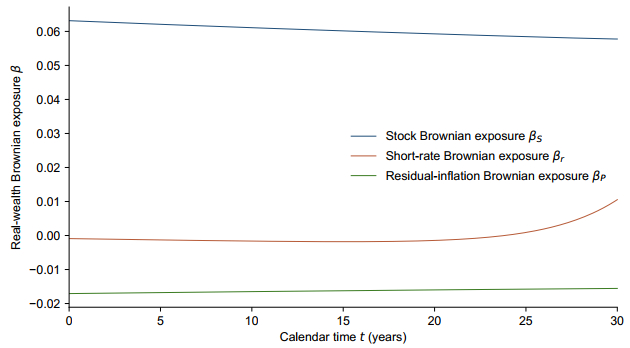
Equilibrium real wealth Brownian exposures for $ p_1 = p_2 = 0.5 $, evaluated at $ V = 0.04 $ and $ r = 0.025 $
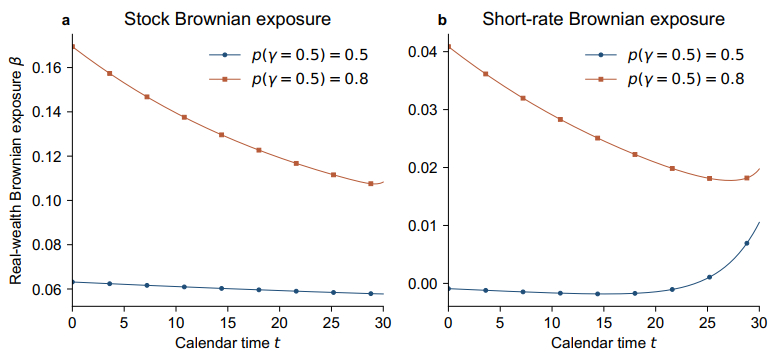
Brownian exposures under alternative risk aversion distributions
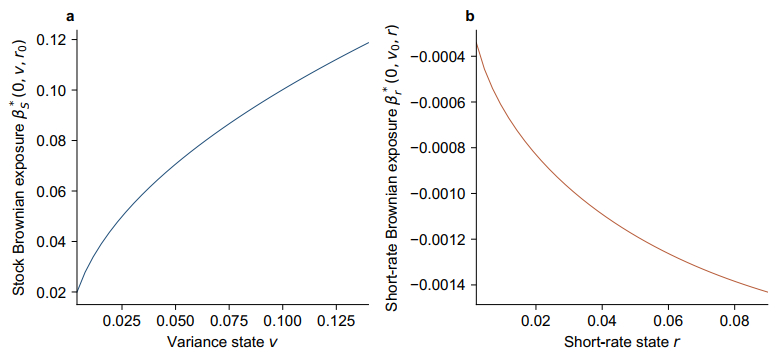
Initial state dependence of stock and short rate Brownian exposures in the balanced case.
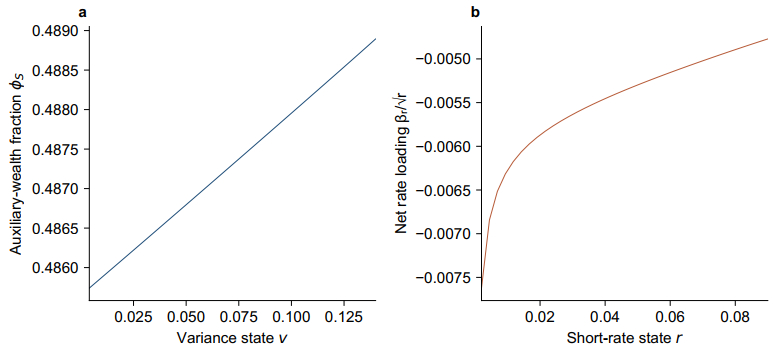
State-normalized portfolio positions
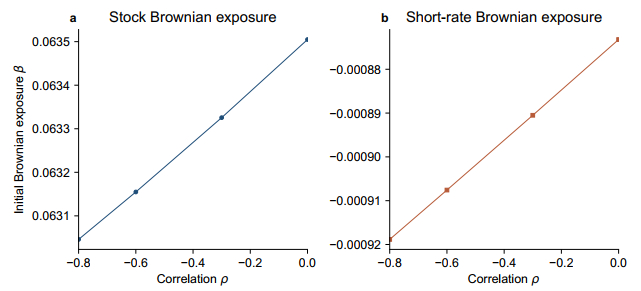
Initial Brownian exposures as functions of return–variance correlation
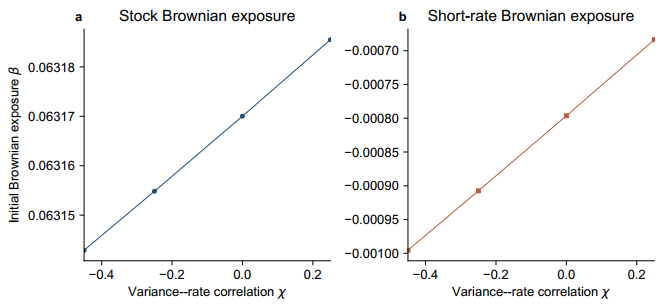
Initial Brownian exposures as functions of the variance–rate correlation
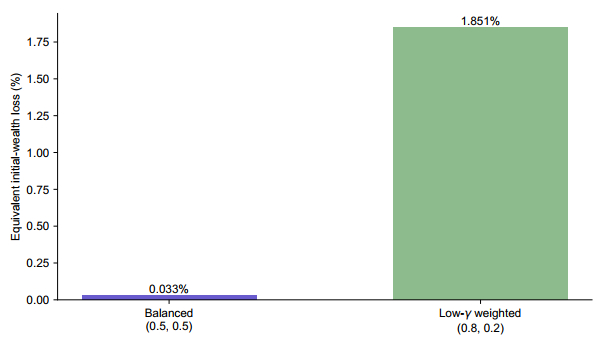
Equivalent initial wealth loss under the mean risk aversion policy



 DownLoad: