We study a time-consistent reinsurance–investment game between two competing mean–variance insurers under a finite-dimensional approximation of rough Heston volatility. Each insurer controls proportional risk retention and stock investment and evaluates normalized memory-adjusted wealth relative to its competitor. A compatibility condition reduces a restricted class of distributed and point-delay models to a finite-dimensional state with an effective accumulation rate. For the $ n $-factor Markov game, we formulate the joint feedback state, derive the extended HJB system, and prove a verification theorem under explicit fourth-moment and uniform-integrability conditions. The coupled affine best-response equations yield closed-form interior strategies and projected retention controls. Within the affine interior best-response system, we establish uniqueness of the coefficient solution. Reinsurance and investment have different strategic multipliers, $ 1/(1-\kappa_1\kappa_2\rho_{12}^2) $ and $ 1/(1-\kappa_1\kappa_2) $, respectively. A matrix-exponential solution retains the aggregate-variance drift coupling and the stock–variance hedging feedback, while common-driver cross-factor covariations enter the generator separately. Under the stated state, terminal-wealth, and local-deviation-gain convergence conditions, a conditional compact-action criterion transfers local-equilibrium inequalities to the original rough game. Numerical experiments compare the rough specification with standard Heston, literal no delay, and a matched-effective-rate benchmark, together with full-interval and truncated-interval kernel-approximation error assessments.
Citation: Yong He, Ga Ba. Time-consistent reinsurance-investment game with delay under a multifactor approximation of rough Heston volatility[J]. Journal of Industrial and Management Optimization, 2026, 22(12): 6442-6474. doi: 10.3934/jimo.2026216
We study a time-consistent reinsurance–investment game between two competing mean–variance insurers under a finite-dimensional approximation of rough Heston volatility. Each insurer controls proportional risk retention and stock investment and evaluates normalized memory-adjusted wealth relative to its competitor. A compatibility condition reduces a restricted class of distributed and point-delay models to a finite-dimensional state with an effective accumulation rate. For the $ n $-factor Markov game, we formulate the joint feedback state, derive the extended HJB system, and prove a verification theorem under explicit fourth-moment and uniform-integrability conditions. The coupled affine best-response equations yield closed-form interior strategies and projected retention controls. Within the affine interior best-response system, we establish uniqueness of the coefficient solution. Reinsurance and investment have different strategic multipliers, $ 1/(1-\kappa_1\kappa_2\rho_{12}^2) $ and $ 1/(1-\kappa_1\kappa_2) $, respectively. A matrix-exponential solution retains the aggregate-variance drift coupling and the stock–variance hedging feedback, while common-driver cross-factor covariations enter the generator separately. Under the stated state, terminal-wealth, and local-deviation-gain convergence conditions, a conditional compact-action criterion transfers local-equilibrium inequalities to the original rough game. Numerical experiments compare the rough specification with standard Heston, literal no delay, and a matched-effective-rate benchmark, together with full-interval and truncated-interval kernel-approximation error assessments.

| [1] |
H. Markowitz, Portfolio selection, J. Finance, 7 (1952), 77–91. https://doi.org/10.1111/j.1540-6261.1952.tb01525.x |
| [2] |
D. Li, W. L. Ng, Optimal dynamic portfolio selection: Multiperiod mean-variance formulation, Math. Finance, 10 (2001), 387–406. https://doi.org/10.1111/1467-9965.00100 doi: 10.1111/1467-9965.00100
|
| [3] |
X. Zhou, D. Li, Continuous-time mean-variance portfolio selection: A stochastic LQ framework, Appl. Math. Optim., 42 (2000), 19–33. https://doi.org/10.1007/s002450010003 doi: 10.1007/s002450010003
|
| [4] |
R. C. Merton, Optimum consumption and portfolio rules in a continuous-time model, J. Econ. Theory, 3 (1971), 373–413. https://doi.org/10.1016/0022-0531(71)90038-X doi: 10.1016/0022-0531(71)90038-X
|
| [5] |
T. Björk, M. Khapko, A. Murgoci, On time-inconsistent stochastic control in continuous time, Finance Stoch., 21 (2017), 331–360. https://doi.org/10.1007/s00780-017-0327-5 doi: 10.1007/s00780-017-0327-5
|
| [6] |
T. Björk, A. Murgoci, X. Zhou, Mean-variance portfolio optimization with state-dependent risk aversion, Math. Finance, 24 (2014), 1–24. https://doi.org/10.1111/j.1467-9965.2011.00515.x doi: 10.1111/j.1467-9965.2011.00515.x
|
| [7] |
Y. Zeng, Z. Li, Optimal time-consistent investment and reinsurance policies for mean-variance insurers, Insur. Math. Econom., 49 (2011), 145–154. https://doi.org/10.1016/j.insmatheco.2011.01.001 doi: 10.1016/j.insmatheco.2011.01.001
|
| [8] |
L. Bai, H. Zhang, Dynamic mean-variance problem with constrained risk control for the insurers, Math. Methods Oper. Res., 68 (2008), 181–205. https://doi.org/10.1007/s00186-007-0195-4 doi: 10.1007/s00186-007-0195-4
|
| [9] |
G. Guan, Z. Liang, Optimal reinsurance and investment strategies for insurer under interest rate and inflation risks, Insur. Math. Econom., 55 (2014), 105–115. https://doi.org/10.1016/j.insmatheco.2014.01.007 doi: 10.1016/j.insmatheco.2014.01.007
|
| [10] |
A. Bensoussan, C. C. Siu, S. C. P. Yam, H. Yang, A class of non-zero-sum stochastic differential investment and reinsurance games, Automatica, 50 (2014), 2025–2037. https://doi.org/10.1016/j.automatica.2014.05.033 doi: 10.1016/j.automatica.2014.05.033
|
| [11] |
L. Bian, Y. Shen, W. Zhang, B. Zou, Mean-variance investment and reinsurance optimization with stochastic interest rate and volatility, Quant. Finance, 25 (2025), 1615–1637. https://doi.org/10.1080/14697688.2025.2566353 doi: 10.1080/14697688.2025.2566353
|
| [12] |
W. Jiang, X. Huang, Heston model about optimal investment and proportional reinsurance strategies for an insurer, Braz. J. Probab. Stat., 39 (2025), 151–164. https://doi.org/10.1214/25-BJPS628 doi: 10.1214/25-BJPS628
|
| [13] |
S. Basak, A. Pavlova, A. Shapiro, Optimal asset allocation and risk shifting in money management, Rev. Financ. Stud., 20 (2007), 1583–1621. https://doi.org/10.1093/rfs/hhm026 doi: 10.1093/rfs/hhm026
|
| [14] |
G. E. Espinosa, N. Touzi, Optimal investment under relative performance concerns, Math. Finance, 25 (2015), 221–257. https://doi.org/10.1111/mafi.12034 doi: 10.1111/mafi.12034
|
| [15] |
C. C. Siu, S. C. P. Yam, H. Yang, H. Zhao, A class of nonzero-sum investment and reinsurance games subject to systematic risks, Scand. Actuar. J., 2017 (2017), 670–707. https://doi.org/10.1080/03461238.2016.1228542 doi: 10.1080/03461238.2016.1228542
|
| [16] |
C. Deng, X. Zeng, H. Zhu, Non-zero-sum stochastic differential reinsurance and investment games with default risk, Eur. J. Oper. Res., 264 (2018), 1144–1158. https://doi.org/10.1016/j.ejor.2017.06.065 doi: 10.1016/j.ejor.2017.06.065
|
| [17] |
S. Basak, G. Chabakauri, Dynamic mean-variance asset allocation, Rev. Financ. Stud., 23 (2010), 2970–3016. https://doi.org/10.1093/rfs/hhq028 doi: 10.1093/rfs/hhq028
|
| [18] |
Y. Yang, G. Wang, J. Yao, Time-consistent reinsurance-investment games for multiple mean-variance insurers with mispricing and default risks, Insur. Math. Econom., 114 (2024), 79–107. https://doi.org/10.1016/j.insmatheco.2023.11.004 doi: 10.1016/j.insmatheco.2023.11.004
|
| [19] |
C. Zhang, Z. Liang, Q. Li, Time-consistent investment and reinsurance strategies under thinning-dependence structure, IMA J. Manag. Math., 36 (2025), 833–859. https://doi.org/10.1093/imaman/dpaf011 doi: 10.1093/imaman/dpaf011
|
| [20] |
J. Guo, X. Han, H. Wang, K. C. Yuen, A nonzero-sum game with reinforcement learning under mean-variance framework, ASTIN Bull., 56 (2026), 154–180. https://doi.org/10.1017/asb.2025.10080 doi: 10.1017/asb.2025.10080
|
| [21] |
H. Zhu, M. Cao, C. Zhang, Time-consistent investment and reinsurance strategies for mean-variance insurers with relative performance concerns under the Heston model, Finance Res. Lett., 30 (2019), 280–291. https://doi.org/10.1016/j.frl.2018.10.009 doi: 10.1016/j.frl.2018.10.009
|
| [22] |
N. Wang, N. Zhang, Z. Jin, L. Qian, Robust non-zero-sum investment and reinsurance game with default risk, Insur. Math. Econom., 84 (2019), 115–132. https://doi.org/10.1016/j.insmatheco.2018.09.009 doi: 10.1016/j.insmatheco.2018.09.009
|
| [23] |
N. Wang, N. Zhang, Z. Jin, L. Qian, Reinsurance-investment game between two mean-variance insurers under model uncertainty, J. Comput. Appl. Math., 382 (2021), 113095. https://doi.org/10.1016/j.cam.2020.113095 doi: 10.1016/j.cam.2020.113095
|
| [24] |
L. Li, H. Mi, Optimal investment and consumption with stochastic factor and delay, ANZIAM J., 61 (2019). https://doi.org/10.21914/anziamj.v61i0.13011 |
| [25] |
M. Arriojas, Y. Hu, S. E. Mohammed, G. Pap, A delayed Black and Scholes formula, Stoch. Anal. Appl., 25 (2007), 471–492. https://doi.org/10.1080/07362990601139669 doi: 10.1080/07362990601139669
|
| [26] |
G. Zhou, Z. Qiu, S. Li, A hybrid reinsurance-investment game with delay and asymmetric information, J. Comput. Appl. Math., 440 (2024), 115491. https://doi.org/10.1016/j.cam.2023.115491 doi: 10.1016/j.cam.2023.115491
|
| [27] |
X. Han, D. Li, Y. Yuan, Robust reinsurance contract and investment with delay under mean-variance framework, Commun. Stat. Theory Methods, 53 (2024), 8614–8658. https://doi.org/10.1080/03610926.2023.2282380 doi: 10.1080/03610926.2023.2282380
|
| [28] |
G. Zhou, Q. Zhang, L. Zhong, Robust reinsurance and investment strategies with bounded memory in a stochastic Stackelberg differential game, J. Ind. Manag. Optim., 21 (2025), 6760–6793. https://doi.org/10.3934/jimo.2025148 doi: 10.3934/jimo.2025148
|
| [29] |
J. Gatheral, T. Jaisson, M. Rosenbaum, Volatility is rough, Quant. Finance, 18 (2018), 933–949. https://doi.org/10.1080/14697688.2017.1393551 |
| [30] |
O. El Euch, M. Rosenbaum, The characteristic function of rough Heston models, Math. Finance, 29 (2019), 3–38. https://doi.org/10.1111/mafi.12173 doi: 10.1111/mafi.12173
|
| [31] |
E. Abi Jaber, O. El Euch, Multifactor approximation of rough volatility models, SIAM J. Financ. Math., 10 (2019), 309–349. https://doi.org/10.1137/18M1170236 doi: 10.1137/18M1170236
|
| [32] |
E. Abi Jaber, Lifting the Heston model, Quant. Finance, 19 (2019), 1995–2013. https://doi.org/10.1080/14697688.2019.1615113 |
| [33] |
N. Bäuerle, S. Desmettre, Portfolio optimization in fractional and rough Heston models, SIAM J. Financ. Math., 11 (2020), 240–273. https://doi.org/10.1137/18M1217243 doi: 10.1137/18M1217243
|
| [34] |
A. Bondi, S. Pulido, S. Scotti, The rough Hawkes Heston stochastic volatility model, Math. Finance, 34 (2024), 1197–1241. https://doi.org/10.1111/mafi.12432 doi: 10.1111/mafi.12432
|
| [35] |
E. Motte, D. Hainaut, Partial hedging in rough volatility models, SIAM J. Financ. Math., 15 (2024), 601–652. https://doi.org/10.1137/23M1583090 doi: 10.1137/23M1583090
|
Figures(7) / Tables(2)
Yong He, Ga Ba. Time-consistent reinsurance-investment game with delay under a multifactor approximation of rough Heston volatility[J]. Journal of Industrial and Management Optimization, 2026, 22(12): 6442-6474. doi: 10.3934/jimo.2026216

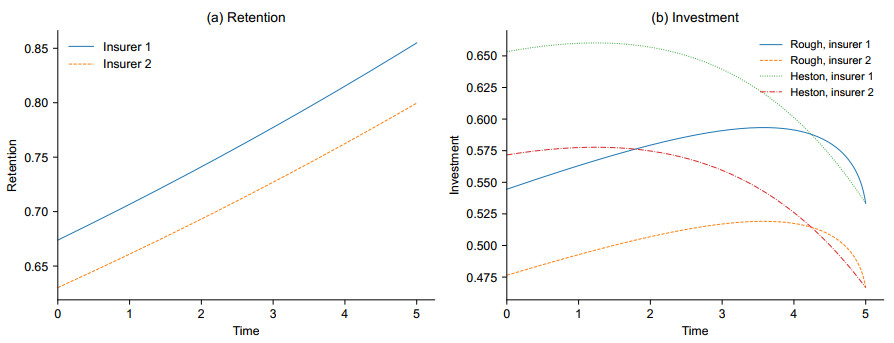
Baseline equilibrium strategies over time. Insurer 1 is shown by a blue solid line and insurer 2 by an orange dashed line. (a) Retention $ a_k^*(t) $; (b) rough and standard-Heston investment $ b_k^*(t) $ in monetary units. The Heston retention curves coincide with the rough curves and are not plotted separately. All undisplayed parameters are fixed at Table 1
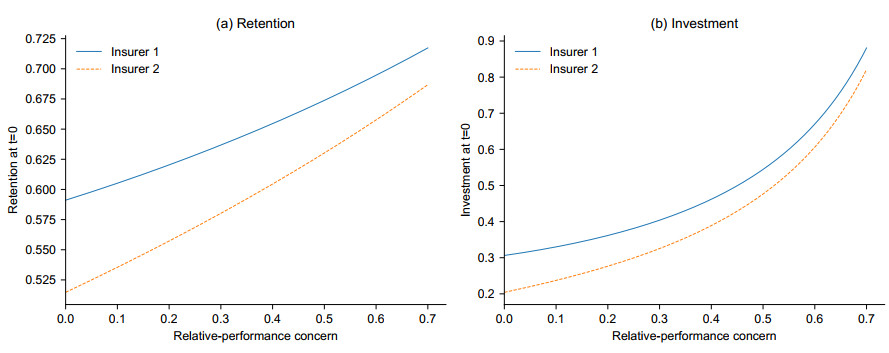
Sensitivity of the initial equilibrium strategies to the relative-concern coefficient $ \kappa = \kappa_1 = \kappa_2 $ over $ [0, 0.7] $. Insurer 1 is blue solid and insurer 2 orange dashed. (a) Initial retention; (b) initial investment in monetary units
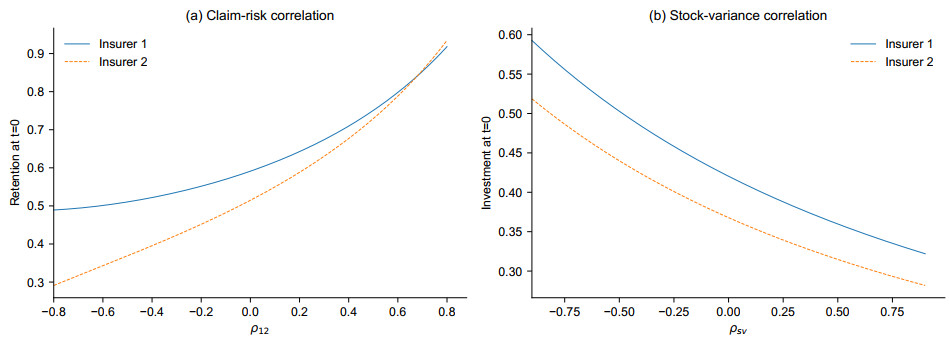
Sensitivity to the two correlation structures (evaluated at $ t = 0 $). (a) Reinsurance retention $ a_k^*(0) $ versus the insurer–insurer risk correlation $ \rho_{12} $. (b) Investment $ b_k^*(0) $ versus the stock–variance correlation $ \rho_{\mathrm{sv}} $. Insurer 1 is blue solid and insurer 2 orange dashed; all other parameters are fixed at Table 1
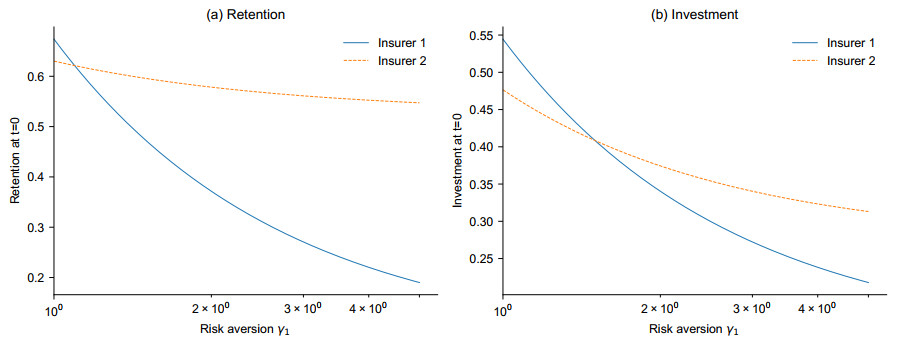
Sensitivity of the initial equilibrium strategies to insurer 1's risk-aversion coefficient $ \gamma_1\in[1, 5] $ (log scale on the horizontal axis, $ \gamma_2 = 1.5 $ fixed). Insurer 1 is blue solid and insurer 2 orange dashed. (a) Retention; (b) investment in monetary units
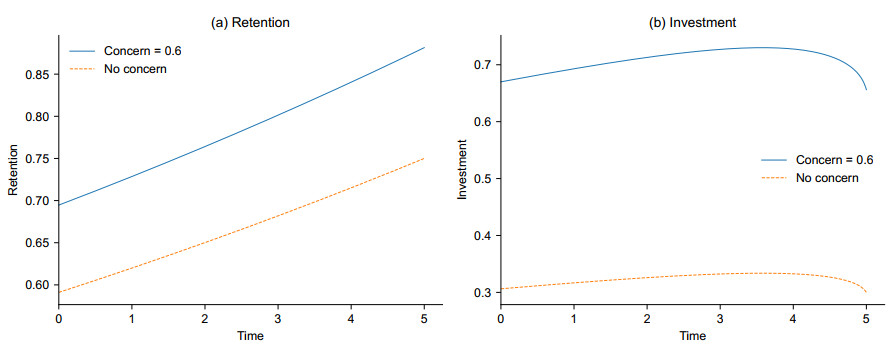
Equilibrium strategies of insurer 1 with relative-performance concern $ \kappa = 0.6 $ (solid) and without concern $ \kappa = 0 $ (dashed). (a) Retention; (b) investment in monetary units. Other parameters are fixed at Table 1
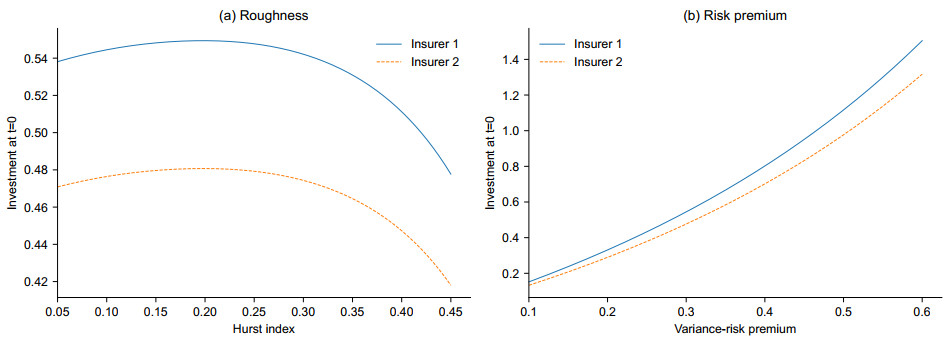
Sensitivity of the initial investment strategy to the volatility specification. (a) Hurst index $ H $; (b) variance-risk premium $ m $. Insurer 1 is blue solid and insurer 2 orange dashed. The Hurst panel uses the baseline eight-factor rule separately at each $ H $; Table 2 reports the associated stability check
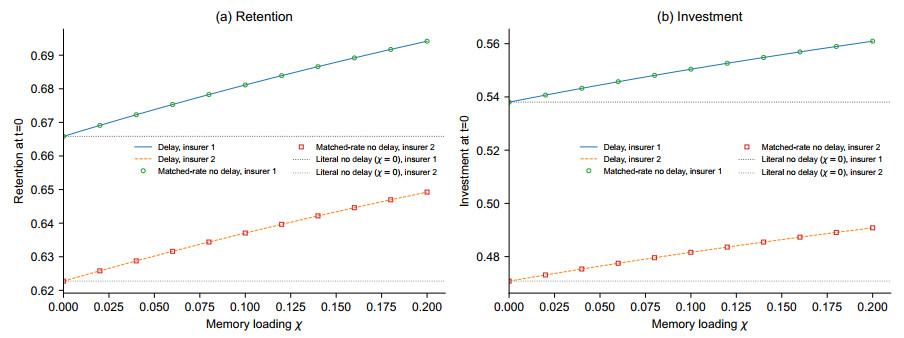
Sensitivity of the initial strategies to the memory loading $ \chi $ along the compatible delay-parameter path. Insurer 1 is blue solid and insurer 2 orange dashed. Open circles mark the matched-effective-rate no-delay control for insurer 1; open squares show the independently recomputed matched-effective-rate no-delay control for insurer 2. Both marker series coincide with their corresponding delay curves. Dotted horizontal lines show the respective literal no-delay benchmarks. (a) Retention; (b) investment in monetary units



 DownLoad: