In this paper, we examined how carbon pricing and retailer inequity aversion interact through profit allocation in a two-echelon low-carbon supply chain. The analysis distinguished behavioral responses from material-profit outcomes. A finite-horizon open-loop model combined a forward-looking manufacturer, a myopic retailer, low-carbon goodwill, and product-specific low-carbon awareness under cap-and-trade regulation; control parameterization and constrained retailer responses yield selected numerical candidates with Softplus smoothing. Carbon-price transmission depended on the emission-effort regime: Effort remained at its upper bound in the tested low-cost setting, whereas mean effort declined modestly with carbon price in the higher-cost interior regimes. Across these regimes, higher carbon prices raise mean wholesale and retail prices, reduce mean demand, and increase the retailer's mean disadvantageous profit gap. Stronger inequity aversion under high profit-comparison pressure induces preemptive wholesale-price concessions. An exact positive-part benchmark preserves this direction while revealing smoothing sensitivity in near-kink activation and response magnitudes. A composite contract combined marginal-cost wholesale pricing, promotion sharing, direct emission-incentive support, and fixed redistribution. Under the tested discretization and contract conditions, independently selected contract paths approached the discrete integrated reference and satisfied material-profit and post-fee behavioral-utility participation. These findings revealed a price-coordination/emission-incentive conflict and supported numerical contract implementation within the specified model and finite checks; they do not establish general continuous-time coordination.
Citation: Bo Xu, Yunlong Tian. A dynamic low-carbon supply chain coordination model under cap-and-trade regulation and the retailer's disadvantageous inequity aversion[J]. Journal of Industrial and Management Optimization, 2026, 22(12): 6399-6441. doi: 10.3934/jimo.2026215
In this paper, we examined how carbon pricing and retailer inequity aversion interact through profit allocation in a two-echelon low-carbon supply chain. The analysis distinguished behavioral responses from material-profit outcomes. A finite-horizon open-loop model combined a forward-looking manufacturer, a myopic retailer, low-carbon goodwill, and product-specific low-carbon awareness under cap-and-trade regulation; control parameterization and constrained retailer responses yield selected numerical candidates with Softplus smoothing. Carbon-price transmission depended on the emission-effort regime: Effort remained at its upper bound in the tested low-cost setting, whereas mean effort declined modestly with carbon price in the higher-cost interior regimes. Across these regimes, higher carbon prices raise mean wholesale and retail prices, reduce mean demand, and increase the retailer's mean disadvantageous profit gap. Stronger inequity aversion under high profit-comparison pressure induces preemptive wholesale-price concessions. An exact positive-part benchmark preserves this direction while revealing smoothing sensitivity in near-kink activation and response magnitudes. A composite contract combined marginal-cost wholesale pricing, promotion sharing, direct emission-incentive support, and fixed redistribution. Under the tested discretization and contract conditions, independently selected contract paths approached the discrete integrated reference and satisfied material-profit and post-fee behavioral-utility participation. These findings revealed a price-coordination/emission-incentive conflict and supported numerical contract implementation within the specified model and finite checks; they do not establish general continuous-time coordination.

| [1] |
S. Benjaafar, Y. Li, M. Daskin, Carbon footprint and the management of supply chains: Insights from simple models, IEEE Trans. Autom. Sci. Eng., 10 (2013), 99–116. https://doi.org/10.1109/TASE.2012.2203304 doi: 10.1109/TASE.2012.2203304
|
| [2] |
G. Hua, T. C. E. Cheng, S. Wang, Managing carbon footprints in inventory management, Int. J. Prod. Econ., 132 (2011), 178–185. https://doi.org/10.1016/j.ijpe.2011.03.024 doi: 10.1016/j.ijpe.2011.03.024
|
| [3] |
S. Du, L. Zhu, L. Liang, F. Ma, Emission-dependent supply chain and environment-policy-making in the "cap-and-trade" system, Energy Policy, 57 (2013), 61–67. https://doi.org/10.1016/j.enpol.2012.09.042 doi: 10.1016/j.enpol.2012.09.042
|
| [4] |
S. Xu, K. Govindan, W. Wang, W. Yang, Supply chain management under cap-and-trade regulation: A literature review and research opportunities, Int. J. Prod. Econ., 271 (2024), 109199. https://doi.org/10.1016/j.ijpe.2024.109199 doi: 10.1016/j.ijpe.2024.109199
|
| [5] |
M. Nerlove, K. J. Arrow, Optimal advertising policy under dynamic conditions, Economica, 29 (1962), 129–142. https://doi.org/10.2307/2551549 doi: 10.2307/2551549
|
| [6] |
C. Xu, D. Zhao, B. Yuan, L. He, Differential game model on joint carbon emission reduction and low-carbon promotion in supply chains, J. Manag. Sci. China, 19 (2016), 53–65. https://doi.org/10.3969/j.issn.1007-9807.2016.02.005 doi: 10.3969/j.issn.1007-9807.2016.02.005
|
| [7] |
Y. Wang, Q. Zhu, Long-term emission reduction decisions of a supply chain under different carbon emission permit allocation rules, Syst. Eng. Theory Pract., 43 (2023), 2084–2101. https://doi.org/10.12011/SETP2022-2158 doi: 10.12011/SETP2022-2158
|
| [8] |
T. H. Cui, J. S. Raju, Z. J. Zhang, Fairness and channel coordination, Manage. Sci., 53 (2007), 1303–1314. https://doi.org/10.1287/mnsc.1060.0697 doi: 10.1287/mnsc.1060.0697
|
| [9] |
Y. Zhou, X. Ye, Differential game model of joint emission reduction strategies and contract design in a dual-channel supply chain, J. Clean. Prod., 190 (2018), 592–607. https://doi.org/10.1016/j.jclepro.2018.04.133 doi: 10.1016/j.jclepro.2018.04.133
|
| [10] |
Q. Wang, D. Zhao, Cooperative strategy of carbon emissions reduction and promotion in a two-echelon supply chain, Control Decis., 29 (2014), 307–314. |
| [11] |
X. Peng, Y. Tao, C. Wang, Z. Zhong, Research on low-carbon supply chain decision-making under carbon cap-and-trade and subsidy policy, Int. J. Low-Carbon Technol., 17 (2022), 1061–1074. https://doi.org/10.1093/ijlct/ctac086 doi: 10.1093/ijlct/ctac086
|
| [12] |
F. Ren, B. Hu, Decisions and coordination in low-carbon supply chains with a wholesale price constraint under government subsidies, Int. J. Prod. Econ., 277 (2024), 109407. https://doi.org/10.1016/j.ijpe.2024.109407 doi: 10.1016/j.ijpe.2024.109407
|
| [13] |
G. Yan, Y. Ni, Pricing and low-carbon decisions in an uncertain supply chain with cap-and-trade regulation, J. Intell. Fuzzy Syst., 46 (2024), 2877–2897. https://doi.org/10.3233/JIFS-232607 doi: 10.3233/JIFS-232607
|
| [14] |
Q. Lin, H. Liao, Y. Liang, Research on the optimization of operational strategies for supply chain members under two carbon trading pathways in the context of carbon emission trade, J. Ind. Manag. Optim., 21 (2025), 6384–6426. https://doi.org/10.3934/jimo.2025135 doi: 10.3934/jimo.2025135
|
| [15] |
C. Zhu, J. Ma, J. Li, M. Goh, Grandfathering or benchmarking? The impact of carbon quota allocation rule on the joint emission reduction supply chain, Int. J. Prod. Res., 63 (2025), 3608–3629. https://doi.org/10.1080/00207543.2024.2425777 doi: 10.1080/00207543.2024.2425777
|
| [16] |
S. Wang, L. Liu, J. Wen, Product pricing, green effort decisions and coordination in a dynamic three-echelon green supply chain, J. Ind. Manag. Optim., 20 (2024), 2906–2933. https://doi.org/10.3934/jimo.2024033 doi: 10.3934/jimo.2024033
|
| [17] |
Z. Zhang, L. Yu, Dynamic optimization and coordination of cooperative emission reduction in a dual-channel supply chain considering reference low-carbon effect and low-carbon goodwill, Int. J. Environ. Res. Public Health, 18 (2021), 539. https://doi.org/10.3390/ijerph18020539 doi: 10.3390/ijerph18020539
|
| [18] |
A. Wu, R. Zhang, Y. Sun, L. Sun, S. Wang, X. Wang, Differential games of supply chain on consideration of low-carbon reference effect under different carbon quota allocation methods, Systems, 12 (2024), 371. https://doi.org/10.3390/systems12090371 doi: 10.3390/systems12090371
|
| [19] |
M. Gao, L. Xia, Q. Xiao, M. Goh, Incentive strategies for low-carbon supply chains with information updating of customer preferences, J. Clean. Prod., 410 (2023), 137162. https://doi.org/10.1016/j.jclepro.2023.137162 doi: 10.1016/j.jclepro.2023.137162
|
| [20] |
C. Zhu, J. Ma, J. Li, M. Goh, Retailer alliance and power structure shift in green brand supply chain under low-carbon operating environment, Int. J. Prod. Res., 64 (2026), 2753–2779. https://doi.org/10.1080/00207543.2025.2583474 doi: 10.1080/00207543.2025.2583474
|
| [21] |
E. Fehr, K. M. Schmidt, A theory of fairness, competition, and cooperation, Q. J. Econ., 114 (1999), 817–868. https://doi.org/10.1162/003355399556151 |
| [22] |
G. E. Bolton, A. Ockenfels, ERC: A theory of equity, reciprocity, and competition, Am. Econ. Rev., 90 (2000), 166–193. https://doi.org/10.1257/aer.90.1.166 |
| [23] |
O. Caliskan-Demirag, Y. F. Chen, J. Li, Channel coordination under fairness concerns and nonlinear demand, Eur. J. Oper. Res., 207 (2010), 1321–1326. https://doi.org/10.1016/j.ejor.2010.07.017 doi: 10.1016/j.ejor.2010.07.017
|
| [24] |
T. H. Ho, X. Su, Y. Wu, Distributional and peer-induced fairness in supply chain contract design, Prod. Oper. Manag., 23 (2014), 161–175. https://doi.org/10.1111/poms.12064 doi: 10.1111/poms.12064
|
| [25] |
C. H. Loch, Y. Wu, Social preferences and supply chain performance: An experimental study, Manage. Sci., 54 (2008), 1835–1849. https://doi.org/10.1287/mnsc.1080.0910 doi: 10.1287/mnsc.1080.0910
|
| [26] |
L. Chen, H. L. Lee, C. S. Tang, Supply chain fairness, Prod. Oper. Manag., 31 (2022), 4304–4318. https://doi.org/10.1111/poms.13849 |
| [27] |
W. Jin, Q. Zhang, Decision making in trade credit financing: Impact of loss aversion and power imbalance, Int. Trans. Oper. Res., 28 (2021), 2607–2632. https://doi.org/10.1111/itor.12912 doi: 10.1111/itor.12912
|
| [28] |
W. Liu, S. Song, Y. Qiao, H. Zhao, Supply chain coordination with a loss-averse retailer and combined contract, Mathematics, 8 (2020), 586. https://doi.org/10.3390/math8040586 doi: 10.3390/math8040586
|
| [29] |
W. Xie, B. Chen, F. Huang, J. He, Coordination of a supply chain with a loss-averse retailer under supply uncertainty and marketing effort, J. Ind. Manag. Optim., 17 (2021), 3393–3415. https://doi.org/10.3934/jimo.2020125 doi: 10.3934/jimo.2020125
|
| [30] |
E. Katok, V. Pavlov, Fairness in supply chain contracts: A laboratory study, J. Oper. Manag., 31 (2013), 129–137. https://doi.org/10.1016/j.jom.2013.01.001 doi: 10.1016/j.jom.2013.01.001
|
| [31] |
F. Qin, F. Mai, M. J. Fry, A. S. Raturi, Supply-chain performance anomalies: Fairness concerns under private cost information, Eur. J. Oper. Res., 252 (2016), 170–182. https://doi.org/10.1016/j.ejor.2016.01.033 doi: 10.1016/j.ejor.2016.01.033
|
| [32] |
V. Pavlov, E. Katok, W. Zhang, Optimal contract under asymmetric information about fairness, Manuf. Serv. Oper. Manag., 24 (2021), 305–314. https://doi.org/10.1287/msom.2020.0945 doi: 10.1287/msom.2020.0945
|
| [33] |
Y. Zhou, M. Bao, X. Chen, X. Xu, Co-op advertising and emission reduction cost sharing contracts and coordination in low-carbon supply chain based on fairness concerns, J. Clean. Prod., 133 (2016), 402–413. https://doi.org/10.1016/j.jclepro.2016.05.097 doi: 10.1016/j.jclepro.2016.05.097
|
| [34] |
X. Qian, F. T. S. Chan, J. Zhang, M. Yin, Q. Zhang, Channel coordination of a two-echelon sustainable supply chain with a fair-minded retailer under cap-and-trade regulation, J. Clean. Prod., 244 (2020), 118715. https://doi.org/10.1016/j.jclepro.2019.118715 doi: 10.1016/j.jclepro.2019.118715
|
| [35] |
L. Xia, T. Guo, J. Qin, X. Yue, N. Zhu, Carbon emission reduction and pricing policies of a supply chain considering reciprocal preferences in cap-and-trade system, Ann. Oper. Res., 268 (2018), 149–175. https://doi.org/10.1007/s10479-017-2657-2 doi: 10.1007/s10479-017-2657-2
|
| [36] |
Y. Zhang, Y. Yi, Sustainable production strategies of loss-averse competitive manufacturers with reference dependence under cap-and-trade policy, Transp. Res. Part E Logist. Transp. Rev., 192 (2024), 103809. https://doi.org/10.1016/j.tre.2024.103809 doi: 10.1016/j.tre.2024.103809
|
| [37] |
Z. Zhang, L. Yu, Joint emission reduction dynamic optimization and coordination in the supply chain considering fairness concern and reference low-carbon effect, J. Ind. Manag. Optim., 18 (2022), 4201–4229. https://doi.org/10.3934/jimo.2021155 doi: 10.3934/jimo.2021155
|
| [38] |
L. Xia, Y. Bai, S. Ghose, J. Qin, Differential game analysis of carbon emissions reduction and promotion in a sustainable supply chain considering social preferences, Ann. Oper. Res., 310 (2022), 257–292. https://doi.org/10.1007/s10479-020-03838-8 doi: 10.1007/s10479-020-03838-8
|
| [39] |
C. Yu, Y. Zhang, L. Liu, T. W. Archibald, Low-carbon supply chain strategy and contract coordination considering manufacturers' fairness concerns, Oper. Res., 24 (2024), 64. https://doi.org/10.1007/s12351-024-00869-y doi: 10.1007/s12351-024-00869-y
|
| [40] |
P. Shi, K. Han, R. Hou, Co-op advertising and carbon emission reduction cost-sharing contracts in coordinating supply chain with reciprocal behavior under cap-and-trade regulation, J. Manag. Sci. China, 27 (2024), 57–81. https://doi.org/10.19920/j.cnki.jmsc.2024.12.004 doi: 10.19920/j.cnki.jmsc.2024.12.004
|
| [41] |
D. Wu, H. Ding, W. Wang, Y. Cheng, Green technology investment and supply chain coordination strategies considering marketing efforts and risk aversion under carbon tax policy, J. Ind. Manag. Optim., 21 (2025), 418–453. https://doi.org/10.3934/jimo.2024089 doi: 10.3934/jimo.2024089
|
| [42] |
J. Chen, L. Sun, T. Zhang, R. Hou, Low carbon joint strategy and coordination for a dyadic supply chain with Nash bargaining fairness, J. Ind. Manag. Optim., 19 (2023), 1282–1309. https://doi.org/10.3934/jimo.2021229 doi: 10.3934/jimo.2021229
|
| [43] |
B. Beyer, R. Chaskel, S. Euler, J. Gassen, A. K. Großkopf, T. Sellhorn, How does carbon footprint information affect consumer choice? A field experiment, J. Account. Res., 62 (2024), 101–136. https://doi.org/10.1111/1475-679X.12505 doi: 10.1111/1475-679X.12505
|
Figures(3) / Tables(11)
Bo Xu, Yunlong Tian. A dynamic low-carbon supply chain coordination model under cap-and-trade regulation and the retailer's disadvantageous inequity aversion[J]. Journal of Industrial and Management Optimization, 2026, 22(12): 6399-6441. doi: 10.3934/jimo.2026215

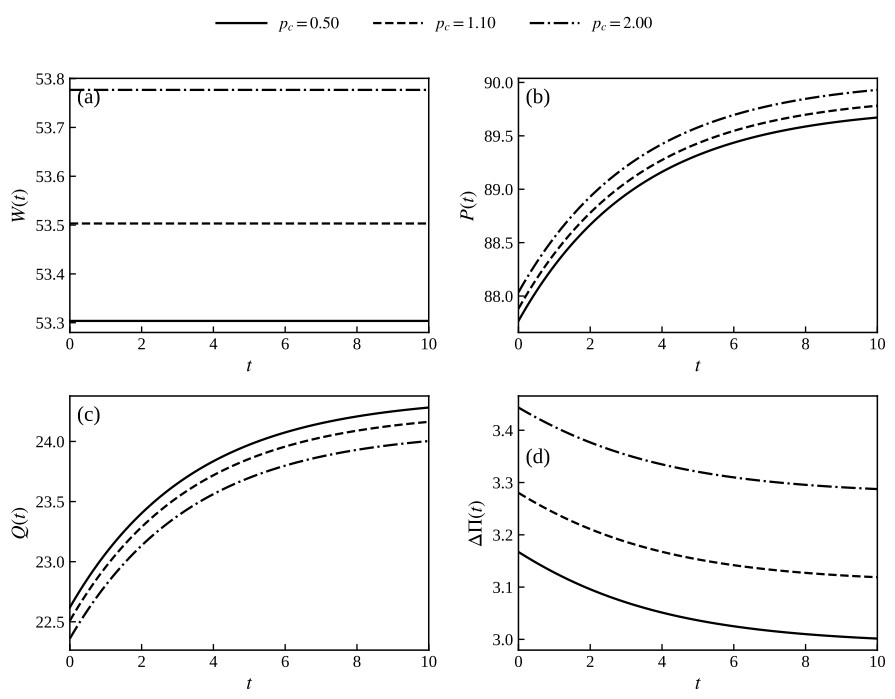
Dynamic paths under carbon-price sensitivity in the standard channel profit-comparison setting. Panels report $ W(t) $, $ P(t) $, $ Q(t) $, and $ \Delta\Pi(t) $ for $ p_c = 0.50 $, $ 1.10 $, and $ 2.00 $. Since emission-reduction effort remains saturated at its upper bound across the sampled carbon prices, carbon-price shocks mainly affect price transmission, demand, and profit allocation rather than additional marginal emission-reduction effort
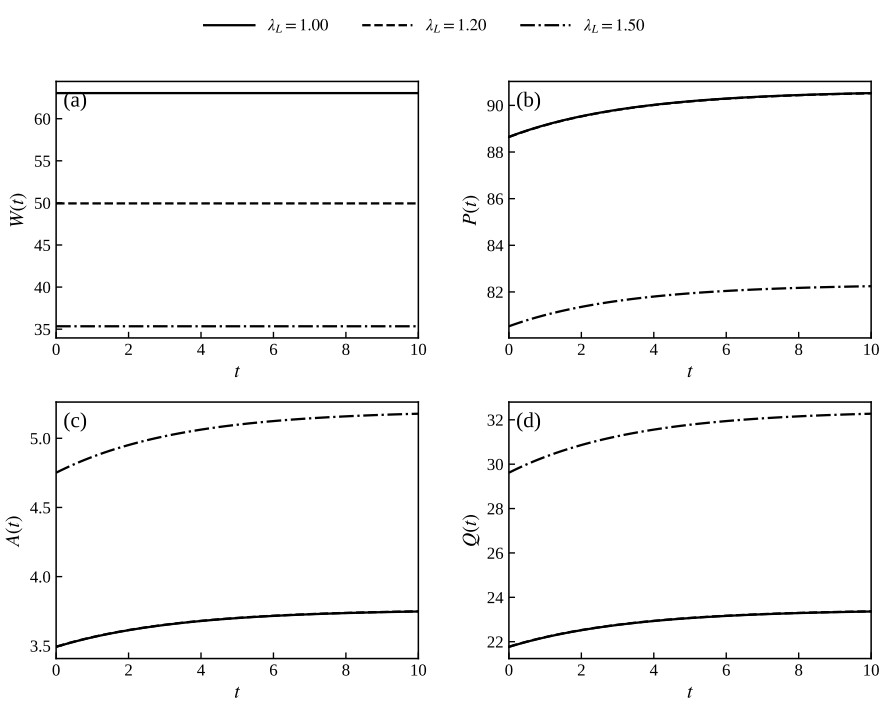
Dynamic paths under inequity-aversion intensity sensitivity in the high channel profit-comparison setting. Panels report $ W(t) $, $ P(t) $, $ A(t) $, and $ Q(t) $ for $ \lambda_L = 1.00 $, $ 1.20 $, and $ 1.50 $. A higher $ \lambda_L $ induces stronger preemptive wholesale-price concessions, as shown in panel (a). Between $ \lambda_L = 1.00 $ and $ \lambda_L = 1.20 $, the downstream paths of $ P(t) $, $ A(t) $, and $ Q(t) $ remain nearly unchanged, indicating that the concession mainly reallocates channel profit through $ W(t) $, consistent with the exact-hinge mechanism illustrated by Proposition 2. When $ \lambda_L = 1.50 $, the system approaches the inequity-aversion kink, leading to a marked reduction in retail price and a substantial expansion of promotion and demand
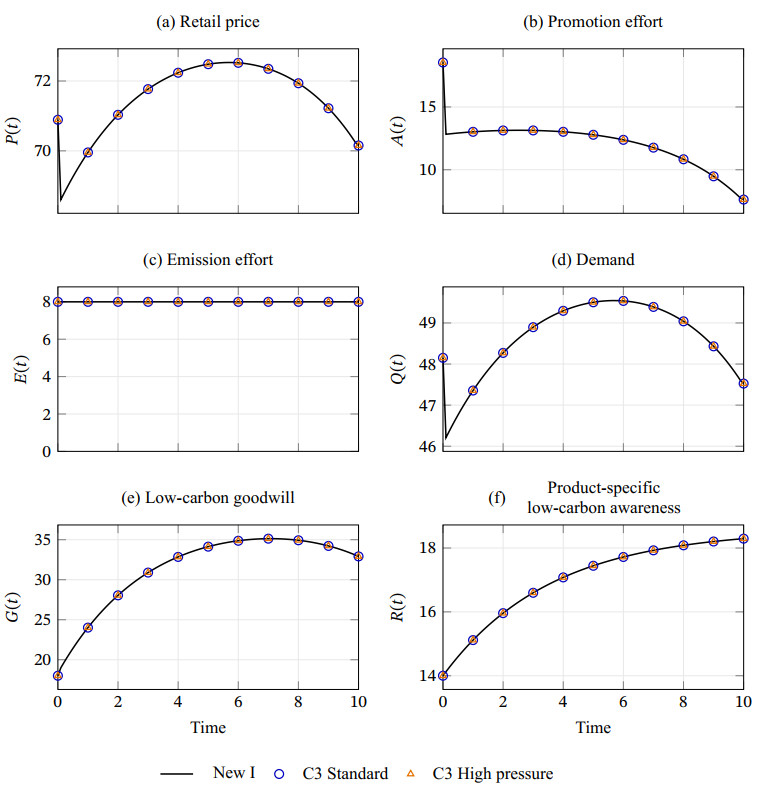
New integrated reference and independently selected C3 paths from complete saved arrays. Black lines show I; open circles and triangles show Standard and High-pressure C3 at every tenth node for legibility. All 101 nodes are used in the reported distances. Panels show $ P, A, E, Q, G, R $ without artificial offsets or amplified residuals; near-overlap is the actual result. Effort reaches its original upper bound as an outcome. Maximum mean-normalized node deviations over the six variables are $ 2.84093\times10^{-8} $ and $ 4.10514\times10^{-8} $, respectively.



 DownLoad: