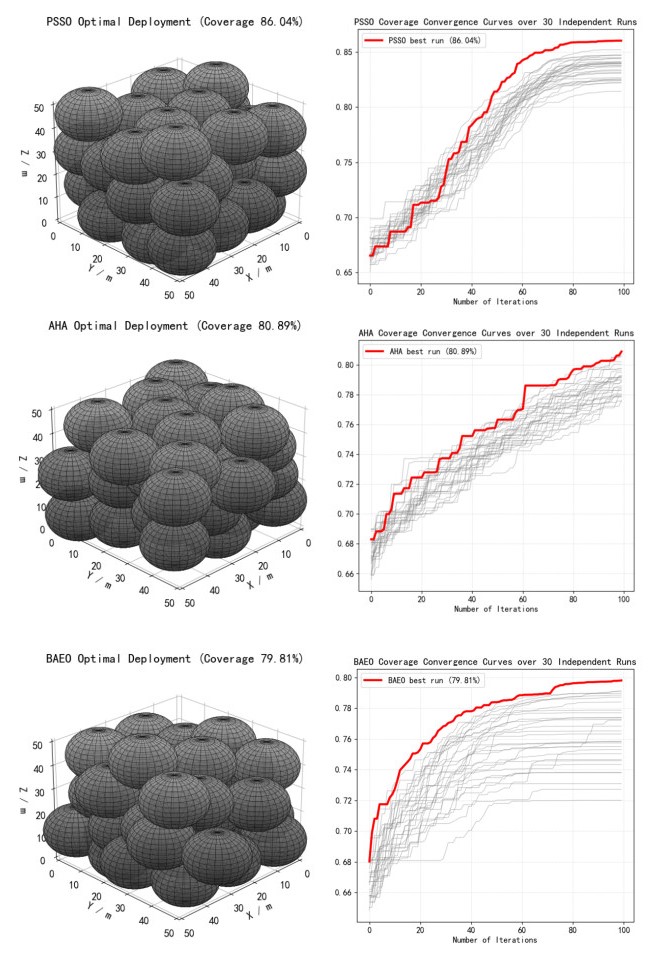
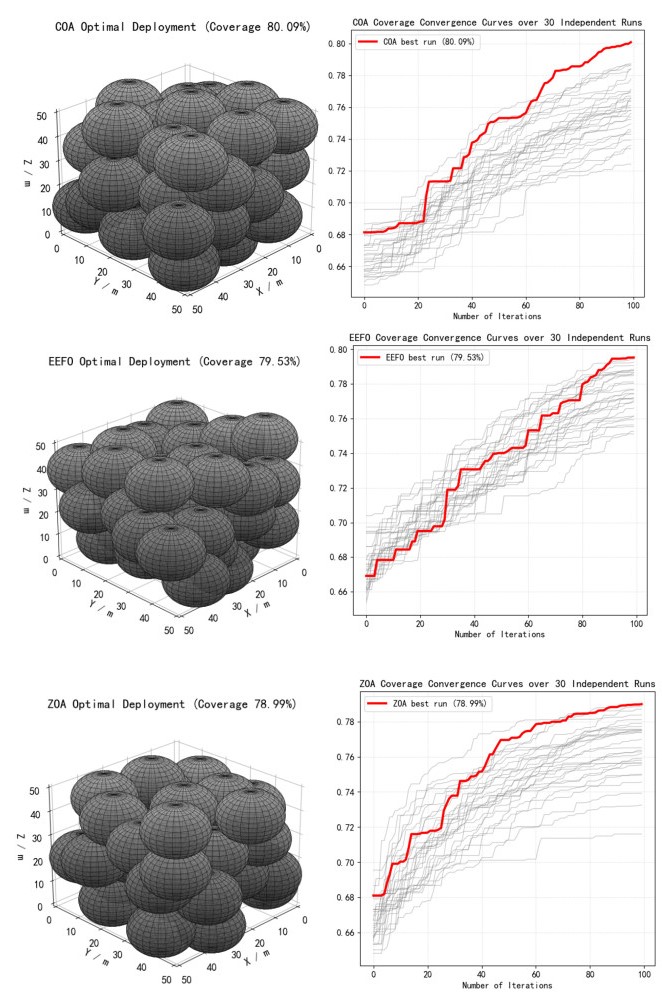
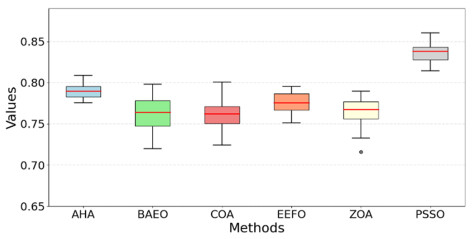
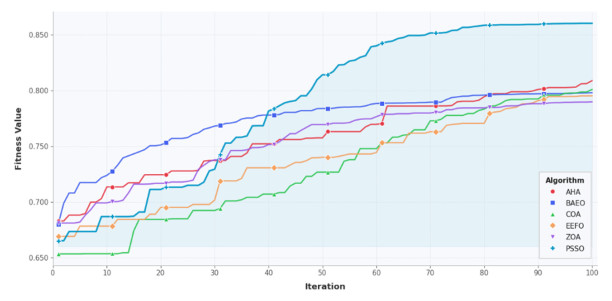
Three-dimensional wireless sensor network deployment is a class of optimization problems that are high-dimensional, non-differentiable, and characterized by numerous locally competitive solutions. This paper proposes a novel petal-spiral search optimizer (PSSO). The method applies multi-lobe sign modulation to the step size via the radial component of a rose curve, forming the petal-bloom exploration operator. It employs the dimension-wise normalized modulus of an epitrochoid to construct the epitrochoid exploitation operator. A bloom weight, composed of a polynomial and trigonometric function, simultaneously governs the selection probability between the two operators and the internal fusion ratio of the exploration step size. A greedy acceptance strategy is further adopted to select and update the population. To examine the effective boundary of the proposed method, this study conducts 30 independent repeated experiments on four three-dimensional wireless sensor network coverage scenarios and 12 benchmark functions from CEC2022, along with a comparative analysis of six single-mechanism ablation variants. In the primary scenario, PSSO achieves an average coverage of 0.836504 with a standard deviation of 0.010121. Its worst result over 30 runs (0.814382) still surpasses the best historical results of artificial hummingbird algorithm (AHA), boomerang aerodynamic ellipse optimizer (BAEO), crayfish optimization algorithm (COA), electric eel foraging optimization (EEFO), and zebra optimization algorithm (ZOA). Compared with the suboptimal algorithm AHA, PSSO improves the average coverage by 5.91%. In the other three scenarios where the number of nodes, sensing radius, and region shape all vary, PSSO simultaneously ranks first in best, worst, and mean values, with relative improvements of 3.67%, 8.23%, and 9.21%, respectively. The total runtime of PSSO is the shortest, far lower than those of COA, EEFO, ZOA, and especially BAEO. The CEC2022 results show that PSSO achieves or ties for the optimal mean on six out of 12 functions. The ablation experiment shows that the complete model achieves the highest search upper bound (0.860452) and outperforms all variants, further validating the effectiveness of the overall architecture of the proposed algorithm.
Citation: Xiaowei Wang, Jun Bao. Petal-Spiral search optimizer: A novel optimization algorithm and its application to three-dimensional wireless sensor network coverage optimization[J]. Journal of Industrial and Management Optimization, 2026, 22(9): 4576-4598. doi: 10.3934/jimo.2026159
Three-dimensional wireless sensor network deployment is a class of optimization problems that are high-dimensional, non-differentiable, and characterized by numerous locally competitive solutions. This paper proposes a novel petal-spiral search optimizer (PSSO). The method applies multi-lobe sign modulation to the step size via the radial component of a rose curve, forming the petal-bloom exploration operator. It employs the dimension-wise normalized modulus of an epitrochoid to construct the epitrochoid exploitation operator. A bloom weight, composed of a polynomial and trigonometric function, simultaneously governs the selection probability between the two operators and the internal fusion ratio of the exploration step size. A greedy acceptance strategy is further adopted to select and update the population. To examine the effective boundary of the proposed method, this study conducts 30 independent repeated experiments on four three-dimensional wireless sensor network coverage scenarios and 12 benchmark functions from CEC2022, along with a comparative analysis of six single-mechanism ablation variants. In the primary scenario, PSSO achieves an average coverage of 0.836504 with a standard deviation of 0.010121. Its worst result over 30 runs (0.814382) still surpasses the best historical results of artificial hummingbird algorithm (AHA), boomerang aerodynamic ellipse optimizer (BAEO), crayfish optimization algorithm (COA), electric eel foraging optimization (EEFO), and zebra optimization algorithm (ZOA). Compared with the suboptimal algorithm AHA, PSSO improves the average coverage by 5.91%. In the other three scenarios where the number of nodes, sensing radius, and region shape all vary, PSSO simultaneously ranks first in best, worst, and mean values, with relative improvements of 3.67%, 8.23%, and 9.21%, respectively. The total runtime of PSSO is the shortest, far lower than those of COA, EEFO, ZOA, and especially BAEO. The CEC2022 results show that PSSO achieves or ties for the optimal mean on six out of 12 functions. The ablation experiment shows that the complete model achieves the highest search upper bound (0.860452) and outperforms all variants, further validating the effectiveness of the overall architecture of the proposed algorithm.

| [1] |
L. Abualigah, M. A. Elaziz, A. M. Khasawneh, M. Alshinwan, R. A. lbrahim, M. A. A. Al-qaness, et al., Meta-heuristic optimization algorithms for solving real-world mechanical engineering design problems: a comprehensive survey, applications, comparative analysis, and results, Neural Comput. Applic., 34 (2022), 4081–4110. https://doi.org/10.1007/s00521-021-06747-4 doi: 10.1007/s00521-021-06747-4

|
| [2] |
L. Wang, Y. Huang, A review of research progress and multi-field applications of Zeroing neural networks in optimization problems, Cluster Comput., 29 (2026), 135. https://doi.org/10.1007/s10586-026-05956-7 doi: 10.1007/s10586-026-05956-7
|
| [3] |
W. Lu, J. Chen, K. Yang, D. Liu, X. Li, Y. Fu, et al., MOSBOA: A novel multi-objective optimization via secretary bird algorithm with reference point guidance, Cluster Comput., 29 (2026), 222. https://doi.org/10.1007/s10586-026-05981-6 doi: 10.1007/s10586-026-05981-6
|
| [4] |
Z. Meng, Z. Song, X. Shao, J. Zhang, H. Xu, FD-DE: Differential Evolution with fitness deviation based adaptation in parameter control, ISA Trans., 139 (2023), 272–290. https://doi.org/10.1016/j.isatra.2023.05.005 doi: 10.1016/j.isatra.2023.05.005
|
| [5] |
A. Aguilar-Rivera, The unscented genetic algorithm for fast solution of GA-hard optimization problems, Appl. Soft Comput., 139 (2023), 110260. https://doi.org/10.1016/j.asoc.2023.110260 doi: 10.1016/j.asoc.2023.110260
|
| [6] |
C. L. Camacho-Villalon, M. Dorigo, T. Stutzle, PSO-X: A Component-Based Framework for the Automatic Design of Particle Swarm Optimization Algorithms, IEEE Trans. Evol. Computat., 26 (2022), 402–416. https://doi.org/10.1109/TEVC.2021.3102863 doi: 10.1109/TEVC.2021.3102863
|
| [7] |
A. N. Soumana Hamadou, C. Wa Maina, M. Moindze Soidridine, A Grey Wolf Optimiser (GWO)-Based RIS Phase Shift Design for a RIS-Assisted Multi-Antenna System, IEEE Commun. Lett., 28 (2024), 2171–2175. https://doi.org/10.1109/LCOMM.2024.3423013 doi: 10.1109/LCOMM.2024.3423013
|
| [8] |
J. Liu, J. Shi, F. Hao, M. Dai, A novel enhanced global exploration whale optimization algorithm based on Lévy flights and judgment mechanism for global continuous optimization problems, Eng. Comput., 39 (2023), 2433–2461. https://doi.org/10.1007/s00366-022-01638-1 doi: 10.1007/s00366-022-01638-1
|
| [9] |
B. Khurshid, S. Maqsood, A hybrid evolution strategies-simulated annealing algorithm for job shop scheduling problems, Eng. Appl. Artif. Intell., 133 (2024), 108016. https://doi.org/10.1016/j.engappai.2024.108016 doi: 10.1016/j.engappai.2024.108016
|
| [10] |
Z. Qian, Y. Xie, S. Xie, MAR-GSA: Mixed attraction and repulsion based gravitational search algorithm, Inf. Sci., 662 (2024), 120250. https://doi.org/10.1016/j.ins.2024.120250 doi: 10.1016/j.ins.2024.120250
|
| [11] | Z. Zeng, H. Dong, Y. Xu, W. Zhang, H. Yu, X. Li, Teaching-learning-based optimization algorithm with dynamic neighborhood and crossover search mechanism for numerical optimization, Appl. Soft Comput., 154 (2024), 111332. https://doi.org/10.1016/j.asoc.2024.111332 |
| [12] |
B. Sasmal, A. Das, K. G. Dhal, R. Saha, R. Rai, T. Bharasa, et al., Artificial hummingbird algorithm: Theory, variants, analysis, applications, and performance evaluation, Comput. Sci. Re., 56 (2025), 100727. https://doi.org/10.1016/j.cosrev.2025.100727 doi: 10.1016/j.cosrev.2025.100727
|
| [13] |
L. Ding, Y. Bai, M. Fan, W. Song, H. Ren, Using a snow ablation optimizer in an autonomous echo state network for the model-free prediction of chaotic systems, Nonlinear Dyn., 112 (2024), 11483–11500. https://doi.org/10.1007/s11071-024-09656-y doi: 10.1007/s11071-024-09656-y
|
| [14] |
M. Abdel-Basset, D. El-Shahat, M. Jameel, M. Abouhawwash, Exponential distribution optimizer (EDO): a novel math-inspired algorithm for global optimization and engineering problems, Artif. Intell. Rev., 56 (2023), 9329–9400. https://doi.org/10.1007/s10462-023-10403-9 doi: 10.1007/s10462-023-10403-9
|
| [15] |
D. H. Wolpert, W. G. Macready, No free lunch theorems for optimization, IEEE Trans. Evol. Comput., 1 (1997), 67–82. https://doi.org/10.1109/4235.585893 doi: 10.1109/4235.585893
|
| [16] |
Z. Pan, D. Lei, L. Wang, A Knowledge-Based Two-Population Optimization Algorithm for Distributed Energy-Efficient Parallel Machines Scheduling, IEEE Trans. Cybern., 52 (2022), 5051–5063. https://doi.org/10.1109/TCYB.2020.3026571 doi: 10.1109/TCYB.2020.3026571
|
| [17] |
H. Wang, B. R. Sarker, J. Li, J. Li, Adaptive scheduling for assembly job shop with uncertain assembly times based on dual Q-learning, Int. J. Prod. Res., 59 (2021), 5867–5883. https://doi.org/10.1080/00207543.2020.1794075 doi: 10.1080/00207543.2020.1794075
|
| [18] |
F. Zhao, Z. Fu, L. Wang, H. Sang, A Heterogeneous Graph Reinforcement Learning Framework With Question-Aware Neighborhood Aggregation and Interoption Prompt Attention for Dynamic Flexible Job Shop Scheduling Problem, IEEE Trans. Ind. Inform., 22 (2026), 2863–2874. https://doi.org/10.1109/TII.2025.3646962 doi: 10.1109/TII.2025.3646962
|
| [19] |
A. A. Alhussan, E. M. El-Kenawy, M. M. Eid, N. Khodadadi, Hybrid Al-Biruni and Puma Optimization (BERPO) for boosting the classification of Quality-of-Service (QoS) in 5G networks, J. Net. Comput. Appl., 250 (2026), 104462. https://doi.org/10.1016/j.jnca.2026.104462 doi: 10.1016/j.jnca.2026.104462
|
| [20] |
W. Zhao, L. Wang, S. Mirjalili, Artificial hummingbird algorithm: A new bio-inspired optimizer with its engineering applications, Comput. Methods Appl. Mech. Eng., 388 (2022), 114194. https://doi.org/10.1016/j.cma.2021.114194 doi: 10.1016/j.cma.2021.114194
|
| [21] |
S. Zhao, F. Meng, L. Cai, R. Yang, Boomerang aerodynamic ellipse optimizer: A human game-inspired optimization technique for numerical optimization and multilevel thresholding image segmentation, Math. Comput. Simul., 238 (2025), 604–636. https://doi.org/10.1016/j.matcom.2025.07.006 doi: 10.1016/j.matcom.2025.07.006
|
| [22] |
H. Jia, H. Rao, C. Wen, S. Mirjalili, Crayfish optimization algorithm, Artif. Intell. Rev., 56 (2023), 1919–1979. https://doi.org/10.1007/s10462-023-10567-4 doi: 10.1007/s10462-023-10567-4
|
| [23] |
W. Zhao, L. Wang, Z. Zhang, H. Fan, J. Zhang, S. Mirjalili, et al., Electric eel foraging optimization: A new bio-inspired optimizer for engineering applications, Expert Syst. Appl., 238 (2024), 122200. https://doi.org/10.1016/j.eswa.2023.122200 doi: 10.1016/j.eswa.2023.122200
|
| [24] |
Q. Ren, F. Feng, PID parameter tuning optimization based on multi-strategy fusion improved zebra optimization algorithm, J. Supercomput., 81 (2025), 266. https://doi.org/10.1007/s11227-024-06548-1 doi: 10.1007/s11227-024-06548-1
|
Figures(4) / Tables(4)
Xiaowei Wang, Jun Bao. Petal-Spiral search optimizer: A novel optimization algorithm and its application to three-dimensional wireless sensor network coverage optimization[J]. Journal of Industrial and Management Optimization, 2026, 22(9): 4576-4598. doi: 10.3934/jimo.2026159




 DownLoad: