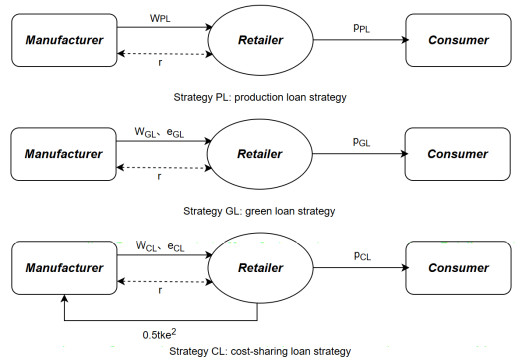
Capital constraints remain a major barrier to green transformation in supply chains, particularly for upstream manufacturers that must finance costly green investment. Yet little is known about how a manufacturer's fairness concern interacts with capital constraints to shape the effectiveness of retailer-led green subsidy strategies. To address this gap, we developd a Stackelberg game between a capital-constrained manufacturer and a financially strong retailer, and compared three retailer-led financing strategies: the production loan (strategy PL), the green loan (strategy GL), and the cost-sharing loan (strategy CL). We derived equilibrium decisions under each strategy, identified the parameter regions in which each strategy is preferred, and further examined how fairness concern alters their comparative performance. The results showed that Strategy PL can relieve short-term liquidity pressure but cannot provide sustained incentives for green investment. Strategy GL is most effective when green investment is relatively inefficient, whereas Strategy CL becomes superior when green investment efficiency is sufficiently high and the retailer's cost participation can materially reduce the manufacturer's burden. Moreover, the manufacturer's fairness concern significantly moderates green investment incentives, profit allocation, and strategy ranking, and may even reverse the relative attractiveness of Strategy GL and Strategy CL. These findings offer new insights into the joint design of financing and coordination mechanisms for sustainable supply chains.
Citation: Fei Pan, Ming Liu, Yanqiu Zhu. Green subsidy strategies in capital-constrained supply chains with manufacturer fairness concerns[J]. Journal of Industrial and Management Optimization, 2026, 22(9): 4449-4480. doi: 10.3934/jimo.2026155
Capital constraints remain a major barrier to green transformation in supply chains, particularly for upstream manufacturers that must finance costly green investment. Yet little is known about how a manufacturer's fairness concern interacts with capital constraints to shape the effectiveness of retailer-led green subsidy strategies. To address this gap, we developd a Stackelberg game between a capital-constrained manufacturer and a financially strong retailer, and compared three retailer-led financing strategies: the production loan (strategy PL), the green loan (strategy GL), and the cost-sharing loan (strategy CL). We derived equilibrium decisions under each strategy, identified the parameter regions in which each strategy is preferred, and further examined how fairness concern alters their comparative performance. The results showed that Strategy PL can relieve short-term liquidity pressure but cannot provide sustained incentives for green investment. Strategy GL is most effective when green investment is relatively inefficient, whereas Strategy CL becomes superior when green investment efficiency is sufficiently high and the retailer's cost participation can materially reduce the manufacturer's burden. Moreover, the manufacturer's fairness concern significantly moderates green investment incentives, profit allocation, and strategy ranking, and may even reverse the relative attractiveness of Strategy GL and Strategy CL. These findings offer new insights into the joint design of financing and coordination mechanisms for sustainable supply chains.

| [1] |
J. Chen, J. Abbas, H. Najam, J. Liu, J. Abbas, Green technological innovation, green finance, and financial development and their role in green total factor productivity: Empirical insights from China, J. Clean. Prod., 382 (2023), 135131. https://doi.org/10.1016/j.jclepro.2022.135131 doi: 10.1016/j.jclepro.2022.135131

|
| [2] |
J. Heydari, K. Govindan, Z. Basiri, Balancing price and green quality in presence of consumer environmental awareness: A green supply chain coordination approach, Int. J. Prod. Res., 59 (2021), 1957–1975. https://doi.org/10.1080/00207543.2020.1771457 doi: 10.1080/00207543.2020.1771457
|
| [3] | J. Wiredu, Q. Yang, A. K. Sampene, B. A. Gyamfi, S. A. Asongu, The effect of green supply chain management practices on corporate environmental performance: Does supply chain competitive advantage matter? Bus. Strategy Environ., 33 (2024), 2578–2599. https://doi.org/10.1002/bse.3606 |
| [4] |
L. V. Lerman, G. B. Benitez, J. M. Müller, P. R. de Sousa, A. G. Frank, Smart green supply chain management: A configurational approach to enhance green performance through digital transformation, Supply Chain Manag., 27 (2022), 147–176. https://doi.org/10.1108/SCM-02-2022-0059 doi: 10.1108/SCM-02-2022-0059
|
| [5] | R. Xu, S. Wang, T. He, Research on the dynamic mechanism of sustainable development of small and medium-sized enterprises from the perspective of green supply chain finance, Financ. Theory Pract., 2022 (2022), 76–86. https://link.cnki.net/urlid/41.1078.F.20220116.1115.018 |
| [6] |
D. A. Wuttke, C. Blome, H. S. Heese, M. Protopappa-Sieke, Supply chain finance: Optimal introduction and adoption decisions, Int. J. Prod. Econ., 178 (2016), 72–81. https://doi.org/10.1016/j.ijpe.2016.05.003 doi: 10.1016/j.ijpe.2016.05.003
|
| [7] |
C. H. Yu, X. Wu, D. Zhang, S. Chen, J. Zhao, Demand for green finance: Resolving financing constraints on green innovation in China, Energy Policy, 153 (2021), 112255. https://doi.org/10.1016/j.enpol.2021.112255 doi: 10.1016/j.enpol.2021.112255
|
| [8] |
P. Shi, K. Han, R. Hou, Modeling and analysis of a sustainable supply chain with fairness concerns and green-sensitive consumer demand, Manag. Decis., 61 (2022), 1298–1319. https://doi.org/10.1108/MD-03-2022-0347 doi: 10.1108/MD-03-2022-0347
|
| [9] |
D. Ghosh, J. Shah, Supply chain analysis under green sensitive consumer demand and cost sharing contract, Int. J. Prod. Econ., 164 (2015), 319–329. https://doi.org/10.1016/j.ijpe.2014.11.005 doi: 10.1016/j.ijpe.2014.11.005
|
| [10] |
P. Kouvelis, W. Zhao, Supply chain contract design under financial constraints and bankruptcy costs, Management Science, 62 (2016), 2341–2357. https://doi.org/10.1287/mnsc.2015.2248 doi: 10.1287/mnsc.2015.2248
|
| [11] |
J. Li, Y. Wang, G. Feng, S. Wang, Y. Song, Supply chain finance review: Current situation and future trend, Syst. Eng. Theory Pract., 40 (2020), 1977–1995. https://doi.org/10.12011/1000-6788-2019-2801-19 doi: 10.12011/1000-6788-2019-2801-19
|
| [12] |
P. He, Y. He, C. Shi, H. Xu, L. Zhou, Cost-sharing contract design in a low-carbon service supply chain, Comput. Ind. Eng., 139 (2020), 106160. https://doi.org/10.1016/j.cie.2019.106160 doi: 10.1016/j.cie.2019.106160
|
| [13] |
R. Zhang, W. Ma, H. Si, J. Liu, L. Liao, Cooperative game analysis of coordination mechanisms under fairness concerns of a green retailer, J. Retail. Consum. Serv., 59 (2021), 102361. https://doi.org/10.1016/j.jretconser.2020.102361 doi: 10.1016/j.jretconser.2020.102361
|
| [14] |
C. Zhao, J. Song, Supply chain coordination considering government regulation of product quality, J. Eng. Res., 14 (2026), 1065–1075. https://doi.org/10.1016/j.jer.2025.09.003 doi: 10.1016/j.jer.2025.09.003
|
| [15] |
T. Nie, S. Du, Dual-fairness supply chain with quantity discount contracts, Eur. J. Oper. Res., 258 (2017), 491–500. https://doi.org/10.1016/j.ejor.2016.08.051 doi: 10.1016/j.ejor.2016.08.051
|
| [16] |
Y. Zhong, H. Sun, Game theoretic analysis of prices and low-carbon strategy considering dual-fairness concerns and different competitive behaviours, Comput. Ind. Eng., 169 (2022), 108195. https://doi.org/10.1016/j.cie.2022.108195 doi: 10.1016/j.cie.2022.108195
|
| [17] |
A. R. Mohamad Mokhtar, A. Genovese, A. Brint, N. Kumar, Supply chain leadership: A systematic literature review and a research agenda, Int. J. Prod. Econ., 216 (2019), 255–273. https://doi.org/10.1016/j.ijpe.2019.04.001 doi: 10.1016/j.ijpe.2019.04.001
|
| [18] | B. Feng, C. Feng, Research on the behavioral strategies of main players in the green supply chain financial credit market: A four-party evolutionary game analysis from the perspective of government subsidies, Financ. Theory Pract., 2022 (2022), 54–66. https://link.cnki.net/urlid/41.1078.F.20230112.1148.002 |
| [19] |
S. Xiao, S. P. Sethi, G. Li, Trade credit vs. supplier-guaranteed financing: Role of friction costs, Transp. Res. Part E Logist. Transp. Rev., 183 (2024), 103421. https://doi.org/10.1016/j.tre.2024.103421 doi: 10.1016/j.tre.2024.103421
|
| [20] |
D. Zhao, Y. Zhang, S. Tang, The impact of supply chain finance on corporate green transformation: inhibition or facilitating? Empirical evidence based on big data identification of listed enterpries' annual reports texts, Mod. Financ. Econ., 44 (2024), 20–36. https://doi.org/10.19559/j.cnki.12-1387.2024.02.002 doi: 10.19559/j.cnki.12-1387.2024.02.002
|
| [21] | J. Wang, Y. Wang, Supply chain decision model considering fairness preferences and sales efforts, J. Syst. Manag., 27 (2018), 374–383. https://link.cnki.net/urlid/31.1977.N.20180409.0845.040 |
| [22] |
T. H. Cui, J. S. Raju, Z. J. Zhang, Fairness and channel coordination, Manag. Sci., 53 (2007), 1303–1314. https://doi.org/10.1287/mnsc.1060.0697 doi: 10.1287/mnsc.1060.0697
|
| [23] |
J. Jian, B. Li, N. Zhang, J. Su, Decision-making and coordination of green closed-loop supply chain with fairness concern, J. Clean. Prod., 298 (2021), 126779. https://doi.org/10.1016/j.jclepro.2021.126779 doi: 10.1016/j.jclepro.2021.126779
|
| [24] |
L. He, H. Wang, F. Liu, Emission abatement in low-carbon supply chains with government subsidy and information asymmetry, Int. J. Prod. Res., 62 (2024), 6598–6626. https://doi.org/10.1080/00207543.2024.2305807 doi: 10.1080/00207543.2024.2305807
|
| [25] | X. Xia, C. Xu, A comparative study on the impacts of government carbon tax and subsidy policies on low-carbon supply chains, Oper. Res. Manag. Sci., 29 (2020), 112–120. |
| [26] |
Y. Wang, R. Fan, L. Shen, M. Jin, Decisions and coordination of green e-commerce supply chain considering green manufacturer's fairness concerns, Int. J. Prod. Res., 58 (2020), 7471–7489. https://doi.org/10.1080/00207543.2020.1765040 doi: 10.1080/00207543.2020.1765040
|
| [27] |
W. Ding, G. Wan, Financing and coordinating the supply chain with a capital-constrained supplier under yield uncertainty, Int. J. Prod. Econ., 230 (2020), 107813. https://doi.org/10.1016/j.ijpe.2020.107813 doi: 10.1016/j.ijpe.2020.107813
|
| [28] |
S. Huang, Z. P. Fan, N. Wang, Green subsidy modes and pricing strategy in a capital-constrained supply chain, Transp. Res. Part E Logist. Transp. Rev., 136 (2020), 101885. https://doi.org/10.1016/j.tre.2020.101885 doi: 10.1016/j.tre.2020.101885
|
| [29] |
P. Ma, Y. Meng, Y. Gong, M. Li, Optimal models for sustainable supply chain finance: evidence from electric vehicle industry, Int. J. Prod. Res., 61 (2023), 5075–5093. https://doi.org/10.1080/00207543.2022.2093142 doi: 10.1080/00207543.2022.2093142
|
| [30] |
R. Tang, L. Yang, J. Ji, Impacts of fairness concerns on financing equilibrium in a low-carbon supply chain, Transp. Res. Part E Logist. Transp. Rev., 180 (2023), 103328. https://doi.org/10.1016/j.tre.2023.103328 doi: 10.1016/j.tre.2023.103328
|
| [31] |
J. Gao, H. Han, L. Hou, H. Wang, Research on retailer-dominated closed-loop supply chain decisions considering product greenness and sales efforts, Manag. Rev., 27 (2015), 187–196. https://doi.org/10.14120/j.cnki.cn11-5057/f.2015.04.019 doi: 10.14120/j.cnki.cn11-5057/f.2015.04.019
|
| [32] |
J. Cai, H. Sun, J. Shang, G. G. Hegde, Information structure selection in a green supply chain: Impacts of wholesale price and greenness level, Eur. J. Oper. Res., 306 (2023), 34–46. https://doi.org/10.1016/j.ejor.2022.11.002 doi: 10.1016/j.ejor.2022.11.002
|
| [33] |
W. Zhu, Y. He, Green product design in supply chains under competition, Eur. J. Oper. Res., 258 (2017), 165–180. https://doi.org/10.1016/j.ejor.2016.08.053 doi: 10.1016/j.ejor.2016.08.053
|
| [34] |
M. Liu, X. Zhang, H. Wu, The impact of platform restriction on manufacturer quality transparency in the blockchain era, Int. J. Prod. Res., 61 (2023), 3582–3598. https://doi.org/10.1080/00207543.2021.1972180 doi: 10.1080/00207543.2021.1972180
|
| [35] |
L. Liu, T. Han, H. Jin, Decision-making of dual-channel green supply chain considering government subsidies and fairness concerns, Chin. J. Manag. Sci., 30 (2022), 194–204. https://doi.org/10.3969/j.issn.1672-884x.2023.01.012 doi: 10.3969/j.issn.1672-884x.2023.01.012
|
| [36] |
Q. M. Zou, L. Q. Hu, T. J. Zou, Supply chain pricing and coordination considering fairness concerns under the carbon cap-and-trade mechanism, Chin. J. Manag. Sci., 30 (2022), 142–154. https://doi.org/10.16381/j.cnki.issn1003-207x.2020.0550 doi: 10.16381/j.cnki.issn1003-207x.2020.0550
|
 jimo-22-09-155-s001.pdf |
 |
Figures(10) / Tables(4)
Fei Pan, Ming Liu, Yanqiu Zhu. Green subsidy strategies in capital-constrained supply chains with manufacturer fairness concerns[J]. Journal of Industrial and Management Optimization, 2026, 22(9): 4449-4480. doi: 10.3934/jimo.2026155




 DownLoad: