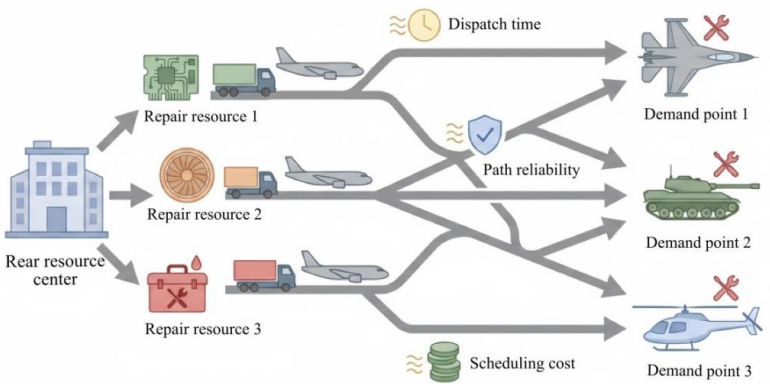
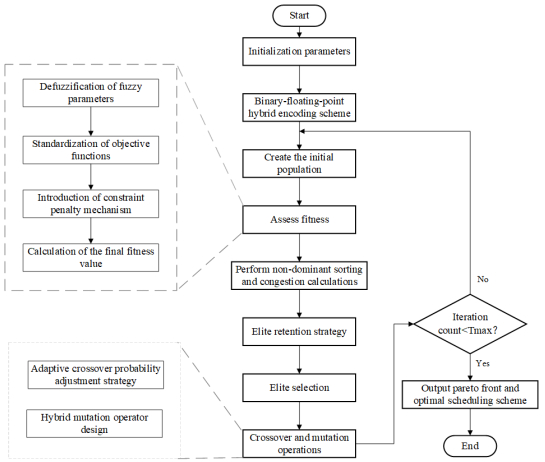
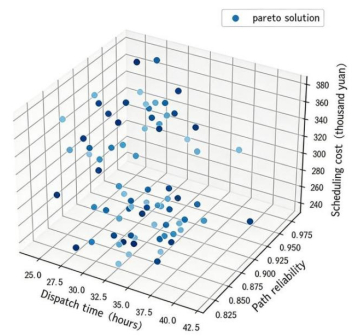
Equipment maintenance-support resource scheduling under high-disruption conditions is critical to sustaining the operational readiness of essential equipment. The main challenge is coordinating maintenance-resource demand, scheduling time, and route reliability among sources of operating-environment uncertainty. To address this challenge, we developed a triangular-fuzzy-number-based multi-objective optimization model for equipment maintenance-support resource scheduling under high-disruption conditions. The model jointly minimized scheduling time, maximized route reliability, and minimized scheduling cost. To improve solution quality, an improved NSGA-Ⅱ algorithm was developed by integrating a binary-real hybrid encoding scheme, adaptive genetic operators, and a constraint-penalty mechanism. The results indicated that the proposed model and algorithm enhanced the efficiency and robustness of maintenance-resource scheduling under high-disruption conditions and revealed the coupled trade-offs among scheduling time, route reliability, and scheduling cost under multiple uncertainties. This study provides a methodological basis and practical decision support for real-time aviation equipment maintenance scheduling in complex high-risk operating environments.
Citation: Li Lan, Hui Liu, Ji-Liang Tu, Dong-Hai Li, Yang Jiao, Fu-Xiang Yuan. Multi-objective optimization of aviation equipment maintenance resource scheduling under high-disruption conditions based on an improved NSGA-Ⅱ algorithm[J]. Journal of Industrial and Management Optimization, 2026, 22(7): 3504-3532. doi: 10.3934/jimo.2026128
Equipment maintenance-support resource scheduling under high-disruption conditions is critical to sustaining the operational readiness of essential equipment. The main challenge is coordinating maintenance-resource demand, scheduling time, and route reliability among sources of operating-environment uncertainty. To address this challenge, we developed a triangular-fuzzy-number-based multi-objective optimization model for equipment maintenance-support resource scheduling under high-disruption conditions. The model jointly minimized scheduling time, maximized route reliability, and minimized scheduling cost. To improve solution quality, an improved NSGA-Ⅱ algorithm was developed by integrating a binary-real hybrid encoding scheme, adaptive genetic operators, and a constraint-penalty mechanism. The results indicated that the proposed model and algorithm enhanced the efficiency and robustness of maintenance-resource scheduling under high-disruption conditions and revealed the coupled trade-offs among scheduling time, route reliability, and scheduling cost under multiple uncertainties. This study provides a methodological basis and practical decision support for real-time aviation equipment maintenance scheduling in complex high-risk operating environments.

| [1] |
J. T. Su, S. Dong, Multi-objective optimization for dynamic logistics scheduling based on hierarchical deep reinforcement learning, Sci. Rep., 15 (2025), 33544. https://doi.org/10.1038/S41598-025-18309-Y doi: 10.1038/S41598-025-18309-Y

|
| [2] |
C. G. Koepke, A. P. Armacost, C. Barnhart, S. E. Kolitz, An integer programming approach to support the US air force's air mobility network, Comput. Oper. Res., 35 (2006), 1771–1788. https://doi.org/10.1016/j.cor.2006.09.010 doi: 10.1016/j.cor.2006.09.010
|
| [3] |
Z. L. Deng, X. B. Liu, Y. Q. Dou, X. C. Su, H. X. Li, L. Wang, X. W. Wang, Autonomous sortie scheduling for carrier aircraft fleet under towing mode, Def. Technol., 43 (2025), 1–12. https://doi.org/10.1016/J.DT.2024.07.011 doi: 10.1016/J.DT.2024.07.011
|
| [4] |
X. Li, W, Zhang, X. D. Zhao, W. Pu, P. Chen, F. Liu, Wartime industrial logistics information integration: framework and application in optimizing deployment and formation of military logistics platforms, J. Ind. Inf. Integr., 22 (2021). https://doi.org/10.1016/J.JII.2021.100201 doi: 10.1016/J.JII.2021.100201
|
| [5] |
V. Hajipour, S. H. Kaveh, F. Yiğit, A. Gharaei, A multi-objective supply chain optimization model for reliable remanufacturing problems with M/M/m/k queues, Supply Chain Anal., 10 (2025), 100118. https://doi.org/10.1016/j.sca.2025.100118 doi: 10.1016/j.sca.2025.100118
|
| [6] |
F. J. Raffensperger, E. L. Schrage, Scheduling training for a tank battalion: How to measure readiness, Comput. Oper. Res., 35 (2008), 1844–1864. https://doi.org/10.1016/j.cor.2006.09.014 doi: 10.1016/j.cor.2006.09.014
|
| [7] |
G. S. Reed, M. D. Petty, N. J. Jones, A. W. Morris, J. P. Ballenger, H. S. Delugach, A principles-based model of ethical considerations in military decision-making, J. Def. Model. Simul., 13 (2016), 195–211. https://doi.org/10.1177/1548512915581213 doi: 10.1177/1548512915581213
|
| [8] |
Y. He, J. S. Zhao, S. C. Wang, Y. D. Liu, X. Zhou, Optimal scheduling of wartime equipment maintenance support forces based on maintenance priority, J. Mil. Transp. Univ., 21 (2019), 42–46. https://doi.org/10.16807/j.cnki.12-1372/e.2019.05.010 doi: 10.16807/j.cnki.12-1372/e.2019.05.010
|
| [9] |
K. Lei, P. Guo, Y. Wang, X. Wu, W. C. Zhao, Solve routing problems with a residual edge-graph attention neural network, Neurocomputing, 508 (2022), 79–98. https://doi.org/10.1016/J.NEUCOM.2022.08.005 doi: 10.1016/J.NEUCOM.2022.08.005
|
| [10] |
P. Zhou, H. P. Li, T. Y. Chai, SPEA2 based on grid density search and elite guidance for multi-objective operation optimization of wastewater treatment process, Appl. Soft Comput., 144 (2023), 110529. https://doi.org/10.1016/j.asoc.2023.110529 doi: 10.1016/j.asoc.2023.110529
|
| [11] |
X. W. Wang, X. H. Gao, L. Wang, X. C. Su, J. H. Jin, X. B. Liu, Z. L. Deng, Resilient multi-objective mission planning for UAV formation: A unified framework integrating task pre- and re-assignment, Def. Technol., 45 (2025), 203–226. https://doi.org/10.1016/J.DT.2024.08.002 doi: 10.1016/J.DT.2024.08.002
|
| [12] |
L. Hezewijk, N. P. Dellaert, W. L. Jaarsveld, Scalable deep reinforcement learning in the non-stationary capacitated lot sizing problem, Int. J. Prod. Econ., 284 (2025), 109601. https://doi.org/10.1016/J.IJPE.2025.109601 doi: 10.1016/J.IJPE.2025.109601
|
| [13] |
R. O'Neil, A. Khatab, C. Diallo, Optimizing predictive maintenance and mission assignment to enhance fleet readiness under uncertainty, Auton. Intell. Syst., 5 (2025), 17. https://doi.org/10.1007/S43684-025-00104-1 doi: 10.1007/S43684-025-00104-1
|
| [14] |
A. P. Chobar, H. Bigdeli, N. Shamami, M. Abolghasemian, Optimizing hub location for military equipment: A robust mathematical model for uncertainty and meta-heuristic approaches, Fuzzy Optim. Model., 5 (2024), 44–59. https://doi.org/10.71808/2024.fomj./1002657 doi: 10.71808/2024.fomj./1002657
|
| [15] |
X. B. Liu, L. Wang, X. Li, M. Y. Qian, X. C. Su, C. Lu, et al., Scheduling for carrier aircraft hangar maintenance in wave missions involving chance constraints, Asia-Pac. J. Oper. Res., 43 (2026), 2540014. https://doi.org/10.1142/S0217595925400147 doi: 10.1142/S0217595925400147
|
| [16] |
X. S. Zhang, A. P. Fu, C. S. Zhan, D. T. Pham, Q. Zhao, T. G. Qiang, et al., Selective disassembly sequence planning under uncertainty using trapezoidal fuzzy numbers: A novel hybrid metaheuristic algorithm, Eng. Appl. Artif. Intell., 128 (2024), 107459. https://doi.org/10.1016/j.engappai.2023.107459 doi: 10.1016/j.engappai.2023.107459
|
| [17] |
E. B. Tirkolaee, A. Goli, G. W. Weber, Fuzzy mathematical programming and self-adaptive artificial fish swarm algorithm for just-in-time energy-aware flow shop scheduling problem with outsourcing option, IEEE Trans. Fuzzy Syst., 28 (2020), 2772–2783. https://doi.org/10.1109/tfuzz.2020.2998174 doi: 10.1109/tfuzz.2020.2998174
|
| [18] |
Y. Jiao, Q. X. Tao, H. Liu, Q. R. Peng, Z. C. Zhou, Joint optimization of selective maintenance decision-making and maintenance personnel allocation under limited resources, J. Ind. Manag. Optim., 22 (2026), 1168–1193. https://doi.org/10.3934/jimo.2026043 doi: 10.3934/jimo.2026043
|
| [19] |
L. Y. Yu, Resource scheduling strategy based on improved whale optimization algorithm. Comput. Era, 41 (2023), 41–45, 51. https://doi.org/10.16644/j.cnki.cn33-1094/tp.2023.08.010 doi: 10.16644/j.cnki.cn33-1094/tp.2023.08.010
|
| [20] |
X. Zan, C. L. Chen, S. X. Zhang, W. L. Chen, Y. F. Mei (2018) Wartime equipment maintenance task scheduling method considering time uncertainty, J. Mech. Eng., 54 (2018), 226–232. https://doi.org/10.3901/JME.2018.24.226 doi: 10.3901/JME.2018.24.226
|
| [21] |
K. Li, T. L. Liu, L. Zhang, M. Y. Li, Optimization of wartime multi-objective ammunition scheduling model based on AHP, Logist. Technol., 46 (2023), 156–159. https://doi.org/10.13714/j.cnki.1002-3100.2023.01.036 doi: 10.13714/j.cnki.1002-3100.2023.01.036
|
| [22] | J. Zhang, F. Zhu, C. Wang, D. Li, Z. Q. Chen, T. Q. Lü, Optimization of multi-agent collaborative algorithm based on deep reinforcement learning under battlefield kill chain construction, Syst. Eng. Electron., 48 (2026), 1–14.https://link.cnki.net/urlid/11.2422.tn.20260320.1343.039 |
| [23] |
X. Li, X. Zhao, W. Pu, P. Chen, F. Liu, Z. N. He, Optimal decisions for operations management of BDAR: A military industrial logistics data analytics perspective. Comput. Ind. Eng., 137 (2019), 106100. https://doi.org/10.1016/j.cie.2019.106100 doi: 10.1016/j.cie.2019.106100
|
| [24] |
Y. Yan, X. Di, Y. Zhang, Optimization-driven distribution of relief materials in emergency disasters. Complex Intell Syst., 9 (2023), 2249–2256. https://doi.org/10.1007/s40747-021-00290-4 doi: 10.1007/s40747-021-00290-4
|
| [25] |
S. H. Wang, S. X. Zhang, Y. S. Dong, K. Gao, Z. J. Peng, Research on modeling and simulation method for effectiveness evaluation of armored equipment support, J. Ordnance Equip. Eng., 39 (2018), 101–106. https://doi.org/10.11809/bqzbgcxb2018.09.022 doi: 10.11809/bqzbgcxb2018.09.022
|
| [26] |
R. N. Fan, Y. P. Lai, S. W. Yao, Q. Liu, Reentrant scheduling optimization method for large ship blanking workshop based on LNS-CAGA, Comput. Integr. Manuf. Syst., 31 (2025), 1–21. https://doi.org/10.13196/j.cims.2025.0440 doi: 10.13196/j.cims.2025.0440
|
| [27] |
Z. L. Yang, K. S. Zhang, X. Y. Huang, W. Z. Liu, Cost optimization of intelligent inspection for special-shaped parts in aviation manufacturing, China New Technol. Prod., 34 (2026), 9–11. https://doi.org/10.13612/j.cnki.cntp.2026.08.018 doi: 10.13612/j.cnki.cntp.2026.08.018
|
| [28] |
J. Gao, W. Xia, X. Y. Zhou, H. Q. Sun, Dynamic scheduling of imaging satellites based on phenotypic genetic algorithm, J. Command Control, 12 (2024), 1–12. https://doi.org/10.20278/j.jc2.2096-0204.2024.0353 doi: 10.20278/j.jc2.2096-0204.2024.0353
|
| [29] |
Z. M. Zhu, C. Q. Yu, J. T. Wang, A hybrid genetic algorithm and proximal policy optimization system for efficient multi-agent task allocation, Systems, 13 (2025), 453. https://doi.org/10.3390/SYSTEMS13060453 doi: 10.3390/SYSTEMS13060453
|
| [30] |
T. Quadt, R. Lindelauf, M. Voskuijl, H. Monsuur, B. Čule, Dealing with multiple optimization objectives for UAV path planning in hostile environments: a literature review, Drones, 8 (2024), 769. https://doi.org/10.3390/DRONES8120769 doi: 10.3390/DRONES8120769
|
Figures(9) / Tables(14)
Li Lan, Hui Liu, Ji-Liang Tu, Dong-Hai Li, Yang Jiao, Fu-Xiang Yuan. Multi-objective optimization of aviation equipment maintenance resource scheduling under high-disruption conditions based on an improved NSGA-Ⅱ algorithm[J]. Journal of Industrial and Management Optimization, 2026, 22(7): 3504-3532. doi: 10.3934/jimo.2026128




 DownLoad: