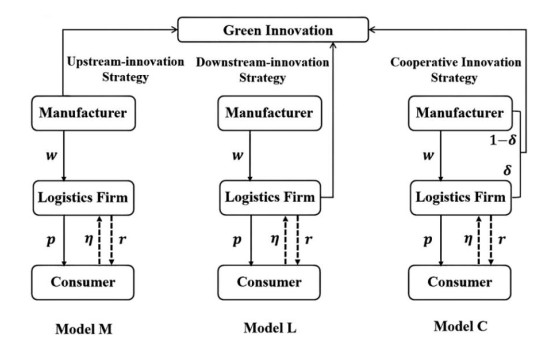
Mitigating the environmental impact of used express packaging has become an urgent imperative for firms seeking to assume environmental responsibility. Here, we considered a closed-loop supply chain comprising a package manufacturer and a logistics firm and explored the optimal green innovation strategy (upstream-invest, downstream-invest, or collaboration). First, we observed that, contingent upon the specific entity undertaking green innovation and the associated investment efficiency, heightened consumer environmental awareness does not unilaterally increase recycling volume, nor does it invariably diminish the recycling incentives of logistics firms. Second, due to the high investment threshold, cooperative innovation is difficult to achieve. However, when the manufacturer considers environmental, social, and governance (ESG) dual-purpose, it prefers to achieve collaboration by shouldering a larger share of the innovation investment, thereby creating win‑win scenarios. Third, when the logistics firm invests in green innovation independently or cooperatively, the manufacturer's green innovation level increases monotonically with its ESG concern in both scenarios. This strategic framework can optimize green innovation investments in circular packaging and meet consumer environmental expectations while maintaining a performance advantage.
Citation: Shuli Yang, Junwu Chai, Zhifeng Qian. Green innovation strategies for circular express packaging[J]. Journal of Industrial and Management Optimization, 2026, 22(7): 3480-3503. doi: 10.3934/jimo.2026127
Mitigating the environmental impact of used express packaging has become an urgent imperative for firms seeking to assume environmental responsibility. Here, we considered a closed-loop supply chain comprising a package manufacturer and a logistics firm and explored the optimal green innovation strategy (upstream-invest, downstream-invest, or collaboration). First, we observed that, contingent upon the specific entity undertaking green innovation and the associated investment efficiency, heightened consumer environmental awareness does not unilaterally increase recycling volume, nor does it invariably diminish the recycling incentives of logistics firms. Second, due to the high investment threshold, cooperative innovation is difficult to achieve. However, when the manufacturer considers environmental, social, and governance (ESG) dual-purpose, it prefers to achieve collaboration by shouldering a larger share of the innovation investment, thereby creating win‑win scenarios. Third, when the logistics firm invests in green innovation independently or cooperatively, the manufacturer's green innovation level increases monotonically with its ESG concern in both scenarios. This strategic framework can optimize green innovation investments in circular packaging and meet consumer environmental expectations while maintaining a performance advantage.

| [1] |
S. Zhang, H. Hou, G. Wang, Y. Yao, Y. Zhang, H. Xu, Exploring the metabolic characteristic of express packaging waste to promote the synergy of pollution and carbon reduction, Environ. Impact Assess. Rev., 106 (2024), 107523. https://doi.org/10.1016/j.eiar.2024.107523 doi: 10.1016/j.eiar.2024.107523

|
| [2] | State Council, Guiding opinions on accelerating the green transition of express packaging (No.115 of the General Office of the State Council), 2020. Available from: https://www.gov.cn/zhengce/zhengceku/2020-12/14/content_5569345.htm. |
| [3] | U.S. Environmental Protection Agency, EPA releases bold national strategy to transform U.S. recycling, California Stands at forefront, 2021. Available from: https://www.epa.gov/newsreleases/epa-releases-bold-national-strategy-transform-us-recycling-california-stands-forefront. |
| [4] | KPMG, New packaging implementation act tightens obligations for companies, 2025. Available from: https://kpmg-law.de/en/new-packaging-implementation-act-tightens-obligations-for-companies/. |
| [5] | Government of Japan, Concerning the act on promotion of resource circulation for plastics, 2022. Available from: https://www.gov-online.go.jp/eng/publicity/book/hlj/html/202205/202205_09_en.html. |
| [6] | Elabel, Amazon pushes more brands towards frustration free packaging, 2021. Available from: https://zhuanlan.zhihu.com/p/540697558. |
| [7] | R. Wang, Reusable up to 70 times, it gives your valuables an exclusive "golden bell cover" when shipping with SF Express, 2022. Available from: https://baijiahao.baidu.com/s?id = 1730527008153912276 & wfr = spider & for = pc. |
| [8] | Jiayuan, Recyclable over 20 times! JD Logistics has deployed 100,000 "Green Stream Boxes" across China, 2017. Available from: https://www.xitongzhijia.net/news/20171208/114198.html. |
| [9] | J. Huang, Green design international awards showcase (13) | zero-tape nestable reusable box, 2025. Available from: http://www.toutiao.com/article/7472763074852749835/?wid = 1782289434597. |
| [10] | LimeLoop, Revolutionizing smart reusable packaging, 2022. Available from: https://www.thelimeloop.com/guide/blog/revolutionizing-smart-reusable-packaging. |
| [11] | K. Gu, Anhui post and Fengyuan group signed a comprehensive strategic cooperation agreement, 2022. Available from: https://www.bengbu.gov.cn/ldzc/lddt/50003263.html. |
| [12] | Repack, The package refurbished tech deserves, 2023. Available from: https://www.repack.com/. |
| [13] |
M. C. Jensen, W. H. Meckling, Theory of the firm: Managerial behavior, agency costs and ownership structure, J. Financ. Econ., 3 (1976), 305−360. https://doi.org/10.1016/0304-405X(76)90026-X doi: 10.1016/0304-405X(76)90026-X
|
| [14] |
A. Schneider, J. Murray, Escaping the loop of unsustainability: Why and how business ethics matters for earth system justice, J. Bus. Ethics, 196 (2025), 21−29. https://doi.org/10.1007/s10551-024-05728-6 doi: 10.1007/s10551-024-05728-6
|
| [15] |
S. D. Dmytriyev, R. E. Freeman, J. Hörisch, The relationship between stakeholder theory and corporate social responsibility: Differences, similarities, and implications for social issues in management, J. Manag. Stud., 58 (2021), 1441−1470. https://doi.org/10.1111/joms.12684 doi: 10.1111/joms.12684
|
| [16] |
W. Ping, Y. Mao, Q. Zhu, H. Shu, ESG-driven corporate value creation under the paradigm of ecological civilization: Evidence from the shareholder, industrial chain and consumer channels, Soc. Sci. China, 44 (2023), 129−157. https://doi.org/10.1080/02529203.2023.2192090 doi: 10.1080/02529203.2023.2192090
|
| [17] |
A. Arya, B. Mittendorf, R. N. Ramanan, Beyond profits: The rise of dual-purpose organizations and its consequences for disclosure, Account. Rev., 94 (2019), 25−43. https://doi.org/10.2308/accr-52166 doi: 10.2308/accr-52166
|
| [18] |
K. E. Aupperle, A. B. Carroll, J. D. Hatfield, An empirical examination of the relationship between corporate social responsibility and profitability, Acad. Manage. J., 28 (1985), 446−463. https://doi.org/10.2307/256210 doi: 10.2307/256210
|
| [19] |
R. Narula, P. Rao, S. Kumar, A. Paltrinieri, ESG investing and firm performance: Retrospections of past and reflections of future, Corp. Soc. Responsib. Environ. Manag., 32 (2025), 1096−1121. https://doi.org/10.1002/csr.2982 doi: 10.1002/csr.2982
|
| [20] |
M. G. Bruna, S. Loprevite, D. Raucci, B. Ricca, D. Rupo, Investigating the marginal impact of ESG results on corporate financial performance, Finance Res. Lett., 47 (2022), 102828. https://doi.org/10.1016/j.frl.2022.102828 doi: 10.1016/j.frl.2022.102828
|
| [21] |
S. Taddeo, P. Agnese, F. Busato, Rethinking the effect of ESG practices on profitability through cross-dimensional substitutability, J. Environ. Manag., 352 (2024), 120115. https://doi.org/10.1016/j.jenvman.2024.120115 doi: 10.1016/j.jenvman.2024.120115
|
| [22] |
A. Atasu, G. C. Souza, How does product recovery affect quality choice? Prod. Oper. Manag., 22 (2013), 991−1010. https://doi.org/10.1111/j.1937-5956.2011.01290.x doi: 10.1111/j.1937-5956.2011.01290.x
|
| [23] |
Y. S. Chen, S. B. Lai, C. T. Wen, The influence of green innovation performance on corporate advantage in Taiwan, J. Bus. Ethics, 67 (2006), 331−339. https://doi.org/10.1007/s10551-006-9025-5 doi: 10.1007/s10551-006-9025-5
|
| [24] |
M. H. C. Resnitzky, G. Grander, L. F. da Silva, E. D. R. S. Gonzalez, Innovation projects of packaging recycling to a circular economy, Sustain. Oper. Comput., 2 (2021), 115−121. https://doi.org/10.1016/j.susoc.2021.05.005 doi: 10.1016/j.susoc.2021.05.005
|
| [25] |
T. Ramayah, J. W. C. Lee, S. Lim, Sustaining the environment through recycling: An empirical study, J. Environ. Manag., 102 (2012), 141−147. https://doi.org/10.1016/j.jenvman.2012.02.025 doi: 10.1016/j.jenvman.2012.02.025
|
| [26] |
R. C. Savaskan, S. Bhattacharya, L. N. Van Wassenhove, Closed-loop supply chain models with product remanufacturing, Manag. Sci., 50 (2004), 239−252. https://doi.org/10.1287/mnsc.1030.0186 doi: 10.1287/mnsc.1030.0186
|
| [27] |
Q. Qian, L. Liu, Y. Yang, To innovate or not? The optimal innovation strategy choice in a supply chain-from the perspective of the leading supplier, Int. Trans. Oper. Res., 32 (2025), 2398−2428. https://doi.org/10.1111/itor.13400 doi: 10.1111/itor.13400
|
| [28] |
X. Yu, Y. Lan, R. Zhao, Strategic green technology innovation in a two-stage alliance: Vertical collaboration or co-development? Omega, 98 (2021), 102116. https://doi.org/10.1016/j.omega.2019.102116 doi: 10.1016/j.omega.2019.102116
|
| [29] |
G. Wei, X. Chen, X. Qin, Product greenness and pricing strategy of supply chain incorporating asymmetric heterogeneous preferences, IEEE Access, 9 (2021), 11563−11584. https://doi.org/10.1109/ACCESS.2021.3050550 doi: 10.1109/ACCESS.2021.3050550
|
| [30] |
J. Jian, B. Li, N. Zhang, J. Su, Decision-making and coordination of green closed-loop supply chain with fairness concern, J. Clean. Prod., 298 (2021), 126779. https://doi.org/10.1016/j.jclepro.2021.126779 doi: 10.1016/j.jclepro.2021.126779
|
| [31] |
H. Li, L. Ge, J. Xi, S. Li, Dynamic analysis of a firm's green and process innovation under green-based price regulation in a monopoly market with network externality, J. Ind. Manag. Optim., 22 (2026), 776−805. https://doi.org/10.3934/jimo.2026028 doi: 10.3934/jimo.2026028
|
| [32] |
R. Chenavaz, Dynamic pricing, product and process innovation, Eur. J. Oper. Res., 222 (2012), 553−557. https://doi.org/10.1016/j.ejor.2012.05.009 doi: 10.1016/j.ejor.2012.05.009
|
| [33] |
P. Ma, H. Wang, J. Shang, Contract design for two-stage supply chain coordination: Integrating manufacturer-quality and retailer-marketing efforts, Int. J. Prod. Econ., 146 (2013), 745−755. https://doi.org/10.1016/j.ijpe.2013.09.004 doi: 10.1016/j.ijpe.2013.09.004
|
| [34] |
R. Yue, X. Xu, Z. Li, Q. Bai, Reusable packaging adoption in e-commerce markets with green consumers: An evolutionary game analysis, J. Retail. Consum. Serv., 81 (2024), 103818. https://doi.org/10.1016/j.jretconser.2024.103818 doi: 10.1016/j.jretconser.2024.103818
|
| [35] |
Z. Deng, M. R. Shaharudin, S. S. R. Shariff, M. L. Tseng, Decision-making of third-party remanufacturing supply chain with risk aversion and retail service, J. Ind. Manag. Optim., 22 (2026), 1693−1725. https://doi.org/10.3934/jimo.2026063 doi: 10.3934/jimo.2026063
|
| [36] |
D. Ghosh, J. Shah, Supply chain analysis under green sensitive consumer demand and cost sharing contract, Int. J. Prod. Econ., 164 (2015), 319−329. https://doi.org/10.1016/j.ijpe.2014.11.005 doi: 10.1016/j.ijpe.2014.11.005
|
| [37] |
K. Kogan, C. S. Tapiero, Optimal co-investment in supply chain infrastructure, Eur. J. Oper. Res., 192 (2009), 265−276. https://doi.org/10.1016/j.ejor.2007.08.038 doi: 10.1016/j.ejor.2007.08.038
|
| [38] |
C.L. Cantu, A. Tunisini, A circular innovation strategy in a supply network context: Evidence from the packaging industry, J. Bus. Ind. Mark., 38 (2023), 220−238. https://doi.org/10.1108/JBIM-07-2021-0325 doi: 10.1108/JBIM-07-2021-0325
|
| [39] |
J. Chai, Z. Qian, F. Wang, J. Zhu, Process innovation for green product in a closed loop supply chain with remanufacturing, Ann. Oper. Res., 333 (2024), 533−557. https://doi.org/10.1007/s10479-020-03888-y doi: 10.1007/s10479-020-03888-y
|
| [40] |
Y. Liu, T. Xiao, Pricing and collection rate decisions and reverse channel choice in a socially responsible supply chain with green consumers, IEEE Trans. Eng. Manag., 67 (2019), 483−495. https://doi.org/10.1109/TEM.2018.2887118 doi: 10.1109/TEM.2018.2887118
|
| [41] |
J. Li, Y. Xu, J. Jiao, R. Yang, J. Zha, Do recycling channels affect young consumers' choices for formal power battery recycling? J. Clean. Prod., 425 (2023), 138766. https://doi.org/10.1016/j.jclepro.2023.138766 doi: 10.1016/j.jclepro.2023.138766
|
| [42] |
X. Guo, X. Li, J. Bian, C. Yang, Deposit or reward: Express packaging recycling for online retailing platforms, Omega, 117 (2023), 102828. https://doi.org/10.1016/j.omega.2022.102828 doi: 10.1016/j.omega.2022.102828
|
| [43] |
Y. Fernando, M. L. Tseng, R. Sroufe, A. Z. Abideen, M. S. Shaharudin, R. Jose, Eco-innovation impacts on recycled product performance and competitiveness: Malaysian automotive industry, Sustain. Prod. Consum., 28 (2021), 1677−1686. https://doi.org/10.1016/j.spc.2021.09.010 doi: 10.1016/j.spc.2021.09.010
|
| [44] |
X. Guo, S. Yao, Q. Wang, H. Zhao, Y. Zhao, F. Zeng et al., The impact of packaging recyclable ability on environment: Case and scenario analysis of polypropylene express boxes and corrugated cartons, Sci. Total Environ., 822 (2022), 153650. https://doi.org/10.1016/j.scitotenv.2022.153650 doi: 10.1016/j.scitotenv.2022.153650
|
| [45] |
B. Sarkar, M. Ullah, M. Sarkar, Environmental and economic sustainability through innovative green products by remanufacturing, J. Clean. Prod., 332 (2022), 129813. https://doi.org/10.1016/j.jclepro.2021.129813 doi: 10.1016/j.jclepro.2021.129813
|
| [46] |
W. Wang, Y. Wang, D. Mo, M. M. Tseng, Managing component reuse in remanufacturing under product diffusion dynamics, Int. J. Prod. Econ., 183 (2017), 551−560. https://doi.org/10.1016/j.ijpe.2016.06.010 doi: 10.1016/j.ijpe.2016.06.010
|
| [47] |
M. R. Galbreth, T. Boyaci, V. Verter, Product reuse in innovative industries, Prod. Oper. Manag., 22 (2013), 1011−1033. https://doi.org/10.1111/j.1937-5956.2012.01330 doi: 10.1111/j.1937-5956.2012.01330
|
| [48] |
M. Mahmoudi, I. Parviziomran, Reusable packaging in supply chains: A review of environmental and economic impacts, logistics system designs, and operations management, Int. J. Prod. Econ., 228 (2020), 107730. https://doi.org/10.1016/j.ijpe.2020.107730 doi: 10.1016/j.ijpe.2020.107730
|
| [49] |
C. K. Kao, M. Sun, Z. B. Tang, Y. P. Luo, F. Zeng, Green manufacturing strategy of e-commerce express packaging in china, Int. Technol. Manag. Rev., 9 (2020), 11−26. https://doi.org/10.2991/itmr.k.200304.001 doi: 10.2991/itmr.k.200304.001
|
| [50] |
Y. Xiao, S. X. Zhou, Trade‐in for cash or for upgrade? Dynamic pricing with customer choice, Prod. Oper. Manag., 29 (2020), 856−881. https://doi.org/10.1111/poms.13140 doi: 10.1111/poms.13140
|
| [51] |
L. Meherishi, S. A. Narayana, K. S. Ranjani, Integrated product and packaging decisions with secondary packaging returns and protective packaging management, Eur. J. Oper. Res., 292 (2021), 930−952. https://doi.org/10.1016/j.ejor.2020.11.022 doi: 10.1016/j.ejor.2020.11.022
|
| [52] | Y. Chen, From reusable courier boxes to "cartons for eggs" campaigns, green recycling is taking off during the Double 11 shopping festival, 2022. Available from: https://www.thepaper.cn/newsDetail_forward_20761286. |
| [53] |
Q. Zhang, J. Zhang, G. Zaccour, W. Tang, Strategic technology licensing in a supply chain, Eur. J. Oper. Res., 267 (2018), 162−175. https://doi.org/10.1016/j.ejor.2017.11.036 doi: 10.1016/j.ejor.2017.11.036
|
| [54] |
Z. L. Liu, T. D. Anderson, J. M. Cruz, Consumer environmental awareness and competition in two-stage supply chains, Eur. J. Oper. Res., 218 (2012), 602−613. https://doi.org/10.1016/j.ejor.2011.11.027 doi: 10.1016/j.ejor.2011.11.027
|
| [55] |
Z. Liu, K. W. Li, B. Y. Li, J. Huang, J. Tang, Impact of product-design strategies on the operations of a closed-loop supply chain, Transp. Res. Part E, 124 (2019), 75−91. https://doi.org/10.1016/j.tre.2019.02.007 doi: 10.1016/j.tre.2019.02.007
|
| [56] | E. Von Hippel, The sources of innovation, In: Innovation cooperation between competing firms (Chapter 8), Oxford University Press, 1988,102−110. |
| [57] | European Commission, European green deal: Commission proposes transformation of EU economy and society to meet climate ambitions, 2021. Available from: https://ec.europa.eu/newsroom/move/items/717355/. |
| [58] | P. Wang, A new blueprint for high-quality development in modern logistics, 2023. Available from: https://www.xinhuanet.com/city/20230104/fc9f6ede12bb4f2ea36642363ed177fa/c.html. |
| [59] |
D. Yu, B. Xu, The jevons paradox in the ai era: Artificial intelligence adoption for enhancing environmental sustainability at the firm level, Econ. Anal. Policy, 90 (2026), 946−966. https://doi.org/10.1016/j.eap.2026.01.060 doi: 10.1016/j.eap.2026.01.060
|
Figures(7) / Tables(2)
Shuli Yang, Junwu Chai, Zhifeng Qian. Green innovation strategies for circular express packaging[J]. Journal of Industrial and Management Optimization, 2026, 22(7): 3480-3503. doi: 10.3934/jimo.2026127




 DownLoad: