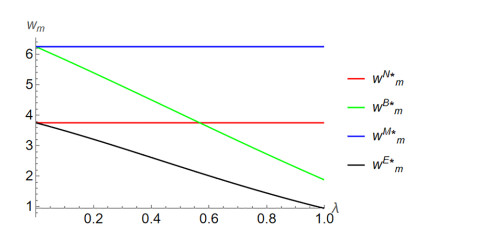
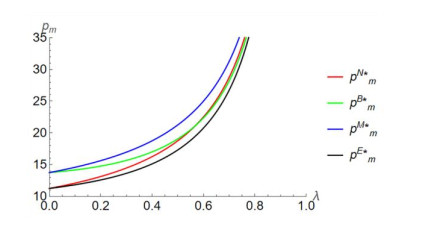
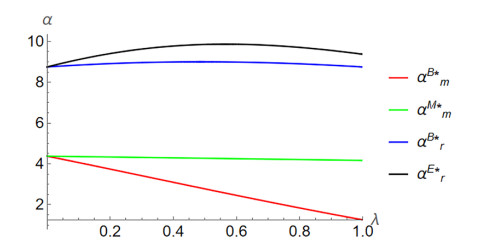
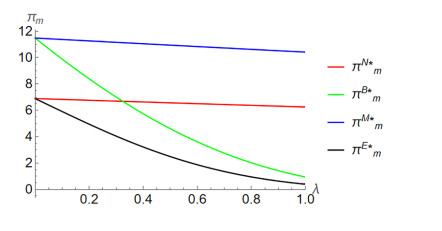
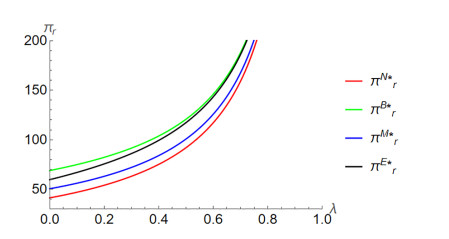
This study examines pricing and green innovation decisions in an e-retail platform supply chain where a national brand (NB) competes directly with a platform-owned private brand (PB). Using a Stackelberg game framework, we analyze four scenarios: No innovation, NB-only innovation, PB-only innovation, and bilateral innovation. The key findings are as follows. Network externalities consistently benefit all supply chain members and enhance green innovation levels across scenarios, but their impact on retail prices is scenario-dependent. The NB manufacturer achieves its highest profit under NB-only innovation, whereas the e-retail platform prefers bilateral innovation, which constitutes the unique Nash equilibrium. This misalignment creates a green innovation prisoner's dilemma: Although bilateral innovation maximizes the total supply chain profit, the manufacturer earns less than under NB-only innovation. Moreover, standalone green innovation by either party yields higher green levels than bilateral innovation. These findings suggest that coordinating bilateral green innovation may require profit-sharing mechanisms, and that innovation strategies should be tailored to the market conditions.
Citation: Chuanxu Wang, Yingying Chen. Pricing and green innovation for national and private brands on the e-retail platform[J]. Journal of Industrial and Management Optimization, 2026, 22(7): 3310-3344. doi: 10.3934/jimo.2026121
This study examines pricing and green innovation decisions in an e-retail platform supply chain where a national brand (NB) competes directly with a platform-owned private brand (PB). Using a Stackelberg game framework, we analyze four scenarios: No innovation, NB-only innovation, PB-only innovation, and bilateral innovation. The key findings are as follows. Network externalities consistently benefit all supply chain members and enhance green innovation levels across scenarios, but their impact on retail prices is scenario-dependent. The NB manufacturer achieves its highest profit under NB-only innovation, whereas the e-retail platform prefers bilateral innovation, which constitutes the unique Nash equilibrium. This misalignment creates a green innovation prisoner's dilemma: Although bilateral innovation maximizes the total supply chain profit, the manufacturer earns less than under NB-only innovation. Moreover, standalone green innovation by either party yields higher green levels than bilateral innovation. These findings suggest that coordinating bilateral green innovation may require profit-sharing mechanisms, and that innovation strategies should be tailored to the market conditions.

| [1] | Y. L. Zheng, Q. Cai, C. G. Bai, L. Wang, X. Jiang, Evolutionary game of production strategies in co-opetitive supply chains under network externality, Syst. Eng., 42 (2024), 65–83. https://link.cnki.net/urlid/43.1115.n.20230921.1448.004 |
| [2] |
Z. Liu, T. D. Anderson, J. M. Cruz, Consumer environmental awareness and competition in two-stage supply chains, Eur. J. Oper. Res., 218 (2012), 602–613. https://doi.org/10.1016/j.ejor.2011.11.027 doi: 10.1016/j.ejor.2011.11.027

|
| [3] |
J. Bai, Implementing the top ten actions for energy conservation and carbon reduction to accelerate high-quality development–The state council issued the "2024-2025 action plan for energy conservation and carbon reduction", Sci. Technol. Ind. China, 6 (2024), 20–21. https://link.cnki.net/doi/10.16277/j.cnki.cn11-2502/n.2024.06.032 doi: 10.16277/j.cnki.cn11-2502/n.2024.06.032
|
| [4] |
T. Yang, C. Q. Ma, X. H. Mi, The transformative potential of blockchain technology in developing green supply chain: An evolutionary perspective on complex networks, Comput. Ind. Eng., 197 (2024), 110548. https://doi.org/10.1016/j.cie.2024.110548 doi: 10.1016/j.cie.2024.110548
|
| [5] |
M. Ovaere, S. Proost, Cost-effective reduction of fossil energy use in the European transport sector: An assessment of the Fit for 55 Package, Energ. Policy, 168 (2022), 113085. https://doi.org/10.1016/j.enpol.2022.113085 doi: 10.1016/j.enpol.2022.113085
|
| [6] |
Q. G. Bai, J. T. Xu, Y. Y. Zhang, Emission reduction decision and coordination of a make-to-order supply chain with two products under cap-and-trade regulation, Comput. Ind. Eng., 119 (2018), 131–145. https://doi.org/10.1016/j.cie.2018.03.032 doi: 10.1016/j.cie.2018.03.032
|
| [7] |
D. E. Mills, Why retailers sell private labels, J. Econ. Manage. Strat., 4 (1995), 509–528. https://doi.org/10.1111/j.1430-9134.1995.00509.x doi: 10.1111/j.1430-9134.1995.00509.x
|
| [8] |
S. K. Dhar, S. J. Hoch, Why store brand penetration varies by retailer, Market. Sci., 16 (1997), 208–227. https://doi.org/10.1287/mksc.16.3.208 doi: 10.1287/mksc.16.3.208
|
| [9] |
S. Meza, K. Sudhir, Do private labels increase retailer bargaining power? Qme-quant. Mark. Econ., 8 (2010), 333–363. https://link.springer.com/article/10.1007/s11129-010-9085-9 doi: 10.1007/s11129-010-9085-9
|
| [10] | H. Y. Wang, Y. Zhou, "New-style OEM" and Independent Innovation, China Soft Sci., 9 (2007), 21–24. |
| [11] |
J. Shan, H. Y. Qin, A review and prospect of the impact of high-end store brands on retailer competition, Mod. Manag., 37 (2017), 127–129. https://doi.org/10.3969/j.issn.1003-1154.2017.01.037 doi: 10.3969/j.issn.1003-1154.2017.01.037
|
| [12] | K. Li, J. H. Sun, J. Y. Yan, Impact analysis of retailer introducing store brand under indirect and hybrid channels, Oper. Res. Manag. Sci., 26 (2017), 103. |
| [13] |
X. J. Fan, C. F. Wang, Y. Liu, Store brand positioning strategy and channel effect under cost differential, Syst. Eng. Theory Pract., 38 (2018), 2006–2017. https://doi.org/10.12011/1000-6788(2018)08-2006-12 doi: 10.12011/1000-6788(2018)08-2006-12
|
| [14] |
M. Szymanowski, E. Gijsbrechts, Consumption-based cross-brand learning: are private labels really private? J. Marketing Res., 49 (2012), 231–246. https://journals.sagepub.com/doi/abs/10.1509/jmr.07.0416 doi: 10.1509/jmr.07.0416
|
| [15] |
E. Manzur, S. Olavarrieta, P. Hidalgo, P. Farías, R. Uribe, Store brand and national brand promotion attitudes antecedents, J. Bus. Res., 64 (2011), 286–291. https://doi.org/10.1016/j.jbusres.2009.11.014 doi: 10.1016/j.jbusres.2009.11.014
|
| [16] |
S. Nasser, D. Turcic, C. Narasimhan, National brand's response to store brands: throw in the towel or fight back? Market. Sci., 32 (2013), 591–608. https://doi.org/10.1287/mksc.2013.0788 doi: 10.1287/mksc.2013.0788
|
| [17] | Q. Lv, J. Z. Huo, Advertising-involved game between supplier and retailer for store brand competition, J. Syst. Manag., 23 (2014), 174–178. https://xtglxb.sjtu.edu.cn/CN/Y2014/V23/I2/174 |
| [18] |
N. Amrouche, R. L. Yan, Aggressive or partnership strategy: Which choice is better for the national brand? Int. J. Prod. Econ., 166 (2015), 50–63. https://doi.org/10.1016/j.ijpe.2015.04.014 doi: 10.1016/j.ijpe.2015.04.014
|
| [19] |
Q. C. Shen, B. He, Can manufacturer advertising curb the introduction of store brands by retailers? J. Ind. Eng. Eng. Manag., 36 (2022), 138–147. https://doi.org/10.13587/j.cnki.jieem.2022.02.012 doi: 10.13587/j.cnki.jieem.2022.02.012
|
| [20] |
Q. Guo, P. F. Zhao, S. Y. Cheng, M. Ahmed, Two-period price competition of second-hand product platforms with or without blockchain under different supply and demand levels, Comput. Ind. Eng., 178 (2023), 109131. https://doi.org/10.1016/j.cie.2023.109131 doi: 10.1016/j.cie.2023.109131
|
| [21] |
L. Shen, R. J. Fan, Y. Y. Wang, H. Li, R. Y. Tang, Advertising and pricing of online direct selling considering network externalities, Ind. Manag. Data Syst., 123 (2023), 2751–2770. https://doi.org/10.1108/IMDS-04-2021-0247 doi: 10.1108/IMDS-04-2021-0247
|
| [22] |
W. Li, Y. P. He, S. G. Ma, Channel management for digital products in the two‐sided market with network externality effects, Discrete Dyn. Nat. Soc., 2023 (2023), 3461050. https://doi.org/10.1155/2023/3461050 doi: 10.1155/2023/3461050
|
| [23] |
L. Shen, F. Lin, Y. Y. Wang, X. Su, H. Li, R. Zhou, Advertising decisions of platform supply chains considering network externalities and fairness concerns, Mathematics, 10 (2022), 2359. https://doi.org/10.3390/math10132359 doi: 10.3390/math10132359
|
| [24] | Y. Cui, Research on the impact of network externality and free-riding behavior on decision-making in e-commerce supply chain, 2024. |
| [25] |
Y. M. Li, Y. Xiong, Y. Zhou, Dynamic pricing strategies: Uniform or discrimination for multi-channel retailing under platform-based supply chain competition, J. Bus. Res., 166 (2023), 114087. https://doi.org/10.1016/j.jbusres.2023.114087 doi: 10.1016/j.jbusres.2023.114087
|
| [26] |
G. Y. Lyu, H. Q. Hu, G. M. Zhuang, C. Y. Xi, C2M strategies on an e-commerce platform under brand competition, Transport. Res. E. Log., 177 (2023), 103184. https://doi.org/10.1016/j.tre.2023.103184 doi: 10.1016/j.tre.2023.103184
|
| [27] |
Z. S. Huang, W. Zhang, B. Liu, Strategic introduction of private brand in the online retail platform, Rairo. Oper. Res., 57 (2023), 1377–1396. https://doi.org/10.1051/ro/2023080 doi: 10.1051/ro/2023080
|
| [28] |
J. J. Zhao, Y. Y. Wang, L. F. Tu, J. C. Wang, X. Luo, The interactions between online platform's store brand introduction and manufacturer's innovation strategies: Reselling vs. agency modes, Electron. Commer. R. A., 62 (2023), 101320. https://doi.org/10.1016/j.elerap.2023.101320 doi: 10.1016/j.elerap.2023.101320
|
| [29] |
J. Xia, W. J. Niu, Carbon-reducing contract design for a supply chain with environmental responsibility under asymmetric information, Omega, 102 (2021), 102390. https://doi.org/10.1016/j.omega.2020.102390 doi: 10.1016/j.omega.2020.102390
|
| [30] |
Q. Peng, C. Wang, M. Goh, Green innovation decision and coordination of supply chain under corporate social responsibility and risk preferences, Comput. Ind. Eng., 185 (2023), 109703. https://doi.org/10.1016/j.cie.2023.109703 doi: 10.1016/j.cie.2023.109703
|
| [31] |
M. Hafezi, X. Zhao, H. Zolfagharinia, Together we stand? Co-opetition for the development of green products, Eur. J. Oper. Res., 306 (2023), 1417–1438. https://doi.org/10.1016/j.ejor.2022.07.027 doi: 10.1016/j.ejor.2022.07.027
|
| [32] |
A. Yenipazarli, To collaborate or not to collaborate: Prompting upstream eco-efficient innovation in a supply chain, Eur. J. Oper. Res., 260 (2017), 571–587. https://doi.org/10.1016/j.ejor.2016.12.035 doi: 10.1016/j.ejor.2016.12.035
|
| [33] |
Z. F. Hong, X. L. Guo, Green product supply chain contracts considering environmental responsibilities, Omega, 83 (2019), 155–166. https://doi.org/10.1016/j.omega.2018.02.010 doi: 10.1016/j.omega.2018.02.010
|
| [34] |
J. Wei, C. Wang, Improving interaction mechanism of carbon reduction technology innovation between supply chain enterprises and government by means of differential game, J. Clean. Prod., 296 (2021), 126578. https://doi.org/10.1016/j.jclepro.2021.126578 doi: 10.1016/j.jclepro.2021.126578
|
| [35] |
K. Y. Liu, W. Li, F. Jia, Y. Lan, Optimal strategies of green product supply chains based on behaviour-based pricing, J. Clean. Prod., 335 (2022), 130288. https://doi.org/10.1016/j.jclepro.2021.130288 doi: 10.1016/j.jclepro.2021.130288
|
| [36] |
F. Yang, J. J. Kong, T. Z. Liu, S. Ang, Cooperation and coordination in green supply chain with R & D uncertainty, J. Oper. Res. Soc., 73 (2022), 481–496. https://doi.org/10.1080/01605682.2020.1848359 doi: 10.1080/01605682.2020.1848359
|
| [37] |
X. T. Shi, C. W. Dong, C. Zhang, X. L. Zhang, Who should invest in clean technologies in a supply chain with competition? J. Clean. Prod., 215 (2019), 689–700. https://doi.org/10.1016/j.jclepro.2019.01.072 doi: 10.1016/j.jclepro.2019.01.072
|
| [38] |
P. Du, X. L. Yang, L. Xu, Y. C. Tan, H. Li, Green design strategies of competing manufacturers in a sustainable supply chain, J. Clean. Prod., 265 (2020), 121853. https://doi.org/10.1016/j.jclepro.2020.121853 doi: 10.1016/j.jclepro.2020.121853
|
| [39] |
T. S. Xia, W. W. Wang, L. X. Lv, L. Shen, T. C. E. Cheng, Financing decisions of low-carbon supply chain under chain-to-chain competition, Int. J. Prod. Res., 61 (2023), 6153–6176. https://doi.org/10.1080/00207543.2021.2023833 doi: 10.1080/00207543.2021.2023833
|
| [40] |
P. Zhang, D. Zhao, Z. Qiao, Y. Xiong, J. M. Liang, Information sharing for competing manufacturers: The strategic analysis of environmental innovation, J. Clean. Prod., 404 (2023), 136884. https://doi.org/10.1016/j.jclepro.2023.136884 doi: 10.1016/j.jclepro.2023.136884
|
| [41] |
Z. Liu, T. D. Anderson, J. M. Cruz, Consumer environmental awareness and competition in two-stage supply chains, Eur. J. Oper. Res., 218 (2012), 602–613. https://doi.org/10.1016/j.ejor.2011.11.027 doi: 10.1016/j.ejor.2011.11.027
|
| [42] |
W. G. Zhu, Y. J. He, Green product design in supply chains under competition, Eur. J. Oper. Res., 258 (2017), 165–180. https://doi.org/10.1016/j.ejor.2016.08.053 doi: 10.1016/j.ejor.2016.08.053
|
| [43] |
L. C. Huang, Z. S. Huang, B. Liu, Interacting with strategic waiting for store brand: Online selling format selection, J. Retail. Consum. Serv., 67 (2022), 102987. https://doi.org/10.1016/j.jretconser.2022.102987 doi: 10.1016/j.jretconser.2022.102987
|
| [44] |
P. Liu, R. Zhang, Y. Wang, H. L. Yang, B. Liu, Manufacturer's sales format selection and information sharing strategy of platform with a private brand, J. Bus. Ind. Mark., 39 (2024), 244–255. https://doi.org/10.1108/JBIM-06-2022-0278 doi: 10.1108/JBIM-06-2022-0278
|
| [45] |
C. Zhang, H. M. Ma, E-retailer information sharing with suppliers online selling mode, Inform. Sciences, 622 (2023), 1252–1272. https://doi.org/10.1016/j.ins.2022.10.094 doi: 10.1016/j.ins.2022.10.094
|
| [46] |
Z. L. Zhou, F. Y. Hu, D. Xiao, Optimal pricing strategy of competing manufacturers under carbon policy and consumer environmental awareness, Comput. Ind. Eng., 150 (2020), 106918. https://doi.org/10.1016/j.cie.2020.106918 doi: 10.1016/j.cie.2020.106918
|
| [47] |
S. Z. A. Gök, Some results on cooperative interval games, Optimization, 63 (2014), 7–13. https://doi.org/10.1080/02331934.2013.784765 doi: 10.1080/02331934.2013.784765
|
| [48] |
İ. Özcan, S. Z. A. Gök, On the fuzzy interval equal surplus sharing solutions, Kybernetes, 51 (2022), 2753–2767. https://doi.org/10.1108/K-09-2020-0554 doi: 10.1108/K-09-2020-0554
|
| [49] |
E. Savku, G. W. Weber, A stochastic maximum principle for a markov regime-switching jump-diffusion model with delay and an application to finance, J. Optimiz. Theory App., 179 (2018), 696–721. https://link.springer.com/article/10.1007/s10957-017-1159-3 doi: 10.1007/s10957-017-1159-3
|
| [50] |
E. Savku, An approach for regime-switching stochastic control problems with memory and terminal conditions, Optimization, 75 (2026), 395–412. https://doi.org/10.1080/02331934.2024.2424442 doi: 10.1080/02331934.2024.2424442
|
| [51] |
I. Baltas, Optimal investment in a general stochastic factor framework under model uncertainty, J. Dyn. Games, 11 (2024), 20–47. https://www.aimsciences.org/article/doi/10.3934/jdg.2023011 doi: 10.3934/jdg.2023011
|
| [52] |
A. Özmen, S. H. Ng, Predictive modeling for levelized cost of green ammonia, Appl. Energ., 398 (2025), 126399. https://doi.org/10.1016/j.apenergy.2025.126399 doi: 10.1016/j.apenergy.2025.126399
|
| [53] |
G. W. Weber, O. Defterli, S. Z. A. Gök, E. Kropat, Modeling, inference and optimization of regulatory networks based on time series data, Eur. J. Ope.r Res., 211 (2011), 1–14. https://doi.org/10.1016/j.ejor.2010.06.038 doi: 10.1016/j.ejor.2010.06.038
|
| [54] |
H. Ö. Bakan, F. Yilmaz, G. W. Weber, An efficient algorithm for stochastic optimal control problems by means of a least-squares Monte-Carlo method, Optimization, 71 (2022), 3133–3146. https://doi.org/10.1080/02331934.2021.2009824 doi: 10.1080/02331934.2021.2009824
|
| [55] |
B. Kalaycı, A. Özmen, G. W. Weber, Mutual relevance of investor sentiment and finance by modeling coupled stochastic systems with MARS, Ann. Ope.r Res., 295 (2020), 183–206. https://link.springer.com/article/10.1007/s10479-020-03757-8 doi: 10.1007/s10479-020-03757-8
|
| [56] |
F. Yerlikaya-Özkurt, M. F. Özbey, C. Turhan, Modeling the mood state on thermal sensation with a data mining algorithm and testing the accuracy of mood state correction factor, New Ideas Psychol., 76 (2025), 101124. https://doi.org/10.1016/j.newideapsych.2024.101124 doi: 10.1016/j.newideapsych.2024.101124
|
 jimo-22-07-121-s001.pdf |
 |


Figures(7) / Tables(1)
Chuanxu Wang, Yingying Chen. Pricing and green innovation for national and private brands on the e-retail platform[J]. Journal of Industrial and Management Optimization, 2026, 22(7): 3310-3344. doi: 10.3934/jimo.2026121




 DownLoad: