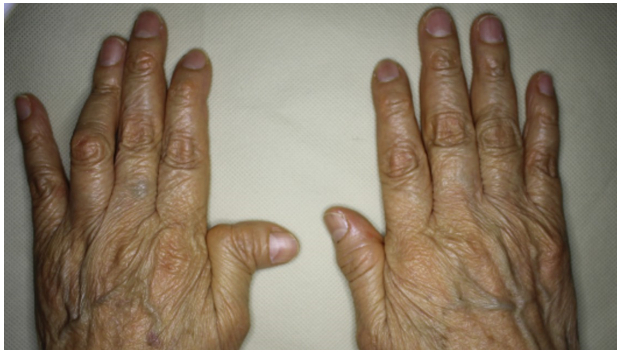
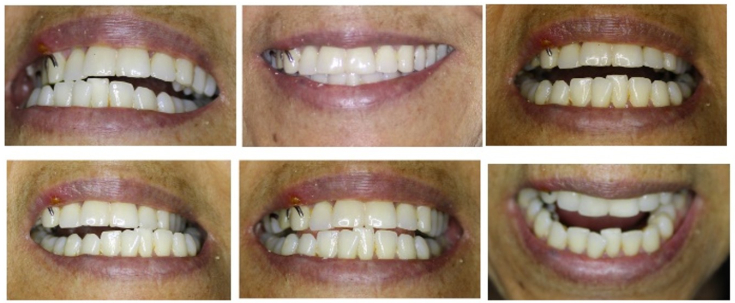
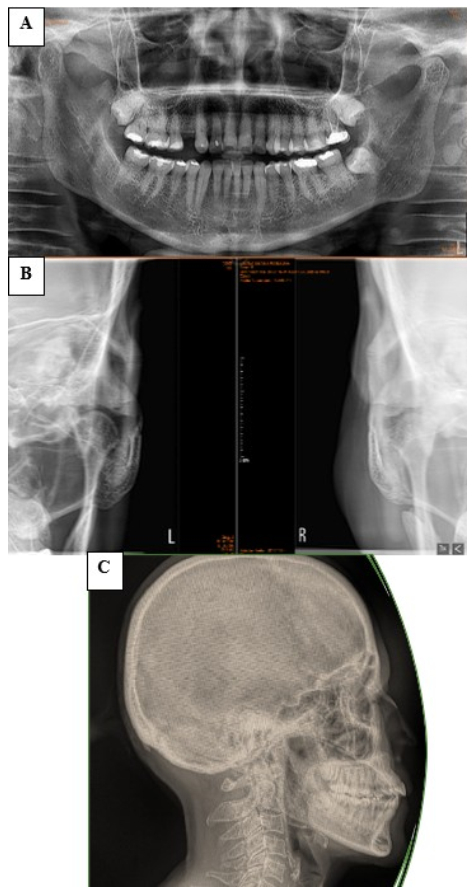
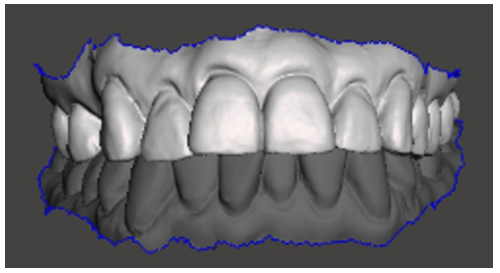
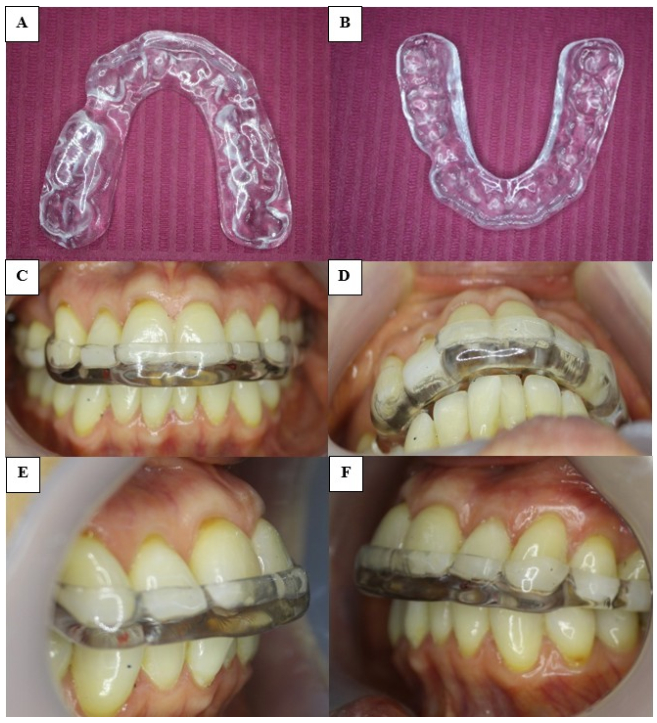
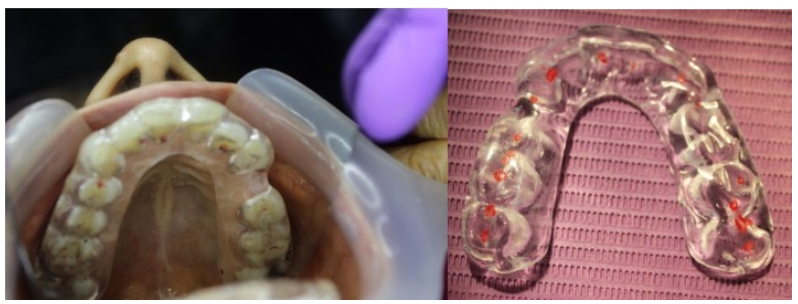
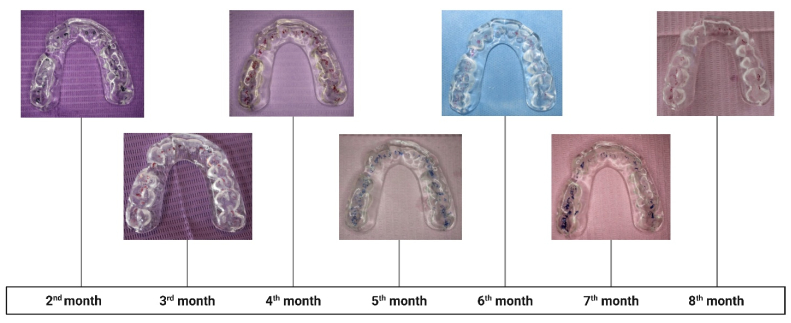
Rheumatoid arthritis (RA) is an autoimmune disease characterized by persistent synovial inflammation and progressive damage to joint structures. The temporomandibular joint (TMJ) may be affected during the course of the disease and present with pain, joint noises, stiffness, and functional alterations. In absence of surgical indication, management includes conservative strategies, such as occlusal splints. A 61-year-old female patient diagnosed with RA in 2004 came to the clinic complaining of audible joint noises when opening and closing her mouth, especially while eating. Clinical examination revealed pain on palpation and bilateral joint noises, with a maximum mouth opening of 36 mm. Imaging studies showed no evident morphological bone changes in the mandibular condyles. Conservative treatment was indicated using a rigid polymethyl methacrylate (PMMA) maxillary stabilization splint, digitally designed (CAD/CAM) and used at night. At the eight-month follow-up, mandibular mobility remained unchanged, while pain on palpation of the masticatory muscles decreased. Right TMJ noise was detected only during closing, and the initially audible joint noise was no longer perceptible. This case documents clinical evolution during the use of an PMMA occlusal splint as part of the conservative management of temporomandibular dysfunction associated with RA; however, findings should be interpreted considering the limitations inherent in a case report.
Citation: Miriam Violeta Alvarado-López, Soledad Leyva-Mena, Diana Guadalupe Agüero-Castañeda, Miguel Ángel Sánchez-Bello, Lilibeth-Stephania Escoto-Vasquez, Artak Heboyan, Mario Alberto Alarcón-Sánchez. Use of a CAD/CAM-fabricated PMMA occlusal splint in a patient with temporomandibular dysfunction associated with rheumatoid arthritis: a case report with an 8-month follow-up[J]. Journal of Dentistry and Multidisciplinary Sciences, 2026, 2(1): 91-101. doi: 10.3934/jdms.2026010
Rheumatoid arthritis (RA) is an autoimmune disease characterized by persistent synovial inflammation and progressive damage to joint structures. The temporomandibular joint (TMJ) may be affected during the course of the disease and present with pain, joint noises, stiffness, and functional alterations. In absence of surgical indication, management includes conservative strategies, such as occlusal splints. A 61-year-old female patient diagnosed with RA in 2004 came to the clinic complaining of audible joint noises when opening and closing her mouth, especially while eating. Clinical examination revealed pain on palpation and bilateral joint noises, with a maximum mouth opening of 36 mm. Imaging studies showed no evident morphological bone changes in the mandibular condyles. Conservative treatment was indicated using a rigid polymethyl methacrylate (PMMA) maxillary stabilization splint, digitally designed (CAD/CAM) and used at night. At the eight-month follow-up, mandibular mobility remained unchanged, while pain on palpation of the masticatory muscles decreased. Right TMJ noise was detected only during closing, and the initially audible joint noise was no longer perceptible. This case documents clinical evolution during the use of an PMMA occlusal splint as part of the conservative management of temporomandibular dysfunction associated with RA; however, findings should be interpreted considering the limitations inherent in a case report.

| [1] |
J. M. Dias, R. Ribeiro, T. Costa, S. S. Serra, S. Silva, A. Iagnocco, et al., Rheumatoid arthritis referral criteria: Systematic review of the literature, BMC Rheumatol., 10 (2026), 8. https://doi.org/10.1186/s41927-025-00602-y doi: 10.1186/s41927-025-00602-y

|
| [2] |
D. P. Misra, Clinical manifestations of rheumatoid arthritis, including comorbidities, complications, and long-term follow-up, Best Pract. Res. Clin. Rheumatol., 39 (2025), 102020. https://doi.org/10.1016/j.berh.2024.102020 doi: 10.1016/j.berh.2024.102020
|
| [3] |
P. Uke, A. Maharaj, A. Adebajo, A review on the epidemiology of rheumatoid arthritis: An update and trends from current literature, Best Pract. Res. Clin. Rheumatol., 39 (2025), 102036. https://doi.org/10.1016/j.berh.2025.102036 doi: 10.1016/j.berh.2025.102036
|
| [4] |
E. Papadimitropoulos, A. Brnabic, E. Vorstenbosch, F. Leonardi, S. Moyano, D. Gomez, The burden of illness of rheumatoid arthritis in Latin America—A systematic literature review, Int. J. Rheum. Dis., 25 (2022), 405–421. https://doi.org/10.1111/1756-185X.14295 doi: 10.1111/1756-185X.14295
|
| [5] |
G. Savtekin, A. O. Sehirli, Rheumatoid arthritis in temporo-mandibular joint: A review, Niger. J. Clin. Pract., 21 (2018), 1243–1246. https://doi.org/10.4103/njcp.njcp_117_18 doi: 10.4103/njcp.njcp_117_18
|
| [6] |
M. Mupparapu, S. Oak, Y. C. Chang, A. Alavi, Conventional and functional imaging in the evaluation of temporomandibular joint rheumatoid arthritis: A systematic review, Quintessence Int., 50 (2019), 742–753. https://doi.org/10.3290/j.qi.a43046 doi: 10.3290/j.qi.a43046
|
| [7] |
I. Różyło-Kalinowska, S. T. Gökdeniz, Imaging of temporomandibular joint inflammatory arthritis, Neuroimaging Clin. N. Am., 35 (2025), 467–476. https://doi.org/10.1016/j.nic.2025.06.010 doi: 10.1016/j.nic.2025.06.010
|
| [8] |
J. Ferri, J. Potier, J. M. Maes, H. Rakotomalala, L. Lauwers, M. Cotelle, et al., Temporomandibular joint arthritis: Clinical, orthodontic, orthopaedic and surgical approaches, Int. Orthod., 16 (2018), 545–561. https://doi.org/10.1016/j.ortho.2018.06.019 doi: 10.1016/j.ortho.2018.06.019
|
| [9] |
M. Benli, N. Al-Haj Husain, M. Özcan, Mechanical and chemical characterization of contemporary occlusal splint materials fabricated with different methods: A systematic review, Clin. Oral Invest., 27 (2023), 7115–7141. https://doi.org/10.1007/s00784-023-05360-0 doi: 10.1007/s00784-023-05360-0
|
| [10] | S. F. Dworkin, L. LeResche, Research diagnostic criteria for temporomandibular disorders: Review, criteria, examinations and specifications, critique, J. Craniomandib. Disord., 6 (1992), 301–355. |
| [11] |
V. Aiello, M. Ferrillo, N. Marotta, F. Agostini, C. Curci, D. Calafiore, et al., Temporomandibular joint arthritis in rheumatic diseases patients: Which are the effective rehabilitative approaches for pain relief? A systematic review, BMC Musculoskelet. Disord., 26 (2025), 159. https://doi.org/10.1186/s12891-024-08196-1 doi: 10.1186/s12891-024-08196-1
|
| [12] |
K. Kryeziu, M. P. Loxha, B. Hajdari, L. Salihu, M. Rexhepi, R. Alihajdaraj, et al., A systematic review on masticatory muscle activity of temporomandibular joint in patients with rheumatoid arthritis, Acta Odontol. Scand., 84 (2025), 625–633. https://doi.org/10.2340/aos.v84.44959 doi: 10.2340/aos.v84.44959
|
| [13] |
J. Rosas, J. Belzunegui, B. Hernández-Cruz, I. Aguirregabiria, S. Moyano, A. Cobo, et al., Real-world evidence for baricitinib in the treatment of rheumatoid arthritis in Spain: A systematic literature review, Adv. Ther., 42 (2025), 2403–2428. https://doi.org/10.1007/s12325-025-03161-3 doi: 10.1007/s12325-025-03161-3
|
| [14] |
K. Moen, L. T. Bertelsen, S. Hellem, R. Jonsson, J. G. Brun, Salivary gland and temporomandibular joint involvement in rheumatoid arthritis: Relation to disease activity, Oral Dis., 11 (2005), 27–34. https://doi.org/10.1111/j.1601-0825.2004.01054.x doi: 10.1111/j.1601-0825.2004.01054.x
|
| [15] |
S. A. González-Chávez, C. Pacheco-Tena, R. M. C. Torres, C. M. Quiñonez-Flores, G. Reyes-Cordero, T. J. C. Frescas, Temporomandibular and odontological abnormalities in patients with rheumatoid arthritis, Reumatol. Clin., 16 (2020), 262–271. https://doi.org/10.1016/j.reuma.2018.07.005 doi: 10.1016/j.reuma.2018.07.005
|
| [16] |
S. Kuroda, Y. Kuroda, Y. Tomita, E. Tanaka, Long-term stability of conservative orthodontic treatment in a patient with rheumatoid arthritis and severe condylar resorption, Am. J. Orthod. Dentofacial Orthop., 141 (2012), 352–362. https://doi.org/10.1016/j.ajodo.2010.04.036 doi: 10.1016/j.ajodo.2010.04.036
|
| [17] |
A. Shouval, A. Levkoviz, S. Keret, I. Rosner, I. Rokhyan, B. Tchalabian, et al., Hand performance assessed by Functional Dexterity Test correlates with clinical disease activity but remains altered in rheumatoid arthritis patients achieving treatment goals: A cross-sectional cohort study, Musculoskeletal Care, 22 (2024), e70023. https://doi.org/10.1002/msc.70023 doi: 10.1002/msc.70023
|
| [18] |
C. Abad-Coronel, C. R. Espinosa, S. O. Palacios, C. A. Paltán, J. I. Fajardo, Comparative analysis between conventional acrylic, CAD/CAM milled, and 3D CAD/CAM printed occlusal splints, Materials, 16 (2023), 6269. https://doi.org/10.3390/ma16186269 doi: 10.3390/ma16186269
|
| [19] |
F. D'Apuzzo, R. P. Rotolo, M. Fordellone, G. Cuomo, A. Jamilian, L. Nucci, et al., Temporomandibular disorders and serological tests in patients with rheumatoid arthritis, Appl. Sci., 13 (2023), 11488. https://doi.org/10.3390/app132011488 doi: 10.3390/app132011488
|
Figures(7) / Tables(1)
Miriam Violeta Alvarado-López, Soledad Leyva-Mena, Diana Guadalupe Agüero-Castañeda, Miguel Ángel Sánchez-Bello, Lilibeth-Stephania Escoto-Vasquez, Artak Heboyan, Mario Alberto Alarcón-Sánchez. Use of a CAD/CAM-fabricated PMMA occlusal splint in a patient with temporomandibular dysfunction associated with rheumatoid arthritis: a case report with an 8-month follow-up[J]. Journal of Dentistry and Multidisciplinary Sciences, 2026, 2(1): 91-101. doi: 10.3934/jdms.2026010




 DownLoad: