The problems we investigated are whether two types of economic information can improve the selection of forecasting models, and whether any resulting gains persist in portfolio construction. The first is the timing of scheduled macroeconomic announcements. The second is how closely the current market resembles past (calm, stressed, or recovery) periods. We proposed an event-conditional mixture-of-experts model (Event-MoE). The model combines a long short-term memory (LSTM) network, a gated recurrent unit (GRU), and a transformer encoder. An event-conditional gate sets the mixture from a calendar of Federal Open Market Committee (FOMC), Consumer Price Index (CPI), and nonfarm-payroll (NFP) releases. A regime layer trains one such mixture per historical regime and blends them by how closely the present resembles each. Since per-stock data are limited, the experts are pooled across all stocks. An augmented variant adds a linear expert, a load-balanced gate, and one-step GARCH and HAR-RV volatility forecasts. The models were evaluated both statistically and through long-only portfolio performance, net transaction costs, and an equal-weight benchmark. Statistical significance was assessed using the Diebold–Mariano and Jobson–Korkie/Memmel tests, and robustness was verified through a walk-forward check. The central finding was that forecast accuracy and portfolio value are distinct objectives. So a more-accurate forecast does not automatically translate into a better portfolio.
Citation: Aivaras Bielskis, Igoris Belovas. Stock return forecasting and portfolio construction using an event-conditional mixture-of-experts framework[J]. Electronic Research Archive, 2026, 34(12): 9317-9351. doi: 10.3934/era.2026392
The problems we investigated are whether two types of economic information can improve the selection of forecasting models, and whether any resulting gains persist in portfolio construction. The first is the timing of scheduled macroeconomic announcements. The second is how closely the current market resembles past (calm, stressed, or recovery) periods. We proposed an event-conditional mixture-of-experts model (Event-MoE). The model combines a long short-term memory (LSTM) network, a gated recurrent unit (GRU), and a transformer encoder. An event-conditional gate sets the mixture from a calendar of Federal Open Market Committee (FOMC), Consumer Price Index (CPI), and nonfarm-payroll (NFP) releases. A regime layer trains one such mixture per historical regime and blends them by how closely the present resembles each. Since per-stock data are limited, the experts are pooled across all stocks. An augmented variant adds a linear expert, a load-balanced gate, and one-step GARCH and HAR-RV volatility forecasts. The models were evaluated both statistically and through long-only portfolio performance, net transaction costs, and an equal-weight benchmark. Statistical significance was assessed using the Diebold–Mariano and Jobson–Korkie/Memmel tests, and robustness was verified through a walk-forward check. The central finding was that forecast accuracy and portfolio value are distinct objectives. So a more-accurate forecast does not automatically translate into a better portfolio.

| [1] |
S. Gu, B. Kelly, D. Xiu, Empirical asset pricing via machine learning, Rev. Financ. Stud., 33 (2020), 2223–2273. https://doi.org/10.1093/rfs/hhaa009 doi: 10.1093/rfs/hhaa009
|
| [2] |
V. DeMiguel, L. Garlappi, R. Uppal, Optimal versus naive diversification: How inefficient is the 1/N portfolio strategy, Rev. Financ. Stud., 22 (2009), 1915–1953. https://doi.org/10.1093/rfs/hhm075 doi: 10.1093/rfs/hhm075
|
| [3] |
O. B. Sezer, M. U. Gudelek, A. M. Ozbayoglu, Financial time series forecasting with deep learning: A systematic literature review (2005–2019), Appl. Soft Comput., 90 (2020), 106181. https://doi.org/10.1016/j.asoc.2020.106181 doi: 10.1016/j.asoc.2020.106181
|
| [4] |
M. Halousková, Š. Lyócsa, Forecasting U.S. equity market volatility with attention and sentiment to the economy, preprint, arXiv: 2503.19767. |
| [5] |
R. Wade, Do better volatility forecasts lead to better portfolios? Evidence from graph neural networks, preprint, arXiv: 2605.19278. |
| [6] |
J. Franke, Markov switching time series models, in Time Series Analysis: Methods and Applications, Handbook of Statistics, 30 (2012), 99–122. https://doi.org/10.1016/B978-0-444-53858-1.00005-3 |
| [7] |
A. C. Blake, N. A. Gandhi, A. R. Jakkula, Improving S&P 500 volatility forecasting through regime-switching methods, preprint, arXiv: 2510.03236. |
| [8] |
H. Y. Kim, C. H. Won, Forecasting the volatility of stock price index: A hybrid model integrating LSTM with multiple GARCH-Type models, Expert Syst. Appl., 103 (2018), 25–37. https://doi.org/10.1016/j.eswa.2018.03.002 doi: 10.1016/j.eswa.2018.03.002
|
| [9] |
C. Krauss, X. A. Do, N. Huck, Deep neural networks, gradient-boosted trees, random Forests: Statistical arbitrage on the S&P 500, Eur. J. Oper. Res., 259 (2017), 689–702. https://doi.org/10.1016/j.ejor.2016.10.031 doi: 10.1016/j.ejor.2016.10.031
|
| [10] |
S. Hochreiter, J. Schmidhuber, Long short-term memory, Neural Comput., 9 (1997), 1735–1780. https://doi.org/10.1162/neco.1997.9.8.1735 |
| [11] |
K. Cho, B. van Merriënboer, C. Gulcehre, D. Bahdanau, F. Bougares, H. Schwenk, et al., Learning phrase representations using RNN encoder–decoder for statistical machine translation, in Proceedings of the 2014 Conference on Empirical Methods in Natural Language Processing (EMNLP), (2014), 1724–1734. https://doi.org/10.3115/v1/D14-1179 |
| [12] |
K. Greff, R. K. Srivastava, J. Koutník, B. R. Steunebrink, J. Schmidhuber, LSTM: A search space odyssey, IEEE Trans. Neural Netw. Learn. Syst., 28 (2016), 2222–2232. https://doi.org/10.1109/TNNLS.2016.2582924 |
| [13] |
A. Vaswani, N. Shazeer, N. Parmar, J. Uszkoreit, L. Jones, A. N. Gomez, et al., Attention is all you need, in Neural Information Processing Systems (NIPS 2017), 30 (2017). https://doi.org/10.48550/arXiv.1706.03762 |
| [14] |
C. Wang, Y. Chen, S. Zhang, Q. Zhang, Stock market index prediction using deep transformer model, Expert Syst. Appl., 208 (2022), 118128. https://doi.org/10.1016/j.eswa.2022.118128 doi: 10.1016/j.eswa.2022.118128
|
| [15] |
Q. Wen, T. Zhou, C. Zhang, W. Chen, Z. Ma, J. Yan, et al., Transformers in time series: A survey, in Proceedings of the Thirty-Second International Joint Conference on Artificial Intelligence (IJCAI-23), (2023), 6778–6786. https://doi.org/10.24963/ijcai.2023/759 |
| [16] |
R. A. Jacobs, M. I. Jordan, S. J. Nowlan, G. E. Hinton, Adaptive mixtures of local experts, Neural Comput., 3 (1991), 79–87. https://doi.org/10.1162/neco.1991.3.1.79 doi: 10.1162/neco.1991.3.1.79
|
| [17] |
M. I. Jordan, R. A. Jacobs, Hierarchical mixtures of experts and the EM algorithm, Neural Comput., 6 (1994), 181–214. https://doi.org/10.1162/neco.1994.6.2.181 doi: 10.1162/neco.1994.6.2.181
|
| [18] |
A. J. Zeevi, R. Meir, R. J. Adler, Time series prediction using mixtures of experts, in Advances in Neural Information Processing Systems (NIPS), 9 (1997). |
| [19] |
R. Ebrahimpour, H. Nikoo, S. Masoudnia, M. R. Yousefi, M. S. Ghaemi, Mixture of MLP-experts for trend forecasting of time series: A case study of the Tehran stock exchange, Int. J. Forecast., 27 (2011), 804–816. https://doi.org/10.1016/j.ijforecast.2010.02.015 doi: 10.1016/j.ijforecast.2010.02.015
|
| [20] |
D. Vallarino, Adaptive market intelligence: A mixture of experts framework for volatility-sensitive stock forecasting, preprint, arXiv: 2508.02686. |
| [21] |
X. Du, J. Cao, X. Jiang, Q. Wang, B. Xu, Z. Liu, et al., Integrating event information and multi-dimensional relationships for improved financial time series forecasting, Sci. Rep., 15 (2025), 38099. https://doi.org/10.1038/s41598-025-22926-y doi: 10.1038/s41598-025-22926-y
|
| [22] |
C. Yu, J. M. Mulvey, P. N. Kolm, Deep statistical jump models: Towards a general mixture-of-experts framework for time series learning, SSRN Electr. J., 2025 (2025). https://doi.org/10.2139/ssrn.5817083 |
| [23] |
X. Shi, S. Wang, Y. Nie, D. Li, Z. Ye, Q. Wen, et al., TIME-MOE: Billion-scale time series foundation models with mixture of experts, in 13th International Conference on Learning Representations (ICLR 2025), (2025), 34635–34667. |
| [24] |
M. Segnon, R. Gupta, B. Wilfling, Forecasting stock market volatility with regime-switching GARCH-MIDAS: The role of geopolitical risks, Int. J. Forecast., 40 (2024), 29–43. https://doi.org/10.1016/j.ijforecast.2022.11.007 doi: 10.1016/j.ijforecast.2022.11.007
|
| [25] |
C. W. S. Chen, C. T. H. Chien, Improving quantile forecasts via realized double hysteretic GARCH model in stock markets, Comput. Econ., 64 (2024), 3447–3471. https://doi.org/10.1007/s10614-024-10563-y doi: 10.1007/s10614-024-10563-y
|
| [26] |
A. Pagliaro, Regime-aware LightGBM for stock market forecasting: A validated walk-forward framework with statistical rigor and explainable AI, Electronics, 15 (2026), 1334. https://doi.org/10.3390/electronics15061334 doi: 10.3390/electronics15061334
|
| [27] |
T. Bollerslev, Generalized autoregressive conditional heteroskedasticity, J. Econom., 31 (1986), 307–327. https://doi.org/10.1016/0304-4076(86)90063-1 doi: 10.1016/0304-4076(86)90063-1
|
| [28] |
A. García-Medina, E. Aguayo-Moreno, LSTM-GARCH hybrid model for the prediction of volatility in cryptocurrency portfolios, Comput. Econ., 63 (2024), 1511–1542. https://doi.org/10.1007/s10614-023-10373-8 doi: 10.1007/s10614-023-10373-8
|
| [29] |
G. Taneva-Angelova, D. Granchev, Deep learning and transformer architectures for volatility forecasting: Evidence from U.S. equity indices, J. Risk Financ. Manag., 18 (2025), 685. https://doi.org/10.3390/jrfm18120685 doi: 10.3390/jrfm18120685
|
| [30] |
M. A. Ganaie, M. Hu, A. K. Malik, M. Tanveer, P. N. Suganthan, Ensemble deep learning: A review, Eng. Appl. Artif. Intell., 115 (2022), 105151. https://doi.org/10.1016/j.engappai.2022.105151 doi: 10.1016/j.engappai.2022.105151
|
| [31] |
W. Chen, Z. Liu, L. Jia, A hybrid approach for portfolio construction: Combining two-stage ensemble forecasting model with portfolio optimization, Comput. Intell., 40 (2024), e12617. https://doi.org/10.1111/coin.12617 doi: 10.1111/coin.12617
|
| [32] |
A. Bielskis, I. Belovas, Machine learning models and ensemble methods for stock index return forecasting, Netw. Heterog. Media, 21 (2026), 848–864. https://doi.org/10.3934/nhm.2026035 doi: 10.3934/nhm.2026035
|
| [33] |
O. Ledoit, M. Wolf, Honey, I shrunk the sample covariance matrix, J. Portf. Manag., 30 (2004), 110–119. https://doi.org/10.3905/jpm.2004.110 doi: 10.3905/jpm.2004.110
|
| [34] |
O. Ledoit, M. Wolf, A well-conditioned estimator for large-dimensional covariance matrices, J. Multivar. Anal., 88 (2004), 365–411. https://doi.org/10.1016/S0047-259X(03)00096-4 doi: 10.1016/S0047-259X(03)00096-4
|
| [35] |
O. Ledoit, S. Péché, Eigenvectors of some large sample covariance matrix ensembles, Probab. Theory Relat. Fields, 151 (2011), 233–264. https://doi.org/10.1007/s00440-010-0298-3 doi: 10.1007/s00440-010-0298-3
|
| [36] |
O. Ledoit, M. Wolf, Analytical nonlinear shrinkage of large-dimensional covariance matrices, Ann. Stat., 48 (2020), 3043–3065. https://doi.org/10.1214/19-AOS1921 doi: 10.1214/19-AOS1921
|
| [37] |
A. García-Medina, High-dimensional covariance matrix estimators on simulated portfolios with complex structures, Phys. Rev. E, 111 (2025), 024316. https://doi.org/10.1103/PhysRevE.111.024316 doi: 10.1103/PhysRevE.111.024316
|
| [38] |
W. F. Sharpe, Capital asset prices: A theory of market equilibrium under conditions of risk, J. Finance, 19 (1964), 425–442. https://doi.org/10.1111/j.1540-6261.1964.tb02865.x doi: 10.1111/j.1540-6261.1964.tb02865.x
|
| [39] |
E. F. Fama, K. R. French, Common risk factors in the returns on stocks and bonds, J. Financ. Econ., 33 (1993), 3–56. https://doi.org/10.1016/0304-405X(93)90023-5 doi: 10.1016/0304-405X(93)90023-5
|
| [40] |
A. Zaimovic, A. Omanovic, A. Arnaut-Berilo, How many stocks are sufficient for equity portfolio diversification? A review of the literature, J. Risk Financ. Manag., 14 (2021), 551. https://doi.org/10.3390/jrfm14110551 doi: 10.3390/jrfm14110551
|
| [41] |
K. Kashif, R. Ślepaczuk, Deep reinforcement learning framework for diversified portfolio management across global equity markets, preprint, arXiv: 2605.17307. |
| [42] |
Y. Hwang, S. Zohren, Signature-informed transformer for asset allocation, preprint, arXiv: 2510.03129. |
| [43] |
Z. Zhu, H. Chen, Q. Qu, V. Chung, FinCast: A foundation model for financial time-series forecasting, in Proceedings of the 34th ACM International Conference on Information and Knowledge Management (CIKM 2025), (2025), 4539–4549. https://doi.org/10.1145/3746252.3761261 |
| [44] |
Z. Wu, S. Pan, F. Chen, G. Long, C. Zhang, P. S. Yu, A comprehensive survey on graph neural networks, IEEE Trans. Neural Netw. Learn. Syst., 32 (2020), 4–24. https://doi.org/10.1109/TNNLS.2020.2978386 doi: 10.1109/TNNLS.2020.2978386
|
| [45] |
A. Bielskis, Machine Learning Financial Dataset Repository. Available from: https://github.com/AivarasBi/MOE. |
| [46] |
N. Shazeer, A. Mirhoseini, K. Maziarz, A. Davis, Q. Le, G. Hinton, et al., Outrageously large neural networks: The sparsely-gated mixture-of-experts layer, in International Conference on Learning Representations (ICLR), (2017), 1–19. |
| [47] |
W. Fedus, B. Zoph, N. Shazeer, Switch transformers: Scaling to trillion parameter models with simple and efficient sparsity, J. Mach. Learn. Res., 23 (2022), 1–39. |
| [48] |
F. Corsi, A simple approximate long-memory model of realized volatility, J. Financ. Econom., 7 (2009), 174–196. https://doi.org/10.1093/jjfinec/nbp001 doi: 10.1093/jjfinec/nbp001
|
| [49] |
H. Markowitz, Portfolio selection, J. Finance, 7 (1952), 77–91. https://doi.org/10.1111/j.1540-6261.1952.tb01525.x |
| [50] |
W. F. Sharpe, The sharpe ratio, J. Portf. Manag., 21 (1994), 49–58. https://doi.org/10.3905/jpm.1994.409501 |
| [51] |
F. X. Diebold, R. S. Mariano, Comparing predictive accuracy, J. Bus. Econ. Stat., 13 (1995), 253–263. https://doi.org/10.1080/07350015.1995.10524599 doi: 10.1080/07350015.1995.10524599
|
| [52] |
D. Harvey, S. Leybourne, P. Newbold, Testing the equality of prediction mean squared errors, Int. J. Forecast., 13 (1997), 281–291. https://doi.org/10.1016/S0169-2070(96)00719-4 doi: 10.1016/S0169-2070(96)00719-4
|
| [53] |
J. D. Jobson, B. M. Korkie, Performance hypothesis testing with the Sharpe and Treynor measures, J. Finance, 36 (1981), 889–908. https://doi.org/10.1111/j.1540-6261.1981.tb04891.x doi: 10.1111/j.1540-6261.1981.tb04891.x
|
| [54] |
C. Memmel, Performance hypothesis testing with the Sharpe ratio, Finance Lett., 1 (2003), 21–23. |


Figures(14) / Tables(10)
Aivaras Bielskis, Igoris Belovas. Stock return forecasting and portfolio construction using an event-conditional mixture-of-experts framework[J]. Electronic Research Archive, 2026, 34(12): 9317-9351. doi: 10.3934/era.2026392

Dataset partitioning: a training window (2000–2021), a validation window (2021–2023) for model and hyperparameter selection, and a held-out test window (2023–2026) used only for evaluation
The full pipeline. Prices and the macro-event calendar become features and sliding windows. The Event-MoE mixture forecasts from them, with experts pooled across tickers and one set per regime. The forecasts are blended by regime similarity and turned into a cross-sectional long-only portfolio
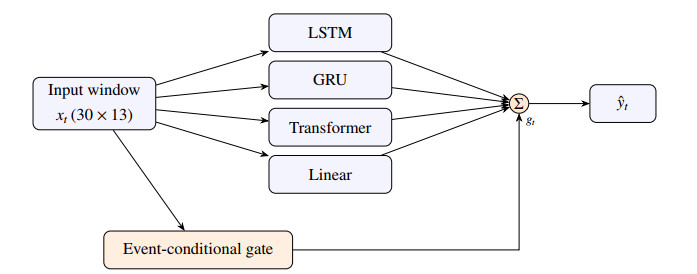
The Event-MoE forecaster. The input window is processed in parallel by heterogeneous experts. The event-conditional gate produces weights $ g_t $, and the final forecast is their weighted combination, $ \hat y_t = \sum_e g_{t, e}\, f_e(x_t) $. The base three-expert Event-MoE does not include the linear branch
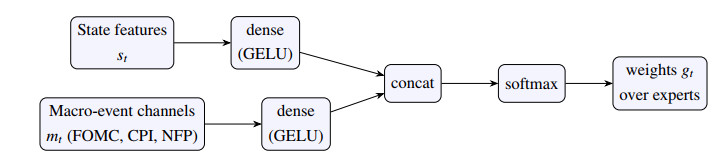
The event-conditional gate. One stream reads the window's state features $ s_t $. A second reads the six macro-event channels $ m_t $. The two are concatenated and mapped by a softmax to the expert weights $ g_t $, so routing can shift as a release approaches
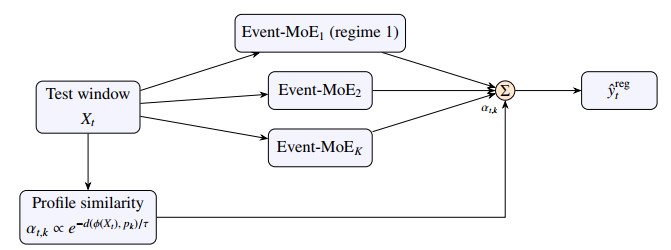
The regime-similarity blend. The test window is scored by every per-period expert, and the forecasts are combined by weights $ \alpha_{t, k} $ measuring how closely the current window resembles each regime's profile $ p_k $
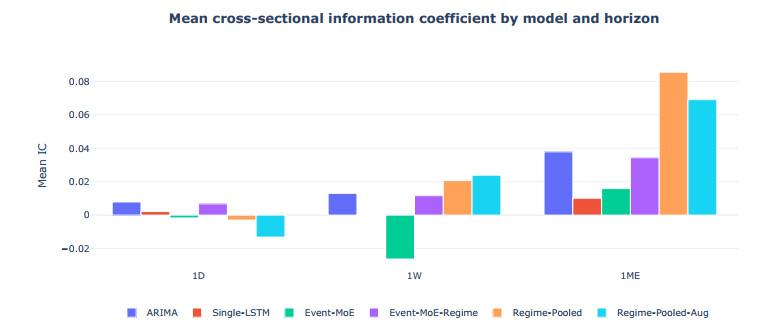
Mean cross-sectional information coefficient by model and horizon. The signal is small throughout and concentrated at the weekly and monthly horizons, where the cross-sectionally pooled regime models lead. In the figures, "Regime-Pooled" and "Regime-Pooled-Aug" denote Event-MoE-Regime-Pooled and its augmented variant
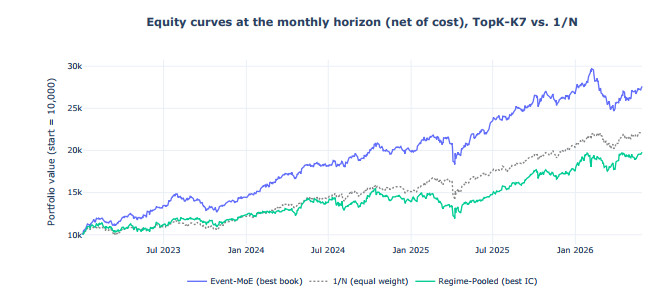
Net-of-cost equity curves at the monthly horizon (start $ = 10{, }000 $): the best prediction-driven book (Event-MoE), the most accurate forecaster's book (Event-MoE-Regime-Pooled), and the 1/N benchmark. Higher forecast accuracy does not produce the higher terminal value
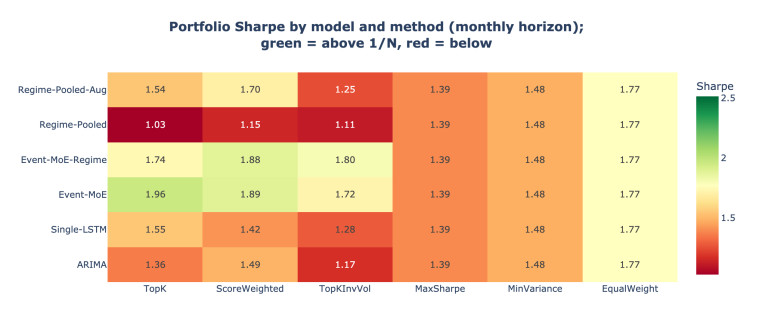
Portfolio Sharpe across the model $ \times $ method grid at the monthly horizon, with the color midpoint at the $ 1/N $ Sharpe (green above $ 1/N $, red below). Most cells sit at or below $ 1/N $. The green region is confined to the prediction-driven books of the stronger models
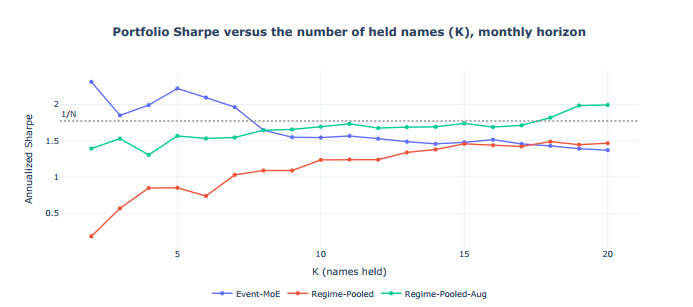
Annualized Sharpe as a function of the number of held names $ K $ at the monthly horizon, for the three mixture variants, against the $ 1/N $ reference line. The ranking of variants is not stable in $ K $, which shows how sensitive the allocation step is
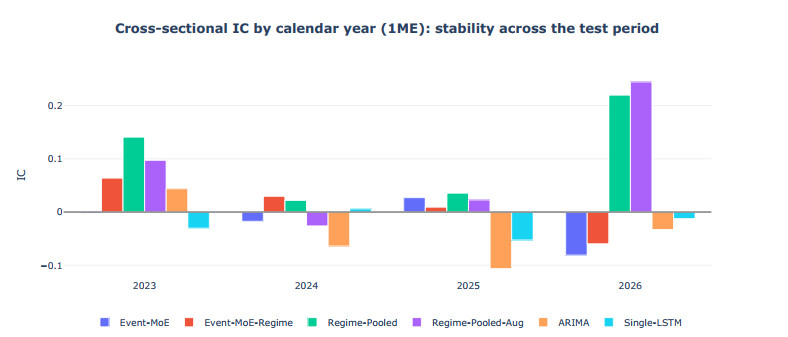
Cross-sectional IC by calendar year at the monthly horizon. Event-MoE-Regime-Pooled is the only model positive in every year. This is the basis for its "stable" verdict in Table 6. The single-network and classical baselines change sign across years
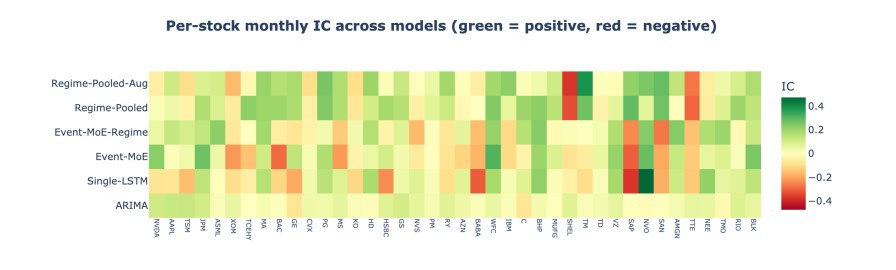
Per-stock monthly IC across models (green positive, red negative). Green predominates for the pooled regime models across most of the forty names, confirming that the monthly edge is broad-based rather than carried by a few stocks
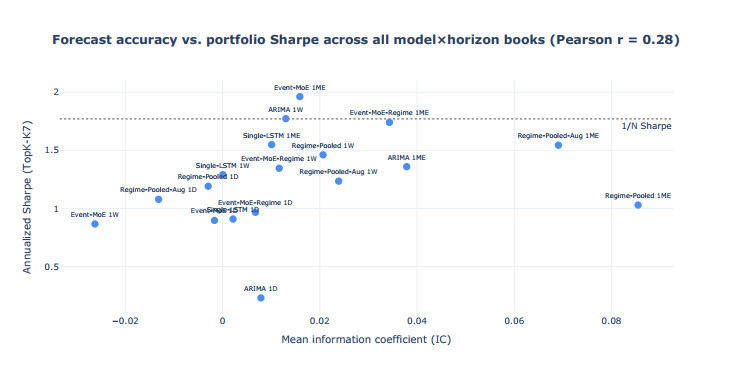
Forecast accuracy versus realized portfolio Sharpe across every model $ \times $ horizon book (TopK, $ K = 7 $, 18 points). The relationship is weak (Pearson $ r = 0.28 $) and not statistically distinguishable from zero at this sample size. This is the compact form of the finding that forecast accuracy and investment value are distinct objectives
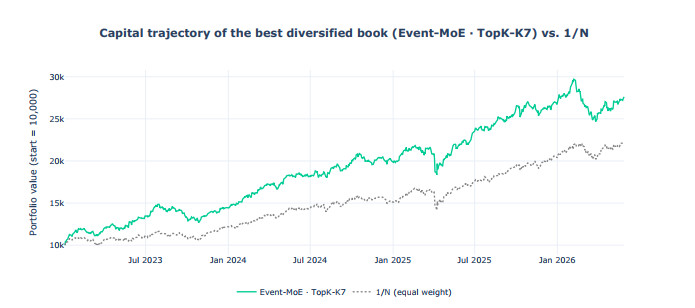
Capital trajectory of the diversified Event-MoE $ \cdot $ TopK-7 book against 1/N, net of cost, from a base of $ 10{, }000 $. It compounds to $ 27{, }620 $ over the test window and tracks the benchmark closely
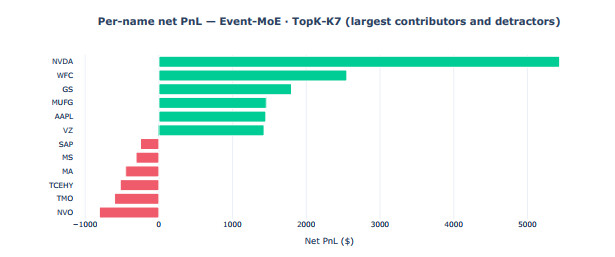
Net per-name PnL for the Event-MoE $ \cdot $ TopK-7 book (green contributors, red detractors). A small number of names dominate the book's outcome




 DownLoad: