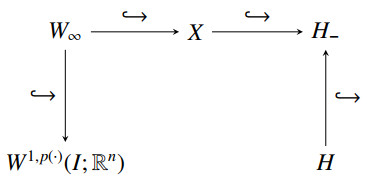
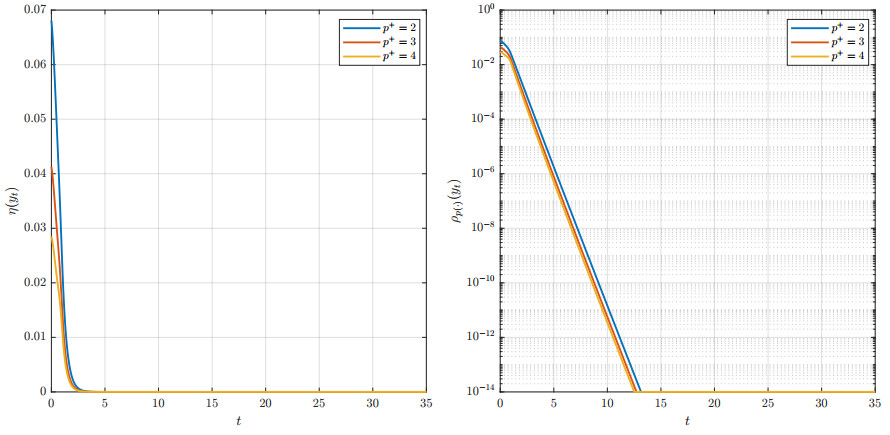
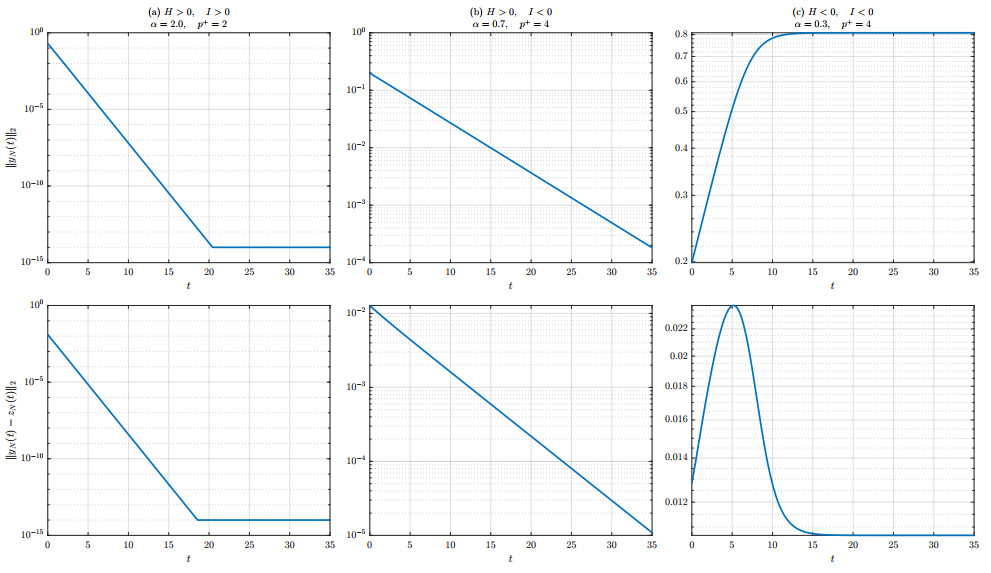
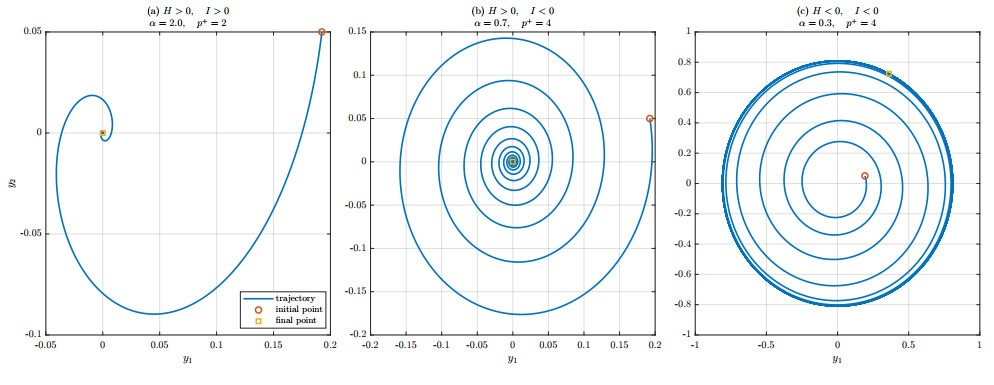
We study state-dependent delay differential equations whose delays are generated by variable-exponent modular functionals. Because translations are not, in general, bounded on $ L^{p(\cdot)}(-h_0, 0;\mathbb{R}^n) $, the classical delay shift semigroup cannot be constructed directly on the variable-exponent space. We therefore combine the Ito-Kappel semigroup framework with the modular structure of $ L^{p(\cdot)} $. We establish an equivalent abstract semilinear formulation, prove local well-posedness, and obtain well-posedness on finite intervals under stronger Lipschitz and growth assumptions. For modular state-dependent delays, we verify the required local Lipschitz properties and derive sufficient conditions for decay relative to the zero equilibrium and for conditional incremental contraction. Numerical experiments illustrate the role of the variable exponent through the modular delay and the distinction between these two sufficient estimates.
Citation: Mostafa Bachar. Variable-exponent modular delays in state-dependent delay differential equations: an abstract semigroup formulation[J]. Electronic Research Archive, 2026, 34(12): 8997-9032. doi: 10.3934/era.2026379
We study state-dependent delay differential equations whose delays are generated by variable-exponent modular functionals. Because translations are not, in general, bounded on $ L^{p(\cdot)}(-h_0, 0;\mathbb{R}^n) $, the classical delay shift semigroup cannot be constructed directly on the variable-exponent space. We therefore combine the Ito-Kappel semigroup framework with the modular structure of $ L^{p(\cdot)} $. We establish an equivalent abstract semilinear formulation, prove local well-posedness, and obtain well-posedness on finite intervals under stronger Lipschitz and growth assumptions. For modular state-dependent delays, we verify the required local Lipschitz properties and derive sufficient conditions for decay relative to the zero equilibrium and for conditional incremental contraction. Numerical experiments illustrate the role of the variable exponent through the modular delay and the distinction between these two sufficient estimates.

| [1] | K. J. Engel, R. Nagel, One-Parameter Semigroups for Linear Evolution Equations, Springer, New York, 2000. https://doi.org/10.1007/b97696 |
| [2] | A. Pazy, Semigroups of Linear Operators and Applications to Partial Differential Equations, Springer, New York, 1983. https://doi.org/10.1007/978-1-4612-5561-1 |
| [3] | M. Růžička, Electrorheological Fluids: Modeling and Mathematical Theory, Springer, Berlin, 2000. https://doi.org/10.1007/BFb0104029 |
| [4] |
E. Acerbi, G. Mingione, Regularity results for stationary electrorheological fluids, Arch. Ration. Mech. Anal., 164 (2002), 213–259. https://doi.org/10.1007/s00205-002-0208-7 doi: 10.1007/s00205-002-0208-7

|
| [5] |
L. Diening, M. Růžička, Calderón-Zygmund operators on generalized lebesgue spaces $L^{p(\cdot)}$ and problems related to fluid dynamics, J. Reine Angew. Math., 563 (2003), 197–220. https://doi.org/10.1515/crll.2003.081 doi: 10.1515/crll.2003.081
|
| [6] | P. Blomgren, T. F. Chan, P. Mulet, C. K. Wong, Total variation image restoration: Numerical methods and extensions, in Proceedings of the International Conference on Image Processing, 3 (1997), 384–387. https://doi.org/10.1109/ICIP.1997.632128 |
| [7] | L. Diening, P. Harjulehto, P. Hästö, M. Růžička, Lebesgue and Sobolev Spaces with Variable Exponents, Springer Science & Business Media, 2011. https://doi.org/10.1007/978-3-642-18363-8 |
| [8] | D. Cruz-Uribe, A. Fiorenza, Variable Lebesgue Spaces: Foundations and Harmonic Analysis, Birkhäuser/Springer, New York, 2013. https://doi.org/10.1007/978-3-0348-0548-3 |
| [9] |
O. Kováčik, J. Rákosník, On spaces $L^{p(x)}$ and $W^{k, p(x)}$, Czech. Math. J., 41 (1991), 592–618. https://doi.org/10.21136/CMJ.1991.102493 doi: 10.21136/CMJ.1991.102493
|
| [10] | J. K. Hale, S. M. V. Lunel, Introduction to Functional Differential Equations, Springer Science & Business Media, 1993. https://doi.org/10.1007/978-1-4612-4342-7 |
| [11] | F. Kappel, Semigroups and delay equations, in Semigroups, Theory and Applications, Vol. II, Longman Scientific & Technical, Harlow, (1986), 136–176. |
| [12] |
K. Ito, F. Kappel, Approximation of semilinear Cauchy problems, Nonlinear Anal. Theory Methods Appl., 24 (1995), 51–80. https://doi.org/10.1016/0362-546X(94)E0022-9 doi: 10.1016/0362-546X(94)E0022-9
|
| [13] | K. Ito, F. Kappel, Evolution Equations and Approximations, World Scientific, 2002. https://doi.org/10.1142/4990 |
| [14] | A. Bátkai, S. Piazzera, Semigroups for Delay Equations, CRC Press, 2005. https://doi.org/10.1201/9781439865682 |
| [15] |
T. Gedeon, A. R. Humphries, M. C. Mackey, H. O. Walther, Z. Wang, Operon dynamics with state dependent transcription and/or translation delays, J. Math. Biol., 84 (2022), 2. https://doi.org/10.1007/s00285-021-01693-0 doi: 10.1007/s00285-021-01693-0
|
| [16] |
T. Gedeon, A. R. Humphries, M. C. Mackey, H. O. Walther, Z. Wang, Dynamics of a state-dependent delay-differential equation, Electron. J. Qual. Theory Differ. Equations, 37 (2025), 1–94. https://doi.org/10.14232/ejqtde.2025.1.37 doi: 10.14232/ejqtde.2025.1.37
|
| [17] | M. A. Khamsi, W. M. Kozlowski, Fixed Point Theory in Modular Function Spaces, Birkhäuser, Cham, 2015. https://doi.org/10.1007/978-3-319-14051-3 |
| [18] |
M. Bachar, Semigroups and evolution equations in modular function spaces, Axioms, 14 (2025), 906. https://doi.org/10.3390/axioms14120906 doi: 10.3390/axioms14120906
|
| [19] |
F. Kappel, W. Schappacher, Autonomous nonlinear functional differential equations and averaging approximations, Nonlinear Anal. Theory Methods Appl., 2 (1978), 391–422. https://doi.org/10.1016/0362-546X(78)90048-2 doi: 10.1016/0362-546X(78)90048-2
|
| [20] | E. Hille, R. S. Phillips, Functional Analysis and Semi-Groups, American Mathematical Society, 1957. |
| [21] | A. Halanay, Differential Equations: Stability, Oscillations, Time Lags, Academic Press, New York, 1966. |
Figures(4) / Tables(4)
Mostafa Bachar. Variable-exponent modular delays in state-dependent delay differential equations: an abstract semigroup formulation[J]. Electronic Research Archive, 2026, 34(12): 8997-9032. doi: 10.3934/era.2026379





 DownLoad: