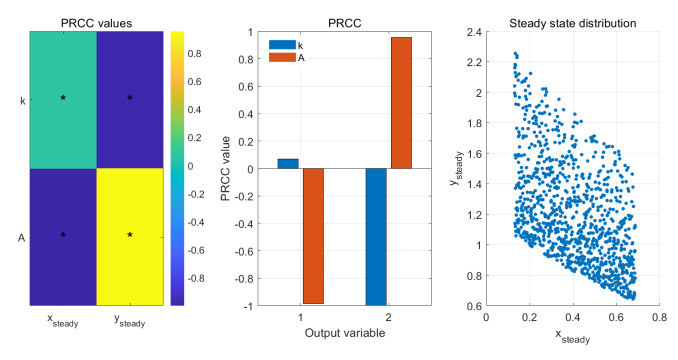
This study proposes a predator-prey model that incorporates fear effects and additional food provision. A theoretical analysis is conducted by first establishing the positivity and boundedness of solutions, and then examining the existence and stability of all feasible equilibria. Models with unilateral and bilateral impulsive state feedback control are further introduced and analyzed. For these controlled systems, sufficient conditions for the existence and orbital asymptotic stability of order-1 periodic solutions are derived. Numerical simulations are provided to support the theoretical findings, showing excellent agreement with the analytical results. Finally, a systematic sensitivity analysis is performed to quantify the influence of the prey's fear factor and the total amount of additional food on the system dynamics.
Citation: Meng Zhang, Jiayi Zheng. Dynamics of a state feedback impulsive predator-prey model incorporating fear effect and additional food supply[J]. Electronic Research Archive, 2026, 34(5): 3481-3502. doi: 10.3934/era.2026155
This study proposes a predator-prey model that incorporates fear effects and additional food provision. A theoretical analysis is conducted by first establishing the positivity and boundedness of solutions, and then examining the existence and stability of all feasible equilibria. Models with unilateral and bilateral impulsive state feedback control are further introduced and analyzed. For these controlled systems, sufficient conditions for the existence and orbital asymptotic stability of order-1 periodic solutions are derived. Numerical simulations are provided to support the theoretical findings, showing excellent agreement with the analytical results. Finally, a systematic sensitivity analysis is performed to quantify the influence of the prey's fear factor and the total amount of additional food on the system dynamics.

| [1] |
S. Creel, D. Christianson, Relationships between direct predation and risk effects, Trends Ecol. Evol., 23 (2008), 194–201. https://doi.org/10.1016/j.tree.2007.12.004 doi: 10.1016/j.tree.2007.12.004

|
| [2] |
E. L. Preisser, D. I. Bolnick, The many faces of fear: comparing the pathways and impacts of nonconsumptive predator effects on prey populations, PLoS One, 3 (2008), e2465. https://doi.org/10.1371/journal.pone.0002465 doi: 10.1371/journal.pone.0002465
|
| [3] |
X. Zhao, L. Yu, X. Li, Dynamics analysis of a predator-prey model incorporating fear effect in prey species, AIMS Math., 10 (2025), 12464–12492. https://doi.org/10.3934/math.2025563 doi: 10.3934/math.2025563
|
| [4] | S. L. Lima, Nonlethal effects in the ecology of predator-prey interactions: What are the ecological effects of anti-predator decision-making? Bioscience, 48 (1998), 25–34. https://doi.org/10.2307/1313225 |
| [5] |
L. Y. Zanette, A. F. White, M. C. Allen, M. Clinchy, Perceived predation risk reduces the number of offspring songbirds produce per year, Science, 334 (2011), 1398–1401. https://doi.org/10.1126/science.1210908 doi: 10.1126/science.1210908
|
| [6] |
S. K. Sasmal, Population dynamics with multiple Allee effects induced by fear factors–A mathematical study on prey-predator interactions, Appl. Math. Modell., 64 (2018), 1–14. https://doi.org/10.1016/j.apm.2018.07.021 doi: 10.1016/j.apm.2018.07.021
|
| [7] |
S. Mondal, A. Maiti, G. P. Samanta, Effects of fear and additional food in a delayed predator-prey model, Biophys. Rev. Lett., 13 (2018), 157–177. https://doi.org/10.1142/S1793048018500091 doi: 10.1142/S1793048018500091
|
| [8] |
S. Sharma, G. P. Samanta, Dynamical behaviour of age-selective harvesting of a prey-predator system, Int. J. Dyn. Control, 6 (2018), 550–560. https://doi.org/10.1007/s40435-017-0337-3 doi: 10.1007/s40435-017-0337-3
|
| [9] |
D. Pal, G. S. Mahapatra, G. P. Samanta, Optimal harvesting of prey-predator system with interval biological parameters: A bioeconomic model, Math. Biosci., 241 (2013), 181–187. https://doi.org/10.1016/j.mbs.2012.11.007 doi: 10.1016/j.mbs.2012.11.007
|
| [10] |
M. R. Wade, M. P. Zalucki, S. D. Wratten, K. A. Robinson, Conservation biological control of arthropods using artificial food sprays: Current status and future challenges, Biol. Control, 45 (2008), 185–199. https://doi.org/10.1016/j.biocontrol.2007.10.024 doi: 10.1016/j.biocontrol.2007.10.024
|
| [11] |
P. D. Srinivasu, B. S. Prasad, M. Venkatesulu, Biological control through provision of additional food to predators: a theoretical study, Theor. Popul Biol., 72 (2007), 111–120. https://doi.org/10.1016/j.tpb.2007.03.011 doi: 10.1016/j.tpb.2007.03.011
|
| [12] |
S. Ghorai, S. Poria, Impacts of additional food on diffusion induced instabilities in a predator-prey system with mutually interfering predator, Chaos, Solitons Fractals, 103 (2017), 68–78. https://doi.org/10.1016/j.chaos.2017.05.031 doi: 10.1016/j.chaos.2017.05.031
|
| [13] |
T. Wang, L. Chen, Nonlinear analysis of a microbial pesticide model with impulsive state feedback control, Nonlinear Dyn., 65 (2011), 1–10. https://doi.org/10.1007/s11071-010-9828-x doi: 10.1007/s11071-010-9828-x
|
| [14] |
S. Tang, B. Tang, A. Wang, Y. Xiao, Holling Ⅱ predator-prey impulsive semi-dynamic model with complex Poincaré map, Nonlinear Dyn., 81 (2015), 1575–1596. https://doi.org/10.1007/s11071-015-2092-3 doi: 10.1007/s11071-015-2092-3
|
| [15] |
P. S. Simeonov, D. D. Bainov, Orbital stability of the periodic solutions of autonomous systems with impulse effect, Int. J. Syst. Sci., 19 (1988), 2561–2585. https://doi.org/10.1080/00207728808547133 doi: 10.1080/00207728808547133
|
| [16] | G. Birkhoff, G. C. Rota, Ordinary Differential Equations, Ginn and Company, Boston, 1962. |
| [17] | L. Perko, Differential Equations and Dynamical Systems, Springer, New York, 2001. https://doi.org/10.1007/978-1-4613-0003-8 |
| [18] |
G. Pang, L. Chen, Periodic solution of the system with impulsive state feedback control, Nonlinear Dyn., 78 (2014), 743–753. https://doi.org/10.1007/s11071-014-1473-3 doi: 10.1007/s11071-014-1473-3
|
| [19] |
Y. Tian, J. Zhu, J. Zheng, K. Sun, Modeling and analysis of a prey-predator system with prey habitat selection in an environment subject to stochastic disturbances, Electron. Res. Arch., 33 (2025), 744–767. https://doi.org/10.3934/era.2025034 doi: 10.3934/era.2025034
|
| [20] |
X. Meng, L. Chen, Periodic solution and almost periodic solution for a nonautonomous Lotka–Volterra dispersal system with infinite delay, J. Math. Anal. Appl., 339 (2008), 125–145. https://doi.org/10.1016/j.jmaa.2007.05.084 doi: 10.1016/j.jmaa.2007.05.084
|
| [21] |
S. Gao, S. Yuan, Dynamics of a tri-trophic level model with excess food nutrient content and intraguild predation structure, J. Biol. Syst., 32 (2024), 1133–1168. https://doi.org/10.1142/S0218339024500384 doi: 10.1142/S0218339024500384
|
| [22] |
X. Duan, S. Yuan, M. Martcheva, Habitat adaption promotes the evolution of predator species, Z. Angew. Math. Phys., 74 (2023), 10. https://doi.org/10.1007/s00033-022-01904-8 doi: 10.1007/s00033-022-01904-8
|
| [23] |
P. Wu, S. Zhang, X. Wang, H. Wang, Spatiotemporal cholera dynamics with antibiotic resistance and vaccination via demographic-epidemic data in Zimbabwe, J. Math. Biol., 92 (2026), 42. https://doi.org/10.1007/s00285-026-02360-y doi: 10.1007/s00285-026-02360-y
|
| [24] |
P. Wu, C. Fang, Spatiotemporal dynamics of syphilis in Xinjiang via a demographic geographic data-validated reaction diffusion model, J. Math. Phys., 66 (2025), 062704. https://doi.org/10.1063/5.0273893 doi: 10.1063/5.0273893
|
| [25] |
Y. Cai, W. Wang, Dynamics of a parasite-host epidemiological model in spatial heterogeneous environment, Discrete Contin. Dyn. Syst. - Ser. B, 20 (2015), 989–1013. https://doi.org/10.3934/dcdsb.2015.20.989 doi: 10.3934/dcdsb.2015.20.989
|
| [26] |
X. Xie, H. Yu, J. Fang, Z. Cao, Q. Wang, M. Zhao, Dynamics analysis of autonomous and nonautonomous predator-prey models with nonlinear harvesting, Electron. Res. Arch., 33 (2025), 6096–6140. https://doi.org/10.3934/era.2025271 doi: 10.3934/era.2025271
|
| [27] |
O. Nave, Y. Baron, M. Sharma, A semi-analytical method for solving problems on the role of prey taxis in a biological control-mathematical model, J. Multiscale Modell., 10 (2019), 1850009. https://doi.org/10.1142/s1756973718500099 doi: 10.1142/s1756973718500099
|
Figures(9)
Meng Zhang, Jiayi Zheng. Dynamics of a state feedback impulsive predator-prey model incorporating fear effect and additional food supply[J]. Electronic Research Archive, 2026, 34(5): 3481-3502. doi: 10.3934/era.2026155





 DownLoad: