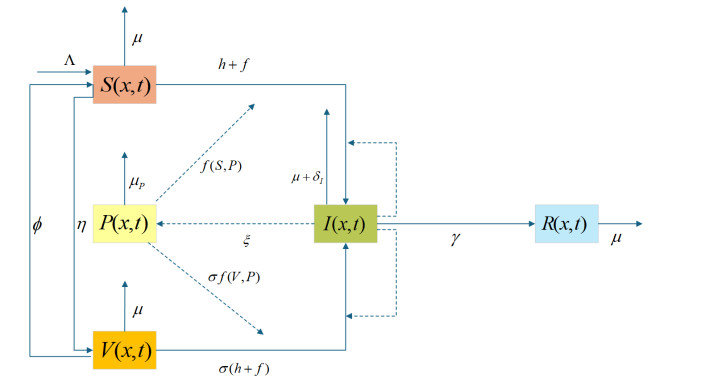
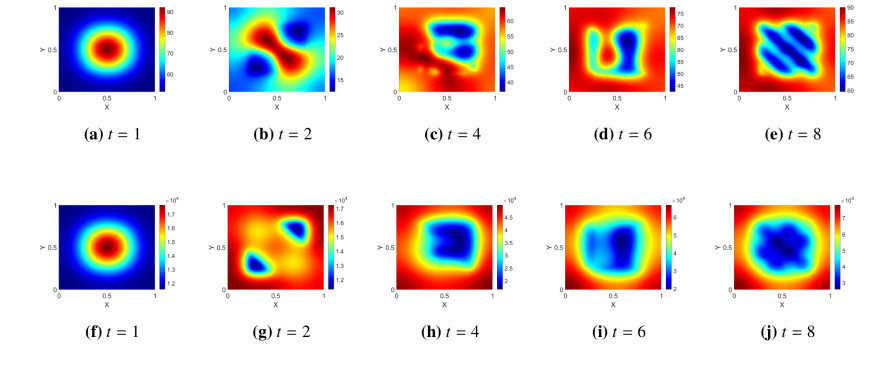
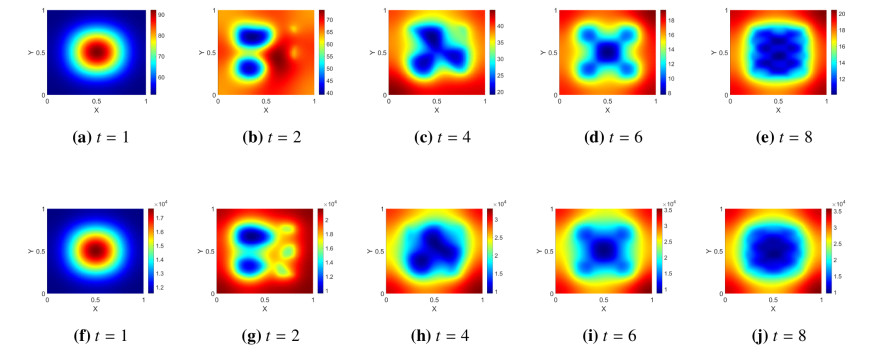
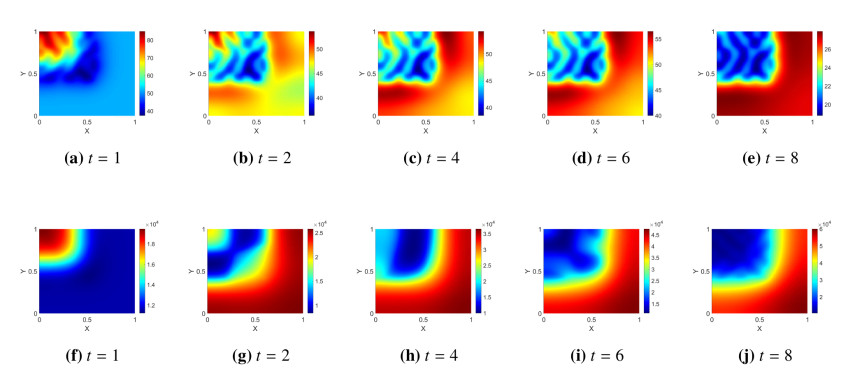
In this paper, we propose a regional control strategy to address the challenge of cholera transmission, which is characterized by significant spatial heterogeneity due to its waterborne nature. A spatiotemporal dynamic model was formulated using reaction-diffusion equations, coupled with a four-dimensional optimal control framework encompassing awareness education, expanded vaccination, water chlorination, and treatment. The core mathematical analysis proceeded in three stages: First, the well-posedness of the state system was established, proving the existence and uniqueness of strong solutions. Second, the existence of an optimal control solution was rigorously demonstrated using the method of minimizing sequences. Finally, the first-order necessary optimality conditions were derived by constructing an adjoint system and applying Pontryagin's maximum principle, which explicitly characterized the optimal control quadruple. Numerical simulations validated the theoretical framework, with direct comparisons between regional and uniform control strategies demonstrating the distinct advantage of our approach in cost-effectiveness and outbreak containment efficacy.
Citation: Jinghan Hui, Tong Chen, Peng Wu. Optimal regional control of a spatial diffusion Cholera model with environmental pathogen transmission[J]. Electronic Research Archive, 2026, 34(5): 3380-3409. doi: 10.3934/era.2026152
In this paper, we propose a regional control strategy to address the challenge of cholera transmission, which is characterized by significant spatial heterogeneity due to its waterborne nature. A spatiotemporal dynamic model was formulated using reaction-diffusion equations, coupled with a four-dimensional optimal control framework encompassing awareness education, expanded vaccination, water chlorination, and treatment. The core mathematical analysis proceeded in three stages: First, the well-posedness of the state system was established, proving the existence and uniqueness of strong solutions. Second, the existence of an optimal control solution was rigorously demonstrated using the method of minimizing sequences. Finally, the first-order necessary optimality conditions were derived by constructing an adjoint system and applying Pontryagin's maximum principle, which explicitly characterized the optimal control quadruple. Numerical simulations validated the theoretical framework, with direct comparisons between regional and uniform control strategies demonstrating the distinct advantage of our approach in cost-effectiveness and outbreak containment efficacy.

| [1] | D. A. Sack, R. B. Sack, G. B. Nair, A. K. Siddique, Cholera, Lancet, 363 (2004), 223–233. https://doi.org/10.1016/S0140-6736(03)15328-7 |
| [2] | J. B. Harris, R. C. LaRocque, F. Qadri, E. T. Ryan, S. B. Calderwood, Cholera, Lancet, 379 (2012), 2466–2476. https://doi.org/10.1016/S0140-6736(12)60436-X |
| [3] | D. Barua, History of cholera, Cholera, (1992), 1–36. https://doi.org/10.1007/978-1-4757-9688-9_1 |
| [4] |
M. Ali, A. R. Nelson, A. L. Lopez, D. A. Sack, Updated global burden of cholera in endemic countries, PLoS Negl.Trop. Dis., 9 (2015), e0003832. https://doi.org/10.1371/journal.pntd.0003832 doi: 10.1371/journal.pntd.0003832

|
| [5] | World Health Organization, Cholera – Global situation, in Disease Outbreak News, 2023. Available from: https://www.who.int/emergencies/disease-outbreak-news/item/2023-DON437. |
| [6] |
A. Camacho, M. Bouhenia, R. Alyusfi, A. Alkohlani, M. A. M. Naji, X. Radiguès, et al., Cholera epidemic in Yemen, 2016–18: an analysis of surveillance data, Lancet Global Health, 6 (2018), e680–e690. https://doi.org/10.1016/S2214-109X(18)30230-4 doi: 10.1016/S2214-109X(18)30230-4
|
| [7] | V. Capasso, S. L. Paveri-Fontana, A mathematical model for the 1973 cholera epidemic in the European Mediterranean region, Rev. Epidemiol. Sante Publique, 27 (1979), 121–132. |
| [8] |
A. S. Azman, K. E. Rudolph, D. A. T. Cummings, J. Lessler, The incubation period of cholera: a systematic review, J. Infect., 66 (2013), 432–438. https://doi.org/10.1016/j.jinf.2012.11.013 doi: 10.1016/j.jinf.2012.11.013
|
| [9] |
C. T. Codeço, Endemic and epidemic dynamics of cholera: the role of the aquatic reservoir, BMC Infect. Dis., 1 (2001), 1. https://doi.org/10.1186/1471-2334-1-1 doi: 10.1186/1471-2334-1-1
|
| [10] |
H. Zhao, S. Zou, X. Wang, Y. Chen, Dynamic behaviors of a cholera model with nonlinear incidences, multiple transmission pathways, and imperfect vaccine, J. Appl. Math. Comput., 70 (2024), 917–946. https://doi.org/10.1007/s12190-024-01994-9 doi: 10.1007/s12190-024-01994-9
|
| [11] |
Z. Mukandavire, S. Liao, J. Wang, H. Gaff, D. L. Smith, J. G. Morris, Estimating the reproductive numbers for the 2008–2009 cholera outbreaks in Zimbabwe, Proc. Natl. Acad. Sci. U.S.A., 108 (2011), 8767–8772. https://doi.org/10.1073/pnas.1019712108 doi: 10.1073/pnas.1019712108
|
| [12] |
X. Tian, R. Xu, J. Lin, Mathematical analysis of a cholera infection model with vaccination strategy, Appl. Math. Comput., 361 (2019), 517–535. https://doi.org/10.1016/j.amc.2019.05.055 doi: 10.1016/j.amc.2019.05.055
|
| [13] |
J. Wang, F. Xie, T. Kuniya, Analysis of a reaction-diffusion cholera epidemic model in a spatially heterogeneous environment, Commun. Nonlinear Sci. Numer. Simul., 80 (2020), 104951. https://doi.org/10.1016/j.cnsns.2019.104951 doi: 10.1016/j.cnsns.2019.104951
|
| [14] |
M. A. Safi, D. Y. Melesse, A. B. Gumel, Dynamics analysis of a multi-strain cholera model with an imperfect vaccine, Bull. Math. Biol., 75 (2013), 1104–1137. https://doi.org/10.1007/s11538-013-9845-2 doi: 10.1007/s11538-013-9845-2
|
| [15] |
X. Wang, X. Q. Zhao, J. Wang, A cholera epidemic model in a spatiotemporally heterogeneous environment, J. Math. Anal. Appl., 468 (2018), 893–912. https://doi.org/10.1016/j.jmaa.2018.08.039 doi: 10.1016/j.jmaa.2018.08.039
|
| [16] |
F. Capone, V. Cataldis, R. De Luca, Influence of diffusion on the stability of equilibria in a reaction-diffusion system modeling cholera dynamics, J. Math. Biol., 71 (2015), 1107–1131. https://doi.org/10.1007/s00285-014-0849-9 doi: 10.1007/s00285-014-0849-9
|
| [17] |
X. Wang, D. Posny, J. Wang, A reaction-convection-diffusion model for cholera spatial dynamics, Discrete Contin. Dyn. Syst. - Ser. B, 21 (2016), 2785–2809. https://doi.org/10.3934/dcdsb.2016073 doi: 10.3934/dcdsb.2016073
|
| [18] |
E. Bertuzzo, R. Casagrandi, M. Gatto, I. Rodriguez-Iturbe, A. Rinaldo, On spatially explicit models of cholera epidemics, J. R. Soc. Interface, 7 (2009), 321–333. https://doi.org/10.1098/rsif.2009.0204 doi: 10.1098/rsif.2009.0204
|
| [19] |
N. Bai, C. Song, R. Xu, Mathematical analysis and application of a cholera transmission model with waning vaccine-induced immunity, Nonlinear Anal. Real World Appl., 58 (2021), 103232. https://doi.org/10.1016/j.nonrwa.2020.103232 doi: 10.1016/j.nonrwa.2020.103232
|
| [20] |
C. Modnak, A model of cholera transmission with hyperinfectivity and its optimal vaccination control, Int. J. Biomath., 10 (2017), 1750084. https://doi.org/10.1142/S179352451750084X doi: 10.1142/S179352451750084X
|
| [21] |
Y. Kang, L. Nie, Dynamical analysis and optimal control of an age-structured epidemic model with asymptomatic infection and multiple transmission pathways, Math. Methods Appl. Sci., 47 (2024), 9669–9702. https://doi.org/10.1002/mma.10088 doi: 10.1002/mma.10088
|
| [22] |
W. Li, L. Zhang, J. Cao, F. Xu, Z. Cai, Finite time attractivity and exponentially stable of a multi-stage epidemic system with discontinuous incidence, Qual. Theory Dyn. Syst., 24 (2025), 199. https://doi.org/10.1007/s12346-025-01358-z doi: 10.1007/s12346-025-01358-z
|
| [23] |
M. S. Islam, M. A. Miah, M. K. Hasan, R. B. Sack, M. J. Albert Detection of non-culturable Vibrio cholerae O1 associated with a cyanobacterium from an aquatic environment in Bangladesh, Trans. R. Soc. Trop. Med. Hyg., 88 (1994), 298–299. https://doi.org/10.1016/0035-9203(94)90085-X doi: 10.1016/0035-9203(94)90085-X
|
| [24] |
D. Lantagne, T. Yates, Household water treatment and cholera control, J. Infect. Dis., 218 (2018), S147–S153. https://doi.org/10.1093/infdis/jiy488 doi: 10.1093/infdis/jiy488
|
| [25] |
F. Qadri, M. Ali, J. Lynch, F. Chowdhury, A. I. Khan, T. F. Wierzba, et al., Efficacy of a single-dose regimen of inactivated whole-cell oral cholera vaccine: results from 2 years of follow-up of a randomised trial, Lancet Infect. Dis., 18 (2018), 666–674. https://doi.org/10.1016/S1473-3099(18)30108-7 doi: 10.1016/S1473-3099(18)30108-7
|
| [26] |
K. Sévère, V. Rouzier, S.B. Anglade, et al., Effectiveness of oral cholera vaccine in Haiti: 37-month follow-up, Am. J. Trop. Med. Hyg., 94 (2016), 1136. https://doi:10.4269/ajtmh.15-0700 doi: 10.4269/ajtmh.15-0700
|
| [27] |
S. Zhang, S. Fan, P. Wu, Complete dynamics of a heterogeneous space diffusion cholera model with nonlocal time delay and drug resistance, Z. Angew. Math. Phys., 76 (2025), 200. https://doi.org/10.1007/s00033-025-02584-w doi: 10.1007/s00033-025-02584-w
|
| [28] |
W. Wang, X. Wang, H. Wang, Spatial dynamics of a generalized cholera model with nonlocal time delay in a heterogeneous environment, J. Differ. Equations, 405 (2024), 103–150. https://doi.org/10.1016/j.jde.2024.05.049 doi: 10.1016/j.jde.2024.05.049
|
| [29] |
W. Li, L. Yang, J. Cao, Threshold dynamics of a degenerated diffusive incubation period host–pathogen model with saturation incidence rate, Appl. Math. Lett., 160 (2025), 109312. https://doi.org/10.1016/j.aml.2024.109312 doi: 10.1016/j.aml.2024.109312
|
| [30] |
A. El A. Laaroussi, M. Rachik, On the regional control of a reaction-diffusion system SIR, Bull. Math. Biol., 82 (2020), 5. https://doi.org/10.1007/s11538-019-00673-2 doi: 10.1007/s11538-019-00673-2
|
| [31] |
T. Chen, L. Chen, P. Wu, Spatiotemporal transmission dynamics and optimal regional control of a spatial heterogeneity reaction-diffusion schistosomiasis model, Commun. Nonlinear Sci. Numer. Simul., 151 (2025), 109097. https://doi.org/10.1016/j.cnsns.2025.109097 doi: 10.1016/j.cnsns.2025.109097
|



Figures(11) / Tables(2)
Jinghan Hui, Tong Chen, Peng Wu. Optimal regional control of a spatial diffusion Cholera model with environmental pathogen transmission[J]. Electronic Research Archive, 2026, 34(5): 3380-3409. doi: 10.3934/era.2026152





 DownLoad: