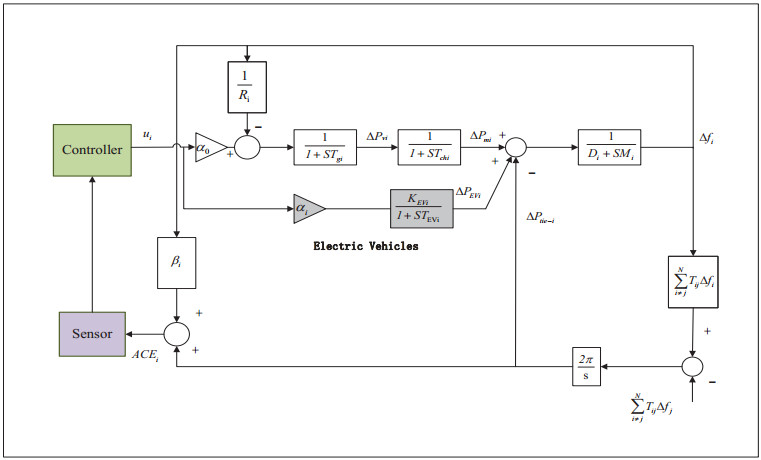
This paper focuses on the robust data-driven load frequency control (LFC) of an interconnected power system involving Markovian jump parameters from damaged data by unknown noise. Firstly, due to the changes in system structure, the LFC model for an interconnected power system involving Markovian jump parameters is described. The vehicle-to-grid technique is also applied to regulate the power system frequency by employing the electric vehicles as a new frequency regulation loop in this model. Secondly, a data-driven control method is used to stabilize the Markovian jump power system (MJPS). Drawing on the damaged data corrupted by unknown noise, two robust stability conditions for the MJPS are formulated, corresponding to the energy-bound approach and the instantaneous-bound approach, respectively. Then, the control gains of the system are obtained by the data-based linear matrix inequalities (LMIs). Finally, the effectiveness of the proposed methods is verified by applying them to a two-area interconnected power system with the participation of electric vehicles.
Citation: Guobao Liu, Aobo Zhang, Xiaoming Yan, Shicheng Huo, Huai Liu. Robust data-driven load frequency control of interconnected power systems with Markovian jump parameters[J]. Electronic Research Archive, 2025, 33(10): 6538-6557. doi: 10.3934/era.2025289
This paper focuses on the robust data-driven load frequency control (LFC) of an interconnected power system involving Markovian jump parameters from damaged data by unknown noise. Firstly, due to the changes in system structure, the LFC model for an interconnected power system involving Markovian jump parameters is described. The vehicle-to-grid technique is also applied to regulate the power system frequency by employing the electric vehicles as a new frequency regulation loop in this model. Secondly, a data-driven control method is used to stabilize the Markovian jump power system (MJPS). Drawing on the damaged data corrupted by unknown noise, two robust stability conditions for the MJPS are formulated, corresponding to the energy-bound approach and the instantaneous-bound approach, respectively. Then, the control gains of the system are obtained by the data-based linear matrix inequalities (LMIs). Finally, the effectiveness of the proposed methods is verified by applying them to a two-area interconnected power system with the participation of electric vehicles.

| [1] |
G. Zhang, Y. Xing, W. Zhang, J. Li, Prescribed performance control for USV-UAV via a robust bounded compensating technique, IEEE Trans. Control Network Syst., 12 (2025), 2289–2299. https://doi.org/10.1109/TCNS.2025.3566320 doi: 10.1109/TCNS.2025.3566320

|
| [2] |
S. Park, C. Park, J. Kim, Learning-based cooperative mobility control for autonomous drone-delivery, IEEE Trans. Veh. Technol., 73 (2024), 4870–4885. https://doi.org/10.1109/TVT.2023.3330460 doi: 10.1109/TVT.2023.3330460
|
| [3] |
G. Zhang, Z. Li, J. Li, Y. Shu, X. Zhang, Reinforcement learning-driven autonomous navigation strategy for rotor-assisted vehicles via integral event-triggered mechanism, Transp. Res. Part D: Transp. Environ., 146 (2025), 104841. https://doi.org/10.1016/j.trd.2025.104841 doi: 10.1016/j.trd.2025.104841
|
| [4] |
B. K. Priya, D. A. Reddy, W. G. Soliman, A. D. Rani, N. Kalahasthi, D. V. R. K. Reddy, Hybrid stepper motor: Model, open-loop test, traditional PI, optimized PI, and optimized gain scheduled PI controllers, Int. J. Control Autom. Syst., 20 (2022), 3915–3922. https://doi.org/10.1007/s12555-021-0371-y doi: 10.1007/s12555-021-0371-y
|
| [5] |
W. Qi, G. Zong, H. R. Karimi, Sliding mode control for nonlinear stochastic singular semi-Markov jump systems, IEEE Trans. Autom. Control, 65 (2020), 361–368. https://doi.org/10.1109/TAC.2019.2915141 doi: 10.1109/TAC.2019.2915141
|
| [6] |
X. Cai, K. Shi, Y. Sun, J. Cao, S. Wen, Z. Tian, Intelligent event-triggered control supervised by mini-batch machine learning and data compression mechanism for T-S fuzzy NCSs under DoS attacks, IEEE Trans. Fuzzy Syst., 32 (2024), 804–815. https://doi.org/10.1109/TFUZZ.2023.3308933 doi: 10.1109/TFUZZ.2023.3308933
|
| [7] |
X. Cai, K. Shi, Y. Sun, J. Cao, S. Wen, C. Qiao, et al., Stability analysis of networked control systems under DoS attacks and security controller design with mini-batch machine learning supervision, IEEE Trans. Inf. Forensics Secur., 19 (2024), 3857–3865. https://doi.org/10.1109/TIFS.2023.3347889 doi: 10.1109/TIFS.2023.3347889
|
| [8] |
T. N. Pham, H. Trinh, L. V. Hien, Load frequency control of power systems With electric vehicles and diverse transmission links using distributed functional observers, IEEE Trans. Smart Grid, 7 (2016), 238–252. https://doi.org/10.1109/TSG.2015.2449877 doi: 10.1109/TSG.2015.2449877
|
| [9] |
P. Yu, S. Tan, J. Guo, Y. Song, Data-driven optimal controller design for sub-satellite deployment of tethered satellite system, Electron. Res. Arch., 32 (2024), 505–522. https://doi.org/10.3934/era.2024025 doi: 10.3934/era.2024025
|
| [10] |
A. Sacco, F. Esposito, G. Marchetto, P. Montuschi, Sustainable task offloading in UAV networks via multi-agent reinforcement learning, IEEE Trans. Veh. Technol., 70 (2021), 5003–5015. https://doi.org/10.1109/TVT.2021.3074304 doi: 10.1109/TVT.2021.3074304
|
| [11] |
L. H. Keel, S. P. Bhattacharyya, Controller synthesis free of analytical models: Three term controllers, IEEE Trans. Autom. Control, 53 (2008), 1353–1369. https://doi.org/10.1109/TAC.2008.925810 doi: 10.1109/TAC.2008.925810
|
| [12] |
M. Cui, M. Pan, J. Wang, P. Li, A parameterized level set method for structural topology optimization based on reaction diffusion equation and fuzzy PID control algorithm, Electron. Res. Arch., 30 (2022), 2568–2599. https://doi.org/10.3934/era.2022132 doi: 10.3934/era.2022132
|
| [13] |
J. C. Willems, P. Rapisarda, I. Markovsky, B. L. M. De Moor, A note on persistency of excitation, Syst. Control Lett., 54 (2005), 325–329. https://doi.org/10.1016/j.sysconle.2004.09.003 doi: 10.1016/j.sysconle.2004.09.003
|
| [14] |
C. De Persis, P. Tesi, Formulas for data-driven control: Stabilization, optimality, and robustness, IEEE Trans. Autom. Control, 65 (2020), 909–924. https://doi.org/10.1109/TAC.2019.2959924 doi: 10.1109/TAC.2019.2959924
|
| [15] |
J. G. Rueda-Escobedo, E. Fridman, J. Schiffer, Data-driven control for linear discrete-time delay systems, IEEE Trans. Autom. Control, 67 (2022), 3321–3336. https://doi.org/10.1109/TAC.2021.3096896 doi: 10.1109/TAC.2021.3096896
|
| [16] |
W. Liu, J. Sun, G. Wang, F. Bullo, J. Chen, Data-driven resilient predictive control under denial-of-service, IEEE Trans. Autom. Control, 68 (2023), 4722–4737. https://doi.org/10.1109/TAC.2022.3209399 doi: 10.1109/TAC.2022.3209399
|
| [17] |
K. Hu, T. Liu, Robust data-driven predictive control for unknown linear time-invariant systems, Syst. Control Lett., 193 (2024), 105914. https://doi.org/10.1016/j.sysconle.2024.105914 doi: 10.1016/j.sysconle.2024.105914
|
| [18] |
X. Wang, J. Berberich, J. Sun, G. Wang, F. Allgöwer, J. Chen, Model-based and data-driven control of event- and self-triggered discrete-time linear systems, IEEE Trans. Cybern., 53 (2023), 6066–6079. https://doi.org/10.1109/TCYB.2023.3272216 doi: 10.1109/TCYB.2023.3272216
|
| [19] |
H. J. van Waarde, M. K. Camlibel, M. Mesbahi, From noisy data to feedback controllers: Nonconservative design via a matrix S-lemma, IEEE Trans. Autom. Control, 67 (2022), 162–175. https://doi.org/10.1109/TAC.2020.3047577 doi: 10.1109/TAC.2020.3047577
|
| [20] |
R. Sakthivel, P. Selvaraj, O. M. Kwon, S. G. Choi, R. Sakthivel, Robust memory control design for semi-Markovian jump systems with cyber attacks, Electron. Res. Arch., 31 (2023), 7496–7510. https://doi.org/10.3934/era.2023378 doi: 10.3934/era.2023378
|
| [21] |
M. Shen, J. H. Park, ${H}_\infty$ filtering of Markov jump linear systems with general transition probabilities and output quantization, ISA Trans., 63 (2016), 204–210. https://doi.org/10.1016/j.isatra.2016.04.007 doi: 10.1016/j.isatra.2016.04.007
|
| [22] |
G. Wang, L. Xu, Almost sure stability and stabilization of Markovian jump systems with stochastic switching, IEEE Trans. Autom. Control, 67 (2022), 1529–1536. https://doi.org/10.1109/TAC.2021.3069705 doi: 10.1109/TAC.2021.3069705
|
| [23] |
O. L. V. Costa, E. O. A. Filho, E. K. Boukas, R. P. Marques, Constrained quadratic state feedback control of discrete-time Markovian jump linear systems, Automatica, 35 (1999), 617–626. https://doi.org/10.1016/S0005-1098(98)00202-7 doi: 10.1016/S0005-1098(98)00202-7
|
| [24] |
B. Zhang, Y. Song, Model-predictive control for Markovian jump systems under ssynchronous scenario: An optimizing prediction dynamics approach, IEEE Trans. Autom. Control, 67 (2022), 4900–4907. https://doi.org/10.1109/TAC.2022.3164832 doi: 10.1109/TAC.2022.3164832
|
| [25] |
G. Chen, L. Wang, J. Xia, X. Xie, J. H. Park, Data-driven aperiodic sampled-data control of Markovian jump system, IEEE Trans. Syst. Man Cybern.: Syst., 55 (2025), 3338–3349. https://doi.org/10.1109/TSMC.2025.3540568 doi: 10.1109/TSMC.2025.3540568
|
| [26] |
X. Liu, Y. Liang, S. Qiao, P. Wang, Memory-based event-triggered fault-tolerant load frequency control of multi-area power systems with electric vehicles, Appl. Math. Comput., 472 (2024), 128636. https://doi.org/10.1016/j.amc.2024.128636 doi: 10.1016/j.amc.2024.128636
|
| [27] |
S. Kuppusamy, Y. H. Joo, H. S. Kim, Asynchronous control for discrete-time hidden Markov jump power systems, IEEE Trans. Cybern., 52 (2022), 9943–9948. https://doi.org/10.1109/TCYB.2021.3062672 doi: 10.1109/TCYB.2021.3062672
|
| [28] |
A. Bisoffi, C. De Persis, P. Tesi, Trade-offs in learning controllers from noisy data, Syst. Control Lett., 154 (2021), 104985. https://doi.org/10.1016/j.sysconle.2021.104985 doi: 10.1016/j.sysconle.2021.104985
|
| [29] |
C. E. de Souza, Robust stability and stabilization of uncertain discrete-time Markovian jump linear systems, IEEE Trans. Autom. Control, 51 (2006), 836–841. https://doi.org/10.1109/TAC.2006.875012 doi: 10.1109/TAC.2006.875012
|
| [30] |
X. M. Zhang, Q. L. Han, B. L. Zhang, X. H. Ge, D. W. Zhang, Accumulated-state-error-based event-triggered sampling scheme and its application to ${H}_\infty$ control of sampled-data systems, Sci. China Inf. Sci., 67 (2024), 162206. https://doi.org/10.1007/s11432-023-4038-3 doi: 10.1007/s11432-023-4038-3
|
| [31] |
X. M. Zhang, Q. L. Han, X. H. Ge, B. L. Zhang, Accumulative-error-based event-triggered control for discrete-time linear systems: A discrete-time looped functional method, IEEE/CAA J. Autom. Sin., 12 (2025), 683–693. https://doi.org/10.1109/JAS.2024.124476 doi: 10.1109/JAS.2024.124476
|
| [32] |
X. Ge, Q. L. Han, X. M. Zhang, D. Ding, B. Ning, Distributed coordination control of multi-agent systems under intermittent sampling and communication: A comprehensive survey, Sci. China Inf. Sci., 68 (2025), 151201. https://doi.org/10.1007/s11432-024-4355-1 doi: 10.1007/s11432-024-4355-1
|
Figures(10) / Tables(1)
Guobao Liu, Aobo Zhang, Xiaoming Yan, Shicheng Huo, Huai Liu. Robust data-driven load frequency control of interconnected power systems with Markovian jump parameters[J]. Electronic Research Archive, 2025, 33(10): 6538-6557. doi: 10.3934/era.2025289





 DownLoad: