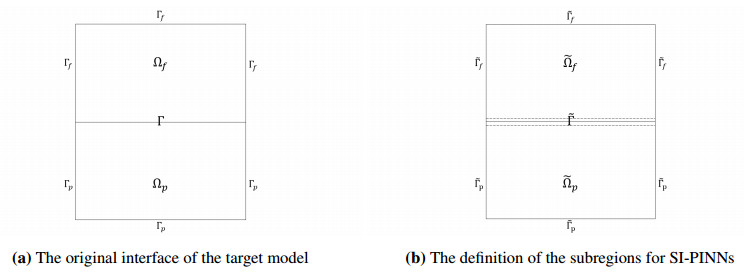
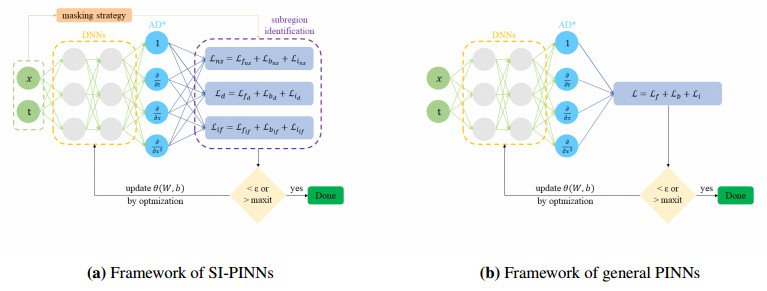
Physics-informed neural networks (PINNs), built upon general neural networks, integrate physical information into the loss function, achieving remarkable results in solving partial differential equations (PDEs). Meanwhile, PINNs face challenges in solving complex interface problems, such as the Navier–Stokes/Darcy interface model considered in this paper. To address these challenges, we extend the general PINNs to propose subregion–identified physics-informed neural networks (SI-PINNs), which consist of three different neural networks for different subregions (Navier–Stokes, Darcy, and interface) with separated datasets. By identifying and classifying the regional features of the neural networks and datasets, the complexity of the physical information that SI-PINNs need to process is effectively split, while the networks also take all physical information into account during the training. Additionally, this splitting feature substantially reduces the training costs while enhancing or maintaining the accuracy of the general PINNs for the target model. Numerical experiments are performed to validate the effectiveness of the SI-PINN method.
Citation: Mulin Wang, Jinyi Luo, Xiangpeng Xin, Changxin Qiu. Subregion–identified physics-informed neural networks for the Navier–Stokes/Darcy interface model[J]. Electronic Research Archive, 2025, 33(8): 4964-4983. doi: 10.3934/era.2025223
Physics-informed neural networks (PINNs), built upon general neural networks, integrate physical information into the loss function, achieving remarkable results in solving partial differential equations (PDEs). Meanwhile, PINNs face challenges in solving complex interface problems, such as the Navier–Stokes/Darcy interface model considered in this paper. To address these challenges, we extend the general PINNs to propose subregion–identified physics-informed neural networks (SI-PINNs), which consist of three different neural networks for different subregions (Navier–Stokes, Darcy, and interface) with separated datasets. By identifying and classifying the regional features of the neural networks and datasets, the complexity of the physical information that SI-PINNs need to process is effectively split, while the networks also take all physical information into account during the training. Additionally, this splitting feature substantially reduces the training costs while enhancing or maintaining the accuracy of the general PINNs for the target model. Numerical experiments are performed to validate the effectiveness of the SI-PINN method.

| [1] |
T. Arbogast, D. S. Brunson, A computational method for approximating a Darcy-Stokes system governing a vuggy porous medium, Comput. Geosci., 11 (2007), 207–218. https://doi.org/10.1007/s10596-007-9043-0 doi: 10.1007/s10596-007-9043-0

|
| [2] |
T. Arbogast, H. L. Lehr, Homogenization of a Darcy-Stokes system modeling vuggy porous media, Comput. Geosci., 10 (2006), 291–302. https://doi.org/10.1007/s10596-006-9024-8 doi: 10.1007/s10596-006-9024-8
|
| [3] |
J. Hou, D. Hu, X. M. He, C. Qiu, Modeling and a Robin-type decoupled finite element method for dual-porosity-Navier-Stokes system with application to flows around multistage fractured horizontal wellbore, Comput. Methods Appl. Mech. Eng., 388 (2022), 114248. https://doi.org/10.1016/j.cma.2021.114248 doi: 10.1016/j.cma.2021.114248
|
| [4] |
J. Hou, M. Qiu, X. M. He, C. Guo, M. Wei, B. Bai, A dual-porosity-Stokes model and finite element method for coupling dual-porosity flow and free flow, SIAM J. Sci. Comput., 38 (2016), B710–B739. https://doi.org/10.1137/15M1044072 doi: 10.1137/15M1044072
|
| [5] |
Y. Zhang, C. Zhou, C. Qu, M. Wei, X. M. He, B. Bai, Fabrication and verification of a glass-silicon-glass micro-nanofluidic model for investigating multi-phase flow in unconventional dual-porosity porous media, Lab Chip, 19 (2019), 4071–4082. https://doi.org/10.1039/C9LC00847K doi: 10.1039/C9LC00847K
|
| [6] |
Y. Gao, D. Han, X. M. He, U. Rüde, Unconditionally stable numerical methods for Cahn-Hilliard-Navier-Stokes-Darcy system with different densities and viscosities, J. Comput. Phys., 454 (2022), 110968. https://doi.org/10.1016/j.jcp.2022.110968 doi: 10.1016/j.jcp.2022.110968
|
| [7] |
Y. Gao, X. M. He, L. Mei, X. Yang, Decoupled, linear, and energy stable finite element method for the Cahn-Hilliard-Navier-Stokes-Darcy phase field model, SIAM J. Sci. Comput., 40 (2018), B110–B137. https://doi.org/10.1137/16M1100885 doi: 10.1137/16M1100885
|
| [8] |
M. Discacciati, R. Oyarzúa, A conforming mixed finite element method for the Navier-Stokes/Darcy coupled problem, Numer. Math., 135 (2017), 571–606. https://doi.org/10.1007/s00211-016-0811-4 doi: 10.1007/s00211-016-0811-4
|
| [9] |
W. J. Layton, F. Schieweck, I. Yotov, Coupling fluid flow with porous media flow, SIAM J. Numer. Anal., 40 (2002), 2195–2218. https://doi.org/10.1137/S0036142901392766 doi: 10.1137/S0036142901392766
|
| [10] |
M. Discacciati, E. Miglio, A. Quarteroni, Mathematical and numerical models for coupling surface and groundwater flows, Appl. Numer. Math., 43 (2002), 57–74. https://doi.org/10.1016/S0168-9274(02)00125-3 doi: 10.1016/S0168-9274(02)00125-3
|
| [11] |
D. Vassilev, C. Wang, I. Yotov, Domain decomposition for coupled Stokes and Darcy flows, Comput. Methods Appl. Mech. Eng., 268 (2014), 264–283. https://doi.org/10.1016/j.cma.2013.09.009 doi: 10.1016/j.cma.2013.09.009
|
| [12] |
M. Discacciati, A. Quarteroni, A. Valli, Robin-Robin domain decomposition methods for the Stokes-Darcy coupling, SIAM J. Numer. Anal., 45 (2007), 1246–1268. https://doi.org/10.1137/06065091X doi: 10.1137/06065091X
|
| [13] |
M. Discacciati, P. Gervasio, A. Giacomini, A. Quarteroni, The interface control domain decomposition method for Stokes-Darcy coupling, SIAM J. Numer. Anal., 54 (2016), 1039–1068. https://doi.org/10.1137/15M101854X doi: 10.1137/15M101854X
|
| [14] |
M. Gunzburger, X. M. He, B. Li, On Stokes-Ritz projection and multistep backward differentiation schemes in decoupling the Stokes-Darcy model, SIAM J. Numer. Anal., 56 (2018), 397–427. https://doi.org/10.1137/16M1099601 doi: 10.1137/16M1099601
|
| [15] |
Y. Cao, M. Gunzburger, X. M. He, X. Wang, Parallel, non-iterative, multi-physics domain decomposition methods for time-dependent Stokes-Darcy systems, Math. Comput., 83 (2014), 1617–1644. https://doi.org/10.1090/S0025-5718-2014-02779-8 doi: 10.1090/S0025-5718-2014-02779-8
|
| [16] |
Y. Liu, Y. Boubendir, X. M. He, Y. He, New optimized Robin-Robin domain decomposition methods using Krylov solvers for the Stokes-Darcy system, SIAM J. Sci. Comput., 44 (2022), B1068–B1095. https://doi.org/10.1137/21M1417223 doi: 10.1137/21M1417223
|
| [17] |
P. Chidyagwai, B. Rivière, On the solution of the coupled Navier-Stokes and Darcy equations, Comput. Methods Appl. Mech. Eng., 198 (2009), 3806–3820. https://doi.org/10.1016/j.cma.2009.08.012 doi: 10.1016/j.cma.2009.08.012
|
| [18] |
B. Rivière, I. Yotov, Locally conservative coupling of Stokes and Darcy flows, SIAM J. Numer. Anal., 42 (2005), 1959–1977. https://doi.org/10.1137/S0036142903427640 doi: 10.1137/S0036142903427640
|
| [19] |
G. Kanschat, B. Riviere, A strongly conservative finite element method for the coupling of Stokes and Darcy flow, J. Comput. Phys., 229 (2010), 5933–5943. https://doi.org/10.1016/j.jcp.2010.04.021 doi: 10.1016/j.jcp.2010.04.021
|
| [20] |
J. Camaño, G. N. Gatica, R. Oyarzúa, R. Ruiz-Baier, P. Venegas, New fully-mixed finite element methods for the Stokes-Darcy coupling, Comput. Methods Appl. Mech. Eng., 295 (2015), 362–395. https://doi.org/10.1016/j.cma.2015.07.007 doi: 10.1016/j.cma.2015.07.007
|
| [21] |
K. Lipnikov, D. Vassilev, I. Yotov, Discontinuous Galerkin and mimetic finite difference methods for coupled Stokes-Darcy flows on polygonal and polyhedral grids, Numer. Math., 126 (2014), 321–360. https://doi.org/10.1007/s00211-013-0563-3 doi: 10.1007/s00211-013-0563-3
|
| [22] |
N. Jiang, H. Yang, Highly efficient ensemble algorithms for computing the Stokes-Darcy equations, Comput. Methods Appl. Mech. Eng., 418 (2024), 116562. https://doi.org/10.1016/j.cma.2023.116562 doi: 10.1016/j.cma.2023.116562
|
| [23] |
Y. Boubendir, S. Tlupova, Domain decomposition methods for solving Stokes-Darcy problems with boundary integrals, SIAM J. Sci. Comput., 35 (2013), B82–B106. https://doi.org/10.1137/110838376 doi: 10.1137/110838376
|
| [24] |
Y. Boubendir, S. Tlupova, Stokes-Darcy boundary integral solutions using preconditioners, J. Comput. Phys., 228 (2009), 8627–8641. https://doi.org/10.1016/j.jcp.2009.08.014 doi: 10.1016/j.jcp.2009.08.014
|
| [25] |
M. Mu, J. Xu, A two-grid method of a mixed Stokes-Darcy model for coupling fluid flow with porous media flow, SIAM J. Numer. Anal., 45 (2007), 1801–1813. https://doi.org/10.1137/050637820 doi: 10.1137/050637820
|
| [26] |
S. Münzenmaier, G. Starke, First-order system least squares for coupled Stokes-Darcy flow, SIAM J. Numer. Anal., 49 (2011), 387–404. https://doi.org/10.1137/100805108 doi: 10.1137/100805108
|
| [27] |
S. Zeng, Z. Xie, X. Yang, J. Wang, Fully discrete, decoupled and energy-stable Fourier-spectral numerical scheme for the nonlocal Cahn-Hilliard equation coupled with Navier-Stokes/Darcy flow regime of two-phase incompressible flows, Comput. Methods Appl. Mech. Eng., 415 (2023), 116289. https://doi.org/10.1016/j.cma.2023.116289 doi: 10.1016/j.cma.2023.116289
|
| [28] |
W. Chen, M. Gunzburger, D. Sun, X. Wang, An efficient and long-time accurate third-order algorithm for the Stokes-Darcy system, Numer. Math., 134 (2016), 857–879. https://doi.org/10.1007/s00211-015-0789-3 doi: 10.1007/s00211-015-0789-3
|
| [29] |
V. Girault, D. Vassilev, I. Yotov, Mortar multiscale finite element methods for Stokes-Darcy flows, Numer. Math., 127 (2014), 93–165. https://doi.org/10.1007/s00211-013-0583-z doi: 10.1007/s00211-013-0583-z
|
| [30] |
X. Li, W. Gong, X. M. He, T. Lin, Variational data assimilation and its decoupled iterative numerical algorithms for Stokes-Darcy model, SIAM J. Sci. Comput., 46 (2024), S142–S175. https://doi.org/10.1137/22M1492994 doi: 10.1137/22M1492994
|
| [31] |
C. Mingard, H. Rees, G. V. Pérez, A. A. Louis, Deep neural networks have an inbuilt Occam's razor, Nat. Commun., 16 (2025), 220. https://doi.org/10.1038/s41467-024-54813-x doi: 10.1038/s41467-024-54813-x
|
| [32] |
Q. Guan, How can deep neural networks fail even with global optima?, Int. J. Numer. Anal. Model., 21 (2024), 674–696. https://doi.org/10.4208/ijnam2024-1027 doi: 10.4208/ijnam2024-1027
|
| [33] |
L. Storm, H. Linander, J. Bec, K. Gustavsson, B. Mehlig, Finite-time Lyapunov exponents of deep neural networks, Phys. Rev. Lett., 132 (2024), 057301. https://doi.org/10.1103/PhysRevLett.132.057301 doi: 10.1103/PhysRevLett.132.057301
|
| [34] |
J. Cheng, Q. Li, T. Lin, Z. Shen, Interpolation, approximation, and controllability of deep neural networks, SIAM J. Control Optim., 63 (2025), 625–649. https://doi.org/10.1137/23M1599744 doi: 10.1137/23M1599744
|
| [35] |
Z. Zhang, F. Bao, G. Zhang, Improving the expressive power of deep neural networks through integral activation transform, Int. J. Numer. Anal. Model., 21 (2024), 739–763. https://doi.org/10.4208/ijnam2024-1030 doi: 10.4208/ijnam2024-1030
|
| [36] |
D. Frerichs-Mihov, L. Henning, V. John, Using deep neural networks for detecting spurious oscillations in discontinuous Galerkin solutions of convection-dominated convection–diffusion equations, J. Sci. Comput., 97 (2023), 36. https://doi.org/10.1007/s10915-023-02335-x doi: 10.1007/s10915-023-02335-x
|
| [37] |
S. Ji, S. Peng, Y. Peng, X. Zhang, A novel control method for solving high-dimensional Hamiltonian systems through deep neural networks, SIAM J. Sci. Comput., 47 (2025), C873–C898. https://doi.org/10.1137/24M1647084 doi: 10.1137/24M1647084
|
| [38] |
B. Chudomelka, Y. Hong, J. Morgan, H. Kim, J. Park, Deep neural network for solving differential equations motivated by Legendre-Galerkin approximation, Int. J. Numer. Anal. Model., 21 (2024), 652–673. https://doi.org/10.4208/ijnam2024-1026 doi: 10.4208/ijnam2024-1026
|
| [39] |
J. Y. Lee, J. W. Jang, H. J. Wang, The model reduction of the Vlasov–Poisson–Fokker–Planck system to the Poisson–Nernst–Planck system via the deep neural network approach, ESAIM: M2AN, 55 (2021), 1803–1846. https://doi.org/10.1051/m2an/2021038 doi: 10.1051/m2an/2021038
|
| [40] |
C. Fan, M. A. Ali, Z. Zhang, Decoupling numerical method based on deep neural network for nonlinear degenerate interface problems, Comput. Phys. Commun., 303 (2024), 109275. https://doi.org/10.1016/j.cpc.2024.109275 doi: 10.1016/j.cpc.2024.109275
|
| [41] |
M. Raissi, P. Perdikaris, G. E. Karniadakis, Physics-informed neural networks: A deep learning framework for solving forward and inverse problems involving nonlinear partial differential equations, J. Comput. Phys., 378 (2019), 686–707. https://doi.org/10.1016/j.jcp.2018.10.045 doi: 10.1016/j.jcp.2018.10.045
|
| [42] |
S. Wang, Y. Teng, P. Perdikaris, Understanding and mitigating gradient flow pathologies in physics-informed neural networks, SIAM J. Sci. Comput., 43 (2021), A3055–A3081. https://doi.org/10.1137/20M1318043 doi: 10.1137/20M1318043
|
| [43] |
W. Cao, W. Zhang, An analysis and solution of ill-conditioning in physics-informed neural networks, J. Comput. Phys., 520 (2025), 113494. https://doi.org/10.1016/j.jcp.2024.113494 doi: 10.1016/j.jcp.2024.113494
|
| [44] |
X. Jin, S. Cai, H. Li, G. E. Karniadakis, NSFnets (Navier-Stokes flow nets): Physics-informed neural networks for the incompressible Navier-Stokes equations, J. Comput. Phys., 426 (2021), 109951. https://doi.org/10.1016/j.jcp.2020.109951 doi: 10.1016/j.jcp.2020.109951
|
| [45] |
A. F. Psaros, K. Kawaguchi, G. E. Karniadakis, Meta-learning PINN loss functions, J. Comput. Phys., 458 (2022), 111121. https://doi.org/10.1016/j.jcp.2022.111121 doi: 10.1016/j.jcp.2022.111121
|
| [46] |
Q. Zhang, C. Qiu, J. Hou, W. Yan, Advanced physics-informed neural networks for numerical approximation of the coupled Schrödinger–KdV equation, Commun. Nonlinear Sci. Numer. Simul., 138 (2024), 108229. https://doi.org/10.1016/j.cnsns.2024.108229 doi: 10.1016/j.cnsns.2024.108229
|
| [47] |
Z. Gao, Z. Fu, M. Wen, Y. Guo, Y. Zhang, Physical informed neural network for thermo-hydral analysis of fire-loaded concrete, Eng. Anal. Boundary Elem., 158 (2024), 252–261. https://doi.org/10.1016/j.enganabound.2023.10.027 doi: 10.1016/j.enganabound.2023.10.027
|
| [48] |
S. Xu, Y. Dai, C. Yan, Z. Sun, R. Huang, D. Guo, et al., On the preprocessing of physics-informed neural networks: How to better utilize data in fluid mechanics, J. Comput. Phys., 528 (2025), 113837. https://doi.org/10.1016/j.jcp.2025.113837 doi: 10.1016/j.jcp.2025.113837
|
| [49] |
Z. Fu, W. Xu, S. Liu, Physics-informed kernel function neural networks for solving partial differential equations, Neural Networks, 172 (2024), 106098. https://doi.org/10.1016/j.neunet.2024.106098 doi: 10.1016/j.neunet.2024.106098
|
| [50] |
A. D. Jagtap, E. Kharazmi, G. E. Karniadakis, Conservative physics-informed neural networks on discrete domains for conservation laws: Applications to forward and inverse problems, Comput. Methods Appl. Mech. Eng., 365 (2020), 113028. https://doi.org/10.1016/j.cma.2020.113028 doi: 10.1016/j.cma.2020.113028
|
| [51] |
A. D. Jagtap, G. E. Karniadakis, Extended physics-informed neural networks (XPINNs): A generalized space-time domain decomposition based deep learning framework for nonlinear partial differential equations, Commun. Comput. Phys., 28 (2020), 2002–2041. https://doi.org/10.4208/cicp.OA-2020-0164 doi: 10.4208/cicp.OA-2020-0164
|
| [52] |
A. Kopaničáková, H. Kothari, G. E. Karniadakis, R. Krause, Enhancing training of physics-informed neural networks using domain decomposition–based preconditioning strategies, SIAM J. Sci. Comput., 46 (2024), S46–S67. https://doi.org/10.1137/23M1583375 doi: 10.1137/23M1583375
|
| [53] |
V. Dolean, A. Heinlein, S. Mishra, B. Moseley, Multilevel domain decomposition-based architectures for physics-informed neural networks, Comput. Methods Appl. Mech. Eng., 429 (2024), 117116. https://doi.org/10.1016/j.cma.2024.117116 doi: 10.1016/j.cma.2024.117116
|
| [54] |
C. Si, M. Yan, Initialization-enhanced physics-informed neural network with domain decomposition (IDPINN), J. Comput. Phys., 530 (2025), 113914. https://doi.org/10.1016/j.jcp.2025.113914 doi: 10.1016/j.jcp.2025.113914
|
| [55] |
G. S. Beavers, D. D. Joseph, Boundary conditions at a naturally permeable wall, J. Fluid Mech., 30 (1967), 197–207. https://doi.org/10.1017/S0022112067001375 doi: 10.1017/S0022112067001375
|
| [56] |
Y. Cao, M. Gunzburger, F. Hua, X. Wang, Coupled Stokes-Darcy model with Beavers-Joseph interface boundary condition, Commun. Math. Sci., 8 (2010), 1–25. https://doi.org/10.4310/CMS.2010.v8.n1.a2 doi: 10.4310/CMS.2010.v8.n1.a2
|
| [57] |
Y. Cao, M. Gunzburger, X. Hu, F. Hua, X. Wang, W. Zhao, Finite element approximations for Stokes-Darcy flow with Beavers-Joseph interface conditions, SIAM J. Numer. Anal., 47 (2010), 4239–4256. https://doi.org/10.1137/080731542 doi: 10.1137/080731542
|
| [58] |
Y. Cao, M. Gunzburger, X. M. He, X. Wang, Robin-Robin domain decomposition methods for the steady-state Stokes-Darcy system with the Beaver-Joseph interface condition, Numer. Math., 117 (2011), 601–629. https://doi.org/10.1007/s00211-011-0361-8 doi: 10.1007/s00211-011-0361-8
|
| [59] |
X. M. He, J. Li, Y. Lin, J. Ming, A domain decomposition method for the steady-state Navier-Stokes-Darcy model with Beavers-Joseph interface condition, SIAM J. Sci. Comput., 37 (2015), S264–S290. https://doi.org/10.1137/140965776 doi: 10.1137/140965776
|
| [60] |
K. Hornik, Approximation capabilities of multilayer feedforward networks, Neural Networks, 4 (1991), 251–257. https://doi.org/10.1016/0893-6080(91)90009-T doi: 10.1016/0893-6080(91)90009-T
|
| [61] | D. Kingma, J. Ba, Adam: A method for stochastic optimization, preprint, arXiv: 1412.6980. |
| [62] |
L. Lu, X. Meng, Z. Mao, G. E. Karniadakis, DeepXDE: A deep learning library for solving differential equations, SIAM Rev., 63 (2021), 208–228. https://doi.org/10.1137/19M1274067 doi: 10.1137/19M1274067
|
| [63] | V. Nair, G. E. Hinton, Rectified linear units improve restricted Boltzmann machines, in Proceedings of the 27th International Conference on Machine Learning (ICML-10), Omnipress, (2010), 807–814. |
| [64] | K. He, X. Zhang, S. Ren, J. Sun, Delving deep into rectifiers: surpassing human-level performance on imagenet classification, in Proceedings of the IEEE International Conference on Computer Vision, IEEE, (2015), 1026–1034. |
| [65] | P. Ramachandran, B. Zoph, Q. V. Le, Searching for activation functions, preprint, arXiv: 1710.05941. |
| [66] | X. Glorot, Y. Bengio, Understanding the difficulty of training deep feedforward neural networks, in Proceedings of the Thirteenth International Conference on Artificial Intelligence and Statistics, PMLR, (2010), 249–256. |
| [67] |
L. Lu, Y. Shin, Y. Su, G. E. Karniadakis, Dying ReLU and initialization: Theory and numerical examples, Commun. Comput. Phys., 28 (2020), 1671–1706. https://doi.org/10.4208/cicp.OA-2020-0165 doi: 10.4208/cicp.OA-2020-0165
|
| [68] |
M. Stein, Large sample properties of simulations using Latin hypercube sampling, Technometrics, 29 (1987), 143–151. https://doi.org/10.1080/00401706.1987.10488205 doi: 10.1080/00401706.1987.10488205
|
Figures(10) / Tables(2)
Mulin Wang, Jinyi Luo, Xiangpeng Xin, Changxin Qiu. Subregion–identified physics-informed neural networks for the Navier–Stokes/Darcy interface model[J]. Electronic Research Archive, 2025, 33(8): 4964-4983. doi: 10.3934/era.2025223





 DownLoad: