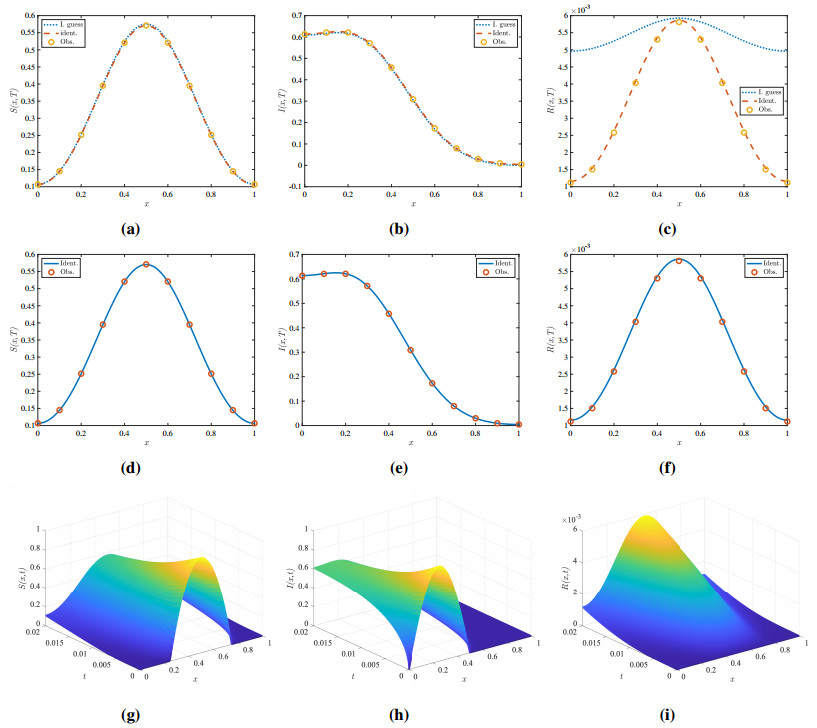
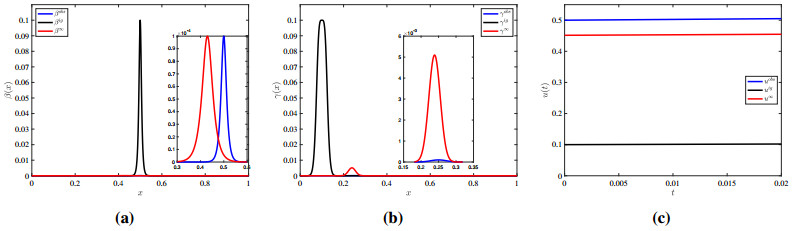
In this paper, we simultaneously study reaction identification and the optimal control problem for a reaction-diffusion system modeling carrier-borne epidemics with a general transmission function and vaccination. The state equations are given by a susceptible-infected-recovered reaction-diffusion system with zero-flux boundary conditions and initial conditions. The reaction is modeled by three terms: a general transmission function modeling the force of the infection or the effective contact between susceptible and infected individuals, a linear function for transition between susceptible and infected individuals, and a function for control of vaccination of susceptible individuals. The cost function consists of two parts: two terms related to parameter identification, comprising a regularized least squares cost function, and five terms related to the control of the population through vaccination. The optimal control problem is analyzed by applying the Dubovitskii and Milyutin formalism. In the main results, we deduce the well-posedness of the state equation, the existence of the optimal control problem, the existence of solutions of the adjoint state, and a first-order optimality condition. We develop a numerical approximation for the optimal control problem by employing an IMEX method to approximate the state equations. In this approach, the coefficients of the reaction terms and the control functions depend on a finite set of parameters. We provide two numerical examples to demonstrate the agreement of our numerical solution with the measurement observations.
Citation: Anibal Coronel, Fernando Huancas, Camila Isoton, Alex Tello. Optimal control problem and reaction identification term for carrier-borne epidemic spread with a general infection force and diffusion[J]. Electronic Research Archive, 2025, 33(7): 4435-4467. doi: 10.3934/era.2025202
In this paper, we simultaneously study reaction identification and the optimal control problem for a reaction-diffusion system modeling carrier-borne epidemics with a general transmission function and vaccination. The state equations are given by a susceptible-infected-recovered reaction-diffusion system with zero-flux boundary conditions and initial conditions. The reaction is modeled by three terms: a general transmission function modeling the force of the infection or the effective contact between susceptible and infected individuals, a linear function for transition between susceptible and infected individuals, and a function for control of vaccination of susceptible individuals. The cost function consists of two parts: two terms related to parameter identification, comprising a regularized least squares cost function, and five terms related to the control of the population through vaccination. The optimal control problem is analyzed by applying the Dubovitskii and Milyutin formalism. In the main results, we deduce the well-posedness of the state equation, the existence of the optimal control problem, the existence of solutions of the adjoint state, and a first-order optimality condition. We develop a numerical approximation for the optimal control problem by employing an IMEX method to approximate the state equations. In this approach, the coefficients of the reaction terms and the control functions depend on a finite set of parameters. We provide two numerical examples to demonstrate the agreement of our numerical solution with the measurement observations.

| [1] | S. Lenhart, J. T. Workman, Optimal Control Applied to Biological Models, Chapman and Hall/CRC, New York, USA, 2007. https://doi.org/10.1201/9781420011418 |
| [2] | J. Jahn, Introduction to the Theory of Nonlinear Optimization, Springer Nature, Cham, Switzerland, 2020. https://doi.org/10.1007/978-3-030-42760-3 |
| [3] | B. Lee, L. Markus, Foundations of Optimal Control Theory, John Wiley and Sons, Inc., New York, 1967. |
| [4] |
E. Fernández-Cara, E. Zuazua, Control theory: History, mathematical achievements and perspectives, Bol. Soc. Esp. Mat. Apl., 26 (2003), 79–140. https://doi.org/10.1002/oca.678 doi: 10.1002/oca.678

|
| [5] |
K. Wickwire, Mathematical models for the control of pests and infectious diseases: a survey, Theor. Popul. Biol., 11 (1977), 182–238. https://doi.org/10.1016/0040-5809(77)90025-9 doi: 10.1016/0040-5809(77)90025-9
|
| [6] | J. L. Sanders, Quantitative guidelines for communicable disease control programs, Biometrics, 27 (1971), 883–893. |
| [7] |
K. Wickwire, A note on the optimal control of carrier-borne epidemics, J. Appl. Probab., 12 (1975), 565–568. https://doi.org/10.2307/3212871 doi: 10.2307/3212871
|
| [8] |
H. Behncke, Optimal control of deterministic epidemics, Optim. Control Appl. Methods, 21 (2000), 269–285. https://doi.org/10.1002/oca.678 doi: 10.1002/oca.678
|
| [9] |
C. Nowzari, V. M. Preciado, G. J. Pappas, Analysis and control of epidemics: A survey of spreading processes on complex networks, IEEE Control Syst. Mag., 36 (2016), 26–46. https://doi.org/10.1109/MCS.2015.2495000 doi: 10.1109/MCS.2015.2495000
|
| [10] |
G. Q. Sun, R. He, L. F. Hou, X. Luo, S. Gao, L. Chang, et al., Optimal control of spatial diseases spreading in networked reaction–diffusion systems, Phys. Rep., 1111 (2025), 269–285. https://doi.org/10.1016/j.physrep.2025.01.005 doi: 10.1016/j.physrep.2025.01.005
|
| [11] |
J. Chen, K. Feng, L. Freddi, D. Goreac, J. Li, Optimality of vaccination for prevalence–constrained SIRS epidemics, Appl. Math. Optim., 91 (2025), 1–26. https://doi.org/10.1007/s00245-024-10212-8 doi: 10.1007/s00245-024-10212-8
|
| [12] |
D. Breda, M. Della Rossa, L. Freddi, Viability and control of a delayed SIR epidemic with an ICU state constraint, ESAIM: Control, Optim. Calculus Var., 31 (2025), 1–40. https://doi.org/10.1051/cocv/2024083 doi: 10.1051/cocv/2024083
|
| [13] |
M. Della Rossa, L. Freddi, D. Goreac, Optimality of Vaccination for an SIR Epidemic with an ICU Constraint, J. Optim. Theory Appl., 204 (2025), 1–40. https://doi.org/10.1007/s10957-024-02598-w doi: 10.1007/s10957-024-02598-w
|
| [14] |
A. Miniguano–Trujillo, J. W. Pearson, B. D. Goddard, A constrained optimisation framework for parameter identification of the SIRD model, Math. Biosci., 380 (2025), 109379. https://doi.org/10.1016/j.mbs.2025.109379 doi: 10.1016/j.mbs.2025.109379
|
| [15] |
A. E. A. Laaroussi, M. Rachik, M. Elhia, An optimal control problem for a spatiotemporal SIR model, Int. J. Dyn. Control, 6 (2018), 384–397. https://doi.org/10.1007/s40435-016-0283-5 doi: 10.1007/s40435-016-0283-5
|
| [16] |
R. Ghazzali, A. E. A. Laaroussi, A. EL Bhih, M. Rachik, On the control of a reaction–diffusion system: a class of SIR distributed parameter systems, Int. J. Dyn. Control, 7 (2019), 1021–1034. https://doi.org/10.1007/s40435-019-00553-6 doi: 10.1007/s40435-019-00553-6
|
| [17] |
F. Dai, B. Liu, Optimal control problem for a general reaction-diffusion eco-epidemiological model with disease in prey, Appl. Math. Modell., 88 (2020), 1–20. https://doi.org/10.1016/j.apm.2020.06.040 doi: 10.1016/j.apm.2020.06.040
|
| [18] |
L. Zhu, X. Huang, Y. Liu, Z. Zhang, Spatiotemporal dynamics analysis and optimal control method for an SI reaction-diffusion propagation model, J. Math. Anal. Appl., 493 (2021), 124539, 1–28. https://doi.org/10.1016/j.jmaa.2020.124539 doi: 10.1016/j.jmaa.2020.124539
|
| [19] |
F. Ge, Y. Chen, Optimal vaccination and treatment policies for regional approximate controllability of the time-fractional reaction–diffusion SIR epidemic systems, ISA Trans., 115 (2021), 143–152. https://doi.org/10.1016/j.isatra.2021.01.023 doi: 10.1016/j.isatra.2021.01.023
|
| [20] | M. Mehdaoui, D. Lacitignola, M. Tilioua, l, Commun. Nonlinear Sci. Numer. Simul., 131 (2024), 107855. https://doi.org/10.1016/j.cnsns.2024.107855 |
| [21] |
A. E. A. Laaroussi, A. El Bhih, M. Rachik, Optimal vaccination and treatment policies with constrained inequalities to study limited vaccination resources for a multistrain reaction–diffusion SEIR model of COVID–19, Partial Differ. Equations Appl. Math., 10 (2024), 100684. https://doi.org/10.1016/j.padiff.2024.100684 doi: 10.1016/j.padiff.2024.100684
|
| [22] |
A. E. A. Laaroussi, A. El Bhih, M. Rachik, Spatiotemporal epidemic models for rabies among dog with vaccination approach, Nonlinear Funct. Anal. Appl., 29 (2024), 711–738. https://doi.org/10.22771/nfaa.2024.29.03.05 doi: 10.22771/nfaa.2024.29.03.05
|
| [23] |
A. Bouissa, M. Tahiri, N. Tsouli, M. R. S. Ammi, Optimal control of multi-group spatio–temporal SIR model, J. Math. Anal. Appl., 542 (2025), 1–21. https://doi.org/10.1016/j.jmaa.2024.128835 doi: 10.1016/j.jmaa.2024.128835
|
| [24] |
K. Wickwire, Control policies for epidemics spread solely by carriers, Int. J. Control, 26 (1977), 473–490. https://doi.org/10.1080/00207177708922323 doi: 10.1080/00207177708922323
|
| [25] |
H. McCallum, N. Barlow, J. Hone. How should pathogen transmission be modelled?, Trends Ecol. Evol., 16 (2001), 295–300. https://doi.org/10.1016/S0169-5347(01)02144-9 doi: 10.1016/S0169-5347(01)02144-9
|
| [26] |
X. Huili, L. Bin, Solving the inverse problem of an SIS epidemic reaction–diffusion model by optimal control methods, Comput. Math. Appl., 70 (2015), 805–819. https://doi.org/10.1016/j.camwa.2015.05.025 doi: 10.1016/j.camwa.2015.05.025
|
| [27] |
A. Coronel, F. Huancas, M. Sepúlveda, A note on the existence and stability of an inverse problem for a SIS model, Comput. Math. Appl., 77 (2019), 3186–3194. https://doi.org/10.1016/j.camwa.2019.01.031 doi: 10.1016/j.camwa.2019.01.031
|
| [28] |
A. Coronel, F. Huancas, M. Sepúlveda, Identification of space distributed coefficients in an indirectly transmitted diseases model, Inverse Probl., 35 (2019), 115001. https://doi.org/10.1088/1361-6420/ab3a86 doi: 10.1088/1361-6420/ab3a86
|
| [29] |
A. Coronel, F. Huancas, I. Hess, A. Tello, The diffusion identification in a SIS reaction-diffusion system, Math. Biosci. Eng., 21 (2024), 562–581. https://doi.org/10.3934/mbe.2024024 doi: 10.3934/mbe.2024024
|
| [30] |
A. Coronel, L. Friz, I. Hess, M. Zegarra, On the existence and uniqueness of an inverse problem in epidemiology, Appl. Anal., 100 (2021), 513–526. https://doi.org/10.1080/00036811.2019.1608964 doi: 10.1080/00036811.2019.1608964
|
| [31] |
A. Coronel, F. Huancas, E. Lozada, M. Rojas–Médar, The Dubovitskii and Milyutin methodology applied to an optimal control problem originating in an ecological system, Mathematicas, 9 (2021), 479. https://doi.org/10.3390/math9050479 doi: 10.3390/math9050479
|
| [32] |
N. C. Apreutesei, An optimal control problem for pest, predator, and plant system, Nonlinear Anal. Real World Appl., 13 (2012), 1391–1400. https://doi.org/10.1016/j.nonrwa.2011.11.004 doi: 10.1016/j.nonrwa.2011.11.004
|
| [33] |
N. C. Apreutesei, An optimal control problem for a two–prey and one–predator model with diffusion, Comput. Math. Appl., 67 (2014), 2127–2143. https://doi.org/10.1016/j.camwa.2014.02.020 doi: 10.1016/j.camwa.2014.02.020
|
| [34] | O. Bara, S. M. Djouadi, J. D. Day, S. Lenhart, Immune therapeutic strategies using optimal controls with L1 and L2 type objectives, Math. Biosci., 290, (2017), 9–21. https://doi.org/10.1016/j.mbs.2017.05.010 |
| [35] | E. Molina, A. Rapaport, An optimal feedback control that minimizes the epidemic peak in the SIR model under a budget constraint, Automatica, 146, (2022), 110596. https://doi.org/10.1016/j.automatica.2022.110596 |
| [36] | A. Y. Dubovitskii, Discrete maximum principle, Autom. Remote Control, 10 (1978), 55–71. |
| [37] | A. Y. Dubovitskii, A. A. Milyutin. Extremum problems in the presence of restrictions, Zh. Vychisl. Mat. Mat. Fiz., 5 (1965), 395–453. |
| [38] |
I. Gayte, F. Guillén-González, M. Rojas-Medar, Dubovitskii-Milyutin formalism applied to optimal control problems with constraints given by the heat equation with final data, IMA J. Math. Control. Inf., 27 (2010), 57–76. https://doi.org/10.1093/imamci/dnq001 doi: 10.1093/imamci/dnq001
|
| [39] | A. Coronel, F. Guillén-González, F. Marques-Lopes, M. Rojas-Medar, The Dubovitskii and Milyutin Formalism Applied to an Optimal Control Problem in a Solidification Model, Recent Advances in PDEs: Analysis, Numerics and Control: In Honor of Prof. Fernández-Cara's 60th Birthday, Cham: Springer International Publishing, (2018), 211–231. https://doi.org/10.1007/978-3-319-97613-6_11 |
| [40] | R. A. Adams, Pure and Applied Mathematics, Academic Press, New York, USA, 1975. |
| [41] | L. C. Evans, Partial Differential Equations, American Mathematical Society, Providence, Rhode Island, USA, 1997. |
| [42] | M. T. Hoang, M. Ehrhardt, Differential equation models for infectious diseases: Mathematical modeling, qualitative analysis, numerical methods and applications, preprint, arXiv: 2401.03308. |
| [43] | W. O. Kermack, A. G. McKendrick, A contribution to the mathematical theory of epidemics, in Proceedings of the Royal Society of London. Series A, Containing Papers of a Mathematical and Physical Character, 115 (1927), 700–721. https://doi.org/10.1098/rspa.1927.0118 |
| [44] | M. Martcheva, An Introduction to Mathematical Epidemiology, Springer, New York, USA, 2015. https://doi.org/10.1007/978-1-4899-7612-3 |
| [45] |
F. Al Basir, A. Banerjee, S. Ray, Role of farming awareness in crop pest management-A mathematical model, J. Theor. Biol., 461 (2019), 59–67. https://doi.org/10.1016/j.jtbi.2018.10.033 doi: 10.1016/j.jtbi.2018.10.033
|
| [46] |
N. C. Apreutesei, Necessary optimality conditions for a lotka-volterra three species system, Math. Modell. Nat. Phenom., 1 (2006), 120–132. https://doi.org/10.1051/mmnp:2006005 doi: 10.1051/mmnp:2006005
|
| [47] |
M. Asif, Z. A. Khan, N. Haider, Q. Al-Mdallal, Numerical simulation for solution of SEIR models by meshless and finite difference methods, Chaos, Solitons Fractals, 141 (2020), 110340. https://doi.org/10.1016/j.chaos.2020.110340 doi: 10.1016/j.chaos.2020.110340
|
| [48] |
V. A. Bokil, L. J. S. Allen, M. J. Jeger, S. Lenhart, Optimal control of a vectored plant disease model for a crop with continuous replanting, J. Biol. Dyn., 1 (2019), 325–353. https://doi.org/10.1080/17513758.2019.1622808 doi: 10.1080/17513758.2019.1622808
|
| [49] |
V. Capasso, G. Serio, A generalization of the kermack-mckendrick deterministic epidemic model, Math. Biosci., 42 (1978), 43–61. https://doi.org/10.1016/0025-5564(78)90006-8 doi: 10.1016/0025-5564(78)90006-8
|
| [50] | S. Zhu, N. Verdiere, D. Manceau, L. Denis-Vidal, D. Kateb, Modeling spatial spread of an epidemiologic model in a spatially continuous domain, in International Conference on Complex Dynamical Systems in Life Sciences: Modeling and Analysis, 2016. https://hal.science/hal-01412768 |
| [51] |
H. Fang, M. Wang, T. Zhou, Existence of positive periodic solution of a hepatitis B virus infection model, Math. Methods Appl. Sci., 38 (2015), 188–196. https://doi.org/10.1002/mma.3074 doi: 10.1002/mma.3074
|
| [52] |
G. Q. Sun, R. He, L. F. Hou, X. Luo, S. Gao, L. Chang, et al., Optimal control of spatial diseases spreading in networked reaction–diffusion systems, Phys. Rep., 1111 (2025), 1–64. https://doi.org/10.1016/j.physrep.2024.12.001 doi: 10.1016/j.physrep.2024.12.001
|
| [53] |
X. Wang, R. Wu, X. Q. Zhao, A reaction-advection-diffusion model of cholera epidemics with seasonality and human behavior change, J. Math. Biol., 84 (2022), 34. https://doi.org/10.1007/s00285-022-01774-2 doi: 10.1007/s00285-022-01774-2
|
| [54] |
Y. Lou, R. B. Salako, Mathematical analysis of the dynamics of some reaction–diffusion models for infectious diseases, J. Differ. Equations, 370 (2023), 424–469. https://doi.org/10.1016/j.jde.2023.01.032 doi: 10.1016/j.jde.2023.01.032
|
| [55] |
A. A. Ayoade, S. Thota, Z. Shah, Theoretical framework for biological control of pest: a mathematical modeling approach, Environ. Sci. Pollut. Res. Int., 31 (2024), 54453–54462. https://doi.org/10.1007/s11356-024-34788-4 doi: 10.1007/s11356-024-34788-4
|
| [56] | V. Barbu, Mathematical Methods in Optimization of Differential Systems, Translated and Revised from the 1989 Romanian Original, Mathematics and Its Applications 310, Kluwer Academic Publishers Group: Dordrecht, The Netherlands, 1994. |
| [57] | A. Manzoni, A. Quarteroni, G. Rozza, Optimal Control of Partial Differential Equations: Theory, Methods, and Applications, Springer, 2022. |
| [58] | I. V. Girsanov, Lectures on Mathematical Theory of Extremum Problems, Lectures Notes in Economics and Mathematical Systems, Volume 67 Springer: Berlin, Germany; New York, NY, USA, 1972. |
| [59] |
W. Kotarski, Characterization of pareto optimal points in problems with multi-equality constraints, Optimization, 20 (1989), 93–106. https://doi.org/10.1080/02331938908843418 doi: 10.1080/02331938908843418
|
| [60] | J. Jahn, Introduction to the Theory of Nonlinear Optimization, Springer: Berlin, Germany, 2020. |
| [61] | M. E. Taylor, Partial Differential Equations II. Qualitative Studies of Linear Equation, Springer Verlag: New York, USA, 1999. |
| [62] | I. Vrabie, C$_0$-Semigroups and Applications, In: North-Holland Math. Stud., Netherlands, 2003. |
| [63] | D. Uciński, Optimal Measurement Methods for Distributed Parameter System Identification, CRC Press, Boca Raton London, New York Washington, D.C., USA, 2005. |
| [64] | M. D. Gunzburger, Perspectives in Flow and Optimization. Volume II of Advances in Design and Control Series, SIAM, Philadelphia, USA, 2003. |
| [65] |
T. T. Marinov, R. S. Marinova, Dynamics of COVID-19 using inverse problem for coefficient identification in SIR epidemic models, Chaos, Solitons Fractals, 5 (2020), 100041. https://doi.org/10.1016/j.csfx.2020.100041. doi: 10.1016/j.csfx.2020.100041
|
| [66] |
A. Comunian, R. Gaburro, M. Giudici, Inversion of a SIR-based model: A critical analysis about the application to COVID-19 epidemic, Phys. D, 413 (2020), 132674. https://doi.org/10.1016/j.physd.2020.132674. doi: 10.1016/j.physd.2020.132674
|
| [67] | D. Prodanov, Analytical solutions and parameter estimation of the SIR epidemic model, Math. Anal. Infect. Dis., (2022), 163–189. https://doi.org/10.1016/B978-0-32-390504-6.00015-2. |
| [68] |
L. Allen, B. Bolker, Y. Lou, A. Nevai, Asymptotic profiles of the steady states for an SIS epidemic reaction-diffusion model, Discrete Contin. Dyn. Syst., 21 (2008), 1–20. https://doi.org/10.3934/dcds.2008.21.1 doi: 10.3934/dcds.2008.21.1
|
Figures(6) / Tables(1)
Anibal Coronel, Fernando Huancas, Camila Isoton, Alex Tello. Optimal control problem and reaction identification term for carrier-borne epidemic spread with a general infection force and diffusion[J]. Electronic Research Archive, 2025, 33(7): 4435-4467. doi: 10.3934/era.2025202





 DownLoad: