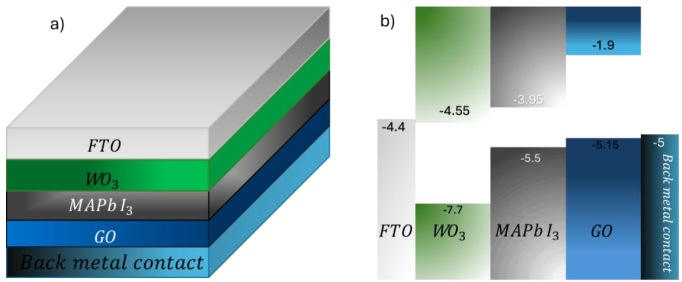
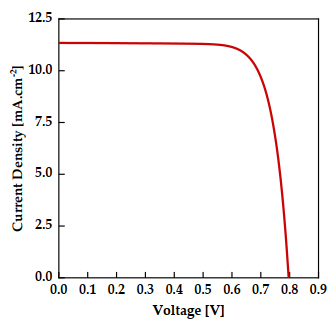
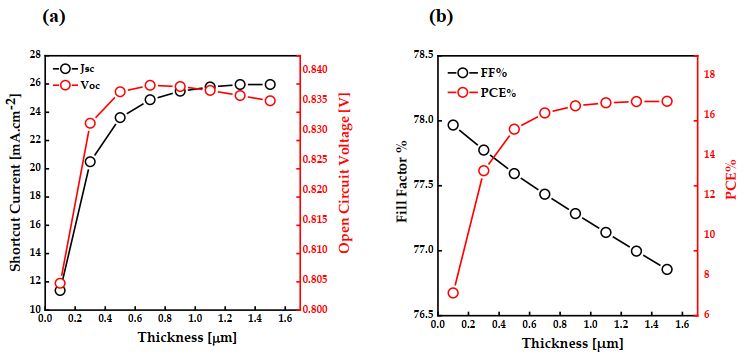
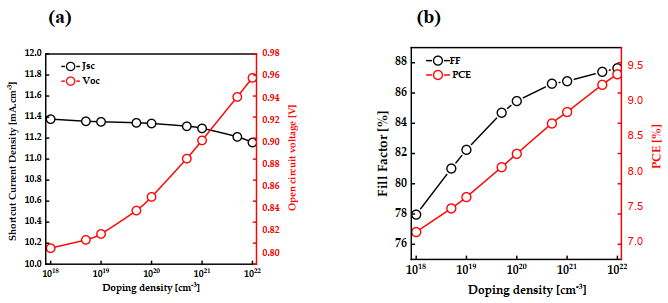
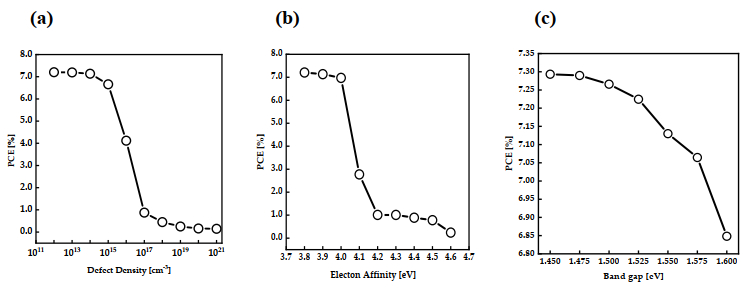
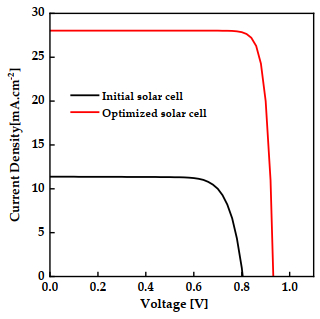
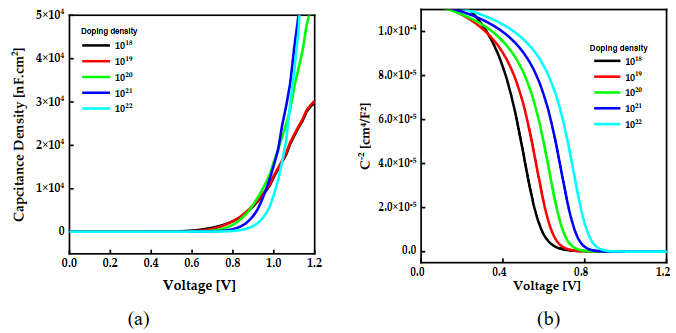
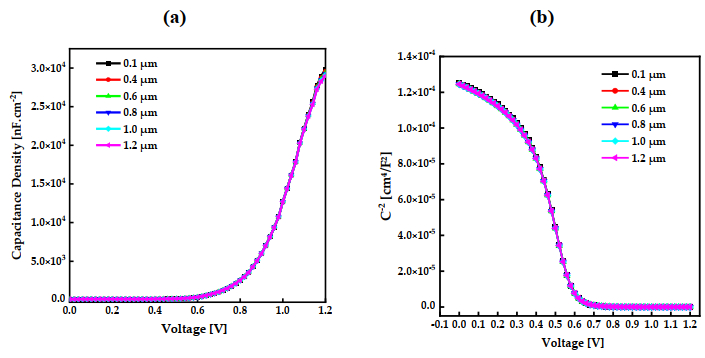
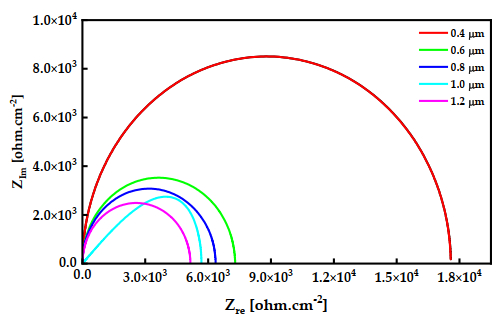
The solar cell capacitance simulator in one dimension was used to examine how the perovskite layer's properties influence devices' performance in a simulated solar cell structure comprising graphene oxide (GO) as the hole transport material (HTL), tungsten trioxide (WO3) as the electron transport material (ETL), and methylammonium lead iodide (MAPbI3) as the absorber layer. The simulation investigated the effects of the MAPbI3 layer's thickness, defect density, electron affinity, and doping concentration on photovoltaic parameters. The baseline nonoptimized structure yielded a power conversion efficiency (PCE) of 7.1%, with a short-circuit current density (Jsc) of 11.38 mA/cm2, an open-circuit voltage (Voc) of 0.80 V, and a fill factor (FF) of 77.9%. Optimization of the MAPbI3 layer's thickness to 1.2 µm and the acceptor doping density to 1.0 × 1022 cm-3 improved the $ \mathrm{P}\mathrm{C}\mathrm{E} $ to 22.9%, with Jsc = 28 mA/cm2, Voc = 0.93 V, and FF = 87.4%. These improvements stem from enhanced light absorption and more efficient charge separation. Alternating current (AC) analysis through capacitance–voltage and electrochemical impedance spectroscopy indicated that optimized doping reduces series resistance and modifies the depletion region's width, though the interpretation of the Nyquist plots requires careful consideration of competing transport and recombination processes. These findings provide guidance for experimental design of perovskite solar cells, though the simulated efficiencies represent theoretical upper bounds that may not be achievable experimentally with these transport layer materials.
Citation: Saleh R. Al-Bashaish, Hmoud Al Dmour, Bonginkosi V. Kheswa, Selma Rabhi, Nabil Bouri, Ahmad M. D. (Assa'd) Jaber, Ahmad Telfah. Influence of MAPbI3 absorber layer properties on WO3/MAPbI3/GO perovskite solar cells' performance using SCAPS-1D[J]. AIMS Energy, 2026, 14(5): 1142-1163. doi: 10.3934/energy.2026045
The solar cell capacitance simulator in one dimension was used to examine how the perovskite layer's properties influence devices' performance in a simulated solar cell structure comprising graphene oxide (GO) as the hole transport material (HTL), tungsten trioxide (WO3) as the electron transport material (ETL), and methylammonium lead iodide (MAPbI3) as the absorber layer. The simulation investigated the effects of the MAPbI3 layer's thickness, defect density, electron affinity, and doping concentration on photovoltaic parameters. The baseline nonoptimized structure yielded a power conversion efficiency (PCE) of 7.1%, with a short-circuit current density (Jsc) of 11.38 mA/cm2, an open-circuit voltage (Voc) of 0.80 V, and a fill factor (FF) of 77.9%. Optimization of the MAPbI3 layer's thickness to 1.2 µm and the acceptor doping density to 1.0 × 1022 cm-3 improved the $ \mathrm{P}\mathrm{C}\mathrm{E} $ to 22.9%, with Jsc = 28 mA/cm2, Voc = 0.93 V, and FF = 87.4%. These improvements stem from enhanced light absorption and more efficient charge separation. Alternating current (AC) analysis through capacitance–voltage and electrochemical impedance spectroscopy indicated that optimized doping reduces series resistance and modifies the depletion region's width, though the interpretation of the Nyquist plots requires careful consideration of competing transport and recombination processes. These findings provide guidance for experimental design of perovskite solar cells, though the simulated efficiencies represent theoretical upper bounds that may not be achievable experimentally with these transport layer materials.

| [1] |
Wang J, Azam W (2024) Natural resource scarcity, fossil fuel energy consumption, and total greenhouse gas emissions in top emitting countries. Geosci Front 15: 101757. https://doi.org/10.1016/j.gsf.2023.101757 doi: 10.1016/j.gsf.2023.101757

|
| [2] |
Rahal A, Bouchama I, Khalladi MR, et al. (2026) Hybrid semiconductor based on CuO/Cu2O/CIGS: Analysis of photovoltaic properties. J Sol-Gel Sci Technol 119: 17. https://doi.org/10.1007/s10971-026-07213-0 doi: 10.1007/s10971-026-07213-0
|
| [3] |
Sakib NA, Ahammed R, Tarekuzzaman Md, et al. (2025) Highly efficient (31%) of rubidium-based halide perovskite solar cell using SCAPS-1D simulation. AIP Adv 15: 025110. https://doi.org/10.1063/5.0251323 doi: 10.1063/5.0251323
|
| [4] |
Chapin DM, Fuller CS, Pearson GL (1954) A new silicon p-n junction photocell for converting solar radiation into electrical power. J Appl Phys 25: 676–677. https://doi.org/10.1063/1.1721711 doi: 10.1063/1.1721711
|
| [5] |
Reza MdS, Ghosh A, Drissi N, et al. (2024) Evaluation of design and device parameters for lead-free Sr3PBr3/Sr3NCl3 duel-layer perovskite photovoltaic device technology. RSC Adv 14: 36675–36697. https://doi.org/10.1039/D4RA07912D doi: 10.1039/D4RA07912D
|
| [6] |
Kojima A, Teshima K, Shirai Y, et al. (2009) Organometal halide perovskites as visible-light sensitizers for photovoltaic cells. J Am Chem Soc 131: 6050–6051. https://doi.org/10.1021/ja809598r doi: 10.1021/ja809598r
|
| [7] |
Sumona FB, Mahmud NA, Zhang T, et al. (2026) Exploring lead‐free Rb2PtI6-Based perovskite solar cells through SCAPS‐1D and charge transport layer variations for enhanced photovoltaic efficiency. Int J Energy Res 2026: 9356830. https://doi.org/10.1155/er/9356830 doi: 10.1155/er/9356830
|
| [8] |
Zheng Z, Wang S, Hu Y, et al. (2022) Development of formamidinium lead iodide-based perovskite solar cells: Efficiency and stability. Chem Sci 13: 2167–2183. https://doi.org/10.1039/D1SC04769H doi: 10.1039/D1SC04769H
|
| [9] |
Park NG (2018) Halide perovskite photovoltaics: History, progress, and perspectives. MRS Bull 43: 527–533. https://doi.org/10.1557/mrs.2018.152 doi: 10.1557/mrs.2018.152
|
| [10] |
Mousa MS, Al Dmour H, Jaradat EK, et al. (2024) Studying the effect of transport layers on ZrS2/MEH-PPV solar cells: Using SCAPS-1D software. East Eur J Phy 4: 419–426. https://doi.org/10.26565/2312-4334-2024-4-49 doi: 10.26565/2312-4334-2024-4-49
|
| [11] |
Abnavi H, Maram DK, Abnavi A (2021) Performance analysis of several electron/hole transport layers in thin film MAPbI3-based perovskite solar cells: A simulation study. Opt Mater (Amst) 118: 111258. https://doi.org/10.1016/j.optmat.2021.111258 doi: 10.1016/j.optmat.2021.111258
|
| [12] |
Adnan M, Irshad Z, Hussain R, et al. (2023) Efficient ternary active layer materials for organic photovoltaics. Sol Energy 257: 324–343. https://doi.org/10.1016/j.solener.2023.04.012 doi: 10.1016/j.solener.2023.04.012
|
| [13] |
Rashmi SN, Chandrashekar HK, Sangamesha MA, et al. (2022) A review on synthesis and applications of tungsten oxide nanoparticles and their polymer composites. Int J Nanosci 21: 2230001. https://doi.org/10.1142/S0219581X22300012 doi: 10.1142/S0219581X22300012
|
| [14] |
Mujtaba A, Khan MI, Amami M, et al. (2025) Enhancing perovskite solar cell efficiency: ZnO–WO3 as an electron transport layer to minimize recombination losses. RSC Adv 15: 25019–25029. https://doi.org/10.1039/D5RA03446A doi: 10.1039/D5RA03446A
|
| [15] |
Kang SB, Jo Y, Lam NH, et al. (2022) The role of the Graphene Oxide (GO) and PEO Treated-Zinc Oxide (ZnO/PEO) intermediate electrode buffer layer in vacuum-free quantum dots solar cell. Metals 12: 2096. https://doi.org/10.3390/met12122096 doi: 10.3390/met12122096
|
| [16] |
Abbas KJ, Bahrami A (2024) Investigating the potential of WO3 and WS2 as Cd-free buffer layers in Sb2Se3-Based thin-film solar cells: A numerical study with SCAPS-1D software. Sol Energy Mater Sol Cells 272: 112891. https://doi.org/10.1016/j.solmat.2024.112891 doi: 10.1016/j.solmat.2024.112891
|
| [17] |
Al Dmour H, Al-Madanat OY, Altarawneh RM, et al. (2025) Enhancing efficiency in TiO2/MAPbI3/GO perovskite solar cells: Theoretical investigation of MAPbI3 interlayer effects using SCAPS-1D simulation. AIMS Energy 13: 732–755. https://doi.org/10.3934/energy.2025026 doi: 10.3934/energy.2025026
|
| [18] |
Zhang W, Xia Z, Chen C, et al. (2026) Enhancing perovskite solar cell performance via engineering the hole transport interface with star-shaped nitrogen-rich material. J Phys Chem Lett 17: 2152–2160. https://doi.org/10.1021/acs.jpclett.5c03830 doi: 10.1021/acs.jpclett.5c03830
|
| [19] |
Najafi-Ashtiani H, Bilek MM, Akhavan B (2024) Tungsten oxide thin films for electrochromic applications: Pulse width-controlled deposition by high-power impulse magnetron sputtering. Adv Eng Mater 26: 2301378. https://doi.org/10.1002/adem.202301378 doi: 10.1002/adem.202301378
|
| [20] |
Mews M, Korte L, Rech B (2016) Oxygen vacancies in tungsten oxide and their influence on tungsten oxide/silicon heterojunction solar cells. Sol Energy Mater Sol Cells 158: 77–83. https://doi.org/10.1016/j.solmat.2016.05.042 doi: 10.1016/j.solmat.2016.05.042
|
| [21] |
Yang QD, Li J, Cheng Y, et al. (2017) Graphene oxide as an efficient hole-transporting material for high-performance perovskite solar cells with enhanced stability. J Mater Chem A 5: 9852–9858. https://doi.org/10.1039/C7TA01752A doi: 10.1039/C7TA01752A
|
| [22] |
Amjad A, Qamar S, Zhao C, et al. (2023) Numerical simulation of lead-free vacancy ordered Cs2PtI6 based perovskite solar cell using SCAPS-1D. RSC Adv 13: 23211–23222. https://doi.org/10.1039/D3RA04176J doi: 10.1039/D3RA04176J
|
| [23] |
Danladi E, Gyuk PM, Tasie NN, et al. (2023) Impact of hole transport material on perovskite solar cells with different metal electrode: A SCAPS-1D simulation insight. Heliyon 9: e16838. https://doi.org/10.1016/j.heliyon.2023.e16838 doi: 10.1016/j.heliyon.2023.e16838
|
| [24] |
Burgelman M, Nollet P, Degrave S (2000) Modelling polycrystalline semiconductor solar cells. Thin Solid Films 361–362: 527–532. https://doi.org/10.1016/S0040-6090(99)00825-1 doi: 10.1016/S0040-6090(99)00825-1
|
| [25] |
Al-Dmour H (2024) SCAPS numerical analysis of graphene Oxide/Zirconium disulfide solar cells. East Eur J Phy 2: 445–449. https://doi.org/10.26565/2312-4334-2024-2-58 doi: 10.26565/2312-4334-2024-2-58
|
| [26] |
Medina JCZ, Andrés ER, Ruíz CM, et al. (2023) Numerical simulation and performance optimization of a solar cell based on WO3/CdTe heterostructure using NiO as HTL layer by SCAPS 1D. Coatings 13: 1436. https://doi.org/10.3390/coatings13081436 doi: 10.3390/coatings13081436
|
| [27] |
Al-Dmour H, Taylor DM (2023) Effect of properties of NC-TiO2 grains on the performance of organic/inorganic solar cells. J Ovonic Res 19: 587–596. https://doi.org/10.15251/JOR.2023.195.587 doi: 10.15251/JOR.2023.195.587
|
| [28] | Gallet T (2021) Co-evaporation and scanning probe microscopy characterizations of hybrid halide perovskite thin films for solar cells. PhD thesis, University of Luxembourg. https://doi.org/10.13140/RG.2.2.11415.65445 |
| [29] |
Chowdhury TA (2026) Numerical modeling to enhance the efficiency of experimentally fabricated Sb2Se3-based solar cell. RSC Adv 16: 2873–2903. https://doi.org/10.1039/D5RA04411A doi: 10.1039/D5RA04411A
|
| [30] |
Ouslimane T, Et-taya L, Elmaimouni L, et al. (2021) Impact of absorber layer thickness, defect density, and operating temperature on the performance of MAPbI3 solar cells based on ZnO electron transporting material. Heliyon 7: e06379. https://doi.org/10.1016/j.heliyon.2021.e06379 doi: 10.1016/j.heliyon.2021.e06379
|
| [31] |
Islam R, Saraswat K (2018) Limitation of optical enhancement in ultra-thin solar cells imposed by contact selectivity. Sci Rep 8: 8863. https://doi.org/10.1038/s41598-018-27155-0 doi: 10.1038/s41598-018-27155-0
|
| [32] |
Li X, Li P, Wu Z, et al. (2021) Review and perspective of materials for flexible solar cells. Mater Rep: Energy 1: 100001. https://doi.org/10.1016/j.matre.2020.09.001 doi: 10.1016/j.matre.2020.09.001
|
| [33] |
Lomuscio A, Rödel T, Schwarz T, et al. (2019) Quasi-Fermi-Level splitting of Cu-Poor and Cu-Rich CuInS2 absorber layers. Phys Rev Appl 11: 054052. https://doi.org/10.1103/PhysRevApplied.11.054052 doi: 10.1103/PhysRevApplied.11.054052
|
| [34] |
Al-Dmour H, Al-Trawneh S, Al-Taweel S (2021) Synthesis, characterization, and performance of oligothiophene cyanoacrylic acid derivatives for solar cell applications. Int J Adv Appl Sci 8: 128–135. https://doi.org/10.21833/ijaas.2021.06.015 doi: 10.21833/ijaas.2021.06.015
|
| [35] |
Alghafis A, Sobayel K (2024) Assessment of photovoltaic efficacy in antimony-based cesium halide perovskite utilizing transition metal chalcogenide. Int J Renew Energy Dev 13: 832–845. https://doi.org/10.61435/ijred.2024.60282 doi: 10.61435/ijred.2024.60282
|
| [36] | Bagade SS, Barik SB, Malik MM, et al. (2023) Impact of band alignment at interfaces in perovskite-based solar cell devices. Mater Today Proc. https://doi.org/10.1016/j.matpr.2023.02.117 |
| [37] |
Latrous AR, Mahamdi R, Touafek N, et al. (2021) Conduction band offset effect on the cu2znsns4 solar cells performance. Ann Chim Sci Mater 45: 431–437. https://doi.org/10.18280/acsm.450601 doi: 10.18280/acsm.450601
|
| [38] |
Shaker LM, Al-Amiery AA, Hanoon MM, et al. (2024) Examining the influence of thermal effects on solar cells: A comprehensive review. Sustain Energy Res 11: 6. https://doi.org/10.1186/s40807-024-00100-8 doi: 10.1186/s40807-024-00100-8
|
| [39] |
Almora O, Aranda C, Mas-Marzá E, et al. (2016) On Mott-Schottky analysis interpretation of capacitance measurements in organometal perovskite solar cells. Appl Phys Lett 109: 173903. https://doi.org/10.1063/1.4966127 doi: 10.1063/1.4966127
|
| [40] |
Sinha NK, Ghosh DS, Khare A (2022) Role of built-in potential over ETL/perovskite interface on the performance of HTL-free perovskite solar cells. Opt Mater 129: 112517. https://doi.org/10.1016/j.optmat.2022.112517 doi: 10.1016/j.optmat.2022.112517
|
| [41] |
Kheswa BV, Majola SNT, Al-Dmour H, et al. (2025) Modeling and analysis of KSnI3 perovskite solar cells yielding power conversion efficiency of 30.21%. Nanomaterials 15: 580. https://doi.org/10.3390/nano15080580 doi: 10.3390/nano15080580
|
Figures(11) / Tables(6)

Saleh R. Al-Bashaish, Hmoud Al Dmour, Bonginkosi V. Kheswa, Selma Rabhi, Nabil Bouri, Ahmad M. D. (Assa'd) Jaber, Ahmad Telfah. Influence of MAPbI3 absorber layer properties on WO3/MAPbI3/GO perovskite solar cells' performance using SCAPS-1D[J]. AIMS Energy, 2026, 14(5): 1142-1163. doi: 10.3934/energy.2026045





 DownLoad: