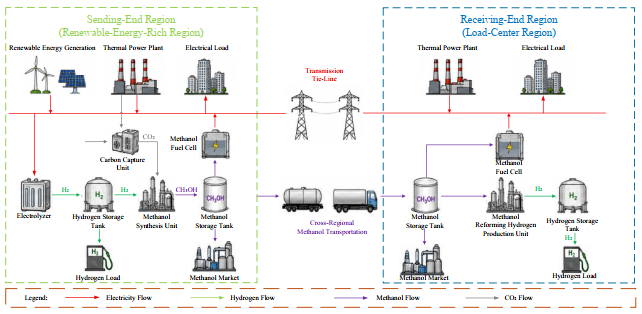
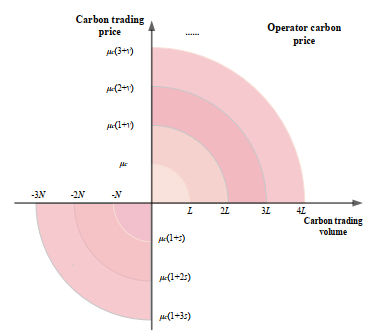
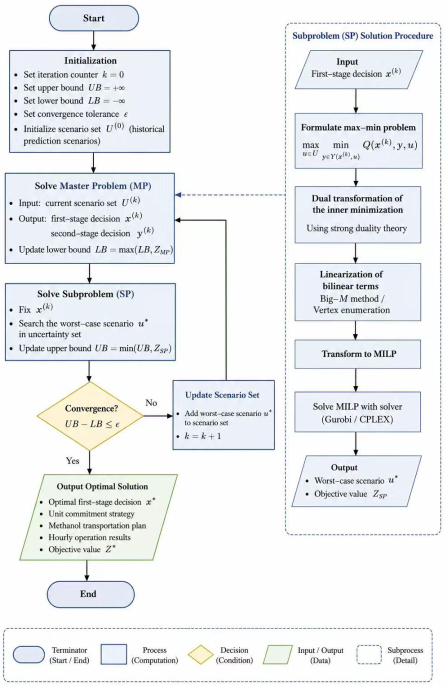
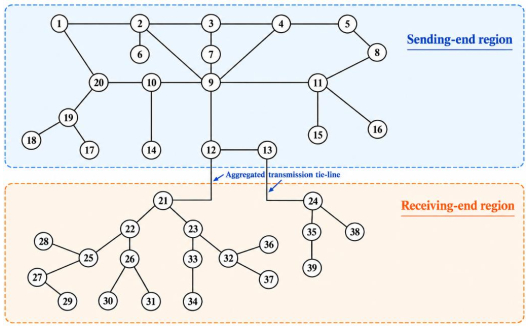
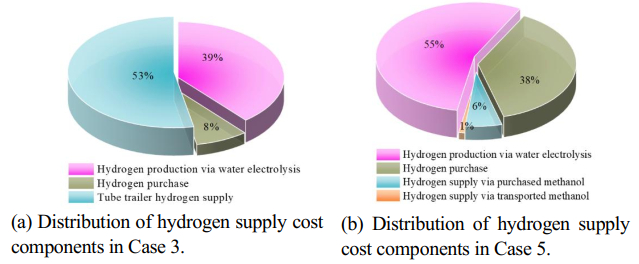
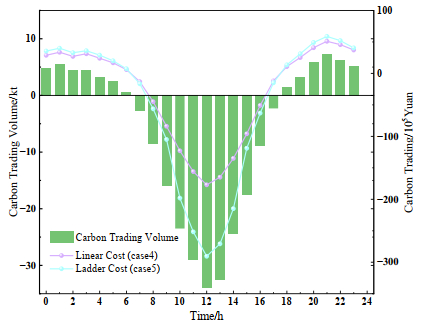
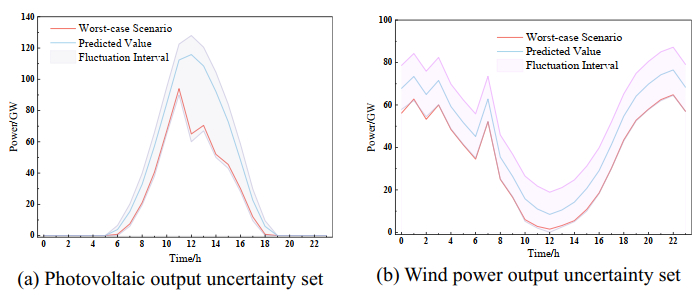
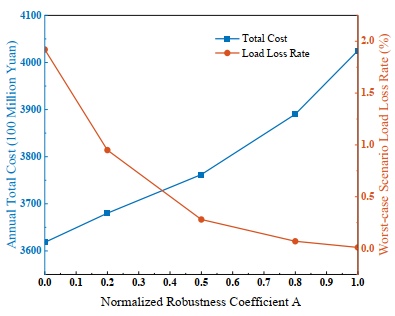
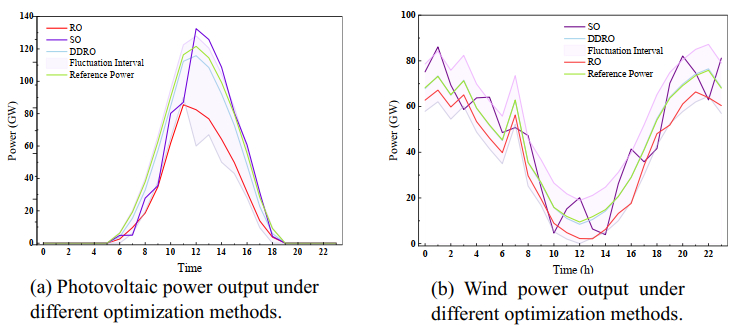
The power-hydrogen-methanol multi-energy coupling system enables flexible conversion of electricity, hydrogen, and liquid chemical energy, providing an effective pathway for renewable energy accommodation and low-carbon operation. However, spatial mismatch between renewable-energy-rich regions and load centers, together with wind and photovoltaic fluctuations, brings challenges to cross-regional energy coordination, flexible regulation, and economic operation. To address these issues, this paper proposed an optimal scheduling method for a power-hydrogen-methanol multi-energy coupling system considering cross-regional methanol transportation. First, a coupled operation framework was established for the sending-end and receiving-end regions, where transmission tie-lines and methanol transportation jointly form dual cross-regional energy transfer pathways. Second, a methanol storage and transportation model considering transportation delay was developed. By integrating electrolytic hydrogen production, methanol synthesis, methanol reforming, and methanol fuel cell power generation, the coordinated operation of the methanol production-storage-transportation-utilization chain and the power-hydrogen system is realized. Furthermore, a unified multi-timescale scheduling model was constructed to coordinate hourly power balance with daily methanol storage and transportation characteristics. On this basis, a reward-penalty differentiated stepped carbon trading scheme and a data-driven robust optimization (DDRO) approach are incorporated. Wind and photovoltaic uncertainty sets were built using historical forecasting errors, and the resulting two-stage robust scheduling model was solved by the column-and-constraint generation (C&CG) algorithm. Case studies on the IEEE 39-bus system showed that the proposed method achieves an annual operating cost of ¥381.275 billion, carbon emissions of 672,500 kt, and a worst-case load shedding rate of only 0.05%. These results confirm that the proposed approach can promote interregional renewable energy utilization, improve the hydrogen supply structure in the receiving-end region, and coordinate system economy, low-carbon performance, and supply reliability under renewable generation uncertainty.
Citation: Borui Zhang, Yuming Yang, Xueru Liu, Sida Lv. Optimal scheduling of a power-hydrogen-methanol multi-energy coupling system considering cross-regional methanol transportation[J]. AIMS Energy, 2026, 14(5): 1095-1141. doi: 10.3934/energy.2026044
The power-hydrogen-methanol multi-energy coupling system enables flexible conversion of electricity, hydrogen, and liquid chemical energy, providing an effective pathway for renewable energy accommodation and low-carbon operation. However, spatial mismatch between renewable-energy-rich regions and load centers, together with wind and photovoltaic fluctuations, brings challenges to cross-regional energy coordination, flexible regulation, and economic operation. To address these issues, this paper proposed an optimal scheduling method for a power-hydrogen-methanol multi-energy coupling system considering cross-regional methanol transportation. First, a coupled operation framework was established for the sending-end and receiving-end regions, where transmission tie-lines and methanol transportation jointly form dual cross-regional energy transfer pathways. Second, a methanol storage and transportation model considering transportation delay was developed. By integrating electrolytic hydrogen production, methanol synthesis, methanol reforming, and methanol fuel cell power generation, the coordinated operation of the methanol production-storage-transportation-utilization chain and the power-hydrogen system is realized. Furthermore, a unified multi-timescale scheduling model was constructed to coordinate hourly power balance with daily methanol storage and transportation characteristics. On this basis, a reward-penalty differentiated stepped carbon trading scheme and a data-driven robust optimization (DDRO) approach are incorporated. Wind and photovoltaic uncertainty sets were built using historical forecasting errors, and the resulting two-stage robust scheduling model was solved by the column-and-constraint generation (C&CG) algorithm. Case studies on the IEEE 39-bus system showed that the proposed method achieves an annual operating cost of ¥381.275 billion, carbon emissions of 672,500 kt, and a worst-case load shedding rate of only 0.05%. These results confirm that the proposed approach can promote interregional renewable energy utilization, improve the hydrogen supply structure in the receiving-end region, and coordinate system economy, low-carbon performance, and supply reliability under renewable generation uncertainty.

| [1] |
Jiang H, Yao L, Qin J, et al. (2025) Globally interconnected solar-wind system addresses future electricity demands. Nat Commun 16: 4523. https://doi.org/10.1038/s41467-025-59879-9 doi: 10.1038/s41467-025-59879-9

|
| [2] |
Oyewo AS, Lopez G, ElSayed M, et al. (2024) Power-to-X economy: Green e-hydrogen, e-fuels, e-chemicals, and e-materials opportunities in Africa. Energy Rep 12: 2026–2048. https://doi.org/10.1016/j.egyr.2024.08.011 doi: 10.1016/j.egyr.2024.08.011
|
| [3] |
Cui J, Aziz M (2023) Techno-economic analysis of hydrogen transportation infrastructure using ammonia and methanol. Int J Hydrogen Energy 48: 15737–15747. https://doi.org/10.1016/j.ijhydene.2023.01.096 doi: 10.1016/j.ijhydene.2023.01.096
|
| [4] |
Sánchez A, Blanco EC, Martín M (2024) Comparative assessment of methanol and ammonia: Green fuels vs. hydrogen carriers in fuel cell power generation. Appl Energy 374: 124009. https://doi.org/10.1016/j.apenergy.2024.124009 doi: 10.1016/j.apenergy.2024.124009
|
| [5] |
Fasihi M, Breyer C (2024) Global production potential of green methanol based on variable renewable electricity. Energy Environ Sci 17: 3503–3522. https://doi.org/10.1039/D3EE02951D doi: 10.1039/D3EE02951D
|
| [6] |
Fulham GJ, Mendoza-Moreno PV, Marek EJ (2024) Managing intermittency of renewable power in sustainable production of methanol, coupled with direct air capture. Energy Environ Sci 17: 4594–4621. https://doi.org/10.1039/D4EE00933A doi: 10.1039/D4EE00933A
|
| [7] |
Galimova T, Fasihi M, Bogdanov D, et al. (2025) Analysis of green e-methanol supply costs: Domestic production in Europe versus imports via pipeline and sea shipping. Renew Energy 241: 122336. https://doi.org/10.1016/j.renene.2024.122336 doi: 10.1016/j.renene.2024.122336
|
| [8] |
Alamia A, Partoon B, Rattigan E, et al. (2024) Optimizing hydrogen and e-methanol production through Power-to-X integration in biogas plants. Energy Convers Manag 322: 119175. https://doi.org/10.1016/j.enconman.2024.119175 doi: 10.1016/j.enconman.2024.119175
|
| [9] |
Pakdel A, Eslamloueyan R (2024) Techno-economic and sustainability assessment of the power to MeOH processes: The present and future perspective. Heliyon 10: e39860. https://doi.org/10.1016/j.heliyon.2024.e39860 doi: 10.1016/j.heliyon.2024.e39860
|
| [10] |
Duan Z, Xu P, Xu C, et al. (2025) An integrated Power-to-X-to-Power system in green methanol carrier with gas turbine combined cycle and carbon capture: Energy-exergy-cost-carbon intensities. Energy Convers Manag 342: 120141. https://doi.org/10.1016/j.enconman.2025.120141 doi: 10.1016/j.enconman.2025.120141
|
| [11] |
Dautel JL, Thakur J, Elberry AM (2024) Enabling industrial decarbonization: A MILP optimization model for low-carbon hydrogen supply chains. Int J Hydrogen Energy 77: 863–891. https://doi.org/10.1016/j.ijhydene.2024.06.050 doi: 10.1016/j.ijhydene.2024.06.050
|
| [12] |
Cheng Z, Jia D, Li Z, et al. (2022) Multi-time scale energy management of microgrid considering the uncertainties in both supply and demand. Energy Rep 8: 10372–10384. https://doi.org/10.1016/j.egyr.2022.08.179 doi: 10.1016/j.egyr.2022.08.179
|
| [13] |
Wang M, Zhang B, Su B, et al. (2024) An multi-timescale optimization strategy for integrated energy system considering source-load uncertainties. Energy Rep 12: 5083–5095. https://doi.org/10.1016/j.egyr.2024.10.040 doi: 10.1016/j.egyr.2024.10.040
|
| [14] |
Liu H, Lu R, Dou Z, et al. (2024) A distributed multi-timescale dispatch strategy for a city-integrated energy system with carbon capture power plants. Energies 17: 1395. https://doi.org/10.3390/en17061395 doi: 10.3390/en17061395
|
| [15] |
Zhou Y, Zhai Q, Xu Z, et al. (2024) Multi-stage adaptive stochastic-robust scheduling method with affine decision policies for hydrogen-based multi-energy microgrid. IEEE Trans Smart Grid 15: 2738–2750. https://doi.org/10.1109/TSG.2023.3340727 doi: 10.1109/TSG.2023.3340727
|
| [16] |
Li Y, Han M, Shahidehpour M, et al. (2023) Data-driven distributionally robust scheduling of community integrated energy systems with uncertain renewable generations considering integrated demand response. Appl Energy 335: 120749. https://doi.org/10.1016/j.apenergy.2023.120749 doi: 10.1016/j.apenergy.2023.120749
|
| [17] |
Xu X, Shao Z, Chen F, et al. (2025) Stochastic robust optimization scheduling for integrated energy system cluster based on data-driven method. Appl Energy 400: 126512. https://doi.org/10.1016/j.apenergy.2025.126512 doi: 10.1016/j.apenergy.2025.126512
|
| [18] |
Gao J, Meng Q, Liu J, et al. (2024) Thermoelectric optimization of integrated energy system considering wind-photovoltaic uncertainty, two-stage power-to-gas and ladder-type carbon trading. Renew Energy 221: 119806. https://doi.org/10.1016/j.renene.2023.119806 doi: 10.1016/j.renene.2023.119806
|
| [19] |
Yan N, Li X, Wu Z, et al. (2024) Low-carbon economic scheduling with demand-side response uncertainty in regional integrated energy system. Int J Electr Power Energy Syst 156: 109691. https://doi.org/10.1016/j.ijepes.2023.109691 doi: 10.1016/j.ijepes.2023.109691
|
| [20] |
Yi T, Ren W (2024) Low carbon economy scheduling of integrated energy system considering the mutual response of supply and demand. Sustain Energy Grids Netw 38: 101279. https://doi.org/10.1016/j.segan.2024.101279 doi: 10.1016/j.segan.2024.101279
|
| [21] |
Ni Q, Xu C, Cai Z, et al. (2025) Optimal dispatch of integrated energy system with CCUS-P2G coupling and hydrogen-doped gas equipment based on ladder-type carbon trading mechanism. Energy 336: 138397. https://doi.org/10.1016/j.energy.2025.138397 doi: 10.1016/j.energy.2025.138397
|
| [22] |
Yousaf M, Mahmood A, Elkamel A, et al. (2022) Techno-economic analysis of integrated hydrogen and methanol production process by CO2 hydrogenation. Int J Greenh Gas Control 115: 103615. https://doi.org/10.1016/j.ijggc.2022.103615 doi: 10.1016/j.ijggc.2022.103615
|
| [23] |
Mohammed Abbas AH, Cheralathan KK, Porpatham E, et al. (2024) Hydrogen generation using methanol steam reforming-catalysts, reactors, and thermo-chemical recuperation. Renew Sustain Energy Rev 191: 114147. https://doi.org/10.1016/j.rser.2023.114147 doi: 10.1016/j.rser.2023.114147
|
| [24] |
Wang Y, Lu Z, Li Y, et al. (2024) Performance analysis and multi-optimization of direct methanol fuel cell based on a novel numerical model considering mass transfer. Int J Hydrogen Energy 62: 362–374. https://doi.org/10.1016/j.ijhydene.2024.03.015 doi: 10.1016/j.ijhydene.2024.03.015
|
| [25] |
Wu Q, Li C (2023) Modeling and operation optimization of hydrogen-based integrated energy system with refined power-to-gas and carbon-capture-storage technologies under carbon trading. Energy 270: 126832. https://doi.org/10.1016/j.energy.2023.126832 doi: 10.1016/j.energy.2023.126832
|
| [26] |
Wang L, Dong W, Wang S, et al. (2025) Optimizing flexibility and low-carbon emissions in integrated energy systems: A two-stage robust optimization model incorporating hydrogen and carbon trading. Energy Rep 13: 1620–1631. https://doi.org/10.1016/j.egyr.2025.01.035 doi: 10.1016/j.egyr.2025.01.035
|
| [27] |
Sun ZY, Wang YJ, Li D (2023) Carbon allowance allocation rules under emission intensity regulation: Grandfathering versus benchmarking. Manag Decis Econ 44: 3185–3198. https://doi.org/10.1002/mde.3870 doi: 10.1002/mde.3870
|
| [28] |
Mucci S, Mitsos A, Bongartz D (2023) Cost-optimal Power-to-Methanol: Flexible operation or intermediate storage? J Energy Storage 72: 108614. https://doi.org/10.1016/j.est.2023.108614 doi: 10.1016/j.est.2023.108614
|
| [29] |
Chang P, Li C, Zhu Q, et al. (2024) Optimal scheduling of electricity and hydrogen integrated energy system considering multiple uncertainties. iScience 27: 109654. https://doi.org/10.1016/j.isci.2024.109654 doi: 10.1016/j.isci.2024.109654
|
| [30] |
Yan L, Zhang X, Ullah Z, et al. (2025) Optimal scheduling of hydrogen storage in integrated energy system including multi-source and load uncertainties. Alex Eng J 114: 266–278. https://doi.org/10.1016/j.aej.2024.11.061 doi: 10.1016/j.aej.2024.11.061
|
| [31] |
Jiang J, Zhu Y, Wang Y, et al. (2025) Unit commitment with bidirectional ramping constraints of flexibility retrofit thermal power unit. Int J Electr Power Energy Syst 168: 110709. https://doi.org/10.1016/j.ijepes.2025.110709 doi: 10.1016/j.ijepes.2025.110709
|
| [32] |
Zhao Y, Chen C, Teng M, et al. (2024) Refined modeling and approximated aggregation method for alkaline water electrolyzers in power system optimal scheduling. Int J Hydrogen Energy 52: 200–212. https://doi.org/10.1016/j.ijhydene.2023.11.204 doi: 10.1016/j.ijhydene.2023.11.204
|
| [33] |
Wang Y, Ma Z, Zhu Y, et al. (2024) 4E performance analysis and multi-optimization of a novel system integrating direct methanol fuel cell and ORC. Fuel 371: 132091. https://doi.org/10.1016/j.fuel.2024.132091 doi: 10.1016/j.fuel.2024.132091
|
| [34] |
Sollai S, Porcu A, Tola V, et al. (2023) Renewable methanol production from green hydrogen and captured CO2: A techno-economic assessment. J CO2 Util 68: 102345. https://doi.org/10.1016/j.jcou.2022.102345 doi: 10.1016/j.jcou.2022.102345
|
| [35] |
Song D, Lee J, Kim YH, et al. (2025) Integrated process modeling and optimization on methanol reforming-fuel cell systems via genetic algorithm with techno-economic analysis. Energy 335: 137856. https://doi.org/10.1016/j.energy.2025.137856 doi: 10.1016/j.energy.2025.137856
|
| [36] |
Han L, Wang S, Cheng Y, et al. (2024) Multi-timescale scheduling of an integrated electric-hydrogen energy system with multiple types of electrolysis cells operating in concert with fuel cells. Energy 307: 132707. https://doi.org/10.1016/j.energy.2024.132707 doi: 10.1016/j.energy.2024.132707
|
| [37] |
Yang M, Liu Y (2024) A two-stage robust configuration optimization framework for integrated energy system considering multiple uncertainties. Sustain Cities Soc 101: 105120. https://doi.org/10.1016/j.scs.2023.105120 doi: 10.1016/j.scs.2023.105120
|
| [38] |
Li F, Wang D, Guo H, et al. (2024) Distributionally robust optimization for integrated energy system accounting for refinement utilization of hydrogen and ladder-type carbon trading mechanism. Appl Energy 367: 123391. https://doi.org/10.1016/j.apenergy.2024.123391 doi: 10.1016/j.apenergy.2024.123391
|
| [39] |
Zong X, Yuan Y (2023) Two-stage robust optimization of regional integrated energy systems considering uncertainties of distributed energy stations. Front Energy Res 11: 1135056. https://doi.org/10.3389/fenrg.2023.1135056 doi: 10.3389/fenrg.2023.1135056
|
| [40] |
Chatzos M, Tanneau M, Van Hentenryck P (2022) Data-driven time series reconstruction for modern power systems research. Electr Power Syst Res 212: 108589. https://doi.org/10.1016/j.epsr.2022.108589 doi: 10.1016/j.epsr.2022.108589
|
| [41] |
Arrigoni A, D'Agostini T, Dolci F, et al. (2025) Techno-economic and life-cycle assessment comparisons of hydrogen delivery options. Front Energy 19: 1129–1142. https://doi.org/10.1007/s11708-025-1041-1 doi: 10.1007/s11708-025-1041-1
|
Figures(13) / Tables(7)

Borui Zhang, Yuming Yang, Xueru Liu, Sida Lv. Optimal scheduling of a power-hydrogen-methanol multi-energy coupling system considering cross-regional methanol transportation[J]. AIMS Energy, 2026, 14(5): 1095-1141. doi: 10.3934/energy.2026044





 DownLoad: