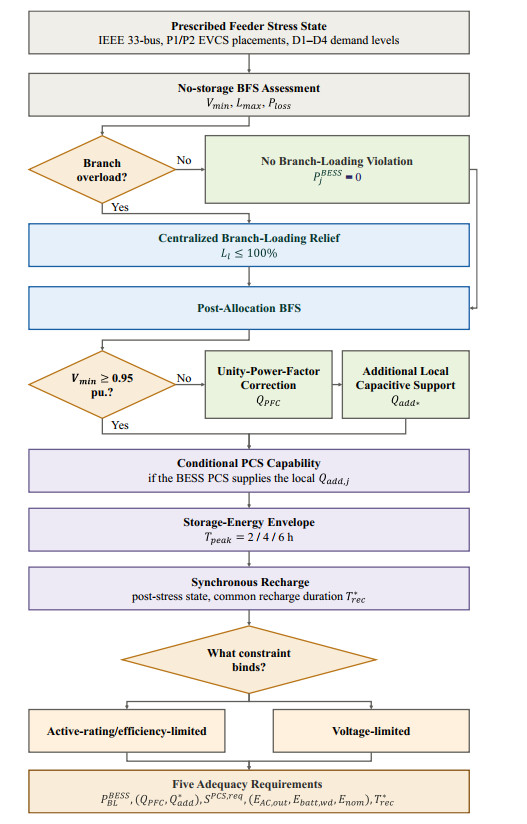
Co-located battery energy storage (BESS) is often sized as a single power and energy rating for electric-vehicle fast-charging stations (EVCSs), although feeder adequacy is governed by different limits. This paper separated five requirements on a single backward/forward-sweep (BFS) model: branch-loading relief, residual voltage support, power conversion system (PCS) apparent-power capability, storage energy, and post-stress recharge. Active power was sized against branch-loading alone; voltage was then restored through unity-power-factor correction and local capacitive support. On the IEEE 33-bus benchmark, two placements and four demand levels produced a nominal branch-loading-relief requirement of 0 to 855.56 kW, yet three of eight cases required no active storage while remaining voltage-infeasible. Exhaustive enumeration of 720 processing orders yielded 0.07% to 96.69% sequential excess. Independent tests with two published current-limit parameterizations showed strong capacity-data dependence: a 275/120 A set left only two cases requiring 20.25 and 158.53 kW, whereas a multi-tier set admitted no current-feasible active-only solution. Unity-power-factor correction was insufficient in all eight nominal cases, leaving 114.77 to 879.94 kVAr of additional support and 0.32% to 96.17% conditional PCS headroom. For a 4-hour design duration, synchronous recharge ranged from the 4.43 h active-rating/efficiency floor to 31.19 h under voltage limitation, while branch-loading never bound. A single MW/MWh rating therefore cannot represent all five adequacy requirements.
Citation: Thi-Minh-Chau Le, Tien-Khai Nguyen, Trong-Nghia Le. Feeder-constrained co-located BESS sizing for grid-interactive EV fast-charging stations: Branch-loading relief, voltage support, and recharge deliverability[J]. AIMS Energy, 2026, 14(5): 1033-1058. doi: 10.3934/energy.2026042
Co-located battery energy storage (BESS) is often sized as a single power and energy rating for electric-vehicle fast-charging stations (EVCSs), although feeder adequacy is governed by different limits. This paper separated five requirements on a single backward/forward-sweep (BFS) model: branch-loading relief, residual voltage support, power conversion system (PCS) apparent-power capability, storage energy, and post-stress recharge. Active power was sized against branch-loading alone; voltage was then restored through unity-power-factor correction and local capacitive support. On the IEEE 33-bus benchmark, two placements and four demand levels produced a nominal branch-loading-relief requirement of 0 to 855.56 kW, yet three of eight cases required no active storage while remaining voltage-infeasible. Exhaustive enumeration of 720 processing orders yielded 0.07% to 96.69% sequential excess. Independent tests with two published current-limit parameterizations showed strong capacity-data dependence: a 275/120 A set left only two cases requiring 20.25 and 158.53 kW, whereas a multi-tier set admitted no current-feasible active-only solution. Unity-power-factor correction was insufficient in all eight nominal cases, leaving 114.77 to 879.94 kVAr of additional support and 0.32% to 96.17% conditional PCS headroom. For a 4-hour design duration, synchronous recharge ranged from the 4.43 h active-rating/efficiency floor to 31.19 h under voltage limitation, while branch-loading never bound. A single MW/MWh rating therefore cannot represent all five adequacy requirements.

| [1] | Kersting WH (2017) Distribution System Modeling and Analysis, 4th Ed., Boca Raton: CRC Press. https://doi.org/10.1201/9781315120782 |
| [2] |
Acharige SSG, Haque ME, Arif MT, et al. (2025) Grid integration of electric vehicles: Impact assessment and remedial measures. J Power Sources 650: 236697. https://doi.org/10.1016/j.jpowsour.2025.236697 doi: 10.1016/j.jpowsour.2025.236697

|
| [3] |
Powell S, Cezar GV, Min L, et al. (2022) Charging infrastructure access and operation to reduce the grid impacts of deep electric vehicle adoption. Nat Energy 7: 932–945. https://doi.org/10.1038/s41560-022-01105-7 doi: 10.1038/s41560-022-01105-7
|
| [4] |
Karmaker AK, Prakash K, Siddique MNI, et al. (2024) Electric vehicle hosting capacity analysis: Challenges and solutions. Renew Sustain Energy Rev 189: 113916. https://doi.org/10.1016/j.rser.2023.113916 doi: 10.1016/j.rser.2023.113916
|
| [5] |
Bi T, Mao B, Liu H (2025) A distributionally robust calculation method for distribution network EV hosting capacity considering charging demand. Int J Electr Power Energy Syst 172: 111342. https://doi.org/10.1016/j.ijepes.2025.111342 doi: 10.1016/j.ijepes.2025.111342
|
| [6] | He S, Zhao H, Mai W, et al. (2026) Public centralized ultra-fast charging stations: A grid and service performance analysis. Green Energy Intell Transp. In press. https://doi.org/10.1016/j.geits.2026.100445 |
| [7] |
Unterluggauer T, Rich J, Andersen PB, et al. (2022) Electric vehicle charging infrastructure planning for integrated transportation and power distribution networks: A review. eTransportation 12: 100163. https://doi.org/10.1016/j.etran.2022.100163 doi: 10.1016/j.etran.2022.100163
|
| [8] |
Yao H, Xiang Y, Gu C, et al. (2025) Optimal planning of distribution systems and charging stations considering PV-Grid-EV transactions. IEEE Trans Smart Grid 16: 691–703. https://doi.org/10.1109/TSG.2024.3429371 doi: 10.1109/TSG.2024.3429371
|
| [9] |
Mishra S, Mondal A, Mondal S (2024) Charging station siting and sizing considering uncertainty in electric vehicle charging demand distribution. IEEE Trans Intell Transp Syst 25: 12709–12721. https://doi.org/10.1109/TITS.2024.3384537 doi: 10.1109/TITS.2024.3384537
|
| [10] |
Le TMC, Nguyen TK, Le TN (2026) Grid-impact-aware planning of electric vehicle charging infrastructure for a tourism-intensive island grid using mixed-integer optimization and AC power flow assessment. IEEE Access 14: 119449–119466. https://doi.org/10.1109/ACCESS.2026.3718247 doi: 10.1109/ACCESS.2026.3718247
|
| [11] | Na HS, Yoon S, Jo S, et al. (2026) A mixed integer quadratically constrained programming model for optimal deployment of capacitated fast-charging stations for electric vehicles: A Bayesian optimization approach. Optim Eng. In press. https://doi.org/10.1007/s11081-026-10099-0 |
| [12] |
Argiolas L, Stecca M, Ramirez-Elizondo LM, et al. (2022) Optimal battery energy storage dispatch in energy and frequency regulation markets while peak shaving an EV fast charging station. IEEE Open Access J Power Energy 9: 374–385. https://doi.org/10.1109/OAJPE.2022.3198553 doi: 10.1109/OAJPE.2022.3198553
|
| [13] |
Arias NB, López JC, Hashemi S, et al. (2021) Multi-objective sizing of battery energy storage systems for stackable grid applications. IEEE Trans Smart Grid 12: 2708–2721. https://doi.org/10.1109/TSG.2020.3042186 doi: 10.1109/TSG.2020.3042186
|
| [14] |
Ray S, Kasturi K, Nayak MR (2025) Multi-objective electric vehicle charge scheduling for photovoltaic and battery energy storage based electric vehicle charging stations in distribution network. Green Energy Intell Transp 4: 100296. https://doi.org/10.1016/j.geits.2025.100296 doi: 10.1016/j.geits.2025.100296
|
| [15] |
IEEE (2018) IEEE standard for interconnection and interoperability of distributed energy resources with associated electric power systems interfaces. IEEE Std 1547-2018: 1–138. https://doi.org/10.1109/IEEESTD.2018.8332112 doi: 10.1109/IEEESTD.2018.8332112
|
| [16] |
Liang Z, Qian T, Korkali M, et al. (2024) A vehicle-to-grid planning framework incorporating electric vehicle user equilibrium and distribution network flexibility enhancement. Appl Energy 376: 124231. https://doi.org/10.1016/j.apenergy.2024.124231 doi: 10.1016/j.apenergy.2024.124231
|
| [17] |
Giraldo JS, Arias NB, Vergara PP, et al. (2023) Estimating risk-aware flexibility areas for electric vehicle charging pools via AC stochastic optimal power flow. J Mod Power Syst Clean Energy 11: 1247–1256. https://doi.org/10.35833/MPCE.2022.000452 doi: 10.35833/MPCE.2022.000452
|
| [18] |
Wan Y, Wang N, Liu X, et al. (2025) Inertia-emulation-based fast frequency response from EVs: A multi-level framework with game-theoretic incentives and DRL. IEEE Trans Smart Grid 16: 5353–5364. https://doi.org/10.1109/TSG.2025.3603256 doi: 10.1109/TSG.2025.3603256
|
| [19] |
Wan Y, Gebbran D, Subroto RK, et al. (2024) Optimal day-ahead scheduling of fast EV charging station with multi-stage battery degradation model. IEEE Trans Energy Convers 39: 872–883. https://doi.org/10.1109/TEC.2023.3335661 doi: 10.1109/TEC.2023.3335661
|
| [20] |
Jo S, Yoon S, Na HS, et al. (2026) Multi-period large-scale electric vehicle charging station deployment under latent charging demand: A Bayesian optimization-based large neighborhood search approach. Expert Syst Appl 323: 132054. https://doi.org/10.1016/j.eswa.2026.132054 doi: 10.1016/j.eswa.2026.132054
|
| [21] |
Wan Y, Wang N, Du E, et al. (2025) Coordinated operation of alternative fuel vehicle-integrated microgrid in a coupled power-transportation network: A Stackelberg–Nash game framework. Appl Energy 401: 126800. https://doi.org/10.1016/j.apenergy.2025.126800 doi: 10.1016/j.apenergy.2025.126800
|
| [22] |
Baran ME, Wu FF (1989) Network reconfiguration in distribution systems for loss reduction and load balancing. IEEE Trans Power Deliv 4: 1401–1407. https://doi.org/10.1109/61.25627 doi: 10.1109/61.25627
|
| [23] |
Das D, Kothari DP, Kalam A (1995) Simple and efficient method for load flow solution of radial distribution networks. Int J Electr Power Energy Syst 17: 335–346. https://doi.org/10.1016/0142-0615(95)00050-0 doi: 10.1016/0142-0615(95)00050-0
|
| [24] | ANSI/NEMA (2025) Electric Power Systems and Equipment—Voltage Ratings (60 Hz). ANSI/NEMA C84.1-2020 (R2025). Available from: https://webstore.ansi.org/standards/nema/ansinemac842020r2025. |
| [25] | IEEE (2023) IEEE standard for calculating the current-temperature relationship of bare overhead conductors. IEEE Std 738-2023 (Revision of IEEE Std 738-2012): 1–56. https://doi.org/10.1109/IEEESTD.2023.10382442 |
| [26] |
Tercan SM, Elma O, Gokalp E, et al. (2022) An expansion planning method for extending distributed energy system lifespan with energy storage systems. Energy Explor Exploit 40: 599–618. https://doi.org/10.1177/01445987211058304 doi: 10.1177/01445987211058304
|
| [27] | Sosnowski R, Baszyński M, Konstantinou C (2024) An MDP-based approach for distribution system control with PV generation and battery storage. 2024 IEEE International Conference on Communications, Control, and Computing Technologies for Smart Grids (SmartGridComm): 307–313. https://doi.org/10.1109/SmartGridComm60555.2024.10738110 |
| [28] |
Rene EA, Tounsi Fokui WS, Nembou Kouonchie PK (2023) Optimal allocation of plug-in electric vehicle charging stations in the distribution network with distributed generation. Green Energy Intell Transp 2: 100094. https://doi.org/10.1016/j.geits.2023.100094 doi: 10.1016/j.geits.2023.100094
|
| [29] |
IEEE (2019) IEEE guide for design, operation, and maintenance of battery energy storage systems, both stationary and mobile, and applications integrated with electric power systems. IEEE Std 2030.2. 1-2019. https://doi.org/10.1109/IEEESTD.2019.8930450 doi: 10.1109/IEEESTD.2019.8930450
|
| [30] |
Khedar KK, Goyal GR, Singh P, et al. (2025) Business model & load profile for commercial EV charging stations. AIMS Energy 13: 1518–1537. https://doi.org/10.3934/energy.2025056 doi: 10.3934/energy.2025056
|
Figures(4) / Tables(9)

Thi-Minh-Chau Le, Tien-Khai Nguyen, Trong-Nghia Le. Feeder-constrained co-located BESS sizing for grid-interactive EV fast-charging stations: Branch-loading relief, voltage support, and recharge deliverability[J]. AIMS Energy, 2026, 14(5): 1033-1058. doi: 10.3934/energy.2026042





 DownLoad: