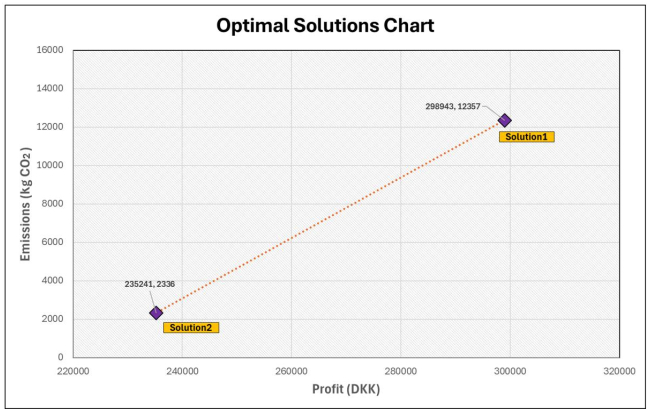
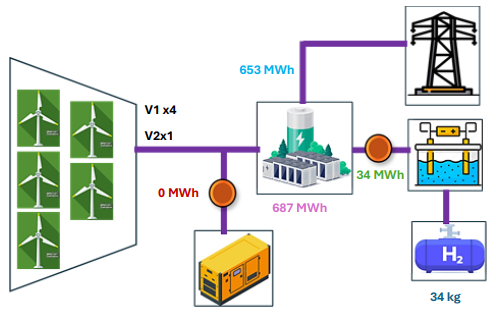
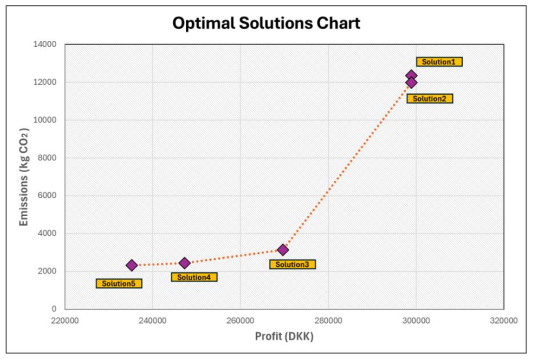
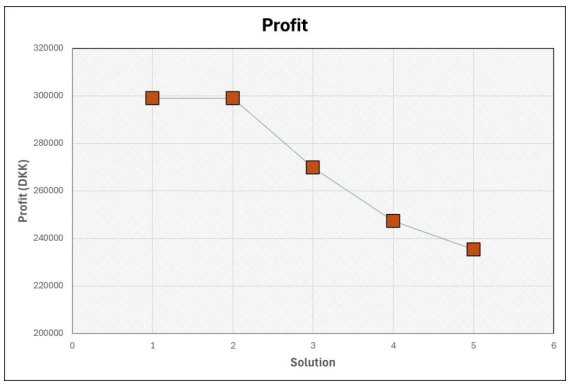
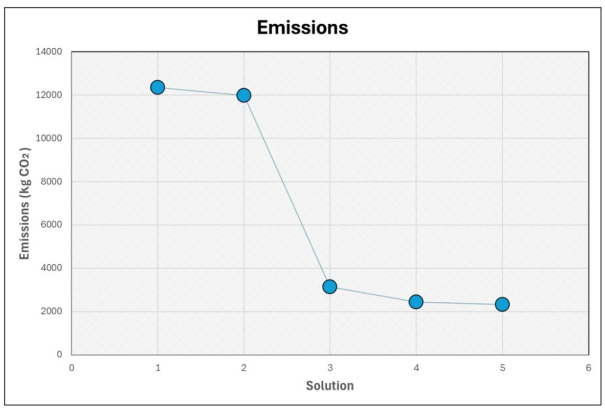
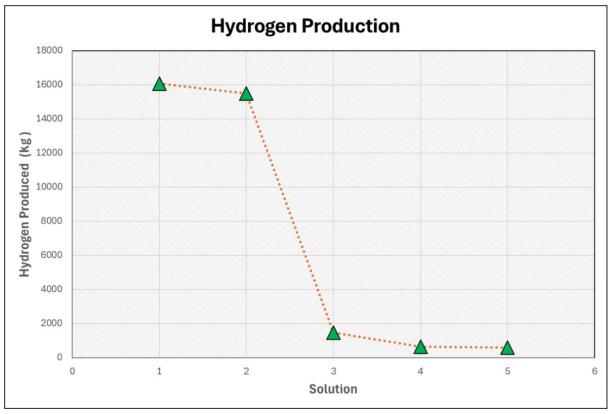
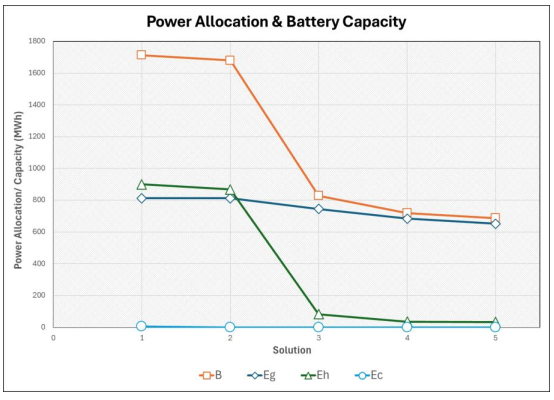
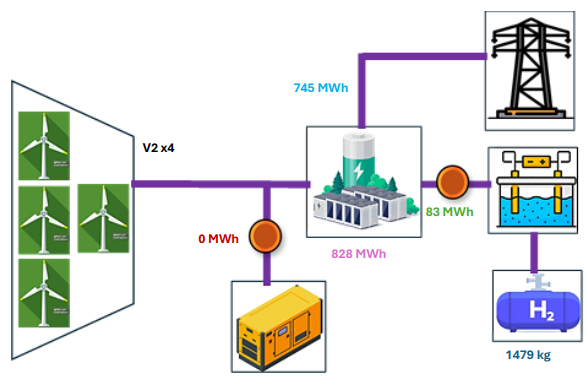
This work optimized Power-to-X (PtX) operations in a Danish wind farm, balancing profitability and emissions through single and multi-objective optimization. The analysis was conducted through secondary data and an optimization model developed in Solver in order to evaluate operational scenarios. Among all the different evaluated solutions, Solution 3 emerged as optimal, reducing CO2 emissions to 3146 kg while maintaining 90% of maximum profit (269,706 DKK). It allocated energy efficiently—745 MWh to the grid, 83 MWh to hydrogen (producing 1479 kg of green hydrogen), and 828 MWh to storage, with zero curtailment. Compared to profit-maximizing (Solution 1: 298,943 DKK, 12,357 kg CO2) and emission-minimizing (Solution 5: 235,244 DKK, 2336 kg CO2) alternatives, Solution 3 offers a sustainable compromise, supporting decarbonization goals without significant economic trade-offs. The findings highlight replicable strategies for PtX systems in renewable energy integration for future projects.
Citation: Waleed Azhar, George Xydis. Operational optimization of a Wind-Hydrogen Power-to-X System in Denmark: An experimental approach[J]. AIMS Energy, 2026, 14(2): 291-309. doi: 10.3934/energy.2026013
This work optimized Power-to-X (PtX) operations in a Danish wind farm, balancing profitability and emissions through single and multi-objective optimization. The analysis was conducted through secondary data and an optimization model developed in Solver in order to evaluate operational scenarios. Among all the different evaluated solutions, Solution 3 emerged as optimal, reducing CO2 emissions to 3146 kg while maintaining 90% of maximum profit (269,706 DKK). It allocated energy efficiently—745 MWh to the grid, 83 MWh to hydrogen (producing 1479 kg of green hydrogen), and 828 MWh to storage, with zero curtailment. Compared to profit-maximizing (Solution 1: 298,943 DKK, 12,357 kg CO2) and emission-minimizing (Solution 5: 235,244 DKK, 2336 kg CO2) alternatives, Solution 3 offers a sustainable compromise, supporting decarbonization goals without significant economic trade-offs. The findings highlight replicable strategies for PtX systems in renewable energy integration for future projects.

| [1] |
Rego de Vasconcelos B, Lavoie JM (2019) Recent advances in power-to-X technology for the production of fuels and chemicals. Front Chemistry 7: 392. https://doi.org/10.3389/fchem.2019.00392 doi: 10.3389/fchem.2019.00392

|
| [2] |
Søgaard-Deakin J, Xydis G (2024) Prefeasibility study on optimal site location for Power‐to‐X: An experiment for the Danish energy system. Energy Rep 12: 1859–1875. https://doi.org/10.1016/j.egyr.2024.08.003 doi: 10.1016/j.egyr.2024.08.003
|
| [3] | Oxford Net Zero (2024) What is net zero? Retrieved December 07, 2024. Available from: https://netzeroclimate.org/what-is-net-zero-2/. |
| [4] |
Weimann L, Gabrielli P, Boldrini A, et al. (2021) Optimal hydrogen production in a wind-dominated zero-emission energy system. Adv Appl Energy 3: 100032. https://doi.org/10.1016/j.adapen.2021.100032 doi: 10.1016/j.adapen.2021.100032
|
| [5] |
Nanjundaswamy A, Nayak KM, Dinesh S, et al. (2025) Enablers of net-zero transition: A holistic model of energy policy, innovation and infrastructure. Cambridge Prisms: Energy Transitions 1: e8. https://doi.org/10.1017/etr.2025.10007 doi: 10.1017/etr.2025.10007
|
| [6] |
Bennett NJ, Blythe J, Cisneros-Montemayor AM, et al. (2019) Just transformations to sustainability. Sustainability 11: 3881. https://doi.org/10.3390/su11143881 doi: 10.3390/su11143881
|
| [7] |
Hariram NP, Mekha KB, Suganthan V, et al. (2023) Sustainalism: An integrated socio-economic-environmental model to address sustainable development and sustainability. Sustainability 15: 10682. https://doi.org/10.3390/su151310682 doi: 10.3390/su151310682
|
| [8] |
Matthews HD, Wynes S (2022) Current global efforts are insufficient to limit warming to 1.5 ℃. Science 376: 1404–1409. https://doi.org/10.1126/science.abo3378 doi: 10.1126/science.abo3378
|
| [9] |
Fankhauser S, Smith SM, Allen M, et al. (2022) The meaning of net zero and how to get it right. Nat Clim change 12: 15–21. https://doi.org/10.1038/s41558-021-01245-w doi: 10.1038/s41558-021-01245-w
|
| [10] |
Aziz S, Ahmed I, Khan K, et al. (2024) Emerging trends and approaches for designing net-zero low-carbon integrated energy networks: A review of current practices. Arabian J Sci Eng 49: 6163–6185. https://doi.org/10.1007/s13369-023-08336-0 doi: 10.1007/s13369-023-08336-0
|
| [11] |
Bistline JET, Blanford GJ (2021) The role of the power sector in net-zero energy systems. Energy Clim Change 2: 100045. https://doi.org/10.1016/j.egycc.2021.100045 doi: 10.1016/j.egycc.2021.100045
|
| [12] | Womble MS, Xydis G (2021) Energy storage: A practical solution to increase wind energy integration in the US electricity sector. In: Renewable Energy for Mitigating Climate Change, 1st Edition, CRC Press, 41–54. CRC Press. https://doi.org/10.1201/9781003240129-3 |
| [13] |
Bram MV, Liniger J, Majidabad SS, et al. (2024) Challenges in Power-to-X: A perspective of the configuration and control process for E-methanol production. Int J Hydrogen Energy 76: 315–325. https://doi.org/10.1016/j.ijhydene.2024.05.273 doi: 10.1016/j.ijhydene.2024.05.273
|
| [14] |
Tin TTH, Xydis G (2025) The power of battery energy storage systems: Unlocking home efficiency. Int J Emerging Electr Power Syst, 26. https://doi.org/10.1515/ijeeps-2024-0164 doi: 10.1515/ijeeps-2024-0164
|
| [15] |
Nanaki EA, Xydis GA (2018) Deployment of renewable energy systems: Barriers, challenges, and opportunities. Adv Renewable Energ Power Technol 2: 207–229. https://doi.org/10.1016/B978-0-12-813185-5.00005-X doi: 10.1016/B978-0-12-813185-5.00005-X
|
| [16] |
Bąk I, Cheba K (2022) Green transformation: Applying statistical data analysis to a systematic literature review. Energies 16: 253. https://doi.org/10.3390/en16010253 doi: 10.3390/en16010253
|
| [17] |
Isella A, Manca D (2022) GHG emissions by (petro)chemical processes and decarbonization priorities—A review. Energies 15: 7560. https://doi.org/10.3390/en15207560 doi: 10.3390/en15207560
|
| [18] |
Shboul B, Zayed ME, Tariq R, et al. (2024) New hybrid photovoltaic-fuel cell system for green hydrogen and power production: Performance optimization assisted with Gaussian process regression method. Int J Hydrogen Energy 59: 1214–1229. https://doi.org/10.1016/j.ijhydene.2024.02.087 doi: 10.1016/j.ijhydene.2024.02.087
|
| [19] |
Rehman S, Kotb KM, Zayed ME, et al. (2024) Techno-economic evaluation and improved sizing optimization of green hydrogen production and storage under higher wind penetration in Aqaba Gulf. J Energy Storage 99: 113368. https://doi.org/10.1016/j.est.2024.113368 doi: 10.1016/j.est.2024.113368
|
| [20] |
Søgaard-Deakin J, Xydis G (2024) Green hydrogen production using proton membrane electrolysis of clean drinking water. J Environ Eng Sci 19: 214–222. https://doi.org/10.1680/jenes.23.00071 doi: 10.1680/jenes.23.00071
|
| [21] |
Incer-Valverde J, Korayem A, Tsatsaronis G, et al. (2023) "Colors" of hydrogen: Definitions and carbon intensity. Energy Convers Manage 292: 117294. https://doi.org/10.1016/j.enconman.2023.117294 doi: 10.1016/j.enconman.2023.117294
|
| [22] |
Mucci S, Mitsos A, Bongartz D (2023) Cost-optimal Power-to-Methanol: Flexible operation or intermediate storage? J Energy Storage 69: 108614. https://doi.org/10.1016/j.est.2023.108614 doi: 10.1016/j.est.2023.108614
|
| [23] |
Wei D, Li H, Ren Y, et al. (2022) Modeling of hydrogen production system for photovoltaic power generation and capacity optimization of energy storage system. Front Energy Res 10: 1004277. https://doi.org/10.3389/fenrg.2022.1004277 doi: 10.3389/fenrg.2022.1004277
|
| [24] |
Badruzzaman A, Karagoz S, Eljack F (2025) Sustainable-green hydrogen production through integrating electrolysis, water treatment and solar energy. Front Chem Eng 7: 1526331. https://doi.org/10.3389/fceng.2025.1526331 doi: 10.3389/fceng.2025.1526331
|
| [25] |
Bora DK (2025) Green hydrogen production with 25 kW alkaline electrolyzer pilot plant shows hydrogen flow rate exponential asymptotic behavior with the stack current. Hydrogen 6: 75. https://doi.org/10.3390/hydrogen6040075 doi: 10.3390/hydrogen6040075
|
| [26] |
Nair NKC, Garimella N (2010) Battery energy storage systems: Assessment for small-scale renewable energy integration. Energy Build 42: 2124–2130. https://doi.org/10.1016/j.enbuild.2010.07.002 doi: 10.1016/j.enbuild.2010.07.002
|
| [27] |
Dantzig GB (2002) Linear programming. Oper Res 50: 42–47. https://doi.org/10.1287/opre.50.1.42.17798 doi: 10.1287/opre.50.1.42.17798
|
| [28] | William P, García Márquez FP (2013) Modeling and linear programming in engineering management. In: Engineering Management. https://doi.org/10.5772/54500 |
| [29] | Dantzig GB, Thapa MN (2003) Linear programming: 2: theory and extensions. New York, NY: Springer. Available from: https://link.springer.com/content/pdf/10.1007/0-387-21569-7_10.pdf. |
| [30] |
Kravanja Z, Čuček L (2013) Multi-objective optimisation for generating sustainable solutions considering total effects on the environment. Appl Energy 101: 67–80. https://doi.org/10.1016/j.apenergy.2012.04.025 doi: 10.1016/j.apenergy.2012.04.025
|
| [31] | Deb K, Sindhya K, Hakanen J (2016) Multi-objective optimization. In: Decision sciences, 1st Edition, CRC Press, 161–200. Available from: https://www.taylorfrancis.com/chapters/edit/10.1201/9781315183176-12/multi-objective-optimization-kalyanmoy-deb-karthik-sindhya-jussi-hakanen. |
| [32] |
Raman R, Nair VK, Prakash V, et al. (2022) Green-hydrogen research: What have we achieved, and where are we going? Bibliometrics analysis. Energy Rep 8: 10333–10344. https://doi.org/10.1016/j.egyr.2022.07.058 doi: 10.1016/j.egyr.2022.07.058
|
| [33] |
Sebbahi S, Nabil N, Alaoui-Belghiti A, et al. (2022) Assessment of the three most developed water electrolysis technologies: Alkaline water electrolysis, proton exchange membrane and solid-oxide electrolysis. Mater Today: Proc 66: 140–145. https://doi.org/10.1016/j.matpr.2022.04.264 doi: 10.1016/j.matpr.2022.04.264
|
| [34] |
Simoes SG, Catarino J, Picado A, et al. (2021) Water availability and water usage solutions for electrolysis in hydrogen production. J Cleaner Prod 315: 128124. https://doi.org/10.1016/j.jclepro.2021.128124 doi: 10.1016/j.jclepro.2021.128124
|
| [35] |
Siddiqui O, Dincer I (2019) A well to pump life cycle environmental impact assessment of some hydrogen production routes. Int J Hydrogen Energy 44: 5773–5786. https://doi.org/10.1016/j.ijhydene.2019.01.118 doi: 10.1016/j.ijhydene.2019.01.118
|
| [36] |
Garrett P, Rønde K (2013) Life cycle assessment of wind power: Comprehensive results from a state-of-the-art approach. Int J Life Cycle Assess 18: 37–48. https://doi.org/10.1007/s11367-012-0445-4 doi: 10.1007/s11367-012-0445-4
|
| [37] |
Klymovskyi A, Kabza A, Schlumberger G, et al. (2024) Applications—Transportation Applications: Hydrogen refueling stations. Encycl Electrochem Power Sources 7: 391–400. https://doi.org/10.1016/B978-0-323-96022-9.00219-X doi: 10.1016/B978-0-323-96022-9.00219-X
|
| [38] |
Wang W, Qi Y, Zhang X, et al. (2025) Carbon emission optimization of the integrated energy system in industrial parks with hydrogen production from complementary wind and solar systems. Hydrogen 6: 8. https://doi.org/10.3390/hydrogen6010008 doi: 10.3390/hydrogen6010008
|
| [39] |
Ucal M (2025) Moving beyond conventional energy generation and supply: Integrating sustainability, affordability, and accessibility concerns into the discussion. Cambridge Prisms: Energy Transitions 1: 1–6. https://doi.org/10.1017/etr.2025.10001 doi: 10.1017/etr.2025.10001
|
| [40] |
Khosravi N (2025) Enhancing operational efficiency through a control-based approach for hydrogen and battery energy storage systems integration in renewable energy networks. Renewable Energy 248: 123132. https://doi.org/10.1016/j.renene.2025.123132 doi: 10.1016/j.renene.2025.123132
|
| [41] |
Sun H, Guan X, Wang Z, et al. (2025) Financial viability of grid-integrated hydrogen buffering: A techno-economic study on efficiency gains and carbon abatement costs. Int J Hydrogen Energy 134: 299–315. https://doi.org/10.1016/j.ijhydene.2025.04.374 doi: 10.1016/j.ijhydene.2025.04.374
|
Figures(11) / Tables(2)

Waleed Azhar, George Xydis. Operational optimization of a Wind-Hydrogen Power-to-X System in Denmark: An experimental approach[J]. AIMS Energy, 2026, 14(2): 291-309. doi: 10.3934/energy.2026013





 DownLoad: