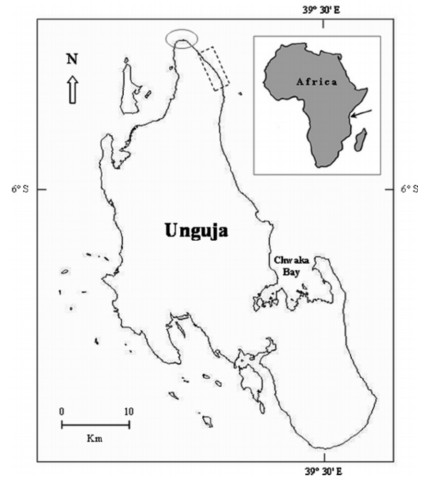
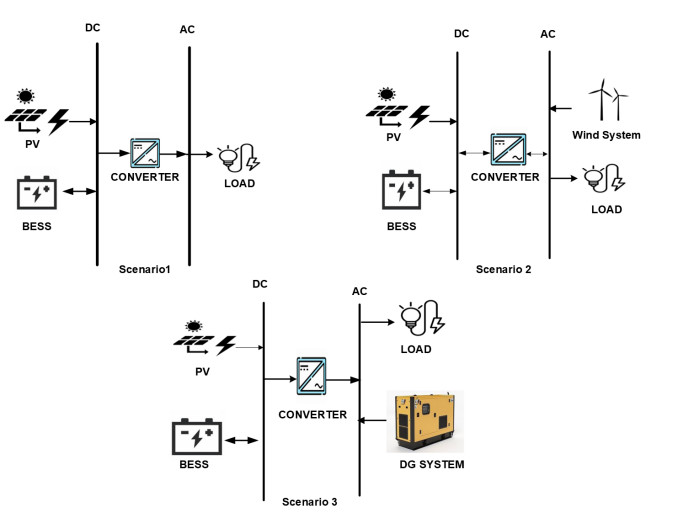
Access to a sustainable and reliable power supply has been a major struggle for most remote and rural communities, particularly on Islands. This is largely due to the uncertainties and vulnerabilities imposed by grid extension and electricity importation. This study employed a Particle Swarm Optimization (PSO) approach to assess the performance of three off-grid microgrid configurations: PV/BESS, PV/Wind/BESS, and PV/BESS/DG for electrifying a village in the northern region of Unguja Island. The effective sizing was conducted using real-time and site-specific meteorological and demand data. The primary goal was to minimize the Levelized Cost of Energy (LCOE) while satisfying the reliability constraint defined as the Loss of Power Supply Probability (LPSP), below 4%. The results demonstrated that the PV/Wind/BESS configuration exhibited the lowest LCOE at $ \$ $0.014/kWh; 13.6% and 46.2% lower than the PV/BESS and PV/BESS/DG configurations, respectively. Although the PV/BESS/DG scenario demonstrated greater reliability compared to other cases, it incurred the highest LCOE over the project lifetime, which was attributed to volatile fuel prices and elevated operational costs. Furthermore, the sensitivity analysis highlighted the substantial influence of life-cycle costs, including component replacement and operational maintenance costs, on the long-term economic viability of the proposed microgrid configurations. These insights offer valuable strategic guidance for energy policymakers aiming to enhance energy security and autonomy in rural and underserved communities.
Citation: Fathia Jombi Kheir, Soichiro Ueda, Takuma Ishibashi, Mitsunaga Kinjo, Issoufou Tahirou Halidou, Masahiro Furukakoi, Tomonobu Senjyu. Scenario-based optimization of standalone microgrids using PSO: comparative assessment of hybrid configurations for off-grid electrification in Unguja Island[J]. AIMS Energy, 2025, 13(4): 938-961. doi: 10.3934/energy.2025035
Access to a sustainable and reliable power supply has been a major struggle for most remote and rural communities, particularly on Islands. This is largely due to the uncertainties and vulnerabilities imposed by grid extension and electricity importation. This study employed a Particle Swarm Optimization (PSO) approach to assess the performance of three off-grid microgrid configurations: PV/BESS, PV/Wind/BESS, and PV/BESS/DG for electrifying a village in the northern region of Unguja Island. The effective sizing was conducted using real-time and site-specific meteorological and demand data. The primary goal was to minimize the Levelized Cost of Energy (LCOE) while satisfying the reliability constraint defined as the Loss of Power Supply Probability (LPSP), below 4%. The results demonstrated that the PV/Wind/BESS configuration exhibited the lowest LCOE at $ \$ $0.014/kWh; 13.6% and 46.2% lower than the PV/BESS and PV/BESS/DG configurations, respectively. Although the PV/BESS/DG scenario demonstrated greater reliability compared to other cases, it incurred the highest LCOE over the project lifetime, which was attributed to volatile fuel prices and elevated operational costs. Furthermore, the sensitivity analysis highlighted the substantial influence of life-cycle costs, including component replacement and operational maintenance costs, on the long-term economic viability of the proposed microgrid configurations. These insights offer valuable strategic guidance for energy policymakers aiming to enhance energy security and autonomy in rural and underserved communities.

| [1] |
Das BK, Alotaibi MA, Das P, et al. (2021) Feasibility and techno-economic analysis of stand-alone and grid-connected PV/Wind/Diesel/Batt hybrid energy system: A case study. Energy Strateg Rev 37: 100673. https://doi.org/10.1016/j.esr.2021.100673 doi: 10.1016/j.esr.2021.100673

|
| [2] | Mission 300 Connecting 300 Million People to Electricity. Available from: https://mission300africa.org/energysummit/wp-content/uploads/2024/12/mission300.pdf. |
| [3] |
Surroop D, Raghoo P (2018) Renewable energy to improve energy situation in African island states. Renewable Sustainable Energy Rev 88: 176–183. https://doi.org/10.1016/j.rser.2018.02.024 doi: 10.1016/j.rser.2018.02.024
|
| [4] | Santos SF, Fitiwi DZ, Shafie-khah M, et al. (2017) Introduction to renewable energy systems, In: Ozan Erdinç (ed) Optimization in Renewable Energy Systems. Academic Press, Cambridge, MA, 1–26. https://doi.org/10.1016/B978-0-08-101041-9.00001-6 |
| [5] |
Bull SR (2001) Renewable energy today and tomorrow. P IEEE 89: 1216–1226. https://doi.org/10.1109/5.940290 doi: 10.1109/5.940290
|
| [6] |
Chebabhi A, Tegani I, Benhamadouche AD, et al. (2023) Optimal design and sizing of renewable energies in microgrids based on financial considerations: A case study of Biskra, Algeria. Energ Convers Manage 291: 117270. https://doi.org/10.1016/j.enconman.2023.117270 doi: 10.1016/j.enconman.2023.117270
|
| [7] | Zibi, Towards Zanzibar Energy Security: The Next Steps in Zanzibar's Power Evolution, 2025. Available from: https://zibi.co.tz/towards-zanzibar-energy-security/. |
| [8] | Revolutionary Government of Zanzibar (2024) The Zanzibar Energy Sector Transformation Project: Project Procurement Strategy for Development. Available from: https://documents1.worldbank.org/curated/en/099151003232326098/pdf/P1695610c5ee9f0fd08ff-40e728ae3e8295.pdf. |
| [9] | World Bank Group (2017) Utility-scale Solar PV and Battery Energy storage System (BESS) for Zanzibar Archipelago Renewable Energy Solution. Available from: https://www.esmap.org/sites/default/files/ESP/23_Tanzania_zanzibar.pdf. |
| [10] |
Westphal I (2024) The effects of reducing renewable power intermittency through portfolio diversification. Renew Sustain Energy Rev 197: 114415. https://doi.org/10.1016/j.rser.2024.114415 doi: 10.1016/j.rser.2024.114415
|
| [11] |
El-Sattar HA, Hassan MH, Vera D, et al. (2024) Maximizing hybrid microgrid system performance: A comparative analysis and optimization using a gradient pelican algorithm. Renewable Energy 227: 120480. https://doi.org/10.1016/j.renene.2024.120480 doi: 10.1016/j.renene.2024.120480
|
| [12] |
Chen B, Xiong R, Li H, et al. (2019) Pathways for sustainable energy transition. J Cleaner Prod 228: 1564–1571. https://doi.org/10.1016/j.jclepro.2019.04.372 doi: 10.1016/j.jclepro.2019.04.372
|
| [13] |
Anand P, Kamboj VK, Rizwan M (2024) Optimal sizing of hybrid energy system using an improved gazelle optimization algorithm. Electr Eng 107: 7263–7296. https://doi.org/10.1007/s00202-024-02892-w doi: 10.1007/s00202-024-02892-w
|
| [14] |
Sinha S, Chandel SS (2014) Review of software tools for hybrid renewable energy systems. Renewable Sustainable Energy Rev 32: 192–205. https://doi.org/10.1016/j.rser.2014.01.035 doi: 10.1016/j.rser.2014.01.035
|
| [15] |
Fodhil F, Hamidat A, Nadjemi O (2019) Potential, optimization and sensitivity analysis of photovoltaic-diesel-battery hybrid energy system for rural electrification in Algeria. Energy 169: 613–624. https://doi.org/10.1016/j.energy.2018.12.049 doi: 10.1016/j.energy.2018.12.049
|
| [16] |
Tudu B, Majumder S, Mandal KK, et al. (2011) Comparative performance study of genetic algorithm and particle swarm optimization applied on off-grid renewable hybrid energy system. Swarm Evol Memetic Comput 2: 151–158. https://doi.org/10.1007/978-3-642-27172-4_19 doi: 10.1007/978-3-642-27172-4_19
|
| [17] |
Lamedica R, Santini E, Ruvio A, et al. (2018) A MILP methodology to optimize sizing of PV-Wind renewable energy systems. Energy 165: 385–398. https://doi.org/10.1016/j.energy.2018.09.087 doi: 10.1016/j.energy.2018.09.087
|
| [18] |
Zhao B, Zhang X, Li P, et al. (2014) Optimal sizing, operating strategy and operational experience of a stand-alone microgrid on Dongfushan Island. Appl Energy 113: 1656–1666. https://doi.org/10.1016/j.apenergy.2013.09.015 doi: 10.1016/j.apenergy.2013.09.015
|
| [19] |
Bukar AL, Tan CW, Lau KY (2019) Optimal sizing of an autonomous photovoltaic/wind/battery/diesel generator microgrid using the grasshopper optimization algorithm. Sol Energy 88: 685–696. https://doi.org/10.1016/j.solener.2019.06.050 doi: 10.1016/j.solener.2019.06.050
|
| [20] | Abusaq M, Zohdy MA (2024) Optimal sizing of solar off-grid microgrid using modified firefly algorithm. Int J Sci Eng Sci 8: 8–16. Available from: https://ijses.com/wp-content/uploads/2024/08/30-IJSES-V8N8.pdf. |
| [21] | NASA. POWER Data Access Viewer. Available from: https://power.larc.nasa.gov/data-access-viewer/. |
| [22] |
Irshad AS, Kargar N, Elkholy MH, et al. (2024) Techno-economic evaluation and comparison of the optimal PV/Wind and grid hybrid system with horizontal and vertical axis wind turbines. Energy Convers Manage: X 23: 100638. https://doi.org/10.1016/j.ecmx.2024.100638 doi: 10.1016/j.ecmx.2024.100638
|
| [23] |
Halidou IT, Elkholy MH, Senjyu T, et al. (2025) Optimal microgrid planning for electricity security in Niamey: A strategic response to sudden supply disruptions from neighboring sources. Energy Convers Manage 326: 119529. https://doi.org/10.1016/j.enconman.2025.119529 doi: 10.1016/j.enconman.2025.119529
|
| [24] |
Diab AAZ, Sultan HM, Mohamed IS, et al. (2019) Application of different optimization algorithms for optimal sizing of PV/wind/diesel/battery storage stand-alone hybrid microgrid. IEEE Access 7: 119223–119245. https://doi.org/10.1109/ACCESS.2019.2936656 doi: 10.1109/ACCESS.2019.2936656
|
| [25] | Hamilton JM, Negnevitsky M, Wang X, et al. (2017) Utilization and optimization of diesel generation for maximum renewable energy integration, In: Islam F, Mamun K, Amanullah M (eds) Smart Energy Grid Design for Island Countries, Green Energy and Technology. Springer, Cham, 1: 21–70. https://doi.org/10.1007/978-3-319-50197-0_2 |
| [26] |
Jafari A, Khalili T, Ganjehlou HG, et al. (2020) Optimal integration of renewable energy sources, diesel generators, and demand response program from pollution, financial, and reliability viewpoints: A multi-objective approach. J Cleaner Prod 247: 119100. https://doi.org/10.1016/j.jclepro.2019.119100 doi: 10.1016/j.jclepro.2019.119100
|
| [27] |
Ramesh M, Saini RP (2020) Effect of different batteries and diesel generator on the performance of a stand-alone hybrid renewable energy system. Energy Sources, Part A 46: 7983–8005. https://doi.org/10.1080/15567036.2020.1763520 doi: 10.1080/15567036.2020.1763520
|
| [28] |
Ouyang X, Lin B (2014) Levelized cost of electricity (LCOE) of renewable energies and required subsidies in China. Energy Policy 70: 64–73. https://doi.org/10.1016/j.enpol.2014.03.030 doi: 10.1016/j.enpol.2014.03.030
|
| [29] |
Bruck M, Sandborn P, Goudarzi N (2018) A Levelized Cost of Energy (LCOE) model for wind farms that include Power Purchase Agreements (PPAs). Renewable Energy 122: 131–139. https://doi.org/10.1016/j.renene.2017.12.100 doi: 10.1016/j.renene.2017.12.100
|
| [30] |
Tabak A, Kayabasi E, Guneser MT, et al. (2022) Grey wolf optimization for optimum sizing and controlling of a PV/WT/BM hybrid energy system considering TNPC, LPSP, and LCOE concepts. Energy Sources, Part A 44: 1508–1528. https://doi.org/10.1080/15567036.2019.1668880 doi: 10.1080/15567036.2019.1668880
|
| [31] |
Agyekum EB, Nutakor C (2020) Feasibility study and economic analysis of stand-alone hybrid energy system for southern Ghana. Sustain Energy Technol Assess 39: 100695. https://doi.org/10.1016/j.seta.2020.100695 doi: 10.1016/j.seta.2020.100695
|
| [32] |
Chauhan A, Saini RP (2016) Techno-economic feasibility study on integrated renewable energy system for an isolated community of India. Renewable Sustainable Energy Rev 59: 388–405. https://doi.org/10.1016/j.rser.2015.12.290 doi: 10.1016/j.rser.2015.12.290
|
| [33] |
Ghosh A, Norton B (2019) Optimization of PV powered SPD switchable glazing to minimise probability of loss of power supply. Renewable Energy 131: 993–1001. https://doi.org/10.1016/j.renene.2018.07.115 doi: 10.1016/j.renene.2018.07.115
|
| [34] |
Ayop R, Isa NM, Tan CW (2018) Components sizing of photovoltaic stand-alone system based on loss of power supply probability. Renewable Sustainable Energy Rev 81: 2731–2743. https://doi.org/10.1016/j.rser.2017.06.079 doi: 10.1016/j.rser.2017.06.079
|
| [35] |
Phommixay S, Doumbia ML, Lupien St-Pierre D (2020) Review on the cost optimization of microgrids via particle swarm optimization. Int J Energy Environ Eng 11: 73–89. https://doi.org/10.1007/s40095-019-00332-1 doi: 10.1007/s40095-019-00332-1
|
| [36] |
Phan-Van L, Takano H, Duc TN (2023) A comparison of different metaheuristic optimization algorithms on hydrogen storage-based microgrid sizing. Energy Rep 9: 542–549. https://doi.org/10.1016/j.egyr.2023.05.152 doi: 10.1016/j.egyr.2023.05.152
|
| [37] |
Flores-Livas JA, Boeri L, Sanna A, et al. (2020) A perspective on conventional high-temperature superconductors at high pressure: Methods and materials. Phys Rep 856: 1–78. https://doi.org/10.1016/j.physrep.2020.02.003 doi: 10.1016/j.physrep.2020.02.003
|
| [38] |
Jain M, Saihjpal V, Singh N, et al. (2022) An overview of variants and advancements of PSO algorithm. Appl Sci 12: 8392. https://doi.org/10.3390/app12178392 doi: 10.3390/app12178392
|
| [39] | Nuzulack Dausen (2024) Tanzania central bank holds key rate, sees strong economic growth. Reuters Available from: https://www.reuters.com/markets/tanzania-central-bank-holds-key-rate-sees-strong-economic-growth-2024-07-04/. |
| [40] |
Li Z, Ma T (2022) Theoretic efficiency limit and design criteria of solar photovoltaics with high visual perceptibility. Appl Energy 324: 119761. https://doi.org/10.1016/j.apenergy.2022.119761 doi: 10.1016/j.apenergy.2022.119761
|
| [41] |
Halidou IT, Howlader HOR, Gamil MM, et al. (2023) Optimal power scheduling and techno-economic analysis of a residential microgrid for a remotely located area: a case study for the Sahara Desert of Niger. Energies 16: 3741. https://doi.org/10.3390/en16083471 doi: 10.3390/en16083471
|
| [42] | Larsson P, Börjesson P. Cost models for battery energy storage systems. Bachelor of Science Thesis, KTH School of Industrial Engineering and Management, Stockholm, 2018. Available from: https://www.diva-portal.org/smash/get/diva2: 1254196/FULLTEXT01.pdf. |
| [43] | Oliveira WS, Fernandes AJ (2013). Investment analysis for wind energy projects. Revista Brasileira de Energia 19: 239–285. Available from: https://sbpe.org.br/index.php/rbe/article/download/314/295/. |
| [44] | Stehly T, Duffy P, Hernando DM (2024) Cost of Wind Energy Review: 2024 Edition. National Renewable Energy Laboratory. Available from: https://docs.nrel.gov/docs/fy25osti/91775.pdf. |
| [45] | Longe OM, Rao N, Omowole F, et al. (2017) A case study on off-grid microgrid for universal electricity access in the Eastern Cape of South Africa. Int J Energy Eng 7: 55–63. Available from: https://pure.iiasa.ac.at/id/eprint/14777/1/10.5923.j.ijee.20170702.03.pdf. |
Figures(22) / Tables(1)

Fathia Jombi Kheir, Soichiro Ueda, Takuma Ishibashi, Mitsunaga Kinjo, Issoufou Tahirou Halidou, Masahiro Furukakoi, Tomonobu Senjyu. Scenario-based optimization of standalone microgrids using PSO: comparative assessment of hybrid configurations for off-grid electrification in Unguja Island[J]. AIMS Energy, 2025, 13(4): 938-961. doi: 10.3934/energy.2025035





 DownLoad: