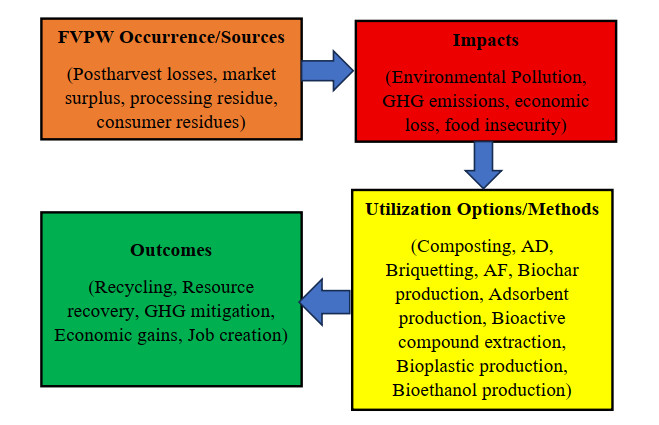
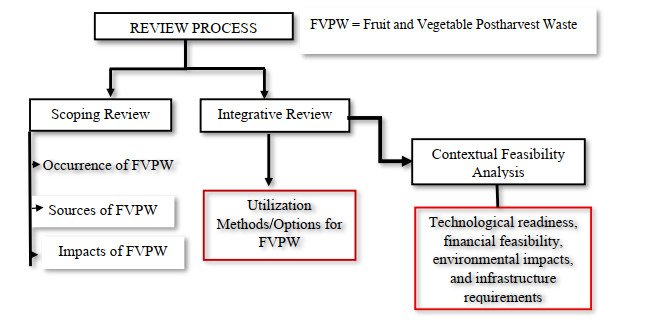
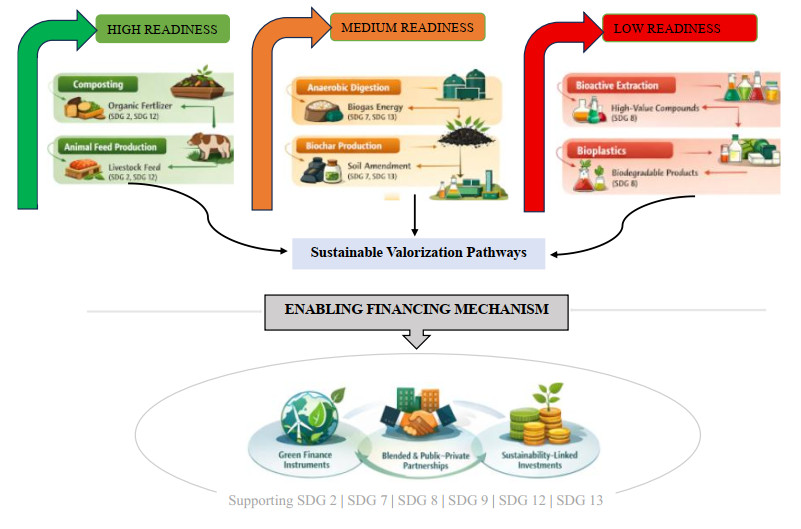
Fruit and vegetable postharvest waste (FVPW) represents a significant environmental and economic challenge in developing countries, where supply-chain inefficiencies and limited infrastructure contribute to substantial losses. While numerous technologies for FVPW utilization exist, integrated assessments that connect waste occurrence, environmental impacts, utilization pathways, and contextual feasibility within specific national settings remain limited. In this review, we synthesized evidence on the sources, environmental impacts, and valorization options of FVPW and evaluated their contextual feasibility within the Tanzanian context. A combined scoping and integrative review approach was employed using peer-reviewed literature, followed by a qualitative feasibility analysis considering technological readiness, cost, environmental benefit, infrastructure needs, and scalability potential. The findings revealed a hierarchy of implementation: High-readiness options such as composting and animal feeding provide immediate and scalable solutions, whereas medium- and low-readiness pathways, including anaerobic digestion, biochar production, bioethanol, bioactive compound extraction, and bioplastic synthesis, offer higher environmental and economic value but face infrastructural and institutional barriers. The analysis suggests that a phased transition strategy, prioritizing readily implementable technologies while progressively strengthening technical capacity and market systems, offers the most realistic pathway toward circular FVPW management. Furthermore, the study highlighted that the scalability of advanced valorization pathways is strongly dependent on access to appropriate financing mechanisms, including green finance instruments, blended finance models, and sustainability-linked investment frameworks. These insights provide practical guidance for policy, research, and investment aimed at enhancing sustainable postharvest waste utilization in Tanzania.
Citation: Nelson Joseph Msacky, Furaha Emmanuel Ndaka, Shaaban Mgana. Fruit and vegetable postharvest waste in Tanzania: A review of occurrence, sources, environmental impacts, and contextual utilization pathways[J]. Clean Technologies and Recycling, 2026, 6(2): 161-207. doi: 10.3934/ctr.2026008
Fruit and vegetable postharvest waste (FVPW) represents a significant environmental and economic challenge in developing countries, where supply-chain inefficiencies and limited infrastructure contribute to substantial losses. While numerous technologies for FVPW utilization exist, integrated assessments that connect waste occurrence, environmental impacts, utilization pathways, and contextual feasibility within specific national settings remain limited. In this review, we synthesized evidence on the sources, environmental impacts, and valorization options of FVPW and evaluated their contextual feasibility within the Tanzanian context. A combined scoping and integrative review approach was employed using peer-reviewed literature, followed by a qualitative feasibility analysis considering technological readiness, cost, environmental benefit, infrastructure needs, and scalability potential. The findings revealed a hierarchy of implementation: High-readiness options such as composting and animal feeding provide immediate and scalable solutions, whereas medium- and low-readiness pathways, including anaerobic digestion, biochar production, bioethanol, bioactive compound extraction, and bioplastic synthesis, offer higher environmental and economic value but face infrastructural and institutional barriers. The analysis suggests that a phased transition strategy, prioritizing readily implementable technologies while progressively strengthening technical capacity and market systems, offers the most realistic pathway toward circular FVPW management. Furthermore, the study highlighted that the scalability of advanced valorization pathways is strongly dependent on access to appropriate financing mechanisms, including green finance instruments, blended finance models, and sustainability-linked investment frameworks. These insights provide practical guidance for policy, research, and investment aimed at enhancing sustainable postharvest waste utilization in Tanzania.

| [1] |
Barra C, Falcone PM (2025a) Institutional quality and the environment-finance nexus: Evidence from global economies. Environ Dev Econ: 1-29. https://doi.org/10.1017/S1355770X25100375 doi: 10.1017/S1355770X25100375

|
| [2] |
Barra C, Falcone PM (2025b) Institutional factors and environmental performance: Insights from global economies. Econ Syst: 101364. https://doi.org/10.1016/j.ecosys.2025.101364 doi: 10.1016/j.ecosys.2025.101364
|
| [3] |
Giganti P, Falcone PM (2025) Unveiling latent topics in the interplay of circular economy and energy transition: A topic modelling approach. Resour Conserv Recycl 219: 108318. https://doi.org/10.1016/j.resconrec.2025.108318 doi: 10.1016/j.resconrec.2025.108318
|
| [4] |
Barra C, Esposito L, Falcone PM (2025) How does state fragility drive environmental degradation? A multidimensional analysis of governance and socio-economic vulnerabilities. Kyklos: 1-30. https://doi.org/10.1111/kykl.70031 doi: 10.1111/kykl.70031
|
| [5] | Sial TA, Rajpar I, Khan MN, et al. (2024) Impact of fruit and vegetable wastes on the environment and possible management strategies. In: Núñez-Delgado A, ed., Planet Earth: Scientific Proposals to Solve Urgent Issues, 307-330. https://doi.org/10.1007/978-3-031-53208-5_14 |
| [6] | Hailu G, Derbew B (2015) Extent, causes and reduction strategies of postharvest losses of fresh fruits and vegetables: A review. J Biol Agric Healthc 5: 49-64. |
| [7] |
Nguyen NH, Michaud J, Mogollon R, et al. (2024) Rating pome fruit quality traits using deep learning and image processing. Plant Direct 8: e70005. https://doi.org/10.1002/pld3.70005 doi: 10.1002/pld3.70005
|
| [8] |
Khort DO, Kutyrev A, Smirnov I, et al. (2024) Enhancing sustainable automated fruit sorting: Hyperspectral analysis and machine learning algorithms. Sustainability 16: 10084. https://doi.org/10.3390/su162210084 doi: 10.3390/su162210084
|
| [9] |
Thi NBD, Kumar G, Lin CY (2015) An overview of food waste management in developing countries: Current status and future perspective. J Environ Manag 157: 220-229. https://doi.org/10.1016/j.jenvman.2015.04.022 doi: 10.1016/j.jenvman.2015.04.022
|
| [10] |
Pires A, Martinho G (2019) Waste hierarchy index for circular economy in waste management. Waste Manag 95: 298-305. https://doi.org/10.1016/j.wasman.2019.06.014 doi: 10.1016/j.wasman.2019.06.014
|
| [11] |
Yadav H, Soni U, Kumar G (2023) Analysing challenges to smart waste management for a sustainable circular economy in developing countries: A fuzzy DEMATEL study. Smart Sustain Built Environ 12: 361-384. https://doi.org/10.1007/978-3-031-53208-5_14 10.1108/SASBE-06-2021-0097 doi: 10.1007/978-3-031-53208-5_1410.1108/SASBE-06-2021-0097
|
| [12] | United Nations (2015) Transforming our world: The 2030 Agenda for Sustainable Development |
| [13] | The United Republic of Tanzania (2021) 2019/20 National Sample Census of Agriculture: Key findings report for crops and livestock sectors and fish farming. National Bureau of Statistics, Dodoma. |
| [14] |
Abass AB, Ndunguru G, Mamiro P, et al. (2014) Post-harvest food losses in a maize-based farming system of semi-arid savannah area of Tanzania. J Stored Prod Res 49: 49-57. https://doi.org/10.1016/j.jspr.2013.12.004 doi: 10.1016/j.jspr.2013.12.004
|
| [15] | Mwankemwa LS, Silayo VC, Lazaro EL, et al. (2023) Tomato post-harvest losses as influenced by improper handling facilities in Morogoro, Tanzania. Tanzan J Agric Sci 22: 394-403. https://www.suaire.sua.ac.tz/handle/20.500.14820/6412 |
| [16] |
Msacky NJ, Leonard LS (2023) Performance evaluation of evaporative cooling systems as alternative for increasing the shelf life of perishable crops at the farmer level in Vunjo-Moshi Rural. Int J Environ 12: 17-40. https://doi.org/10.3126/ije.v12i2.65433 doi: 10.3126/ije.v12i2.65433
|
| [17] |
Lyakurwa FS (2023) Food waste and loss in the food service industry of Tanzania: Learning from the value addition chain. Int J Food Agric Nat Resour: 7-13. https://doi.org/10.46676/ij-fanres.v4i3.146 doi: 10.46676/ij-fanres.v4i3.146
|
| [18] | The United Republic of Tanzania (2019) National Postharvest Management Strategy (NPHMS) 2019-2029. Ministry of Agriculture, Dodoma. Available from: https://faolex.fao.org/docs/pdf/tan191075.pdf |
| [19] | Yhdego M, Kingu A (2016) Solid waste management in urban centres of Tanzania: Leapfrogging toward a circular economy. https://doi.org/10.13140/RG.2.2.15647.15520 |
| [20] |
Kafa N, Jaegler A (2021) Food losses and waste quantification in supply chains: A systematic literature review. Br Food J 123: 3502-3521. https://doi.org/10.1108/BFJ-09-2020-0879 doi: 10.1108/BFJ-09-2020-0879
|
| [21] |
Ambuko JL, Masakhwe SM, Amwoka E, et al. (2025) Food loss and waste data gaps in fruit and vegetable value chains: A review of the literature. Front Hortic: 1529040. https://doi.org/10.3389/fhort.2025.1529040 doi: 10.3389/fhort.2025.1529040
|
| [22] |
Bartezzaghi G, Cattani A, Garrone P, et al. (2022) Food waste causes in fruit and vegetables supply chains. Transp Res Proced 67: 118-130. https://doi.org/10.1016/j.trpro.2022.12.042 doi: 10.1016/j.trpro.2022.12.042
|
| [23] |
Joshi VK (2020) Fruit and vegetable processing waste management: An overview. Int J Food Ferment Technol 10: 67-94. https://doi.org/10.30954/2277-9396.02.2020.4 doi: 10.30954/2277-9396.02.2020.4
|
| [24] | de Moraes CC, de Oliveira Costa FH, da Silva AL, et al. (2022) Causes and prevention practices of food waste in fruit and vegetable supply chains: How is Brazil dealing with these issues? Waste Manag 154: 320-330. https://doi.org/10.1016/j.wasman.2022.10.021 |
| [25] | Rodger D, Admani A, Thomas M (2024) What is a scoping review? Evid Based Nurs 27: 84-85. https://doi.org/10.1136/ebnurs-2024-103969 |
| [26] | World Health Organization (2018) Millennium Development Goals (MDGs). Available from: https://www.who.int/news-room/fact-sheets/detail/millennium-development-goals-(mdgs) |
| [27] |
Currie RR, Wesley F, Pandher G (2014) Contextualising site factors for feasibility analysis. J Environ Plan Manag 57: 1484-1496. https://doi.org/10.1080/09640568.2013.815606 doi: 10.1080/09640568.2013.815606
|
| [28] |
Senzige J, Gyeke Y, Makinde D, et al. (2014) The potential for solid waste recycling in urban area of Tanzania: The case of Dar es Salaam. Int J Environ Prot Policy: 147-152. https://doi.org/10.11648/j.ijepp.20140205.11 doi: 10.11648/j.ijepp.20140205.11
|
| [29] | Tonini D, Manfredi S, Bakas I, et al. (2019) Life cycle assessment of landfilling. In: Solid Waste Landfilling: Concepts, Processes, Technologies, Elsevier, 955-972. https://doi.org/10.1016/B978-0-12-407721-8.00046-2 |
| [30] |
Tedesco D, Conti C, Lovarelli D, et al. (2019) Bioconversion of fruit and vegetable waste into earthworms as a new protein source: The environmental impact of earthworm meal production. Sci Total Environ 683: 690-698. https://doi.org/10.1016/j.scitotenv.2019.05.226 doi: 10.1016/j.scitotenv.2019.05.226
|
| [31] |
Munhuweyi K, Opara UL, Sigge G (2016) Postharvest losses of cabbages from retail to consumer and the socio-economic and environmental impacts. Br Food J 118: 286-300. https://doi.org/10.1108/BFJ-08-2014-0280 doi: 10.1108/BFJ-08-2014-0280
|
| [32] | Meybeck A, Cederberg C, Gustavsson J, et al. (2011) Global food losses and food waste. Food and Agriculture Organization of the United Nations, Swedish Institute for Food and Biotechnology, Düsseldorf, Interpack. Available from: https://openknowledge.fao.org/handle/20.500.14283/i2697e |
| [33] | Sharma A, Banerjee J, Nishant, et al. (2021) Vegetable waste management: An assessment of sustainability in environmental chemistry for sustainable world. Cape Comorin Publisher, Kanyakumari, 170-179. |
| [34] | Mwagike L, Mdoe N (2015) The role of middlemen in fresh tomato supply chain in Kilolo district, Tanzania. Int J Agric Mark 2: 45-56. |
| [35] |
Kwak DW, Seo YJ, Mason R (2018) Investigating the relationship between supply chain innovation, risk management capabilities and competitive advantage in global supply chains. Int J Oper Prod Manag 38: 2-21. https://doi.org/10.1108/IJOPM-06-2015-0390 doi: 10.1108/IJOPM-06-2015-0390
|
| [36] |
Gouda MH-S (2024) An overview of low-cost approaches for the postharvest storage of fruits and vegetables for smallholders, retailers, and consumers. Horticulturae 10: 803. https://doi.org/10.3390/horticulturae10080803 doi: 10.3390/horticulturae10080803
|
| [37] | Muzondo PJ, Pashapa R, Karengesha S (2025) Enhancing supply chains to alleviate postharvest losses and food waste in the Global South. In: Sustainable Food Systems in the Global South: Performance Trends, Vulnerabilities and Policy Frameworks, CABI Digital Library, 91-104. https://doi.org/10.1079/9781836990215.0007 |
| [38] | Adejumo IO, Adebiyi OA (2020) Agricultural solid wastes: Causes, effects, and effective management. In: Strategies of Sustainable Solid Waste Management, IntechOpen Limited, London, 1-19. https://doi.org/10.5772/intechopen.93601 |
| [39] | Uikey P, Sharma A, Yadav A, et al. (2023) Techniques to reduce the postharvest losses of fruits and vegetables. In: Advanced Technology of Horticulture, Daya Publishing House, New Delhi, 321-342. |
| [40] | Janghu S, Kumar V, Yadav AK (2024) Post-harvest management of fruits and vegetables. In: Iriti M, ed., Current Perspectives in Agriculture and Food Science, Volume 7, B P International, West Bengal, 125-148. https://doi.org/10.9734/bpi/cpafs/v7/7984E |
| [41] | Food and Agriculture Organization (1997) Chapter 4: Food supply systems in Africa. In: Agriculture food and nutrition for Africa: A resource book for teachers of agriculture, FAO Information Division, Rome. |
| [42] |
Johnson LK, Bloom JD, Dunning RD, et al. (2019) Farmer harvest decisions and vegetable loss in primary production. Agric Syst 176: 102672. https://doi.org/10.1016/j.agsy.2019.102672 doi: 10.1016/j.agsy.2019.102672
|
| [43] | Mdangi M, Kilasi NL, Kilasi M, et al. (2019) Harvesting and post-harvesting techniques: A training compendium for module code APT 04206, NTA level 4. Ministry of Agriculture, Department of Training, Extension Services and Research, Dodoma. |
| [44] | Abonyi MN, Aniagor CO, Obi CC, et al. (2024) Post-harvest management of food crops and agro-waste utilization in a developing economy: A review. In: Nanobiotechnology for Sustainable Food Management, Taylor & Francis Group, 163-187. |
| [45] |
Elik A, Yanik DK, Istanbullu Y, et al. (2019) Strategies to reduce post-harvest losses for fruits and vegetables. Int J Sci Technol Res 5: 422-8702. https://doi.org/10.7176/JSTR/5-3-04 doi: 10.7176/JSTR/5-3-04
|
| [46] |
Joshi K, Meher MK, Poluri KM (2020) Fabrication and characterization of bioblocks from agricultural waste using fungal mycelium for renewable and sustainable applications. ACS Appl Bio Mater 3: 1884-1892. https://doi.org/10.1021/acsabm.9b01047 doi: 10.1021/acsabm.9b01047
|
| [47] |
Plazzotta S, Manzocco L, Nicoli MC (2017) Fruit and vegetable waste management and the challenge of fresh-cut salad. Trends Food Sci Technol: 51-59. https://doi.org/10.1016/j.tifs.2017.02.013 doi: 10.1016/j.tifs.2017.02.013
|
| [48] |
Reddy SMK, Reddy GS, Chaithanya LK, et al. (2025) Quantifying the hidden costs: A review of true cost accounting in agrifood systems. Eur J Nutr Food Saf 17: 55-67. https://doi.org/10.9734/ejnfs/2025/v17i11619 doi: 10.9734/ejnfs/2025/v17i11619
|
| [49] |
Blanckenberg A, Opara UL, Fawole OA (2021) Postharvest losses in quantity and quality of table grape (cv. Crimson seedless) along the supply chain and associated economic, environmental and resource impacts. Sustainability 13: 4450. https://doi.org/10.3390/su13084450 doi: 10.3390/su13084450
|
| [50] | United States Department of Energy (1998) Method for calculating carbon sequestration by trees in urban and suburban settings. US Department of Energy, Washington, DC. |
| [51] | Yahia EM, Fonseca JM, Kitinoja L (2019) Postharvest losses and waste. In: Postharvest Technology of Perishable Horticultural Commodities, Elsevier Inc., 43-69. https://doi.org/10.1016/B978-0-12-813276-0.00002-X |
| [52] | Koka RE (2017) Assessment of factors leading to poor electronics waste management in Arusha City, Tanzania. Master's Thesis, The Open University of Tanzania, Department of Environmental Studies, Dar es Salaam. Available from: http://repository.out.ac.tz/id/eprint/1990 |
| [53] |
Bhatt R, Giang A, Kandlikar M (2023) Incentivizing alternatives to agricultural waste burning in Northern India: Trust, awareness, and access as barriers to adoption. Environ Syst Decis 43: 358-370. https://doi.org/10.1007/s10669-022-09892-w doi: 10.1007/s10669-022-09892-w
|
| [54] |
Kwakye SO, Amuah EEY, Ankoma KA, et al. (2024) Understanding the performance and challenges of solid waste management in an emerging megacity: Insights from the developing world. Environ Challeng 14: 100805. https://doi.org/10.1016/j.envc.2023.100805 doi: 10.1016/j.envc.2023.100805
|
| [55] | Moharir RV, Kumar S (2021) Traditional solid waste treatment technologies. In: Kumar S, Kumar R, Pandey A, eds., Strategic Perspectives in Solid Waste and Wastewater Management, Elsevier, 23-45. https://doi.org/10.1016/B978-0-12-821009-3.00016-6 |
| [56] |
Ganesh KS, Sridhar A, Vishali S (2022) Utilization of fruit and vegetable waste to produce value-added products: Conventional utilization and emerging opportunities—A review. Chemosphere 287: 132221. https://doi.org/10.1016/j.chemosphere.2021.132221 doi: 10.1016/j.chemosphere.2021.132221
|
| [57] |
Esparza I, Jiménez-Moreno N, Bimbela F, et al. (2020) Fruit and vegetable waste management: Conventional and emerging approaches. J Environ Manag 265: 110510. https://doi.org/10.1016/j.jenvman.2020.110510 doi: 10.1016/j.jenvman.2020.110510
|
| [58] |
Kelbesa WA (2021) Effect of compost in improving soil properties and its consequent effect on crop production: A review. J Nat Sci Res 12: 15-25. https://doi.org/10.7176/JNSR/12-10-02 doi: 10.7176/JNSR/12-10-02
|
| [59] | Harrison RB (2008) Composting and formation of humic substances. In: Jørgensen SE, Fath BD, eds., Encyclopedia of Ecology, Academic Press, 713-719. https://doi.org/10.1016/B978-008045405-4.00262-7 |
| [60] |
Hussain N, Das S, Goswami L, et al. (2018) Intensification of vermitechnology for kitchen vegetable waste and paddy straw employing earthworm consortium: Assessment of maturity time, microbial community structure, and economic benefit. J Clean Prod 182: 414-426. https://doi.org/10.1016/j.jclepro.2018.01.241 doi: 10.1016/j.jclepro.2018.01.241
|
| [61] |
Ghinea C, Leahu A (2020) Monitoring of fruit and vegetable waste composting process: Relationship between microorganisms and physico-chemical parameters. Processes 8: 302. https://doi.org/10.3390/pr8030302 doi: 10.3390/pr8030302
|
| [62] |
Mataba AL, Msuya N, Katima Z (2024) Production of biofertilizer from fruit and garden waste. Tanzan J Eng Technol 43: 158-168. https://doi.org/10.52339/tjet.v43i1.990 doi: 10.52339/tjet.v43i1.990
|
| [63] |
Choi IS, Lee YG, Khanal SK, et al. (2015) A low-energy, cost-effective approach to fruit and citrus peel waste processing for bioethanol production. Appl Energy 140: 65-74. https://doi.org/10.1016/j.apenergy.2014.11.070 doi: 10.1016/j.apenergy.2014.11.070
|
| [64] |
Musa AM, Ishak CF, Karam DS, et al. (2020) Effects of fruit and vegetable wastes and biodegradable municipal wastes co-mixed composts on nitrogen dynamics in an Oxisol. Agronomy 10: 1609. https://doi.org/10.3390/agronomy10101609 doi: 10.3390/agronomy10101609
|
| [65] |
Choy SY, Wang KQW, Wang B, et al. (2015) Co-composting of horticultural waste with fruit peels, food waste, and soybean residues. Environ Technol 36: 1448-1456. https://doi.org/10.1080/09593330.2014.993728 doi: 10.1080/09593330.2014.993728
|
| [66] | Sharma K, Garg VK (2019) Vermicomposting of waste: A zero-waste approach for waste management. In: Taherzadeh MJ, Bolton K, Wong JPA, eds., Sustainable Resource Recovery and Zero Waste Approaches, 133-164. |
| [67] |
Ghinea C, Apostol LC, Prisacaru AE, et al. (2019) Development of a model for food waste composting. Environ Sci Pollut Res: 4056-4069. https://doi.org/10.1007/s11356-018-3939-1 doi: 10.1007/s11356-018-3939-1
|
| [68] |
Nenciu F, Stanciulescu I, Vlad H, et al. (2022) Decentralized processing performance of fruit and vegetable waste discarded from retail, using an automated thermophilic composting technology. Sustainability 14: 2835. https://doi.org/10.3390/su14052835 doi: 10.3390/su14052835
|
| [69] | Conti C, Bacenetti J, Tedesco D (2019) Earthworms for feed production from vegetable waste: Environmental impact assessment. Environ Eng Manag J 18: 2117-2122. |
| [70] |
Isibika A, Simha P, Vinnerås BZ, et al. (2023) Food industry waste: An opportunity for black soldier fly larvae protein production in Tanzania. Sci Total Environ: 159985. https://doi.org/10.1016/j.scitotenv.2022.159985 doi: 10.1016/j.scitotenv.2022.159985
|
| [71] |
Esteban MB, García AJ, Ramos P, et al. (2007) Evaluation of fruit-vegetable and fish wastes as alternative feedstuffs in pig diets. Waste Manag 27: 193-200. https://doi.org/10.1016/j.wasman.2006.01.004 doi: 10.1016/j.wasman.2006.01.004
|
| [72] |
Martin DS, Ramos S, Zufia J (2016) Valorisation of food waste to produce new raw materials for animal feed. Food Chem 198: 68-74. https://doi.org/10.1016/j.foodchem.2015.11.035 doi: 10.1016/j.foodchem.2015.11.035
|
| [73] |
Das NG, Huque KS, Amanullah SM, et al. (2019) Feeding of processed vegetable wastes to bulls and its potential environmental benefit. Anim Nutr 5: 87-94. https://doi.org/10.1016/j.aninu.2018.04.002 doi: 10.1016/j.aninu.2018.04.002
|
| [74] |
Song KH, Woo JS, Kim JR, et al. (2020) Nutritional value and in situ degradability of fruit-vegetable byproducts and their feeding effects on performance of growing Hanwoo steers. Asian-Australas J Anim Sci 33: 973. https://doi.org/10.5713/ajas.19.0743 doi: 10.5713/ajas.19.0743
|
| [75] |
Angulo JM, Valencia E, Villamil T, et al. (2012) Nutritional evaluation of fruit and vegetable waste as feedstuff for diets of lactating Holstein cows. J Environ Manag 95: 210-214. https://doi.org/10.1016/j.jenvman.2011.06.050 doi: 10.1016/j.jenvman.2011.06.050
|
| [76] |
Das NG, Huque KS, Amanullah SM, et al. (2018) Study of chemical composition and nutritional values of vegetable wastes in Bangladesh. Vet Anim Sci 5: 31-37. https://doi.org/10.1016/j.vas.2018.02.003 doi: 10.1016/j.vas.2018.02.003
|
| [77] |
Tedesco DEA, Scarioni STA, Panseri S, et al. (2021) Fruit and vegetable wholesale market waste: Safety and nutritional characterisation for their potential re-use in livestock nutrition. Sustainability 13: 9478. https://doi.org/10.3390/su13169478 doi: 10.3390/su13169478
|
| [78] | Angelidaki I, Ellegaard L, Ahring BK (2003) Applications of the anaerobic digestion process. In: Biomethanation II, 1-33. https://doi.org/10.1007/3-540-45838-7_1 |
| [79] |
Deressa L, Libsu S, Chavan RB, et al. (2015) Production of biogas from fruit and vegetable wastes mixed with different wastes. Environ Ecol Res 3: 65-71. https://doi.org/10.13189/eer.2015.030303 doi: 10.13189/eer.2015.030303
|
| [80] |
Mrosso R, Kiplagat J, Mecha AC (2023) Anaerobic codigestion of tuber waste and fruit waste: Synergy and enhanced biogas production. Int J Chem Eng 2023: 6637249. https://doi.org/10.1155/2023/6637249 doi: 10.1155/2023/6637249
|
| [81] |
Korai MS, Noonari AA, Ali M, et al. (2023) Anaerobic biodegradability and biomethanation potential of fruit-vegetable wastes at Sindh, Pakistan. Pak J Anal Environ Chem 24: 145-154. https://doi.org/10.21743/pjaec/2023.12.03 doi: 10.21743/pjaec/2023.12.03
|
| [82] | Aloyce ENR, Aloyce WM, Richard JK (2018) Characteristics and anaerobic digestion of fruits wastes from Ubungo-Urafiki Market in Dar es Salaam. Tanzan J Eng Technol 37: 33-46. |
| [83] |
Akande OM, Olorunnisola AO (2018) Potential of briquetting as a waste-management option for handling market-generated vegetable waste in Port Harcourt, Nigeria. Recycling 3: 11. https://doi.org/10.3390/recycling3020011 doi: 10.3390/recycling3020011
|
| [84] |
Karimibavani B, Sengul AB, Asmatulu E (2020) Converting briquettes of orange and banana peels into carbonaceous materials for activated sustainable carbon and fuel sources. Energy Ecol Environ 5: 161-170. https://doi.org/10.1007/s40974-020-00148-4 doi: 10.1007/s40974-020-00148-4
|
| [85] |
Afsal A, David R, Baiju V, et al. (2020) Experimental investigations on combustion characteristics of fuel briquettes made from vegetable market waste and saw dust. Mater Today Proc 33: 3826-3831. https://doi.org/10.1016/j.matpr.2020.06.222 doi: 10.1016/j.matpr.2020.06.222
|
| [86] | WasteX (2024) Biochar vs charcoal: 5 key differences. Available from: https://www.wastex.io/post/biochar-vs-charcoal |
| [87] | Brown RC, Bakshi S, Mašek O (2024) Fundamentals of biochar production. In: Biochar for Environmental Management, Routledge, 57-83. |
| [88] |
Takolpuckdee P (2014) Transformation of agricultural market waste disposal to biochar soil amendments. Proced Environ Sci 20: 64-70. https://doi.org/10.1016/j.proenv.2014.03.010 doi: 10.1016/j.proenv.2014.03.010
|
| [89] |
Soltan M, Elsamadony M, Mostafa A, et al. (2019) Harvesting zero waste from co-digested fruit and vegetable peels via integrated fermentation and pyrolysis processes. Environ Sci Pollut Res 26: 10429-10438. https://doi.org/10.1007/s11356-019-04647-8 doi: 10.1007/s11356-019-04647-8
|
| [90] |
Pradhan S, Abdelaal AH, Mroue K, et al. (2020) Biochar from vegetable wastes: Agro-environmental characterization. Biochar 2: 439-453. https://doi.org/10.1007/s42773-020-00069-9 doi: 10.1007/s42773-020-00069-9
|
| [91] |
Aziz S, Yaseen L, Jamal A, et al. (2020) Fabrication of biochar from organic wastes and its effect on wheat growth and soil microflora. Pol J Environ Stud 29: 1069-1076. https://doi.org/10.15244/pjoes/99825 doi: 10.15244/pjoes/99825
|
| [92] |
Pradhan S, Mackey HR, Al-Ansari TA, et al. (2022) Biochar from food waste: A sustainable amendment to reduce water stress and improve the growth of chickpea plants. Biomass Convers Biorefin 12: 4549-4562. https://doi.org/10.1007/s13399-022-02575-1 doi: 10.1007/s13399-022-02575-1
|
| [93] |
binti-Ab-Aziz NS, bin Mohd Nor MA, Hamzah F (2015) Suitability of biochar produced from biomass waste as soil amendment. Proced Soc Behav Sci 195: 2457-2465. https://doi.org/10.1016/j.sbspro.2015.06.288 doi: 10.1016/j.sbspro.2015.06.288
|
| [94] |
Wang L, Ok YS, Tsang DC, et al. (2020) New trends in biochar pyrolysis and modification strategies: Feedstock, pyrolysis conditions, sustainability concerns and implications for soil amendment. Soil Use Manag 36: 358-386. https://doi.org/10.1111/sum.12592 doi: 10.1111/sum.12592
|
| [95] |
Doan TT, Sisouvanh P, Sengkhrua T, et al. (2021) Site-specific effects of organic amendments on parameters of tropical agricultural soil and yield: A field experiment in three countries in Southeast Asia. Agronomy 11: 348. https://doi.org/10.3390/agronomy11020348 doi: 10.3390/agronomy11020348
|
| [96] |
Annadurai G, Juang RS, Lee DJ (2002) Use of cellulose-based wastes for adsorption of dyes from aqueous solutions. J Hazard Mater 92: 263-274. https://doi.org/10.1016/S0304-3894(02)00017-1 doi: 10.1016/S0304-3894(02)00017-1
|
| [97] |
Negroiu M, Țurcanu AA, Matei E, et al. (2021) Novel adsorbent based on banana peel waste for removal of heavy metal ions from synthetic solutions. Materials 14: 3946. https://doi.org/10.3390/ma14143946 doi: 10.3390/ma14143946
|
| [98] | Mallampati R, Valiyaveettil S (2012) Application of tomato peel as an efficient adsorbent for water purification: Alternative biotechnology? RSC Adv 2: 9914-9920. https://doi.org/10.1039/C2RA21108D |
| [99] |
Changmai M, Banerjee P, Nahar K, et al. (2018) A novel adsorbent from carrot, tomato and polyethylene terephthalate waste as a potential adsorbent for Co(II) from aqueous solution: Kinetic and equilibrium studies. J Environ Chem Eng 6: 246-257. https://doi.org/10.1016/j.jece.2017.12.009 doi: 10.1016/j.jece.2017.12.009
|
| [100] |
Lam SS, Liew RK, Cheng CK, et al. (2018) Pyrolysis production of fruit peel biochar for potential use in treatment of palm oil mill effluent. J Environ Manag 213: 400-408. https://doi.org/10.1016/j.jenvman.2018.02.092 doi: 10.1016/j.jenvman.2018.02.092
|
| [101] |
Cao QY, Huang ZH, Liu SG, et al. (2019) Potential of Punica granatum biochar to adsorb Cu(II) in soil. Sci Rep 9: 11116. https://doi.org/10.1038/s41598-019-46983-2 doi: 10.1038/s41598-019-46983-2
|
| [102] | Akhtar MS, Swamy MK, Sinniah UR (2019) Natural bio-active compounds. In: Natural Bio-active Compounds, Springer Singapore, 1-608. https://doi.org/10.1007/978-981-13-7154-7 |
| [103] |
Jiménez-Moreno N, Esparza I, Bimbela F, et al. (2020) Valorization of selected fruit and vegetable wastes as bioactive compounds: Opportunities and challenges. Crit Rev Environ Sci Technol 50: 2061-2108. https://doi.org/10.1080/10643389.2019.1694819 doi: 10.1080/10643389.2019.1694819
|
| [104] |
Nava OJ, Soto-Robles CA, Gómez-Gutiérrez CM, et al. (2017) Fruit peel extract mediated green synthesis of zinc oxide nanoparticles. J Mol Struct 1147: 1-6. https://doi.org/10.1016/j.molstruc.2017.06.078 doi: 10.1016/j.molstruc.2017.06.078
|
| [105] |
Boomi P, Ganesan RM, Poorani G, et al. (2019) Biological synergy of greener gold nanoparticles by using Coleus aromaticus leaf extract. Mater Sci Eng C 99: 202-210. https://doi.org/10.1016/j.msec.2019.01.105 doi: 10.1016/j.msec.2019.01.105
|
| [106] |
Kadam J, Dhawal P, Barve S, et al. (2020) Green synthesis of silver nanoparticles using cauliflower waste and their multifaceted applications in photocatalytic degradation of methylene blue dye and Hg2+. SN Appl Sci 2: 738. https://doi.org/10.1007/s42452-020-2543-4 doi: 10.1007/s42452-020-2543-4
|
| [107] |
Omran BA, Aboelazayem O, Nassar HN, et al. (2021) Biovalorization of mandarin waste peels into silver nanoparticles and activated carbon. Int J Environ Sci Technol 18: 1119-1134. https://doi.org/10.1007/s13762-020-02873-z doi: 10.1007/s13762-020-02873-z
|
| [108] |
Wolfe KL, Liu RH (2003) Apple peels as a value-added food ingredient. J Agric Food Chem 51: 1676-1683. https://doi.org/10.1021/jf025916z doi: 10.1021/jf025916z
|
| [109] |
Lalou S, Mantzouridou F, Paraskevopoulou A, et al. (2013) Bioflavour production from orange peel hydrolysate using immobilized Saccharomyces cerevisiae. Appl Microbiol Biotechnol 97: 9397-9407. https://doi.org/10.1007/s00253-013-5181-6 doi: 10.1007/s00253-013-5181-6
|
| [110] | Lun OK, Wai TB, Ling LS (2014) Pineapple cannery waste as a potential substrate for microbial biotransformation to produce vanillic acid and vanillin. Int Food Res J 21: 953. |
| [111] |
Zhang Y, Cheng X, Wang Z, et al. (2022) Full recycling of high-value resources from cabbage waste by multi-stage utilization. Sci Total Environ 804: 149951. https://doi.org/10.1016/j.scitotenv.2021.149951 doi: 10.1016/j.scitotenv.2021.149951
|
| [112] |
Derrien M, Badr A, Gosselin A, et al. (2017) Optimization of a green process for the extraction of lutein and chlorophyll from spinach by-products using response surface methodology (RSM). LWT Food Sci Technol 79: 170-177. https://doi.org/10.1016/j.lwt.2017.01.010 doi: 10.1016/j.lwt.2017.01.010
|
| [113] |
El Shafey AM (2020) Green synthesis of metal and metal oxide nanoparticles from plant leaf extracts and their applications: A review. Green Process Synth 9: 304-339. https://doi.org/10.1515/gps-2020-0031 doi: 10.1515/gps-2020-0031
|
| [114] |
Sir-Elkhatim KA, Elagib RA, Hassan AB (2018) Content of phenolic compounds and vitamin C and antioxidant activity in wasted parts of Sudanese citrus fruits. Food Sci Nutr 6: 1214-1219. https://doi.org/10.1002/fsn3.660 doi: 10.1002/fsn3.660
|
| [115] |
Bas-Bellver C, Barrera C, Betoret N, et al. (2020) Turning agri-food cooperative vegetable residues into functional powdered ingredients for the food industry. Sustainability 12: 1284. https://doi.org/10.3390/su12041284 doi: 10.3390/su12041284
|
| [116] |
Jayesree N, Hang PK, Priyangaa A, et al. (2021) Valorisation of carrot peel waste by water-induced hydrocolloidal complexation for extraction of carotene and pectin. Chemosphere 272: 129919. https://doi.org/10.1016/j.chemosphere.2021.129919 doi: 10.1016/j.chemosphere.2021.129919
|
| [117] |
Rico X, Nuutinen EM, Gullón B, et al. (2021) Application of an eco-friendly sodium acetate/urea deep eutectic solvent in the valorisation of melon by-products. Food Bioprod Process 130: 216-228. https://doi.org/10.1016/j.fbp.2021.10.006 doi: 10.1016/j.fbp.2021.10.006
|
| [118] |
Jariyasakoolroj P, Leelaphiwat P, Harnkarnsujarit N (2020) Advances in research and development of bioplastic for food packaging. J Sci Food Agric 100: 5032-5045. https://doi.org/10.1002/jsfa.9497 doi: 10.1002/jsfa.9497
|
| [119] |
Kharb J, Saharan R (2025) Development of biodegradable and eco-friendly fruit peel-derived bioplastic film with antibacterial potential for food packaging application. Biomass Convers Biorefin: 10839-10854. https://doi.org/10.1007/s13399-024-05834-5 doi: 10.1007/s13399-024-05834-5
|
| [120] |
Merino D, Simonutti R, Perotto G, et al. (2021) Direct transformation of industrial vegetable waste into bioplastic composites intended for agricultural mulch films. Green Chem 23: 5956-5971. https://doi.org/10.1039/D1GC01316E doi: 10.1039/D1GC01316E
|
| [121] | Grancarić AM, Jerković I, Tarbuk A (2013) Bioplastics in textiles. Polimeri 34: 9-14. Available from: https://hrcak.srce.hr/106071 |
| [122] |
Plank J (2004) Applications of biopolymers and other biotechnological products in building materials. Appl Microbiol Biotechnol 66: 1-9. https://doi.org/10.1007/s00253-004-1714-3 doi: 10.1007/s00253-004-1714-3
|
| [123] |
Perotto G, Simonutti R, Ceseracciu L, et al. (2020) Water-induced plasticization in vegetable-based bioplastic films: A structural and thermo-mechanical study. Polymer 200: 122598. https://doi.org/10.1016/j.polymer.2020.122598 doi: 10.1016/j.polymer.2020.122598
|
| [124] |
Perotto G, Ceseracciu L, Simonutti R, et al. (2018) Bioplastics from vegetable waste via an eco-friendly water-based process. Green Chem 20: 894-902. https://doi.org/10.1039/C7GC03368K doi: 10.1039/C7GC03368K
|
| [125] |
Mroczkowska MCD, Germaine KJ, Hegde M, et al. (2024) Valorisation of tomato waste as a source of cutin for hydrophobic surface coatings to protect starch-and gelatine-blend bioplastics. Biomass 4: 990-1004. https://doi.org/10.3390/biomass4030055 doi: 10.3390/biomass4030055
|
| [126] |
Yaradoddi JS, Banapurmath NR, Ganachari SV, et al. (2022) Bio-based material from fruit waste of orange peel for industrial applications. J Mater Res Technol 17: 3186-3197. https://doi.org/10.1016/j.jmrt.2021.09.016 doi: 10.1016/j.jmrt.2021.09.016
|
| [127] |
Sultan NFK, Johari WLW (2017) The development of banana peel/corn starch bioplastic film: A preliminary study. Bioremediat Sci Technol Res 5: 12-17. https://doi.org/10.54987/bstr.v5i1.352 doi: 10.54987/bstr.v5i1.352
|
| [128] | Jekayinfa SO, Olorunmaiye JA, Ogunsola AD, et al. (2018) Evaluation of petrol and ethanol mixture as a fuel for gasoline engines. Adeleke Univ J Eng Technol 1: 139-148. |
| [129] |
Saikia M, Sarmah P, Deka R, et al. (2024) Ethanol blending in petrol: Current status and prospects in India. Renew Energy Res Appl 5: 45-49. https://doi.org/10.22044/rera.2023.12885.1208 doi: 10.22044/rera.2023.12885.1208
|
| [130] |
Osiolo HH, Marwah H, Leach M (2023) The emergence of large-scale bioethanol utilities: Accelerating energy transitions for cooking. Energies 16: 6242. https://doi.org/10.3390/en16176242 doi: 10.3390/en16176242
|
| [131] |
Valladares-Diestra KK, de Souza Vandenberghe LP, Torres LAZ, et al. (2021) Imidazole green solvent pre-treatment as a strategy for second-generation bioethanol production from sugarcane bagasse. Chem Eng J 420: 127708. https://doi.org/10.1016/j.cej.2020.127708 doi: 10.1016/j.cej.2020.127708
|
| [132] |
Castillo AB, Cortes DJD, Sorino CF, et al. (2023) Bioethanol production from waste and nonsalable date palm (Phoenix dactylifera L.) fruits: Potentials and challenges. Sustainability 15: 2937. https://doi.org/10.3390/su15042937 doi: 10.3390/su15042937
|
| [133] |
Hamzah MA, Alias AB, Ahmad NE (2019) Production of biofuel (bio-ethanol) from fruit waste: Banana peels. Int J Eng Adv Technol 9: 5897-5901. https://doi.org/10.35940/ijeat.A3024.109119 doi: 10.35940/ijeat.A3024.109119
|
| [134] |
Vadalà R, Lo Vecchio G, Rando R, et al. (2023) A sustainable strategy for the conversion of industrial citrus fruit waste into bioethanol. Sustainability 15: 9647. https://doi.org/10.3390/su15129647 doi: 10.3390/su15129647
|
| [135] |
Gil LS, Maupoey PF (2018) An integrated approach for pineapple waste valorisation: Bioethanol production and bromelain extraction from pineapple residues. J Clean Prod 172: 1224-1231. https://doi.org/10.1016/j.jclepro.2017.10.284 doi: 10.1016/j.jclepro.2017.10.284
|
| [136] | Gosavi P, Chaudhary Y, Durve-Gupta A (2017) Production of biofuel from fruits and vegetable wastes. Eur J Biotechnol Biosci 5: 69-73. |
| [137] |
Awodi PS, Ogbonna JC, Nwagu TN (2022) Bioconversion of mango (Mangifera indica) seed kernel starch into bioethanol using various fermentation techniques. Heliyon 8: e09707. https://doi.org/10.1016/j.heliyon.2022.e09707 doi: 10.1016/j.heliyon.2022.e09707
|
| [138] |
Evcan E, Tari C (2015) Production of bioethanol from apple pomace by using cocultures: Conversion of agro-industrial waste to value added product. Energy 88: 775-782. https://doi.org/10.1016/j.energy.2015.05.090 doi: 10.1016/j.energy.2015.05.090
|
| [139] |
Casabar JT, Unpaprom Y, Ramaraj R (2019) Fermentation of pineapple fruit peel wastes for bioethanol production. Biomass Convers Biorefin 9: 761-765. https://doi.org/10.1007/s13399-019-00436-y doi: 10.1007/s13399-019-00436-y
|
| [140] |
Danmaliki GI, Muhammad AM, Shamsuddeen AA, et al. (2016) Bioethanol production from banana peels. IOSR J Environ Sci Toxicol Food Technol 10: 56-62. https://doi.org/10.9790/2402-1006025662 doi: 10.9790/2402-1006025662
|
| [141] | Zhao H, Themelis N, Bourtsalas A, et al. (2019) Methane emissions from landfills. Columbia University. |
| [142] | National Aeronautics and Space Administration (2024) Methane. Available from: https://climate.nasa.gov/vital-signs/methane/?intent = 121 |
| [143] |
Salemdeeb R, zu Ermgassen EKHJ, Kim MH, et al. (2017) Environmental and health impacts of using food waste as animal feed: A comparative analysis of food waste management options. J Clean Prod 140: 871-880. https://doi.org/10.1016/j.jclepro.2016.05.049 doi: 10.1016/j.jclepro.2016.05.049
|
| [144] | Environmental Management Act (2004) United Republic of Tanzania, Dar es Salaam. |
| [145] | Environmental (Solid Waste Management) Regulations (2009) Government Notice No. 263 of 2009, Dar es Salaam. |
| [146] |
Vieira IMM, Santos BLP, Santos CVM, et al. (2022) Valorization of pineapple waste: A review on how the fruit's potential can reduce residue generation. BioEnergy Res 15: 924-934. https://doi.org/10.1007/s12155-021-10318-9 doi: 10.1007/s12155-021-10318-9
|
| [147] |
Plazzotta S, Cottes M, Simeoni P, et al. (2020) Evaluating the environmental and economic impact of fruit and vegetable waste valorisation: The lettuce waste study-case. J Clean Prod 262: 121435. https://doi.org/10.1016/j.jclepro.2020.121435 doi: 10.1016/j.jclepro.2020.121435
|
| [148] | The National Environmental Policy (2021) The United Republic of Tanzania, Vice President's Office, Dodoma. |
| [149] | The National Solid Waste Management Strategy (2018) The United Republic of Tanzania, Dodoma. |
| [150] |
Kumar K, Yadav AN, Kumar V, et al. (2017) Food waste: A potential bioresource for extraction of nutraceuticals and bioactive compounds. Bioresour Bioprocess 4: 18. https://doi.org/10.1186/s40643-017-0148-6 doi: 10.1186/s40643-017-0148-6
|
| [151] |
Sharma M, Usmani Z, Gupta VK, et al. (2021) Valorization of fruits and vegetable wastes and by-products to produce natural pigments. Crit Rev Biotechnol 41: 535-563. https://doi.org/10.1080/07388551.2021.1873240 doi: 10.1080/07388551.2021.1873240
|
| [152] | The Investment Guide on Waste Management in Tanzania (2020) The United Republic of Tanzania, Vice President's Office, Dodoma. |
| [153] | Falcone PM, Sica E (2024) Sustainable Finance and the Global Health Crisis. Taylor & Francis, New York. https://doi.org/10.4324/9781003284703 |
| [154] |
Falcone PM (2020) Environmental regulation and green investments: The role of green finance. Int J Green Econ 14: 159-173. https://doi.org/10.1504/IJGE.2020.109735 doi: 10.1504/IJGE.2020.109735
|
| [155] | National Council for Financial Inclusion (2023) National Financial Inclusion Framework 2023-2028. National Council for Financial Inclusion, Dodoma. |
Figures(8) / Tables(7)
Nelson Joseph Msacky, Furaha Emmanuel Ndaka, Shaaban Mgana. Fruit and vegetable postharvest waste in Tanzania: A review of occurrence, sources, environmental impacts, and contextual utilization pathways[J]. Clean Technologies and Recycling, 2026, 6(2): 161-207. doi: 10.3934/ctr.2026008





 DownLoad: