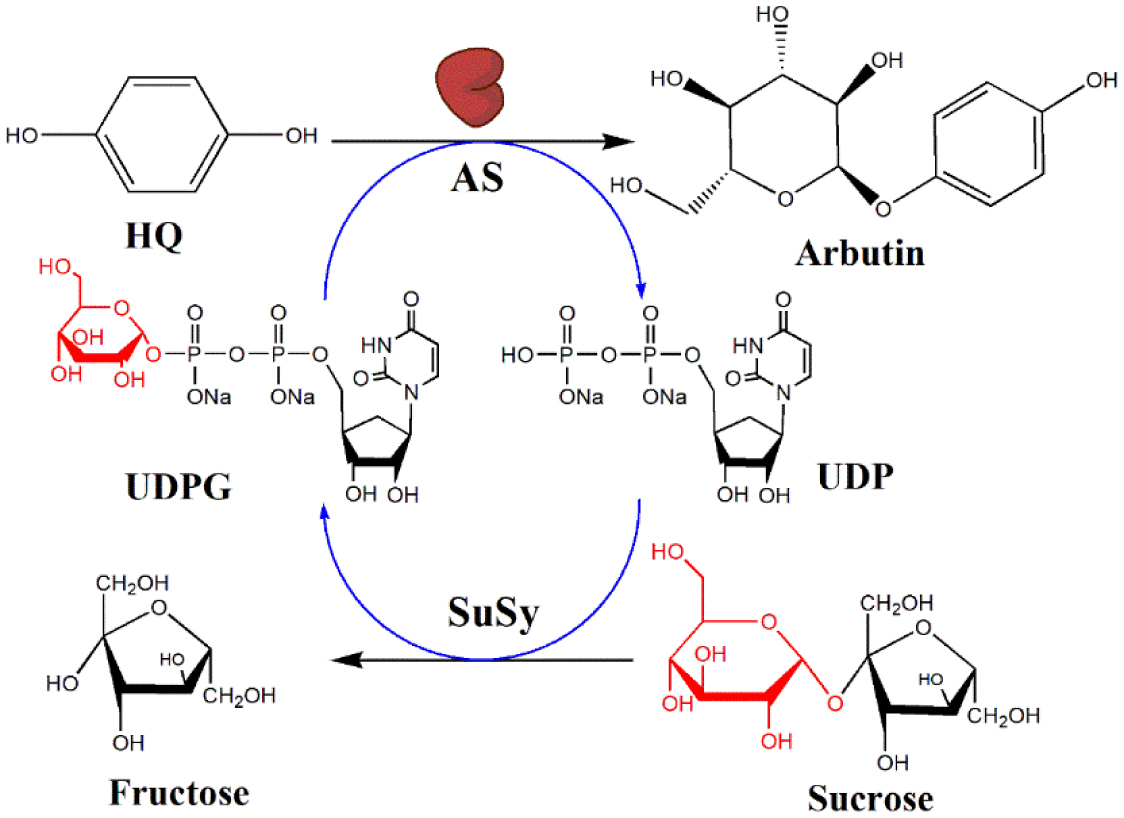
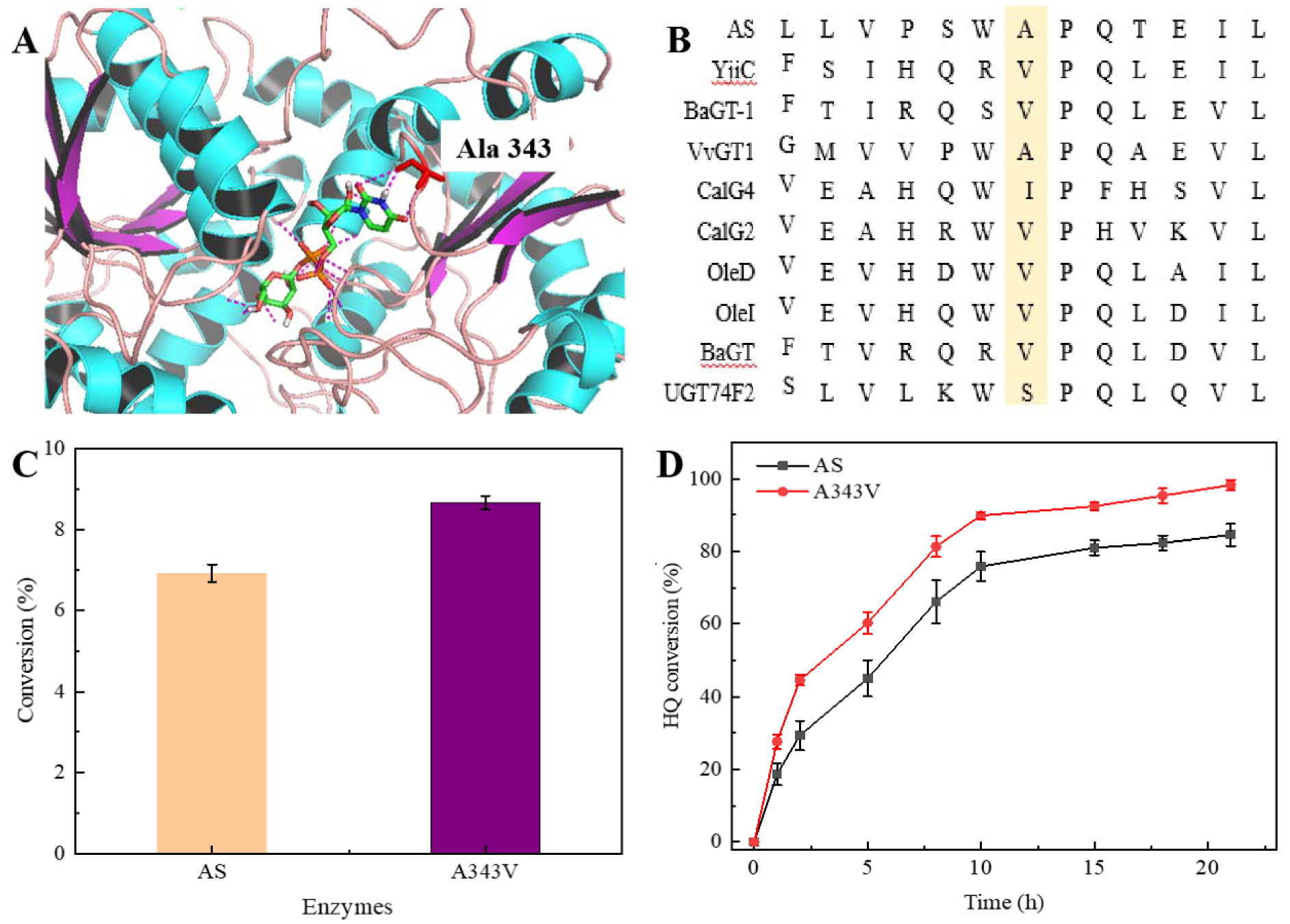
β-Arbutin is a widely used skin-lightening agent in the cosmetology industry. However, the high cost of uridine diphosphate glucose (UDPG) and the low activity of glycosyltransferase have limited its practical biosynthesis. In this study, we constructed a UDPG regeneration system using sucrose synthase (SuSy) to reduce UDPG consumption and enhanced glycosyltransferase efficiency through site-directed mutagenesis. The single-point mutant A343V increased the hydroquinone (HQ) conversion efficiency by 1.25-fold. Under optimized conditions, the β-arbutin yield reached 98%, and the in situ UDPG regeneration cycles reached 39 times. This work demonstrates that the bi-enzymatic cascade reaction with UDPG regeneration and enzyme engineering provides an efficient and environmentally friendly method for β-arbutin biosynthesis.
Citation: Jinyuan Yan, Xi'neng Hou, Minghai Han, Yanying Zhu, Mingjing He, Caixia Cui. Biosynthesis of β-Arbutin via In Situ UDPG regeneration and glycosyltransferase engineering[J]. AIMS Bioengineering, 2026, 13(4): 522-534. doi: 10.3934/bioeng.2026025
β-Arbutin is a widely used skin-lightening agent in the cosmetology industry. However, the high cost of uridine diphosphate glucose (UDPG) and the low activity of glycosyltransferase have limited its practical biosynthesis. In this study, we constructed a UDPG regeneration system using sucrose synthase (SuSy) to reduce UDPG consumption and enhanced glycosyltransferase efficiency through site-directed mutagenesis. The single-point mutant A343V increased the hydroquinone (HQ) conversion efficiency by 1.25-fold. Under optimized conditions, the β-arbutin yield reached 98%, and the in situ UDPG regeneration cycles reached 39 times. This work demonstrates that the bi-enzymatic cascade reaction with UDPG regeneration and enzyme engineering provides an efficient and environmentally friendly method for β-arbutin biosynthesis.

This work was supported by the Changdu Natural Science Foundation (CDKJ-ZRKXJJ2026005) and the Natural Science Foundation of Tibet Autonomous Region (XZ202601ZR0067).
The authors declare no conflict of interest.
Jinyuan Yan: Project administration, Xi'neng Hou: Data curation, Minghai Han: Data curation, Yanying Zhu: Data curation, Mingjing He: Data curation and Caixia Cui: Project administration, Writing – review & editing, Supervision. All authors read and approved the final version of the manuscript.
| [1] |
Migas P, Krauze-Baranowska M (2015) The significance of arbutin and its derivatives in therapy and cosmetics. Phytochem Lett 13: 35-40. https://doi.org/10.1016/j.phytol.2015.05.015 
|
| [2] |
Boo YC (2021) Arbutin as a skin depigmenting agent with antimelanogenic and antioxidant properties. Antioxidants 10: 1129. https://doi.org/10.3390/antiox10071129
|
| [3] |
Mishra P, Ahsan F, Mahmood T, et al. (2026) Arbutin—a hydroquinone glycoside: journey from food supplement to cutting-edge medicine. Chin J Integr Med 32: 746-756. https://doi.org/10.1007/s11655-025-3827-8
|
| [4] |
Kajiwara R, Seto A, Kofujita H, et al. (2019) Enhanced antimicrobial activities of polymerized arbutin and its derivatives prepared by oxidative polymerization of arbutin. React Funct Polym 138: 39-45. https://doi.org/10.1016/j.reactfunctpolym.2019.02.008
|
| [5] |
Saeedi M, Khezri K, Seyed Zakaryaei A, et al. (2021) A comprehensive review of the therapeutic potential of α-arbutin. Phytother Res 35: 4136-4154. https://doi.org/10.1002/ptr.7076
|
| [6] |
Qiu KH, Wang YJ, Cheng KL, et al. (2025) Preparation, characterization and analysis of anthocyanin arbutin co-amorphous complexes and evaluation of the inhibition of tyrosinase. Int J Biol Macromol 311: 143600. https://doi.org/10.1016/j.ijbiomac.2025.143600
|
| [7] |
Seo DH, Jung JH, Ha SJ, et al. (2012) High-yield enzymatic bioconversion of hydroquinone to α-arbutin, a powerful skin lightening agent, by amylosucrase. Appl Microbiol Biotechnol 94: 1189-1197. https://doi.org/10.1007/s00253-012-3905-7
|
| [8] |
Zhu X, Tian Y, Zhang W, et al. (2018) Recent progress on biological production of α-arbutin. Appl Microbiol Biotechnol 102: 8145-8152. https://doi.org/10.1007/s00253-018-9241-9
|
| [9] |
Schmidt RR (1986) New methods for the synthesis of glycosides and oligosaccharides—are there alternatives to the Koenigs-Knorr method?. Angew Chem Int Ed Engl 25: 212-235. https://doi.org/10.1002/anie.198602121
|
| [10] |
Zhou H, Zhao J, Li A, et al. (2019) Chemical and biocatalytic routes to arbutin. Molecules 24: 3303-3311. https://doi.org/10.3390/molecules24183303
|
| [11] |
Wang ZX, Shi XX, Chen GR, et al. (2006) A new synthesis of α-arbutin via Lewis acid catalyzed selective glycosylation of tetra-O-benzyl-α-d-glucopyranosyl trichloroacetimidate with hydroquinone. Carbohydr Res 341: 1945-1947. https://doi.org/10.1016/j.carres.2006.04.022
|
| [12] | Wang S, Fu C, Bilal M, et al. (2018) Enhanced biosynthesis of arbutin by engineering shikimate pathway in Pseudomonas chlororaphis P3. Microb Cell Fact 17: 1-14. https://doi.org/10.1186/s12934-018-1022-8 |
| [13] |
Nidetzky B, Gutmann A, Zhong C (2018) Leloir glycosyltransferases as biocatalysts for chemical production. ACS Catal 8: 6283-6300. https://doi.org/10.1021/acscatal.8b00710
|
| [14] | Zhang Y, Xu S, Jin Y, et al. (2020) Efficient biocatalytic preparation of rebaudioside KA: highly selective glycosylation coupled with UDPG regeneration. Sci Rep 10: 1-9. https://doi.org/10.1038/s41598-020-63379-9 |
| [15] |
Zhao M, Lai D, Jia X, et al. (2025) UDP-Glycosyltransferases Engineering Coupled with UDPG Regeneration Facilitate the Efficient Conversion of Mogroside V. J Agric Food Chem 73: 5341-5352. https://doi.org/10.1021/acs.jafc.4c11011
|
| [16] |
Chen T, Chen Z, Wang N, et al. (2021) Highly Regioselective and Efficient Biosynthesis of Polydatin by an Engineered UGTBL1-At SuSy Cascade Reaction. J Agric Food Chem 69: 8695-8702. https://doi.org/10.1021/acs.jafc.1c02518
|
| [17] |
Zhang C, Griffith BR, Fu Q, et al. (2006) Exploiting the reversibility of natural product glycosyltransferase-catalyzed reactions. Science 313: 1291-1294. https://doi.org/10.1126/science.1130028
|
| [18] |
Schmölzer K, Gutmann A, Diricks M, et al. (2016) Sucrose synthase: A unique glycosyltransferase for biocatalytic glycosylation process development. Biotechnol Adv 34: 88-111. https://doi.org/10.1016/j.biotechadv.2015.11.003
|
| [19] |
Baroja-Fernández E, Muñoz FJ, Li J, et al. (2012) Sucrose synthase activity in the sus1/sus2/sus3/sus4 Arabidopsis mutant is sufficient to support normal cellulose and starch production. Proc Natl Acad Sci USA 109: 321-326. https://doi.org/10.1073/pnas.1117099109
|
| [20] |
Hu Y, Xue J, Min J, et al. (2020) Biocatalytic synthesis of ginsenoside Rh2 using Arabidopsis thaliana glucosyltransferase-catalyzed coupled reactions. J Biotechnol 309: 107-112. https://doi.org/10.1016/j.jbiotec.2020.01.003
|
| [21] |
Sun P, Cai R, Chen L, et al. (2020) Natural product glycosylation: biocatalytic synthesis of quercetin-3, 4′-O-diglucoside. Appl Biochem Biotechnol 190: 464-474. https://doi.org/10.1007/s12010-019-03103-0
|
| [22] |
Liu S, Lyu Y, Yu S, et al. (2021) Efficient production of orientin and vitexin from luteolin and apigenin using coupled catalysis of glycosyltransferase and sucrose synthase. J Agric Food Chem 69: 6578-6587. https://doi.org/10.1021/acs.jafc.1c00602
|
| [23] | Zhang Z, Wang X, Sha X, et al. (2025) Biosynthesis of gastrodin via multi-module UDPG supply and site-directed mutagenesis of glycosyltransferase in Escherichia coli. Mol Catal 578: 114953-114959. https://doi.org/10.1016/j.mcat.2025.114953 |
| [24] |
An N, Zhou S, Chen X, et al. (2023) High-yield production of β-arbutin by identifying and eliminating byproducts formation. Appl Microbiol Biotechnol 107: 6193-6204. https://doi.org/10.1007/s00253-023-12706-x
|
| [25] |
Shang Y, Wei W, Zhang P, et al. (2020) Engineering Yarrowia lipolytica for enhanced production of arbutin. J Agric Food Chem 68: 1364-1372. https://doi.org/10.1021/acs.jafc.9b07151
|
| [26] |
Yang J, Yang L, Zhao F, et al. (2024) De novo biosynthesis of β-Arbutin in Komagataella phaffii based on metabolic engineering strategies. Microb Cell Fact 23: 261. https://doi.org/10.1186/s12934-024-02525-8
|
| [27] |
Zhang B, Gou K, Xu K, et al. (2024) De novo biosynthesis of β-arbutin in Corynebacterium glutamicum via pathway engineering and process optimization. Biotechnol Biofuels 17: 88. https://doi.org/10.1186/s13068-024-02540-2
|
| [28] |
Cui C, Kong M, Wang Y, et al. (2021) Characterization of polyphosphate kinases for the synthesis of GSH with ATP regeneration from AMP. Enzyme Microb Technol 149: 109853-109859. https://doi.org/10.1016/j.enzmictec.2021.109853
|
| [29] |
Bradford MM (1976) A rapid and sensitive method for the quantitation of microgram quantities of protein utilizing the principle of protein-dye binding. Anal Biochem 72: 248-254. https://doi.org/10.1016/0003-2697(76)90527-3
|
| [30] |
Ni J, Gao YY, Tao F, et al. (2018) Temperature-directed biocatalysis for the sustainable production of aromatic aldehydes or alcohols. Angew Chem Int Ed 57: 1214-1217. https://doi.org/10.1002/anie.201710793
|
| [31] |
Wang Y, Chen L, Li Y, et al. (2016) Efficient enzymatic production of rebaudioside A from stevioside. Biosci Biotechnol Biochem 80: 67-73. https://doi.org/10.1080/09168451.2015.1072457
|
| [32] |
Terasaka K, Mizutani Y, Nagatsu A, et al. (2012) In situ UDP-glucose regeneration unravels diverse functions of plant secondary product glycosyltransferases. FEBS Lett 586: 4344-4350. https://doi.org/10.1016/j.febslet.2012.10.045
|
| [33] |
Bandi CK, Goncalves A, Pingali SV, et al. (2020) Carbohydrate-binding domains facilitate efficient oligosaccharides synthesis by enhancing mutant catalytic domain transglycosylation activity. Biotechnol Bioeng 117: 2944-2956. https://doi.org/10.1002/bit.27473
|
| [34] |
Cui C, Yan J, Liu Y, et al. (2023) One-pot biosynthesis of gastrodin using UDP-glycosyltransferase itUGT2 with an in situ UDP-glucose recycling system. Enzyme Microb Technol 166: 110226-110233. https://doi.org/10.1016/j.enzmictec.2023.110226
|
| [35] |
De Bruyn F, Maertens J, Beauprez J, et al. (2015) Biotechnological advances in UDP-sugar based glycosylation of small molecules. Biotechnol Adv 33: 288-302. https://doi.org/10.1016/j.biotechadv.2015.02.005
|
 bioeng-13-04-025-s001.pdf |
 |
Figures(5) / Tables(1)

Jinyuan Yan, Xi'neng Hou, Minghai Han, Yanying Zhu, Mingjing He, Caixia Cui. Biosynthesis of β-Arbutin via In Situ UDPG regeneration and glycosyltransferase engineering[J]. AIMS Bioengineering, 2026, 13(4): 522-534. doi: 10.3934/bioeng.2026025




 DownLoad: