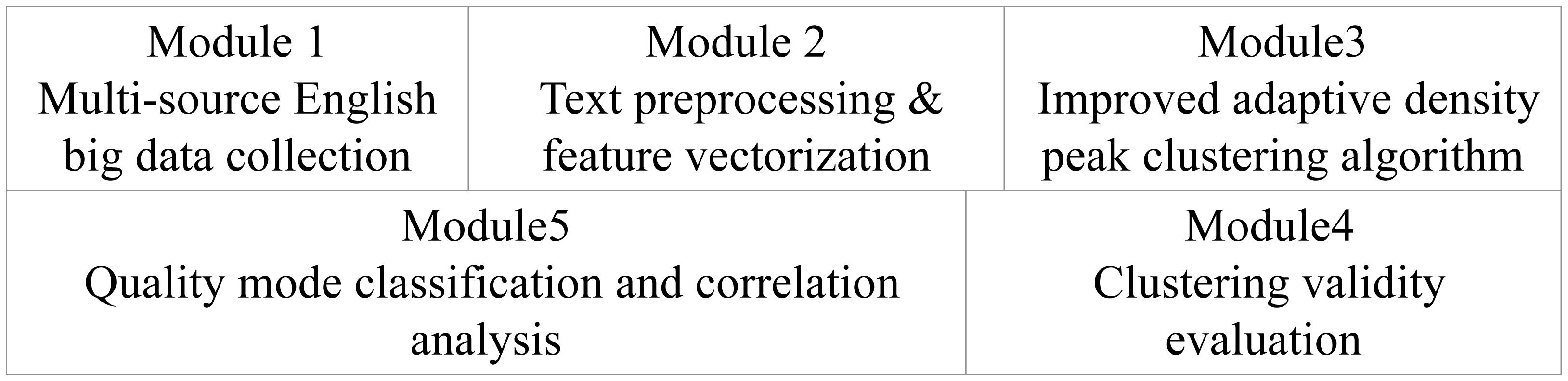
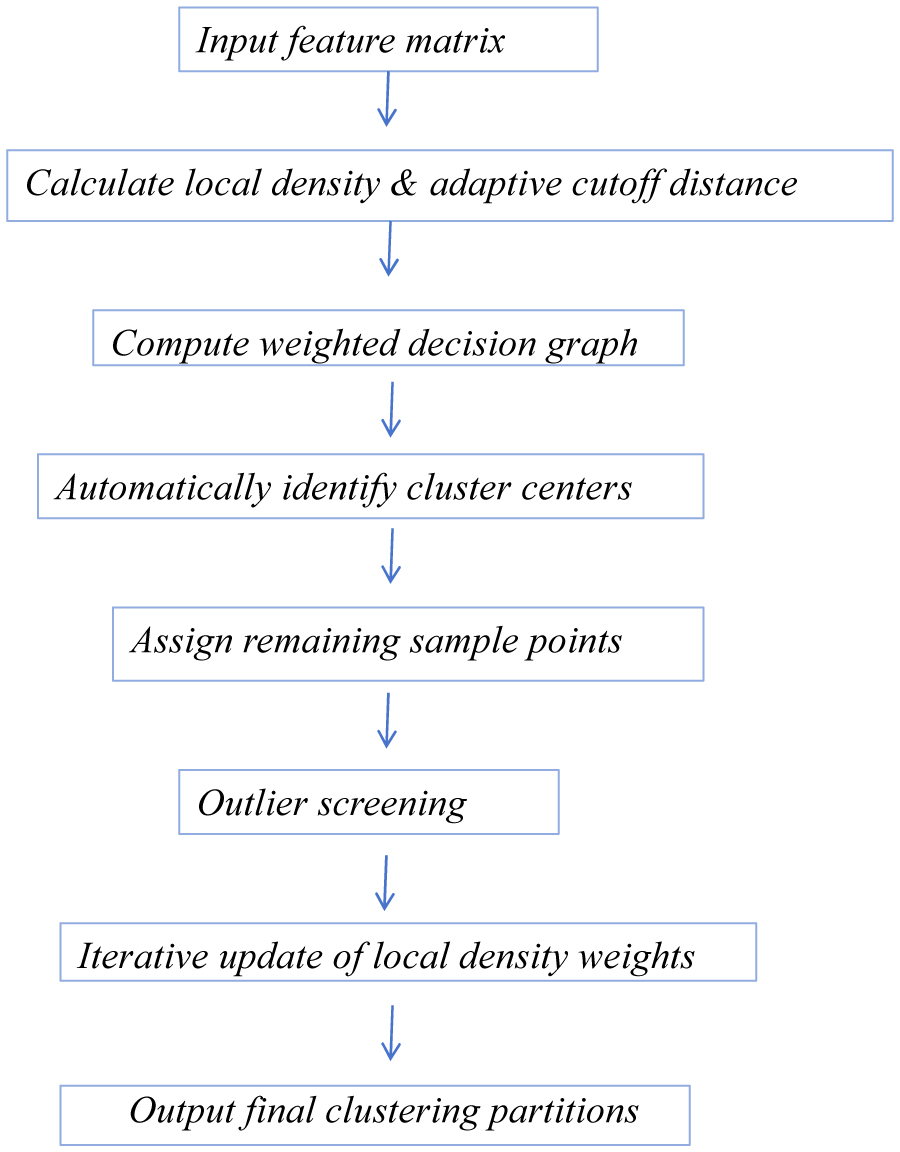
Biomanufacturing is a multi-stage, strongly coupled production process involving microbial fermentation, cell culture, purification, and formulation. Massive heterogeneous process data, including temperature, pH, dissolved oxygen, biomass concentration, and product purity, are continuously generated during production. To tackle the above challenge, this study proposes an adaptive kernel-bandwidth-optimized density peak clustering algorithm (AKB-DPC) for intelligent clustering of biomanufacturing quality-monitoring big data. First, we build a multi-source bioprocess preprocessing pipeline. It supports missing-value imputation, outlier filtering, and standardized normalization for time-dependent process variables. Second, conventional density peak clustering (DPC) requires manual kernel-bandwidth tuning and yields unsatisfactory results for non-spherical, overlapping bioprocess datasets. We adopt an adaptive kernel-bandwidth strategy to dynamically compute local density based on sample spatial distribution. A new criterion for cluster-center selection is further developed to mitigate misclassification of boundary and noise points. Third, the proposed AKB-DPC algorithm is validated using real bioreactor fermentation batch datasets. Clustering metrics including silhouette coefficient, Davies–Bouldin index, and Calinski–Harabasz index are compared with k-means, Gaussian mixture model (GMM), original DPC, and DBSCAN algorithms. The results showed that AKB-DPC achieves a silhouette coefficient of 0.842 and a Davies–Bouldin index of 0.316, outperforming contrast clustering methods. The algorithm can automatically divide production batches into normal quality, early warning anomaly, and severe abnormal clusters. In the early fermentation stage, the clustering model can detect potential quality deviation 4.2 h earlier than conventional threshold monitoring. This research provides an intelligent data mining approach for real-time quality perception, batch classification, and anomaly early warning in biomanufacturing and supports the implementation of digital twin and quality by design (QbD) in bioprocess engineering.
Citation: Pei Yue. Research on intelligent clustering algorithms for big data from English literature in bio-manufacturing quality monitoring[J]. AIMS Bioengineering, 2026, 13(4): 504-521. doi: 10.3934/bioeng.2026024
Biomanufacturing is a multi-stage, strongly coupled production process involving microbial fermentation, cell culture, purification, and formulation. Massive heterogeneous process data, including temperature, pH, dissolved oxygen, biomass concentration, and product purity, are continuously generated during production. To tackle the above challenge, this study proposes an adaptive kernel-bandwidth-optimized density peak clustering algorithm (AKB-DPC) for intelligent clustering of biomanufacturing quality-monitoring big data. First, we build a multi-source bioprocess preprocessing pipeline. It supports missing-value imputation, outlier filtering, and standardized normalization for time-dependent process variables. Second, conventional density peak clustering (DPC) requires manual kernel-bandwidth tuning and yields unsatisfactory results for non-spherical, overlapping bioprocess datasets. We adopt an adaptive kernel-bandwidth strategy to dynamically compute local density based on sample spatial distribution. A new criterion for cluster-center selection is further developed to mitigate misclassification of boundary and noise points. Third, the proposed AKB-DPC algorithm is validated using real bioreactor fermentation batch datasets. Clustering metrics including silhouette coefficient, Davies–Bouldin index, and Calinski–Harabasz index are compared with k-means, Gaussian mixture model (GMM), original DPC, and DBSCAN algorithms. The results showed that AKB-DPC achieves a silhouette coefficient of 0.842 and a Davies–Bouldin index of 0.316, outperforming contrast clustering methods. The algorithm can automatically divide production batches into normal quality, early warning anomaly, and severe abnormal clusters. In the early fermentation stage, the clustering model can detect potential quality deviation 4.2 h earlier than conventional threshold monitoring. This research provides an intelligent data mining approach for real-time quality perception, batch classification, and anomaly early warning in biomanufacturing and supports the implementation of digital twin and quality by design (QbD) in bioprocess engineering.

No external funding was received for this study. The authors thank the editors and reviewers for their valuable comments and suggestions to improve the quality of this manuscript.
The author declares no conflict of interest.
Pei Yue designed the research framework, completed the manuscript writing and revision, and approved the final published version of the paper.
| [1] |
Wada ZO, McKay G, Ansari AT, et al. (2026) AI-driven biochar engineering for emerging pollutants removal from water: performance, mechanisms, and environmental perspectives. Biochar 8: 61. https://doi.org/10.1007/s42773-025-00565-w 
|
| [2] | Yan C, Pan Y, Tian Y, et al. (2026) Bioactive hydrogels for bone tissue engineering: design strategies, bioactive cargo delivery, and artificial intelligence-assisted clinical translation. Asian J Pharm Sci 21: 101188-101188. https://doi.org/10.1016/j.ajps.2026.101188 |
| [3] |
Chen J, Singh N, Lu J, et al. (2025) Artificial intelligence-powered biofoundries for protein engineering and metabolic engineering. Curr Opin Biotechnol 96: 103380. https://doi.org/10.1016/j.copbio.2025.103380
|
| [4] |
Singh J, Bhathal SG (2026) Artificial intelligence in biological cell engineering: future directions and transformative potential. J Res Sci Eng 8: 79-80. https://doi.org/10.53469/jrse.2026.08(03).16
|
| [5] |
Yuan X, Fan L, Jin H, et al. (2025) Phage engineering using synthetic biology and artificial intelligence to enhance phage applications in food industry. Curr Opin Food Sci 62: 101274. https://doi.org/10.1016/j.cofs.2025.101274
|
| [6] |
Berhanu A, Afzal M, Xian Y, et al. (2026) Engineering programmable floating wetlands: synthetic biology, sensing, and AI control for water quality. Bioresour Technol 462: 135561. https://doi.org/10.1016/j.biortech.2026.135561
|
| [7] |
Subramanian P, Thandarvalli V, Thashanamoorthi G, et al. (2023) Artificial intelligence-driven systems engineering for next-generation plant-derived biopharmaceuticals. Front Plant Sci 14: 1252166. https://doi.org/10.3389/fpls.2023.1252166
|
| [8] |
Priti K, Chandra H, Sagar K (2026) Microbial lipases: advances in metagenomics and artificial intelligence for enzyme discovery and engineering. Arch Microbiol 208: 553. https://doi.org/10.1007/s00203-026-05074-3
|
| [9] |
Niyazi S (2026) Global advances in biohydrogen production: a systematic review synergizing nanotechnology, genetic engineering, and AI for sustainable energy. Int J Hydrogen Energy 249: 156073. https://doi.org/10.1016/j.ijhydene.2026.156073
|
| [10] | Bukke NPS, Thalluri C, Vasam M, et al. (2026) Engineering innovations for precision medicine: sensors, AI biomarkers, and predictive interventions. Pers Med 23: 1-16. https://doi.org/10.1080/17410541.2026.2715371 |
| [11] |
Ma A, Yang Z, He Q, et al. (2026) Bioinformatics and AI in dental biomaterials: applications in drug delivery for tissue engineering. Translational Dental Research 2: 100067. https://doi.org/10.1016/j.tdr.2026.100067
|
| [12] |
Tripathi V, Singh S, Srivastava P, et al. (2026) From metabolic burden to distributed function: AI-guided engineering of microbial consortia for industrial and hazardous waste remediation. J Environ Chem Eng 14: 125027. https://doi.org/10.1016/j.jece.2026.125027
|
| [13] |
Huang R, Huang J, Tan P, et al. (2026) Artificial intelligence-guided engineering of a thermostable cellulase cocktail enables efficient biomass hydrolysis at elevated temperatures. Bioresour Technol 461: 135430. https://doi.org/10.1016/j.biortech.2026.135430
|
| [14] |
Sui K, Zhang X, Wang Z (2026) AI-enhanced 3D bioprinting innovations and challenges in bone marrow organoid engineering. Cell Invest 2: 100075. https://doi.org/10.1016/j.clnves.2026.100075
|
| [15] |
Adege BA (2025) Advancing biomedical engineering with artificial intelligence and machine learning: a systematic review. Int J Clin Pract 2025: 9888902. https://doi.org/10.1155/ijcp/9888902
|
| [16] |
Guo Q, Kong C, Zhang J, et al. (2026) Plant synthetic biology: from modular design to artificial intelligence-driven engineering. Model Org Res 1: 100008. https://doi.org/10.1016/j.mores.2026.100008
|
| [17] |
Cha Z, Xiang T, Wu S, et al. (2026) Molecular engineering of CRISPR biosensors: from rational design to AI acceleration. Chem Eng J 548: 181836. https://doi.org/10.1016/j.cej.2026.181836
|
| [18] |
Wani KA, Bashir MS, Elboughdiri N, et al. (2026) Food metagenomics integrated with multi-Omics and AI: functional insights, microbiome engineering and predictive bioprocessing for sustainable food preservation. Trends Food Sci Technol 169: 105566. https://doi.org/10.1016/j.tifs.2026.105566
|
| [19] |
Singh PR, Singh KP, Kumar I, et al. (2026) Sustainable bioenergy from microalgal lipid remodeling: an AI and genetic engineering approach for the circular economy. Energy Strateg Rev 64: 102050. https://doi.org/10.1016/j.esr.2026.102050
|
| [20] |
Cochrane RR, Santos DVL, Cai Y (2026) The convergence of AI-driven engineering biology and emerging technologies advancing globally networked autonomous biofoundries. Curr Opin Biotechnol 99: 103503. https://doi.org/10.1016/j.copbio.2026.103503
|
Figures(2) / Tables(8)

Pei Yue. Research on intelligent clustering algorithms for big data from English literature in bio-manufacturing quality monitoring[J]. AIMS Bioengineering, 2026, 13(4): 504-521. doi: 10.3934/bioeng.2026024




 DownLoad: