At present, there are few studies that systematically investigate the coordinated changes in the kinematics, dynamics, and overall stability control of multiple joints in the lower limbs under the fatigue program of badminton. This paper aimed to explore the effects of intense exercise on the left and right lunges of badminton players.
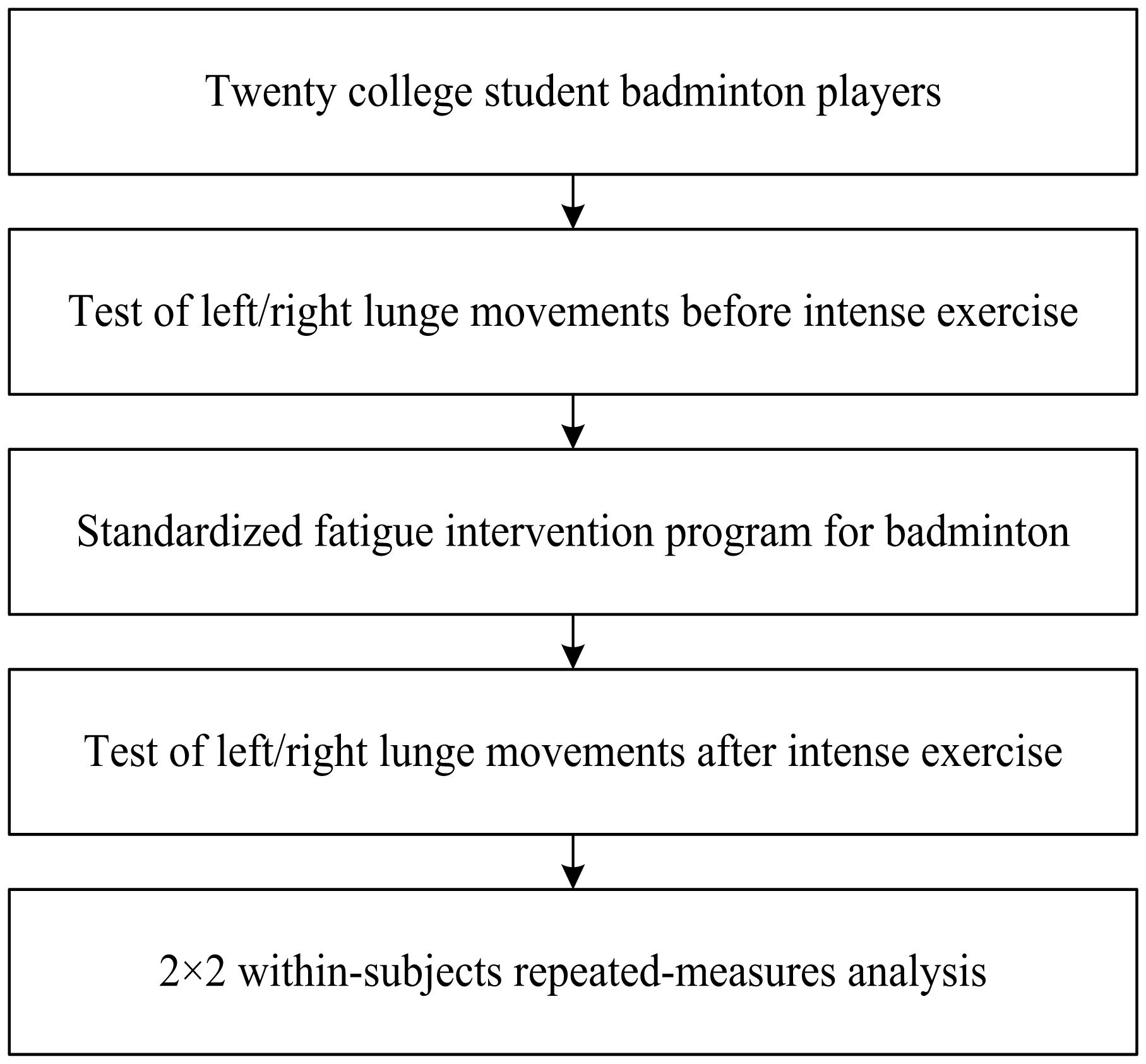
Twenty badminton players from Shandong University of Political Science and Law completed three left lunge movements and three right lunge movements before and after intense exercise, with the right lower limb as the unified support under all conditions. Kinematic and dynamic data were collected simultaneously for two-factor repeated-measures analysis of variance (intense exercise × lunge direction) in SPSS 23.0.
The main effect of the lunge direction and the interaction effect of movement × direction did not reach statistical significance (p > 0.05) for all joint angles and torque indicators, indicating that the fatigue effect of intense exercise is consistent under left and right lunge conditions. Regarding the main effect of movement, the hip flexion angle significantly decreased (p = 0.024), and the hip adduction and external rotation both increased (p = 0.008, p = 0.021); the knee internal rotation increased (p = 0.017); the ankle eversion increased (p = 0.034); the hip extension torque (p = 0.018) and adduction torque (p = 0.015), the knee flexion torque (p = 0.016) and adduction torque (p = 0.012), and the ankle inversion torque (p = 0.021) all significantly decreased. The anterior–posterior velocity of the body's center of mass (p = 0.005), the vertical displacement range (p = 0.014), and the margin of stability (p = 0.008) were all significantly reduced.
After intense exercise, the angles and torques of the lower limb joints of the subjects change. This may be associated with an increased risk of lower limb injuries under fatigue conditions, and it can provide a reference for the design of specialized gait training and injury prevention programs.
Citation: Xiaolong Li. Biomechanical analysis of lower limb movements of badminton players before and after intense exercise[J]. AIMS Bioengineering, 2026, 13(3): 418-432. doi: 10.3934/bioeng.2026020
At present, there are few studies that systematically investigate the coordinated changes in the kinematics, dynamics, and overall stability control of multiple joints in the lower limbs under the fatigue program of badminton. This paper aimed to explore the effects of intense exercise on the left and right lunges of badminton players.
Twenty badminton players from Shandong University of Political Science and Law completed three left lunge movements and three right lunge movements before and after intense exercise, with the right lower limb as the unified support under all conditions. Kinematic and dynamic data were collected simultaneously for two-factor repeated-measures analysis of variance (intense exercise × lunge direction) in SPSS 23.0.
The main effect of the lunge direction and the interaction effect of movement × direction did not reach statistical significance (p > 0.05) for all joint angles and torque indicators, indicating that the fatigue effect of intense exercise is consistent under left and right lunge conditions. Regarding the main effect of movement, the hip flexion angle significantly decreased (p = 0.024), and the hip adduction and external rotation both increased (p = 0.008, p = 0.021); the knee internal rotation increased (p = 0.017); the ankle eversion increased (p = 0.034); the hip extension torque (p = 0.018) and adduction torque (p = 0.015), the knee flexion torque (p = 0.016) and adduction torque (p = 0.012), and the ankle inversion torque (p = 0.021) all significantly decreased. The anterior–posterior velocity of the body's center of mass (p = 0.005), the vertical displacement range (p = 0.014), and the margin of stability (p = 0.008) were all significantly reduced.
After intense exercise, the angles and torques of the lower limb joints of the subjects change. This may be associated with an increased risk of lower limb injuries under fatigue conditions, and it can provide a reference for the design of specialized gait training and injury prevention programs.

| [1] | Wang R, Sheng Y, Lu H, et al. (2020) Isometric Mid-thigh pull correlates with power, sprint, agility and smash performance in junior female badminton players: 3768 Board #85 May 30 8:00 AM - 9:30 AM. Med Sci Sport Exer 52: 1030. https://doi.org/10.1249/01.mss.0000686800.60715.8b |
| [2] |
Kamalden TF, Gasibat Q (2020) Muscle imbalance in badminton athletes: preventive training programmes need to be designed. Sport Sci Health 17: 263-264. https://doi.org/10.1007/s11332-020-00700-z 
|
| [3] |
Tseng HJ, Lo HL, Lin YC, et al. (2021) Analyze the differential rates of anterior cruciate ligament injuries between men and women by biomechanical study of single-leg landing in badminton. Indian J Orthop 2021: 409-417. https://doi.org/10.1007/s43465-021-00421-6
|
| [4] |
Nutarelli S, Rocchi JE, Salerno M, et al. (2024) Higher eccentric hamstring muscle fatigue after participation in a soccer match in young female athletes. Sports Health 16: 903-912. https://doi.org/10.1177/19417381241230613
|
| [5] |
Xuan Q, Huang L, Gu W, et al. (2025) Twenty years of research on exercise-induced fatigue: a bibliometric analysis of hotspots, bursts, and research trends. Medicine 104: e41895. https://doi.org/10.1097/MD.0000000000041895
|
| [6] | Ihsan F, Nasrulloh A, Yuniana R (2023) Effectiveness of shadow training using badminton steps application in increasing footwork agility on badminton athlete. Sport Sci Health 13: 23. https://doi.org/10.7251/SSH2301023I |
| [7] |
Lam GWK, Wong WC, Lee CC (2020) Biomechanics of lower limb in badminton lunge: a systematic scoping review. PeerJ 8: e10300. https://doi.org/10.7717/peerj.10300
|
| [8] |
Valldecabres R, de Benito AM, Littler G, et al. (2018) An exploration of the effect of proprioceptive knee bracing on biomechanics during a badminton lunge to the net, and the implications to injury mechanisms. PeerJ 6: e6033. https://doi.org/10.7717/peerj.6033
|
| [9] | Huang L, Zhang Y, Gao S, et al. (2025) Effects of direction and gender on lower limb biomechanics during forward lunges in badminton players: a preliminary analysis. BMC Sports Sci Med R 17: 1-14. https://doi.org/10.1186/s13102-025-01299-9 |
| [10] |
Xie Z, Pan J, Liang H, et al. (2025) Impact of gender, lunge direction, and fatigue on the lower limb biomechanics in badminton lunges. PLoS One 20: e0327428. https://doi.org/10.1371/journal.pone.0327428
|
| [11] |
Du Y, Fan Y (2023) The effect of fatigue on postural control and biomechanical characteristic of lunge in badminton players. Bioengineering 10: 301. https://doi.org/10.3390/bioengineering10030301
|
| [12] |
Kimura Y, Ishibashi Y, Tsuda E, et al. (2010) Mechanisms for anterior cruciate ligament injuries inbadminton. Brit J Sport Med 44: 1124-1127. https://doi.org/10.1136/bjsm.2010.074153
|
| [13] | Huang T, Ruan M, Huang S, et al. (2024) Comparison of kinematics and joint moments calculations for lower limbs during gait using markerless and marker-based motion capture. Front Bioeng Biotech 12: 9. https://doi.org/10.3389/fbioe.2024.1280363 |
| [14] |
Winter DA (2009) Biomechanics and motor control of human movement. Hoboken, NJ: John Wiley & Sons.
|
| [15] |
Babayi M, Najafabadi SMM, Ashtiani MN, et al. (2023) General muscle fatigue changed joint regulations in static and dynamic balance. Acta Bioeng Biomech 25: 125-132. https://doi.org/10.37190/ABB-02293-2023-02
|
| [16] |
Apseloff NA, Hughes JD, Devitt BM, et al. (2025) Primary anterior cruciate ligament injury: extrinsic and intrinsic risk factors. J Am Acad. Orthop Sur 33: 693-702. https://doi.org/10.5435/JAAOS-D-24-00341
|
| [17] |
Xu Y, Yang Y, He S, et al. (2025) Running-induced fatigue influences lower extremity muscle synergy and related biomechanics. Gait Posture 119: 163-170. https://doi.org/10.1016/j.gaitpost.2025.03.008
|
| [18] |
Jiang H, Wan K, Mei Q, et al. (2025) Alterations of landing biomechanics from an inclined treadmill running-induced fatigue protocol. Acta Bioeng Biomech 27: 61-75. https://doi.org/10.37190/abb/209529
|
Figures(1) / Tables(15)

Xiaolong Li. Biomechanical analysis of lower limb movements of badminton players before and after intense exercise[J]. AIMS Bioengineering, 2026, 13(3): 418-432. doi: 10.3934/bioeng.2026020




 DownLoad: