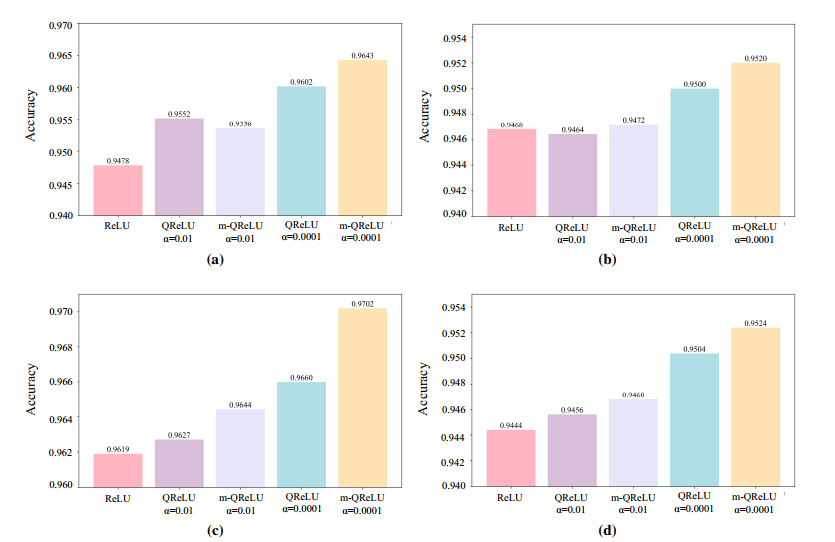
Image classification systems based on convolutional neural networks (CNNs) are frequently subject to noise interruption, and the robustness of CNNs is influenced by the selection of activation functions (AFs). In this paper, we improved the quantum AFs QReLU and m-QReLU, making the parameter value range $ 0.00001 \le \alpha \le 0.01 $. We investigated the classification performance and noise robustness of quantum AFs using the EfficientNetB0, DenseNet121, and 2D-CNN models on remote sensing datasets. The experimental results showed that when the quantum AFs parameter is 0.0001, the classification accuracy of the model is higher than that of the ReLU AF. Under UC Merced and WHU RS19 datasets, the classification accuracy of quantum AF increased by 0.52% and 1.65% in the EfficientNetB0 model, and increased by 0.8% and 0.83% in the DenseNet121 model. Under the India Pines dataset, the classification accuracy of quantum AF increased by 1.71%. Furthermore, we individually introduced noise to the remote sensing datasets to investigate the robustness of quantum AFs. The results showed that when the quantum AFs parameter is 0.0001, the model has strong noise robustness.
Citation: Minghui Yang, Jingli Ren. Quantum ReLU activation function for remote sensing classification and noise robustness analysis[J]. Big Data and Information Analytics, 2025, 9: 48-67. doi: 10.3934/bdia.2025003
Image classification systems based on convolutional neural networks (CNNs) are frequently subject to noise interruption, and the robustness of CNNs is influenced by the selection of activation functions (AFs). In this paper, we improved the quantum AFs QReLU and m-QReLU, making the parameter value range $ 0.00001 \le \alpha \le 0.01 $. We investigated the classification performance and noise robustness of quantum AFs using the EfficientNetB0, DenseNet121, and 2D-CNN models on remote sensing datasets. The experimental results showed that when the quantum AFs parameter is 0.0001, the classification accuracy of the model is higher than that of the ReLU AF. Under UC Merced and WHU RS19 datasets, the classification accuracy of quantum AF increased by 0.52% and 1.65% in the EfficientNetB0 model, and increased by 0.8% and 0.83% in the DenseNet121 model. Under the India Pines dataset, the classification accuracy of quantum AF increased by 1.71%. Furthermore, we individually introduced noise to the remote sensing datasets to investigate the robustness of quantum AFs. The results showed that when the quantum AFs parameter is 0.0001, the model has strong noise robustness.

| [1] |
Zhou W, Guan H, Li Z, Shao Z, Delavar MR, (2023) Remote sensing image retrieval in the past decade: Achievements, challenges, and future directions. IEEE J Sel Top Appl Earth Obs Remote Sens 16: 1447–1473. https://doi.org/10.1109/JSTARS.2023.3236662 doi: 10.1109/JSTARS.2023.3236662

|
| [2] |
Peng C, Li Y, Shang R, Jiao L, (2023) RSBNet: One-shot neural architecture search for a backbone network in remote sensing image recognition. Neurocomputing 537: 110–127. https://doi.org/10.1016/j.neucom.2023.03.046 doi: 10.1016/j.neucom.2023.03.046
|
| [3] |
Tejasree G, Agilandeeswari L, (2024) Land use/land cover (LULC) classification using deep-LSTM for hyperspectral images. Egypt J Remote Sens Space Sci 27: 52–68. https://doi.org/10.1016/j.ejrs.2024.01.004 doi: 10.1016/j.ejrs.2024.01.004
|
| [4] |
Zhao Z, Islam F, Waseem LA, Tariq A, Nawaz M, Ijaz UI, et al. (2024) Comparison of three machine learning algorithms using google earth engine for land use land cover classification. Rangel Ecol Manag 92: 129–137. https://doi.org/10.1016/j.rama.2023.10.007 doi: 10.1016/j.rama.2023.10.007
|
| [5] |
Duan C, Zheng X, Li R, Wu Z, (2024) Urban flood vulnerability knowledge-graph based on remote sensing and textual bimodal data fusion. J Hydrol 633: 131010. https://doi.org/10.1016/j.jhydrol.2024.131010 doi: 10.1016/j.jhydrol.2024.131010
|
| [6] |
Li H, Tian Y, Zhang C, Zhang S, Atkinson PM, (2022) Temporal sequence object-based CNN (TS-OCNN) for crop classification from fine resolution remote sensing image time-series. Crop J 10: 1507–1516. https://doi.org/10.1016/j.cj.2022.07.005 doi: 10.1016/j.cj.2022.07.005
|
| [7] |
Reis HC, Turk V, (2023) Detection of forest fire using deep convolutional neural networks with transfer learning approach. Appl Soft Comput 143: 110362. https://doi.org/10.1016/j.asoc.2023.110362 doi: 10.1016/j.asoc.2023.110362
|
| [8] |
Zhang S, Ma J, Zhang X, Guo C, (2023) Atmospheric remote sensing for anthropogenic methane emissions: Applications and research opportunities. Sci Total Environ 893: 164701. https://doi.org/10.1016/j.scitotenv.2023.164701 doi: 10.1016/j.scitotenv.2023.164701
|
| [9] |
Du Y, Song W, He Q, Huang D, Liotta A, Su C, (2019) Deep learning with multi-scale feature fusion in remote sensing for automatic oceanic eddy detection. Inform Fusion 49: 89–99. https://doi.org/10.1016/j.inffus.2018.09.006 doi: 10.1016/j.inffus.2018.09.006
|
| [10] |
Zhu XX, Tuia D, Mou L, Xia GS, Zhang L, Xu F, (2017) Deep learning in remote sensing: A comprehensive review and list of resources. IEEE Geosci Remote Sens Mag 5: 8–36. https://doi.org/10.1109/MGRS.2017.2762307 doi: 10.1109/MGRS.2017.2762307
|
| [11] |
Jozdani S, Chen D, Pouliot D, Johnson BA, (2022) A review and meta-analysis of generative adversarial networks and their applications in remote sensing. Int J Appl Earth Obs Geoinf 108: 102734. https://doi.org/10.1016/j.jag.2022.102734 doi: 10.1016/j.jag.2022.102734
|
| [12] |
Konar D, Sarma A D, Bhandary S, Bhattacharyya S, Cangi A, Aggarwal V, (2023) A shallow hybrid classical-quantum spiking feedforward neural network for noise-robust image classification. Appl Soft Comput 136: 110099. https://doi.org/10.1016/j.asoc.2023.110099 doi: 10.1016/j.asoc.2023.110099
|
| [13] |
Zhong Z, Li J, Luo Z, Chapman M, (2017) Spectral-spatial residual network for hyperspectral image classification: A 3-D deep learning framework. IEEE Trans Geosci Remote Sens 56: 847–858. https://doi.org/10.1109/TGRS.2017.2755542 doi: 10.1109/TGRS.2017.2755542
|
| [14] |
Roy SK, Krishna G, Dubey SR, Chaudhuri BB, (2019) HybridSN: Exploring 3-D-2-D CNN feature hierarchy for hyperspectral image classification. IEEE Geosci Remote Sens Lett 17: 277–281. https://doi.org/10.1109/LGRS.2019.2918719 doi: 10.1109/LGRS.2019.2918719
|
| [15] |
Naushad R, Kaur T, Ghaderpour E, (2021) Deep transfer learning for land use and land cover classification: A comparative study. Sens Basel 21: 8083. https://doi.org/10.3390/s21238083 doi: 10.3390/s21238083
|
| [16] |
Zhang H, Jiang Z, Zheng G, Yao X, (2023) Semantic segmentation of high-resolution remote sensing images with improved U-Net based on transfer learning. Int J Comput Int Sys 16: 181. https://doi.org/10.1007/s44196-023-00364-w doi: 10.1007/s44196-023-00364-w
|
| [17] |
Zhang Q, Xiao J, Tian C, Lin JCW, Zhang S, (2022) A robust deformed convolutional neural network (CNN) for image denoising. Caai T Intell Techno 8: 331–342. https://doi.org/10.1049/cit2.12110 doi: 10.1049/cit2.12110
|
| [18] |
Sagar ASMS, Chen Y, Xie YK, Kim HS, (2024) MSA R-CNN: A comprehensive approach to remote sensing object detection and scene understanding. Expert Syst Appl 241: 122788. https://doi.org/10.1016/j.eswa.2023.122788 doi: 10.1016/j.eswa.2023.122788
|
| [19] |
Kiliçarslan S, Celik M, (2021) RSigELU: A nonlinear activation function for deep neural networks. Expert Syst Appl 174: 114805. https://doi.org/10.1016/j.eswa.2021.114805 doi: 10.1016/j.eswa.2021.114805
|
| [20] |
Liew SS, Khalil-Hani M, Bakhteri R, (2016) Bounded activation functions for enhanced training stability of deep neural networks on visual pattern recognition problems. Neurocomputing 216: 718–734. https://doi.org/10.1016/j.neucom.2016.08.037 doi: 10.1016/j.neucom.2016.08.037
|
| [21] |
Shi S, Wang Z, Cui G, Wang S, Shang R, Li W, et al. (2022) Quantum-inspired complex convolutional neural networks. Appl Intell 52: 17912–17921. https://doi.org/10.1007/s10489-022-03525-0 doi: 10.1007/s10489-022-03525-0
|
| [22] |
Wang H, (2024) A novel feature selection method based on quantum support vector machine. Phys Scripta 99: 056006. https://doi.org/10.1088/1402-4896/ad36ef doi: 10.1088/1402-4896/ad36ef
|
| [23] |
Parisi L, Neagu D, Ma R, Campean F, (2022) Quantum ReLU activation for convolutional neural networks to improve diagnosis of Parkinson's disease and COVID-19. Expert Syst Appl 187: 115892. https://doi.org/10.1016/j.eswa.2021.115892 doi: 10.1016/j.eswa.2021.115892
|
| [24] |
Peral-García D, Cruz-Benito J, García-Peñalvo FJ, (2024) Systematic literature review: Quantum machine learning and its applications. Comput Sci Rev 51: 100619. https://doi.org/10.1016/j.cosrev.2024.100619 doi: 10.1016/j.cosrev.2024.100619
|
| [25] |
Konar D, Bhattacharyya S, Gandhi TK, Panigrahi BK, (2020) A quantum-inspired self-supervised network model for automatic segmentation of brain MR images. Appl Soft Comput 93: 106348. https://doi.org/10.1016/j.asoc.2020.106348 doi: 10.1016/j.asoc.2020.106348
|
| [26] |
Sheng G, Yang W, Xu T, Sun H, (2012) High-resolution satellite scene classification using a sparse coding based multiple feature combination. Int J Remote Sens 33: 2395–2412. https://doi.org/10.1080/01431161.2011.608740 doi: 10.1080/01431161.2011.608740
|
| [27] |
Zhu D, Xia S, Zhao J, Zhou Y, Jian M, Niu Q, et al. (2020) Diverse sample generation with multi-branch conditional generative adversarial network for remote sensing objects detection. Neurocomputing 381: 40–51. https://doi.org/10.1016/j.neucom.2019.10.065 doi: 10.1016/j.neucom.2019.10.065
|
| [28] |
Li C, Cong R, Guo C, Li H, Zhang C, Zheng F, et al. (2020) A parallel down-up fusion network for salient object detection in optical remote sensing images. Neurocomputing 415: 411–420. https://doi.org/10.1016/j.neucom.2020.05.108 doi: 10.1016/j.neucom.2020.05.108
|
| [29] |
Papoutsis I, Bountos N I, Zavras A, Michail D, Tryfonopoulos C, (2023) Benchmarking and scaling of deep learning models for land cover image classification. ISPRS J Photogramm Remote Sens 195: 250–268. https://doi.org/10.1016/j.isprsjprs.2022.11.012 doi: 10.1016/j.isprsjprs.2022.11.012
|
| [30] |
Bouguettaya A, Zarzour H, Taberkit AM, Kechida A, (2022) A review on early wildfire detection from unmanned aerial vehicles using deep learning-based computer vision algorithms. Signal Process 190: 108309. https://doi.org/10.1016/j.sigpro.2021.108309 doi: 10.1016/j.sigpro.2021.108309
|
| [31] |
Rajpurkar P, Park A, Irvin J, Chute C, Bereket M, Mastrodicasa D, et al. (2020) AppendiXNet: Deep learning for diagnosis of appendicitis from a small dataset of CT exams using video pretraining. Sci Rep 10: 3958. https://doi.org/10.1038/s41598-020-61055-6 doi: 10.1038/s41598-020-61055-6
|
| [32] |
Zhuang F, Qi Z, Duan K, Xi D, Zhu Y, Zhu H, et al. (2020) A comprehensive survey on transfer learning. Proc IEEE 109: 43–76. https://doi.org/10.1109/JPROC.2020.3004555 doi: 10.1109/JPROC.2020.3004555
|
Figures(12) / Tables(4)

Minghui Yang, Jingli Ren. Quantum ReLU activation function for remote sensing classification and noise robustness analysis[J]. Big Data and Information Analytics, 2025, 9: 48-67. doi: 10.3934/bdia.2025003






 DownLoad: