The rapid development of e-government has created new ways for governments to interact with their stakeholders, leading to much critical information in e-government systems being exposed to cybercrime. As a result, information security has become a critical issue that needs to be adequately addressed. Using a technology-organization-environment framework and institutional theory, we developed a conceptual framework of information security compliance in e-government. This framework was then revised based on a thematic analysis of the qualitative data collected using interviews from senior managers in public organizations. The study showed that organizational security culture, information security enforcement, technologies, and environments are the critical factors for effective information security compliance in e-government development. This study contributes to information security research by proposing an information security compliance framework to influence the adoption of information security compliance in e-government development.
Citation: Ahmed AlKalbani, Hepu Deng. Information security compliance for e-government development: A revised framework[J]. Applied Computing and Intelligence, 2026, 6(2): 223-244. doi: 10.3934/aci.2026013
The rapid development of e-government has created new ways for governments to interact with their stakeholders, leading to much critical information in e-government systems being exposed to cybercrime. As a result, information security has become a critical issue that needs to be adequately addressed. Using a technology-organization-environment framework and institutional theory, we developed a conceptual framework of information security compliance in e-government. This framework was then revised based on a thematic analysis of the qualitative data collected using interviews from senior managers in public organizations. The study showed that organizational security culture, information security enforcement, technologies, and environments are the critical factors for effective information security compliance in e-government development. This study contributes to information security research by proposing an information security compliance framework to influence the adoption of information security compliance in e-government development.

| [1] |
K. Karunasena, H. Deng, Critical factors for evaluating the public value of e-government in Sri Lanka, Gov. Inform. Q., 29 (2012), 76–84. https://doi.org/10.1016/j.giq.2011.04.005 doi: 10.1016/j.giq.2011.04.005
|
| [2] |
A. Almukhlifi, H. Deng, B. Kam, E-government adoption in Saudi Arabia: the moderation effect of Wastta, Proceedings of the International Conference on Information Resources Management, 2018, 9. |
| [3] |
P. Gupta, A. Hooda, A. Jeyaraj, J. J. Seddon, Y. K. Dwivedi, Trust, risk, privacy and security in e-government use: insights from a MASEM analysis, Inf. Syst. Front., 27 (2025), 1089–1105. https://doi.org/10.1007/s10796-024-10497-8 doi: 10.1007/s10796-024-10497-8
|
| [4] |
A. Alkalnani, H. Deng, B. Kam, A conceptual framework for information security in public organizations for e-government development, Proceedings of the 25th Australasian Conference on Information Systems, 2014, 1–11. |
| [5] |
A. Gafurov, F. Botirov, Information security requirements in monitoring e-government systems, Procedia Computer Science, 252 (2025), 424–429. https://doi.org/10.1016/j.procs.2025.01.001 doi: 10.1016/j.procs.2025.01.001
|
| [6] |
A. Alkalnani, H. Deng, B. Kam, X. Zhang, Investigating the impact of institutional pressures on information security compliance in organizations, Proceedings of the 27th Australasian Conference on Information Systems, 2016, 26. |
| [7] |
L. Magnusson, S. Iqbal, P. Elm, F. Dalipi, Information security governance in the public sector: investigations, approaches, measures, and trends, Int. J. Inf. Secur., 24 (2025), 177. https://doi.org/10.1007/s10207-025-01097-x doi: 10.1007/s10207-025-01097-x
|
| [8] |
S. Solms, Information security governance-compliance management vs operational management, Comput. Secur., 24 (2005), 443–447. https://doi.org/10.1016/j.cose.2005.07.003 doi: 10.1016/j.cose.2005.07.003
|
| [9] |
P. Li, H. Deng, S. Duan, A compliance-based framework for digital identity management in organizations, Proceedings of the Australian Conference on Information Systems, 2022, 76. |
| [10] |
M. Siponen, S. Pahnila, M. A. Mahmood, Compliance with information security policies: an empirical investigation, Computer, 43 (2010), 64–71. https://doi.org/10.1109/MC.2010.35 doi: 10.1109/MC.2010.35
|
| [11] |
E. Kolkowska, G. Dhillon, Organizational power and information security rule compliance, Comput. Secur., 33 (2013), 3–11. https://doi.org/10.1016/j.cose.2012.07.001 doi: 10.1016/j.cose.2012.07.001
|
| [12] |
M. Siponen, M. A. Mahmood, S. Pahnila, Employees' adherence to information security policies: an exploratory field study, Inform. Manage., 51 (2014), 217–224. https://doi.org/10.1016/j.im.2013.08.006 doi: 10.1016/j.im.2013.08.006
|
| [13] |
H. Cavusoglu, H. Cavusoglu, J. Y. Son, I. Benbasat, Institutional pressures in security management: direct and indirect influences on organizational investment in information security control resources, Inform. Manage., 52 (2015), 385–400. https://doi.org/10.1016/j.im.2014.12.004 doi: 10.1016/j.im.2014.12.004
|
| [14] |
M. A. Sasse, S. Brostoff, D. Weirich, Transforming the 'weakest link'—a human/computer interaction approach to usable and effective security, BT Technol. J., 19 (2001), 122–131. https://doi.org/10.1023/A:1011902718709 doi: 10.1023/A:1011902718709
|
| [15] |
S. M. Lee, S. G. Lee, S. Yoo, An integrative model of computer abuse based on social control and general deterrence theories, Inform. Manage., 41 (2004), 707–718. https://doi.org/10.1016/j.im.2003.08.008 doi: 10.1016/j.im.2003.08.008
|
| [16] |
B. Bulgurcu, H. Cavusoglu, I. Benbasat, Information security policy compliance: an empirical study of rationality-based beliefs and information security awareness, MIS Quart., 34 (2010), 523–548. https://doi.org/10.2307/25750690 doi: 10.2307/25750690
|
| [17] |
N. S. Safa, R. Von Solms, S. Furnell, Information security policy compliance model in organizations, Comput. Secur., 56 (2016), 70–82. https://doi.org/10.1016/j.cose.2015.10.006 doi: 10.1016/j.cose.2015.10.006
|
| [18] |
E. A. Abu-Shanab, E-government familiarity influence on Jordanians' perceptions, Telemat. Inform., 34 (2017), 103–113. https://doi.org/10.1016/j.tele.2016.05.001 doi: 10.1016/j.tele.2016.05.001
|
| [19] |
D. Zissis, D. Lekkas, Securing e-government and e-Voting with an open cloud computing architecture, Gov. Inform. Q., 28 (2011), 239–251. https://doi.org/10.1016/j.giq.2010.05.010 doi: 10.1016/j.giq.2010.05.010
|
| [20] |
C. J. Tolbert, K. Mossberger, The effects of e‐government on trust and confidence in government, Public Admin. Rev., 66 (2006), 354–369. https://doi.org/10.1111/j.1540-6210.2006.00594.x doi: 10.1111/j.1540-6210.2006.00594.x
|
| [21] |
W. A. Conklin, Barriers to adoption of e-government, Proceedings of the 40th Annual Hawaii International Conference on System Sciences, 2007, 98–98. https://doi.org/10.1109/HICSS.2007.102 |
| [22] |
S. Benabdallah, S. Gueniara El Fatmi, N. Oudriga, Security issues in e-government models: what governments should do? Proceedings of IEEE International Conference on Systems, Man and Cybernetics, 2002,398–403. https://doi.org/10.1109/ICSMC.2002.1173445 |
| [23] |
J. S. Burkett, Business security architecture: weaving information security into your organization's enterprise architecture through SABSA®, Inf. Secur. J., 21 (2012), 47–54. https://doi.org/10.1080/19393555.2011.629341 doi: 10.1080/19393555.2011.629341
|
| [24] |
Z. Ebrahim, Z. Irani, E-government adoption: architecture and barriers, Bus. Process Manag. J., 11 (2005), 589–611. https://doi.org/10.1108/14637150510619902 doi: 10.1108/14637150510619902
|
| [25] |
P. Ifinedo, Information systems security policy compliance: an empirical study of the effects of socialization, influence, and cognition, Inform. Manage., 51 (2014), 69–79. https://doi.org/10.1016/j.im.2013.10.001 doi: 10.1016/j.im.2013.10.001
|
| [26] |
T. Neubauer, M. Klemen, S. Biffl, Secure business process management: a roadmap, Proceedings of the First International Conference on Availability, Reliability and Security, 2006, 8. https://doi.org/10.1109/ARES.2006.121 |
| [27] |
T. Herath, H. R. Rao, Protection motivation and deterrence: a framework for security policy compliance in organizations, Eur. J. Inform. Syst., 18 (2009), 106–125. https://doi.org/10.1057/ejis.2009.6 doi: 10.1057/ejis.2009.6
|
| [28] |
S. Palvia, S. Sharma, E-government and e-governance: definitions/domain framework and status around the world, Proceedings of the International Conference on E-governance, 2007, 1–12. |
| [29] |
A. C. Johnston, M. Warkentin, Fear appeals and information security behaviors: an empirical study, MIS Quart., 34 (2010), 549–566. https://doi.org/10.2307/25750691 doi: 10.2307/25750691
|
| [30] |
R. M. Shaw, The influence of organizational culture on employee attitudes towards information security policy, Ph. D Thesis, Capella University, 2012. |
| [31] |
M. Chan, I. Woon, A. Kankanhalli, Perceptions of information security at the workplace: linking information security climate to compliant behavior, Journal of Information Privacy and Security, 1 (2005), 18–41. https://doi.org/10.1080/15536548.2005.10855772 doi: 10.1080/15536548.2005.10855772
|
| [32] |
S. M. Lee, S. G. Lee, S. Yoo, An integrative model of computer abuse based on social control and general deterrence theories, Inform. Manage., 41 (2004), 707–718. https://doi.org/10.1016/j.im.2003.08.008 doi: 10.1016/j.im.2003.08.008
|
| [33] |
L. Myyry, M. Siponen, S. Pahnila, T. Vartiainen, A. Vance, What levels of moral reasoning and values explain adherence to information security rules? An empirical study, Eur. J. Inf. Syst., 18 (2009), 126–139. https://doi.org/10.1057/ejis.2009.10 doi: 10.1057/ejis.2009.10
|
| [34] |
P. Puhakainen, M. Siponen, Improving employees' compliance through information systems security training: an action research study, MIS Quart., 34 (2010), 757–778. https://doi.org/10.2307/25750704 doi: 10.2307/25750704
|
| [35] |
M. T. Siponen, A conceptual foundation for organizational information security awareness, Information Management & Computer Security, 8 (2000), 31–41. https://doi.org/10.1108/09685220010371394 doi: 10.1108/09685220010371394
|
| [36] |
I. Ajzen, The theory of planned behavior, Organ. Behav. Hum. Dec., 50 (1991), 179–211. https://doi.org/10.1016/0749-5978(91)90020-T doi: 10.1016/0749-5978(91)90020-T
|
| [37] |
D. W. Straub, Effective IS security: an empirical study, Inform. Syst. Res., 1 (1990), 255–276. https://doi.org/10.1287/isre.1.3.255 doi: 10.1287/isre.1.3.255
|
| [38] |
H. Liang, Y. Xue, Understanding security behaviors in personal computer usage: a threat avoidance perspective, J. Assoc. Inf. Syst., 11 (2010), 394–413. https://doi.org/10.17705/1jais.00232 doi: 10.17705/1jais.00232
|
| [39] |
S. Smith, R. Jamieson, Determining key factors in e-government information system security, Inform. Syst. Manage., 23 (2006), 23–32. https://doi.org/10.1201/1078.10580530/45925.23.2.20060301/92671.4 doi: 10.1201/1078.10580530/45925.23.2.20060301/92671.4
|
| [40] |
A. Beautement, M. A. Sasse, M. Wonham, The compliance budget: managing security behavior in organizations, Proceedings of the 2008 New Security Paradigms Workshop, 2009, 47–58. https://doi.org/10.1145/1595676.1595684 |
| [41] |
M. Al-Busaidy, V. Weerakkody, E-government diffusion in Oman: a public sector employees' perspective, Transform. Gov. : People, 3 (2009), 375–393. https://doi.org/10.1108/17506160910997883 doi: 10.1108/17506160910997883
|
| [42] |
Q. Al-Mamari, B. Corbitt, V. O. Gekara, E-government adoption in Oman: motivating factors from a government perspective, Transform. Gov. : People, 7 (2013), 199–224. https://doi.org/10.1108/17506161311325369 doi: 10.1108/17506161311325369
|
| [43] |
L. G. Tornatzky, M. Fleischer, A. K. Chakrabarti, The processes of technological innovation, Lexington: Lexington Books, 1990. |
| [44] |
P. J. DiMaggio, W. W. Powell, The iron cage revisited: institutional isomorphism and collective rationality in organizational fields, Amer. Sociol. Rev., 48 (1983), 147–160. https://doi.org/10.2307/2095101 doi: 10.2307/2095101
|
| [45] |
M. Wimmer, B. Von Bredow, A holistic approach for providing security solutions in e-government, Proceedings of the 35th Annual Hawaii International Conference on System Sciences, 2002, 1715–1724. https://doi.org/10.1109/HICSS.2002.994083 |
| [46] |
D. P. Moynihan, Building secure elections: e‐voting, security, and systems theory, Public Admin. Rev., 64 (2004), 515–528. |
| [47] |
A. Kaliontzoglou, P. Sklavos, T. Karantjias, D. Polemi, A secure e-government platform architecture for small to medium sized public organizations, Electron. Commer. Res. Appl., 4 (2005), 174–186. https://doi.org/10.1016/j.elerap.2004.09.002 doi: 10.1016/j.elerap.2004.09.002
|
| [48] |
A. Beautement, M. A. Sasse, M. Wonham, The compliance budget: managing security behavior in organizations, Proceedings of the 2008 New Security Paradigms Workshop, 2009, 47–58. https://doi.org/10.1145/1595676.1595684 |
| [49] |
G. Karokola, L. Yngstrom, S. Kowalski, Secure e-government services: a comparative analysis of e-government maturity models for the developing regions-the need for security services, Int. J. Electron. Gov. Res., 8 (2012), 1–25. https://doi.org/10.4018/jegr.2012010101 doi: 10.4018/jegr.2012010101
|
| [50] |
A. McIlwraith, Information security and employee behavior: how to reduce risk through employee education, training and awareness, London: Routledge Publishing, 2021. https://doi.org/10.4324/9780429281785 |
| [51] |
J. L. Gibbs, K. L. Kraemer, A cross‐country investigation of the determinants of scope of e‐commerce use: an institutional approach, Electron. Mark., 14 (2004), 124–137. https://doi.org/10.1080/10196780410001675077 doi: 10.1080/10196780410001675077
|
| [52] |
A. Kankanhalli, H. H. Teo, B. C. Tan, K. K. Wei, An integrative study of information systems security effectiveness, Int. J. Inform. Manage., 23 (2003), 139–154. https://doi.org/10.1016/S0268-4012(02)00105-6 doi: 10.1016/S0268-4012(02)00105-6
|
| [53] |
H. Deng, K. Karunasena, W. Xu, Evaluating the performance of e-government in developing countries: a public value perspective, Internet Res., 28 (2018), 169–190. https://doi.org/10.1108/IntR-10-2016-0296 doi: 10.1108/IntR-10-2016-0296
|
| [54] |
S. E. Chang, C. B. Ho, Organizational factors to the effectiveness of implementing information security management, Ind. Manage. Data Syst., 106 (2006), 345–361. https://doi.org/10.1108/02635570610653498 doi: 10.1108/02635570610653498
|
| [55] |
L. Khansa, D. Liginlal, The influence of regulations on innovation in information security, Proceedings of the Americas Conference on Information Systems, 2007,180. |
| [56] |
Q. Hu, P. Hart, D. Cooke, The role of external and internal influences on information systems security–a neo-institutional perspective, J. Strategic Inf. Syst., 16 (2007), 153–172. https://doi.org/10.1016/j.jsis.2007.05.004 doi: 10.1016/j.jsis.2007.05.004
|
| [57] |
M. A. Delmas, M. W. Toffel, Organizational responses to environmental demands: opening the black box, Strategic Manage. J., 29 (2008), 1027–1055. https://doi.org/10.1002/smj.701 doi: 10.1002/smj.701
|
| [58] |
K. Knorr, S. Röhrig, Security requirements of e-business processes, In: Towards the e-society: e-commerce, e-business, and e-government, Boston: Springer, 2001, 72–86. https://doi.org/10.1007/0-306-47009-8_6 |
| [59] |
C. Vroom, R. Von Solms, Towards information security behavioral compliance, Comput. Secur., 23 (2004), 191–198. https://doi.org/10.1016/j.cose.2004.01.012 doi: 10.1016/j.cose.2004.01.012
|
| [60] |
M. Backes, B. Pfitzmann, M. Waidner, Security in business process engineering, In: Business process management, Berlin: Springer, 2003,168–183. https://doi.org/10.1007/3-540-44895-0_12 |
| [61] |
T. Neubauer, M. Klemen, S. Biffl, Secure business process management: a roadmap, Proceedings of First International Conference on Availability, Reliability and Security, 2006, 8. https://doi.org/10.1109/ARES.2006.121 |
| [62] |
P. J. Steinbart, R. L. Raschke, G. Gal, W. N. Dilla, The relationship between internal audit and information security: an exploratory investigation, Int. J. Account. Inf. Syst., 13 (2012), 228–243. https://doi.org/10.1016/j.accinf.2012.06.007 doi: 10.1016/j.accinf.2012.06.007
|
| [63] |
E. Kolkowska, G. Dhillon, Organizational power and information security rule compliance, Comput. Secur., 33 (2013), 3–11. https://doi.org/10.1016/j.cose.2012.07.001 doi: 10.1016/j.cose.2012.07.001
|
| [64] |
G. Guest, A. Bunce, L. Johnson, How many interviews are enough? An experiment with data saturation and variability, Field Method., 18 (2006), 59–82. https://doi.org/10.1177/1525822X05279903 doi: 10.1177/1525822X05279903
|
| [65] |
Information Technology Authority, Information technology authority annual report, The official government of Oman, 2013. Available from: https://prod.mtcit.gov.om/ITAPortal/Data/English/DocLibrary/FID2014625114411765/DJ504797_ITA_e.oman_Annual%20English%20Report%202013_FAW_For%20upload, %2002.06.2014.pdf. |
| [66] |
D. Howitt, Introduction to qualitative methods in psychology, New Jersey: Prentice Hall, 2010. |
| [67] |
M. Healy, C. Perry, Comprehensive criteria to judge validity and reliability of qualitative research within the realism paradigm, Qual. Mark. Res., 3 (2000), 118–126. https://doi.org/10.1108/13522750010333861 doi: 10.1108/13522750010333861
|
| [68] |
K. Karunasena, H. Deng, K. S. Harasgama, An investigation of the critical factors for evaluating the public value of e-government: a thematic analysis, In: Information systems and technology for organizations in a networked society, Hershey: IGI Global, 2013,213–233. https://doi.org/10.4018/978-1-4666-4062-7.ch012 |
| [69] |
M. B. Miles, A. M. Huberman, Qualitative data analysis: an expanded sourcebook, Thousand Oaks: Sage Publications, Inc., 1994. |
| [70] |
M. O. Alassafi, A. Alharthi, R. J. Walters, G. B. Wills, A framework for critical security factors that influence the decision of cloud adoption by Saudi government agencies, Telemat. Inform., 34 (2017), 996–1010. https://doi.org/10.1016/j.tele.2017.04.010 doi: 10.1016/j.tele.2017.04.010
|
| [71] |
J. L. Gómez-Barroso, Experiments on personal information disclosure: past and future avenues, Telemat. Inform., 35 (2018), 1473–1490. https://doi.org/10.1016/j.tele.2018.03.017 doi: 10.1016/j.tele.2018.03.017
|
| [72] |
M. S. Janita, F. J. Miranda, Quality in e-government services: a proposal of dimensions from the perspective of public sector employees, Telemat. Inform., 35 (2018), 457–469. https://doi.org/10.1016/j.tele.2018.01.004 doi: 10.1016/j.tele.2018.01.004
|
Figures(2) / Tables(3)
Ahmed AlKalbani, Hepu Deng. Information security compliance for e-government development: A revised framework[J]. Applied Computing and Intelligence, 2026, 6(2): 223-244. doi: 10.3934/aci.2026013

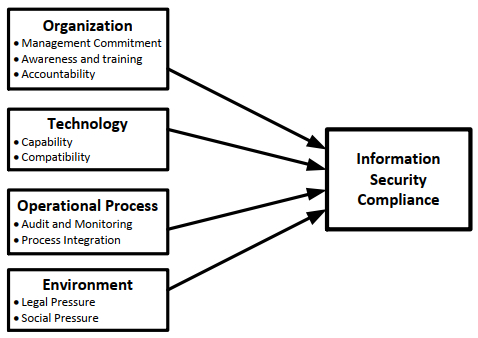
A framework for adopting information security compliance
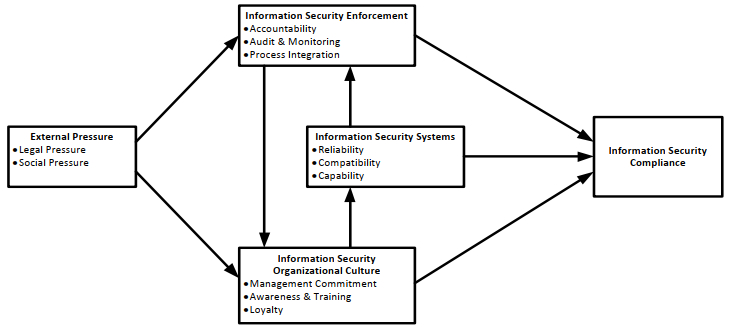
A Revised Information Security Compliance Framework




 DownLoad: