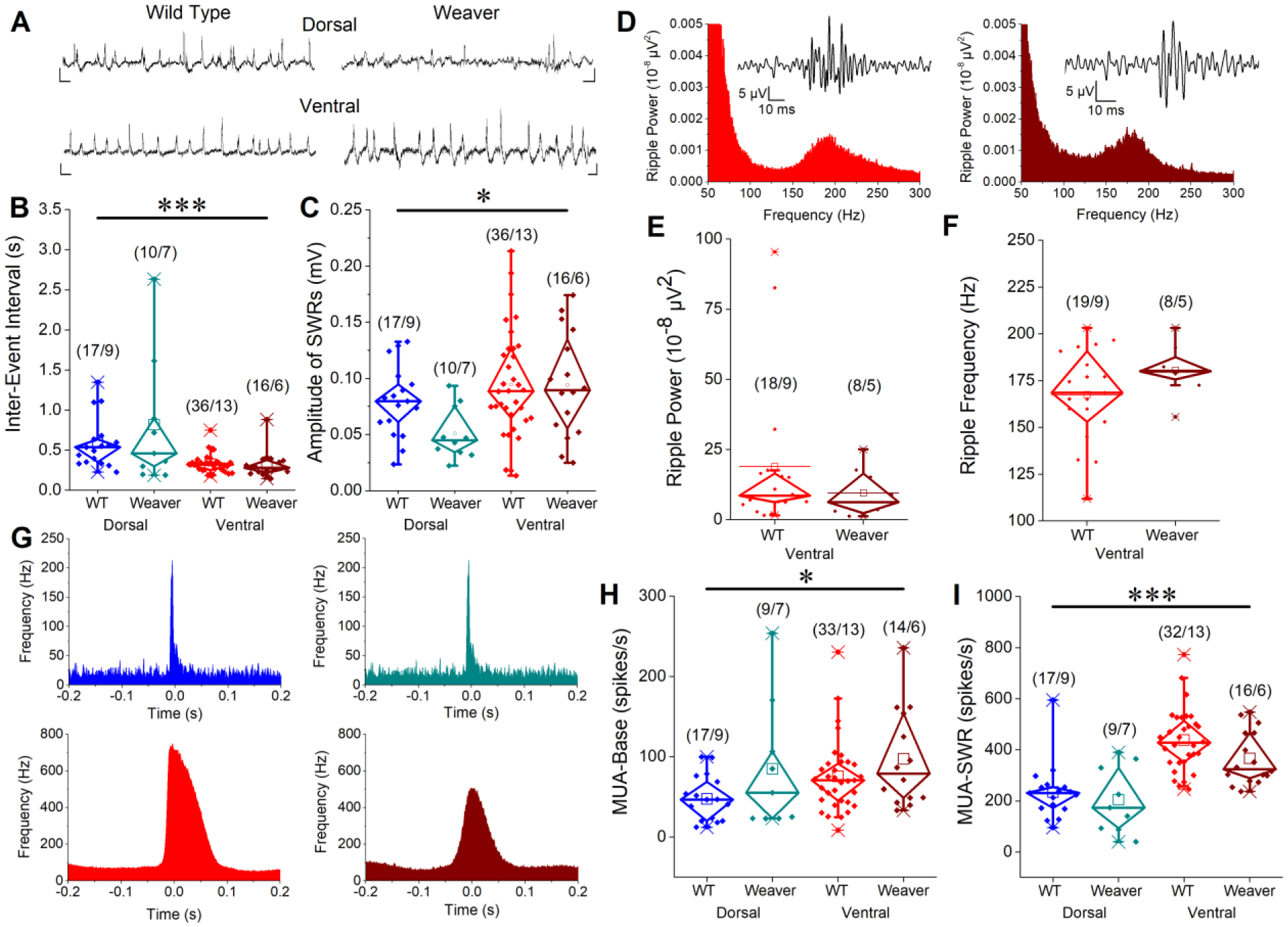
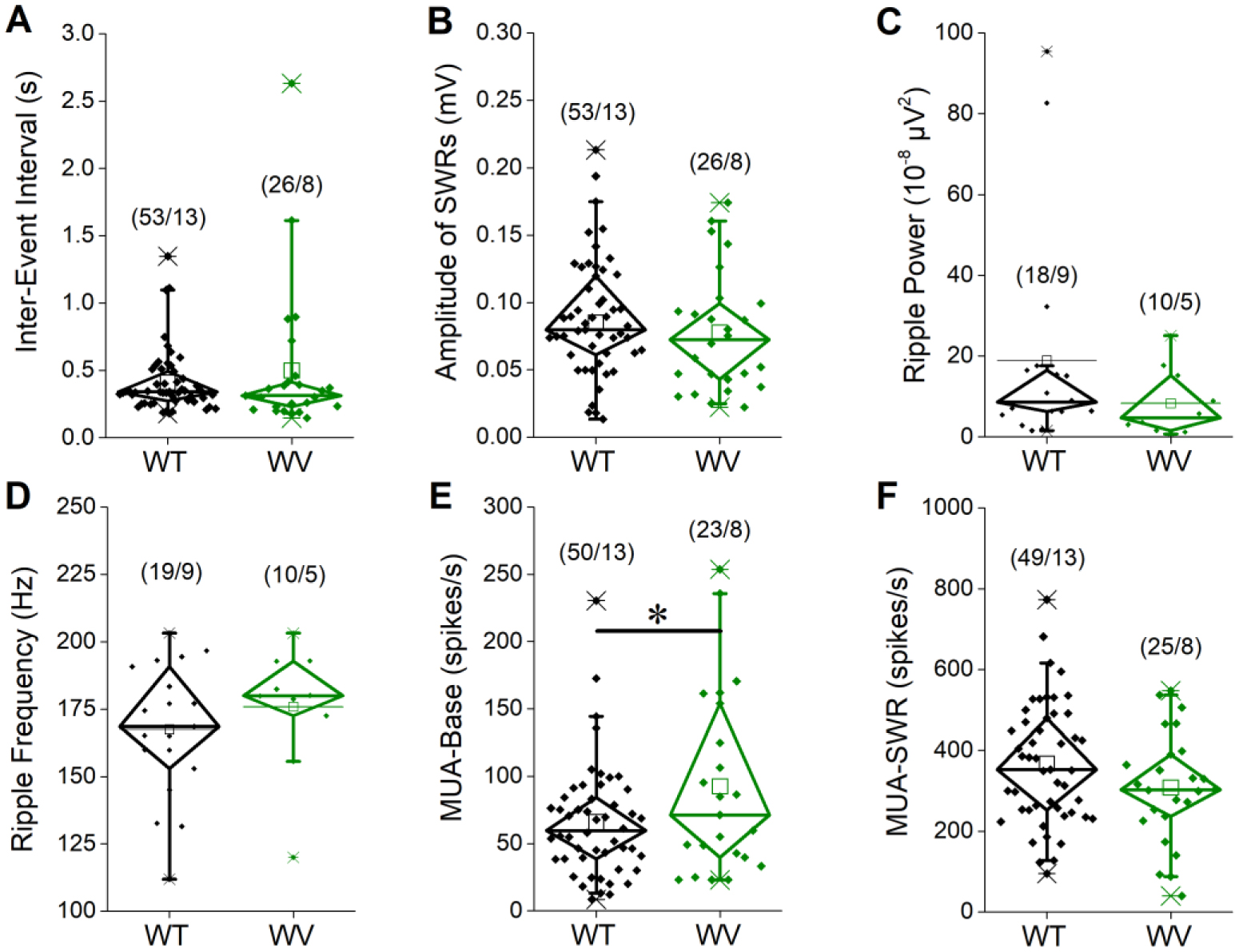
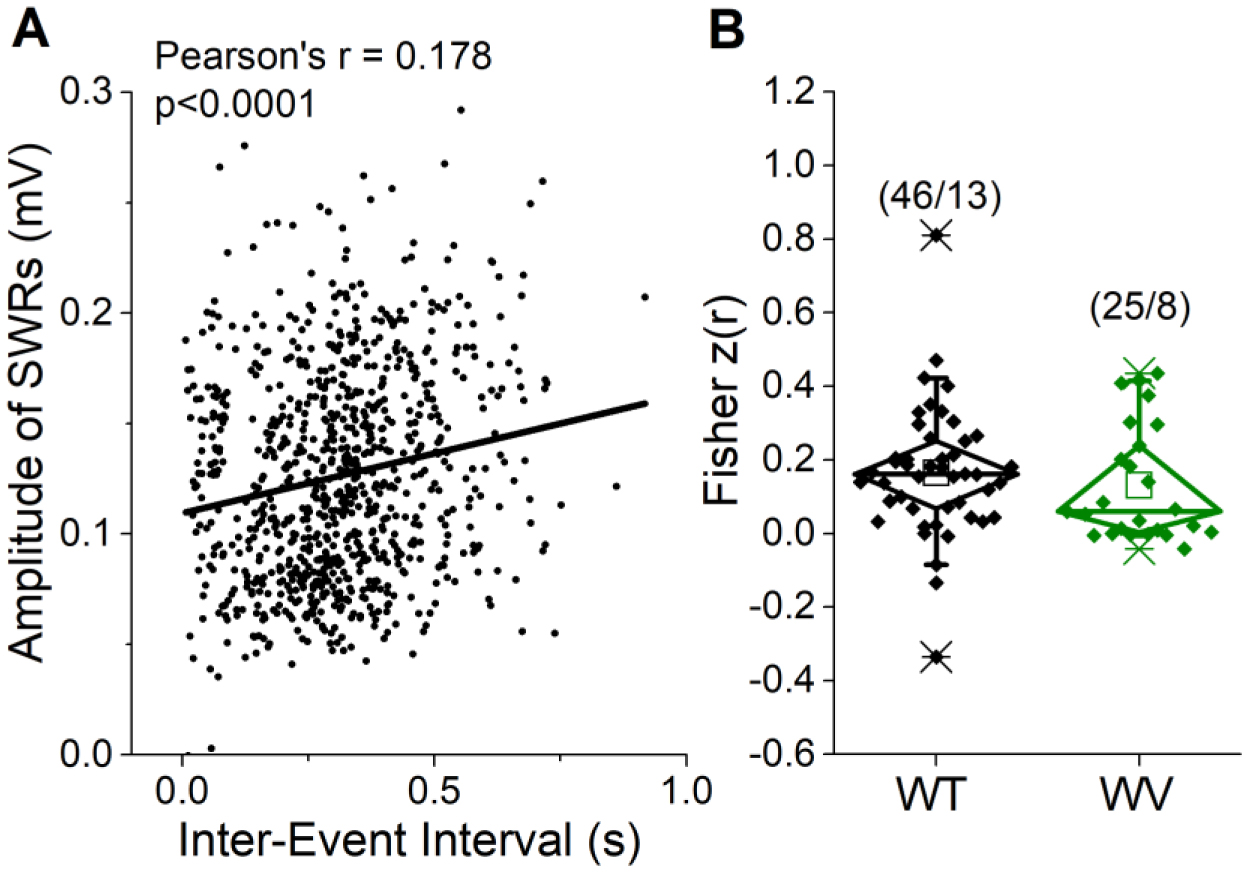
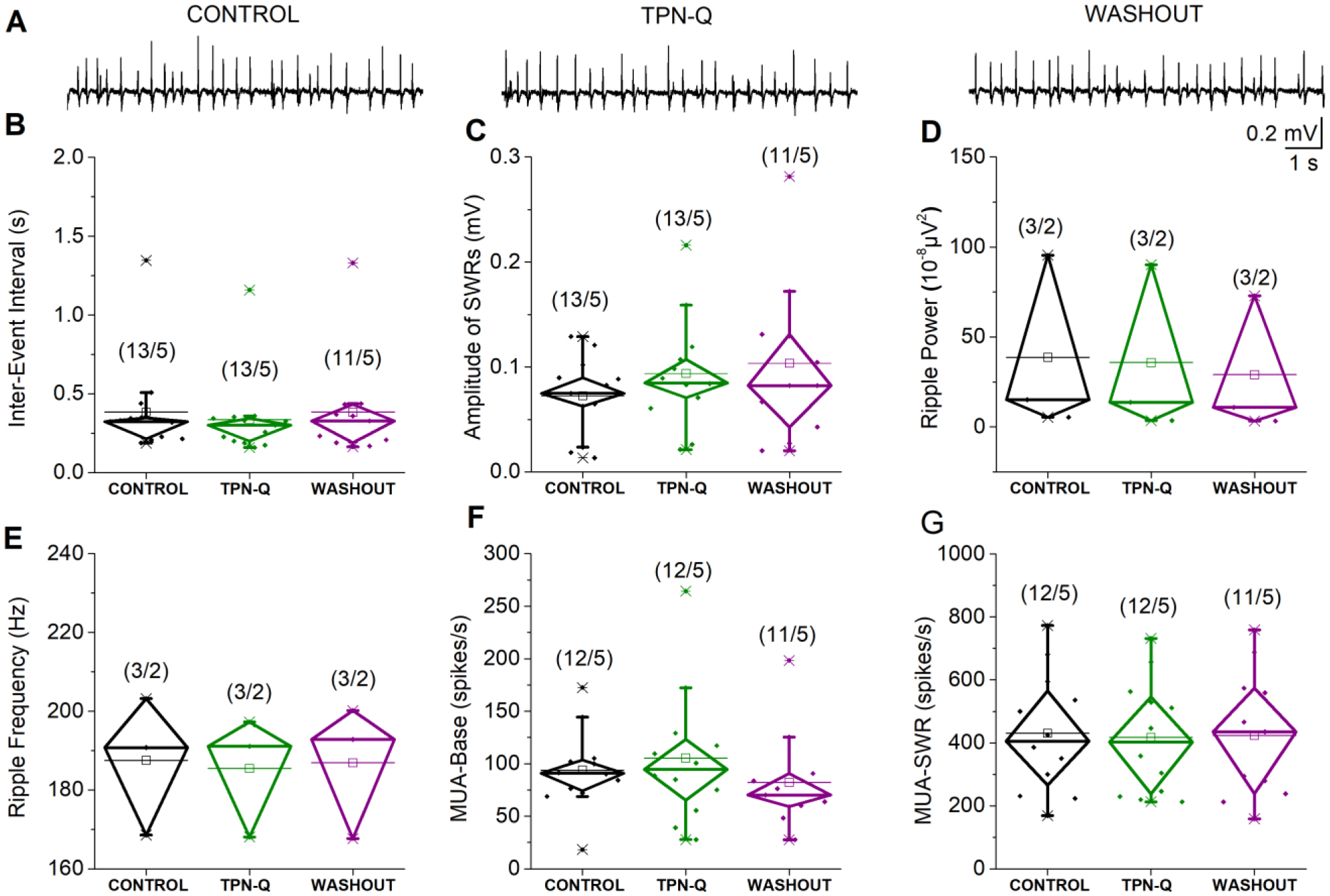
Sharp wave-ripple complexes (SWRs) are intrinsic hippocampal network patterns fundamentally involved in memory processing and are sensitive to changes in excitation-inhibition balance. G protein-gated inwardly rectifying potassium (GIRK) channels regulate neuronal excitability, but their role in shaping SWR dynamics at the network level remains incompletely understood. The weaver mutation (Kcnj6wv/wv) disrupts the GIRK2 channel's function and provides a model of chronic GIRK alteration. Here, we examined how the weaver mutation affects SWR dynamics along the dorsoventral hippocampal axis and whether these effects resemble those of acute GIRK blockade. Extracellular local field potentials and multiunit activity (MUA) were recorded from dorsal and ventral hippocampal slices of wild-type (WT) and weaver mice. SWR incidence, amplitude, ripple properties, and SWR-associated firing were quantified. The effects of the GIRK blocker tertiapin-Q were also assessed. SWR occurrence was strongly determined by dorsoventral location, with higher event rates in the ventral hippocampus, and was not affected by genotype. Similarly, SWR amplitude was region-dependent and preserved in weaver mice. Ripple oscillation properties were largely preserved, with no consistent genotype-dependent differences. In contrast, baseline neuronal activity (MUA-Base) was significantly increased in weaver mice, indicating enhanced intrinsic excitability, whereas SWR-associated firing (MUA-SWR) showed a tendency toward reduction. Acute GIRK blockade with tertiapin-Q did not significantly alter SWR parameters in either genotype, nor did it interact with genotype effects. Together, these findings indicate that chronic GIRK disruption produces selective alterations in the hippocampal network's function that are not mimicked by acute pharmacological inhibition of these channels. While the basic features of SWR generation are preserved, increased baseline excitability and altered neuronal recruitment suggest circuit-level adaptations that reshape hippocampal dynamics beyond direct GIRK channel effects.
Citation: Giota Tsotsokou, Vasiliki Sarantopoulou, Costas Papatheodoropoulos. Chronic GIRK2 disruption in the weaver mouse selectively alters hippocampal excitability without affecting sharp wave-ripple dynamics[J]. AIMS Neuroscience, 2026, 13(3): 530-549. doi: 10.3934/Neuroscience.2026024
Sharp wave-ripple complexes (SWRs) are intrinsic hippocampal network patterns fundamentally involved in memory processing and are sensitive to changes in excitation-inhibition balance. G protein-gated inwardly rectifying potassium (GIRK) channels regulate neuronal excitability, but their role in shaping SWR dynamics at the network level remains incompletely understood. The weaver mutation (Kcnj6wv/wv) disrupts the GIRK2 channel's function and provides a model of chronic GIRK alteration. Here, we examined how the weaver mutation affects SWR dynamics along the dorsoventral hippocampal axis and whether these effects resemble those of acute GIRK blockade. Extracellular local field potentials and multiunit activity (MUA) were recorded from dorsal and ventral hippocampal slices of wild-type (WT) and weaver mice. SWR incidence, amplitude, ripple properties, and SWR-associated firing were quantified. The effects of the GIRK blocker tertiapin-Q were also assessed. SWR occurrence was strongly determined by dorsoventral location, with higher event rates in the ventral hippocampus, and was not affected by genotype. Similarly, SWR amplitude was region-dependent and preserved in weaver mice. Ripple oscillation properties were largely preserved, with no consistent genotype-dependent differences. In contrast, baseline neuronal activity (MUA-Base) was significantly increased in weaver mice, indicating enhanced intrinsic excitability, whereas SWR-associated firing (MUA-SWR) showed a tendency toward reduction. Acute GIRK blockade with tertiapin-Q did not significantly alter SWR parameters in either genotype, nor did it interact with genotype effects. Together, these findings indicate that chronic GIRK disruption produces selective alterations in the hippocampal network's function that are not mimicked by acute pharmacological inhibition of these channels. While the basic features of SWR generation are preserved, increased baseline excitability and altered neuronal recruitment suggest circuit-level adaptations that reshape hippocampal dynamics beyond direct GIRK channel effects.

| [1] |
Buzsaki G (2015) Hippocampal sharp wave–ripple: A cognitive biomarker for episodic memory and planning. Hippocampus 25: 1073-1188. https://doi.org/10.1002/hipo.22488 
|
| [2] |
Skelin I, Zhang H, Zheng J, et al. (2021) Coupling between slow waves and sharp–wave ripples engages distributed neural activity during sleep in humans. Proc Natl Acad Sci U S A 118: e2012075118. https://doi.org/10.1073/pnas.2012075118
|
| [3] |
Tang W, Jadhav SP (2019) Sharp–wave ripples as a signature of hippocampal–prefrontal reactivation for memory during sleep and waking states. Neurobiol Learn Mem 160: 11-20. https://doi.org/10.1016/j.nlm.2018.01.002
|
| [4] |
Foster DJ, Wilson MA (2006) Reverse replay of behavioural sequences in hippocampal place cells during the awake state. Nature 440: 680-683. https://doi.org/10.1038/nature04587
|
| [5] |
Caliskan G, Stork O (2019) Hippocampal network oscillations at the interplay between innate anxiety and learned fear. Psychopharmacology (Berl) 236: 321-338. https://doi.org/10.1007/s00213-018-5109-z
|
| [6] |
Boone CE, Davoudi H, Harrold JB, et al. (2018) Abnormal sleep architecture and hippocampal circuit dysfunction in a mouse model of fragile X syndrome. Neuroscience 384: 275-289. https://doi.org/10.1016/j.neuroscience.2018.05.012
|
| [7] |
Leontiadis LJ, Trompoukis G, Tsotsokou G, et al. (2023) Rescue of sharp wave–ripples and prevention of network hyperexcitability in the ventral but not the dorsal hippocampus of a rat model of fragile X syndrome. Front Cell Neurosci 17: 1296235. https://doi.org/10.3389/fncel.2023.1296235
|
| [8] |
Suh J, Foster DJ, Davoudi H, et al. (2013) Impaired hippocampal ripple–associated replay in a mouse model of schizophrenia. Neuron 80: 484-493. https://doi.org/10.1016/j.neuron.2013.09.014
|
| [9] |
Pollali E, Donaire DF, Ángel MD, et al. (2025) Aberrant hippocampal gamma oscillations in a mouse model of fragile X syndrome: insights from in vitro slice models. Mol Autism 16: 55. https://doi.org/10.1186/s13229-025-00687-9
|
| [10] |
Fanselow MS, Dong HW (2010) Are the dorsal and ventral hippocampus functionally distinct structures?. Neuron 65: 7-19. https://doi.org/10.1016/j.neuron.2009.11.031
|
| [11] |
Strange BA, Witter MP, Lein ES, et al. (2014) Functional organization of the hippocampal longitudinal axis. Nat Rev Neurosci 15: 655-669. https://doi.org/10.1038/nrn3785
|
| [12] |
Bannerman DM, Sprengel R, Sanderson DJ, et al. (2014) Hippocampal synaptic plasticity, spatial memory and anxiety. Nat Rev Neurosci 15: 181-192. https://doi.org/10.1038/nrn3677
|
| [13] |
Risold PY, Swanson LW (1996) Structural evidence for functional domains in the rat hippocampus. Science 272: 1484-1486. https://doi.org/10.1126/science.272.5267.1484
|
| [14] |
Papatheodoropoulos C (2018) Electrophysiological evidence for long–axis intrinsic diversification of the hippocampus. Front Biosci (Landmark Ed) 23: 109-145. https://doi.org/10.2741/4584
|
| [15] |
Kouvaros S, Papatheodoropoulos C (2017) Prominent differences in sharp waves, ripples and complex spike bursts between the dorsal and the ventral rat hippocampus. Neuroscience 352: 131-143. https://doi.org/10.1016/j.neuroscience.2017.03.050
|
| [16] |
Trompoukis G, Rigas P, Leontiadis LJ, et al. (2020) Ih, GIRK, and KCNQ/Kv7 channels differently modulate sharp wave – ripples in the dorsal and ventral hippocampus. Mol Cell Neurosci 107: 103531. https://doi.org/10.1016/j.mcn.2020.103531
|
| [17] |
Trompoukis G, Leontiadis LJ, Rigas P, et al. (2021) Scaling of network excitability and inhibition may contribute to the septotemporal differentiation of sharp waves–ripples in rat hippocampus in vitro. Neuroscience 458: 11-30. https://doi.org/10.1016/j.neuroscience.2020.12.033
|
| [18] |
Kandilakis CL, Papatheodoropoulos C (2025) Opposite serotonergic modulation of sharp waves in the dorsal and ventral hippocampus. Front Synaptic Neurosci 17: 1701349. https://doi.org/10.3389/fnsyn.2025.1701349
|
| [19] |
Patel J, Schomburg EW, Berenyi A, et al. (2013) Local generation and propagation of ripples along the septotemporal axis of the hippocampus. J Neurosci 33: 17029-17041. https://doi.org/10.1523/JNEUROSCI.2036-13.2013
|
| [20] |
Sosa M, Joo HR, Frank LM (2019) Dorsal and ventral hippocampal sharp–wave ripples activate distinct nucleus accumbens networks. Neuron 105: 725-741.e8. https://doi.org/10.1016/j.neuron.2019.11.022
|
| [21] |
Dascal N (1997) Signalling via the G protein–activated K+ channels. Cell Signal 9: 551-573. https://doi.org/10.1016/S0898-6568(97)00095-8
|
| [22] |
Lujan R, Aguado C (2015) Localization and targeting of GIRK channels in mammalian central neurons. Int Rev Neurobiol 123: 161-200. https://doi.org/10.1016/bs.irn.2015.05.009
|
| [23] |
Tipps ME, Buck KJ (2015) GIRK channels: A potential link between learning and addiction. Int Rev Neurobiol 123: 239-277. https://doi.org/10.1016/bs.irn.2015.05.012
|
| [24] |
Lüscher C, Slesinger PA (2010) Emerging roles for G protein–gated inwardly rectifying potassium (GIRK) channels in health and disease. Nat Rev Neurosci 11: 301-315. https://doi.org/10.1038/nrn2834
|
| [25] |
Vogalis F, Storm JF, Lancaster B (2003) SK channels and the varieties of slow after–hyperpolarizations in neurons. Eur J Neurosci 18: 3155-3166. https://doi.org/10.1111/j.1460-9568.2003.03040.x
|
| [26] |
He C, Chen F, Li B, et al. (2014) Neurophysiology of HCN channels: from cellular functions to multiple regulations. Prog Neurobiol 112: 1-23. https://doi.org/10.1016/j.pneurobio.2013.10.001
|
| [27] |
Signorini S, Liao YJ, Duncan SA, et al. (1997) Normal cerebellar development but susceptibility to seizures in mice lacking G protein–coupled, inwardly rectifying K+ channel GIRK2. Proc Natl Acad Sci U S A 94: 923-927. https://doi.org/10.1073/pnas.94.3.923
|
| [28] |
Drake CT, Bausch SB, Milner TA, et al. (1997) GIRK1 immunoreactivity is present predominantly in dendrites, dendritic spines, and somata in the CA1 region of the hippocampus. Proc Natl Acad Sci U S A 94: 1007-1012. https://doi.org/10.1073/pnas.94.3.1007
|
| [29] |
Kim CS, Johnston D (2015) A1 adenosine receptor–mediated GIRK channels contribute to the resting conductance of CA1 neurons in the dorsal hippocampus. J Neurophysiol 113: 2511-2523. https://doi.org/10.1152/jn.00951.2014
|
| [30] |
Malik R, Johnston D (2017) Dendritic GIRK channels gate the integration window, plateau potentials, and induction of synaptic plasticity in dorsal but not ventral ca1 neurons. J Neurosci 37: 3940-3955. https://doi.org/10.1523/JNEUROSCI.2784-16.2017
|
| [31] |
Rakic P, Sidman RL (1973) Weaver mutant mouse cerebellum: defective neuronal migration secondary to abnormality of Bergmann glia. Proc Natl Acad Sci U S A 70: 240-244. https://doi.org/10.1073/pnas.70.1.240
|
| [32] |
Herrup K, Trenkner E (1987) Regional differences in cytoarchitecture of the weaver cerebellum suggest a new model for weaver gene action. Neuroscience 23: 871-885. https://doi.org/10.1016/0306-4522(87)90164-3
|
| [33] |
Hatten ME, Liem RK, Mason CA (1986) Weaver mouse cerebellar granule neurons fail to migrate on wild–type astroglial processes in vitro. J Neurosci 6: 2676-2683. https://doi.org/10.1523/JNEUROSCI.06-09-02676.1986
|
| [34] |
Turrigiano G (2012) Homeostatic synaptic plasticity: local and global mechanisms for stabilizing neuronal function. Cold Spring Harb Perspect Biol 4: a005736. https://doi.org/10.1101/cshperspect.a005736
|
| [35] |
Marder E, Goaillard JM (2006) Variability, compensation and homeostasis in neuron and network function. Nat Rev Neurosci 7: 563-574. https://doi.org/10.1038/nrn1949
|
| [36] |
Nelson SB, Valakh V (2015) Excitatory/Inhibitory balance and circuit homeostasis in autism spectrum disorders. Neuron 87: 684-698. https://doi.org/10.1016/j.neuron.2015.07.033
|
| [37] |
Simon JR, Ghetti B (1994) The weaver mutant mouse as a model of nigrostriatal dysfunction. Mol Neurobiol 9: 183-189. https://doi.org/10.1007/BF02816118
|
| [38] |
Jin W, Klem AM, Lewis JH, et al. (1999) Mechanisms of inward–rectifier K+ channel inhibition by tertiapin–Q. Biochemistry 38: 14294-14301. https://doi.org/10.1021/bi991206j
|
| [39] |
Kandilakis CL, Papatheodoropoulos C (2025) Serotonin modulation of dorsoventral hippocampus in physiology and schizophrenia. Int J Mol Sci 26: 7253. https://doi.org/10.3390/ijms26157253
|
| [40] |
Traub RD, Bibbig A, LeBeau FE, et al. (2004) Cellular mechanisms of neuronal population oscillations in the hippocampus in vitro. Annu Rev Neurosci 27: 247-278. https://doi.org/10.1146/annurev.neuro.27.070203.144303
|
| [41] |
Schlingloff D, Kali S, Freund TF, et al. (2014) Mechanisms of sharp wave initiation and ripple generation. J Neurosci 34: 11385-11398. https://doi.org/10.1523/JNEUROSCI.0867-14.2014
|
| [42] |
Roumis DK, Frank LM (2015) Hippocampal sharp–wave ripples in waking and sleeping states. Curr Opin Neurobiol 35: 6-12. https://doi.org/10.1016/j.conb.2015.05.001
|
| [43] |
Norimoto H, Makino K, Gao M, et al. (2018) Hippocampal ripples down–regulate synapses. Science (New York, NY) 359: 1524-1527. https://doi.org/10.1126/science.aao0702
|
| [44] |
Froemke RC, Schreiner CE (2015) Synaptic plasticity as a cortical coding scheme. Curr Opin Neurobiol 35: 185-199. https://doi.org/10.1016/j.conb.2015.10.003
|
| [45] |
Antoine MW, Langberg T, Schnepel P, et al. (2019) Increased excitation–inhibition ratio stabilizes synapse and circuit excitability in four autism mouse models. Neuron 101: 648-661.e644. https://doi.org/10.1016/j.neuron.2018.12.026
|
| [46] |
Sukenik N, Vinogradov O, Weinreb E, et al. (2021) Neuronal circuits overcome imbalance in excitation and inhibition by adjusting connection numbers. Proc Natl Acad Sci U S A 118. https://doi.org/10.1073/pnas.2018459118
|
| [47] |
Medendorp WE, Bjorefeldt A, Crespo EL, et al. (2021) Selective postnatal excitation of neocortical pyramidal neurons results in distinctive behavioral and circuit deficits in adulthood. iScience 24: 102157. https://doi.org/10.1016/j.isci.2021.102157
|
| [48] |
Wen W, Turrigiano GG (2024) Keeping your brain in balance: homeostatic regulation of network function. Annu Rev Neurosci 47: 41-61. https://doi.org/10.1146/annurev-neuro-092523-110001
|
| [49] |
Csicsvari J, Hirase H, Mamiya A, et al. (2000) Ensemble patterns of hippocampal CA3–CA1 neurons during sharp wave–associated population events. Neuron 28: 585-594. https://doi.org/10.1016/S0896-6273(00)00135-5
|
| [50] |
Klausberger T, Somogyi P (2008) Neuronal diversity and temporal dynamics: the unity of hippocampal circuit operations. Science 321: 53-57. https://doi.org/10.1126/science.1149381
|
| [51] |
Hansel C, Yuste R (2024) Neural ensembles: role of intrinsic excitability and its plasticity. Front Cell Neurosci 18: 1440588. https://doi.org/10.3389/fncel.2024.1440588
|
| [52] |
Girardeau G, Benchenane K, Wiener SI, et al. (2009) Selective suppression of hippocampal ripples impairs spatial memory. Nat Neurosci 12: 1222-1223. https://doi.org/10.1038/nn.2384
|
| [53] |
Jadhav SP, Kemere C, German PW, et al. (2012) Awake hippocampal sharp–wave ripples support spatial memory. Science 336: 1454-1458. https://doi.org/10.1126/science.1217230
|
| [54] |
Joo HR, Frank LM (2018) The hippocampal sharp wave–ripple in memory retrieval for immediate use and consolidation. Nat Rev Neurosci 19: 744-757. https://doi.org/10.1038/s41583-018-0077-1
|
| [55] |
Colgin LL (2020) Five Decades of Hippocampal Place Cells and EEG Rhythms in Behaving Rats. J Neurosci 40: 54-60. https://doi.org/10.1523/JNEUROSCI.0741-19.2019
|
 neurosci-13-03-024-s001.pdf |
 |
Figures(5) / Tables(2)

Giota Tsotsokou, Vasiliki Sarantopoulou, Costas Papatheodoropoulos. Chronic GIRK2 disruption in the weaver mouse selectively alters hippocampal excitability without affecting sharp wave-ripple dynamics[J]. AIMS Neuroscience, 2026, 13(3): 530-549. doi: 10.3934/Neuroscience.2026024




 DownLoad: