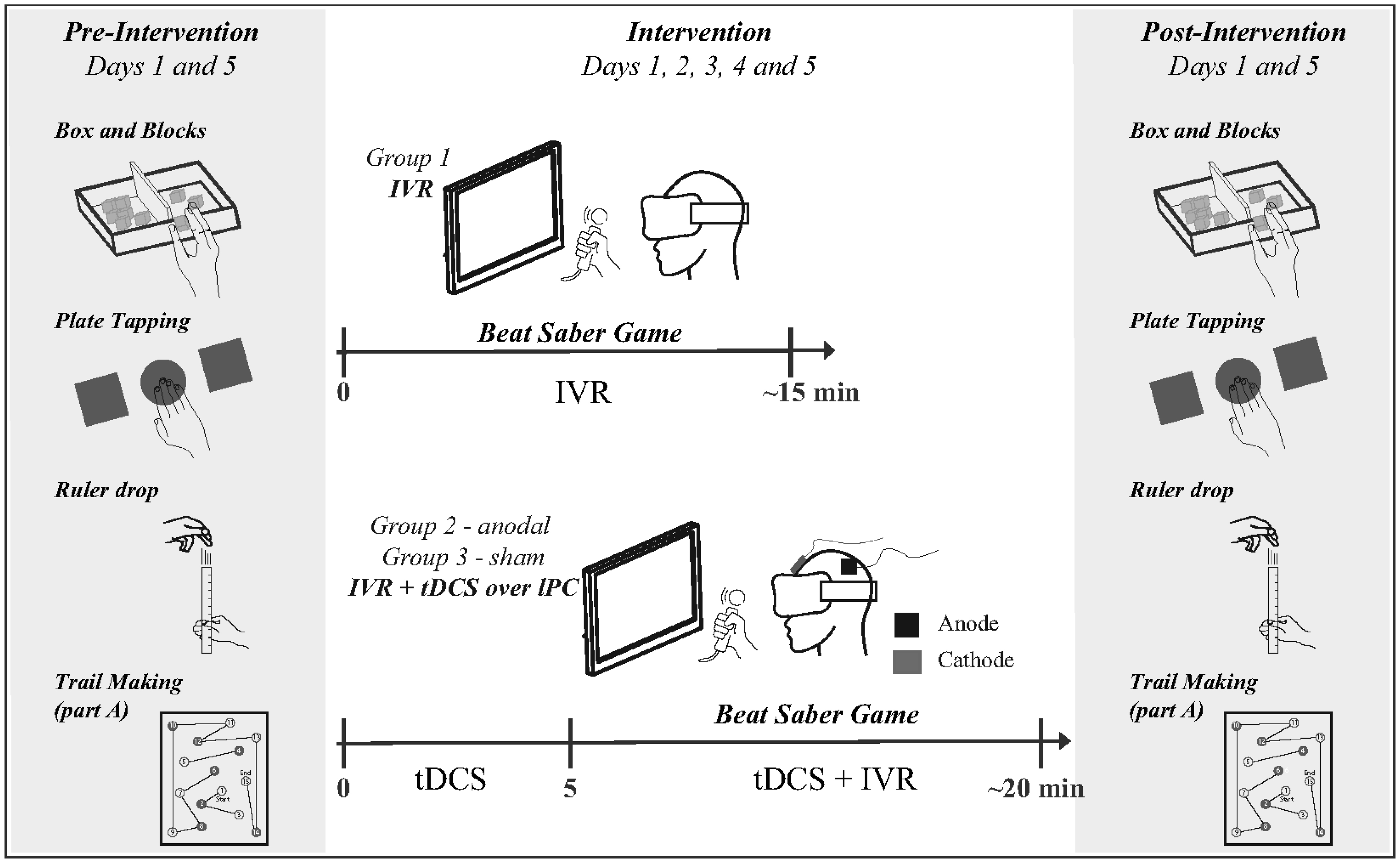
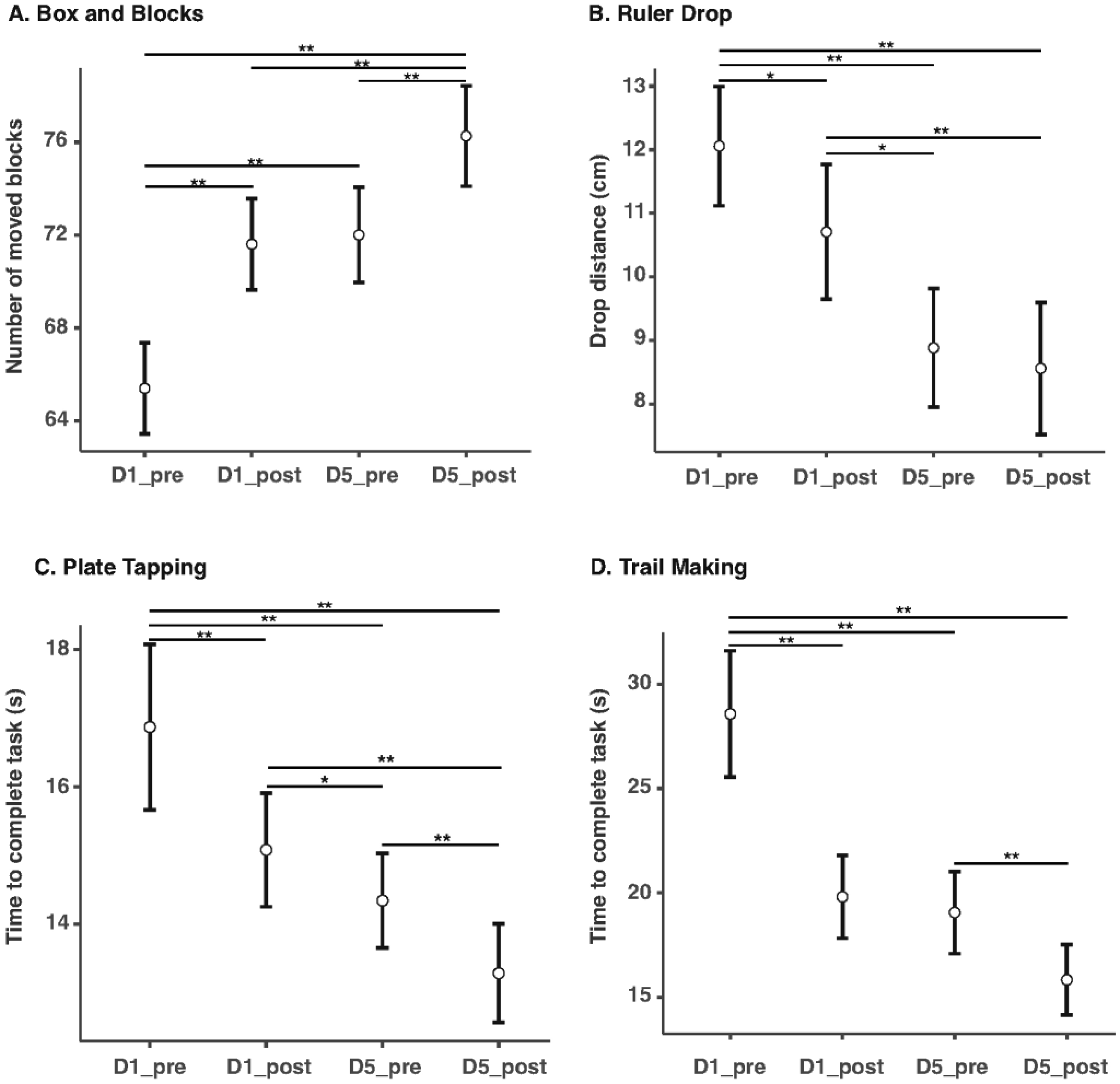
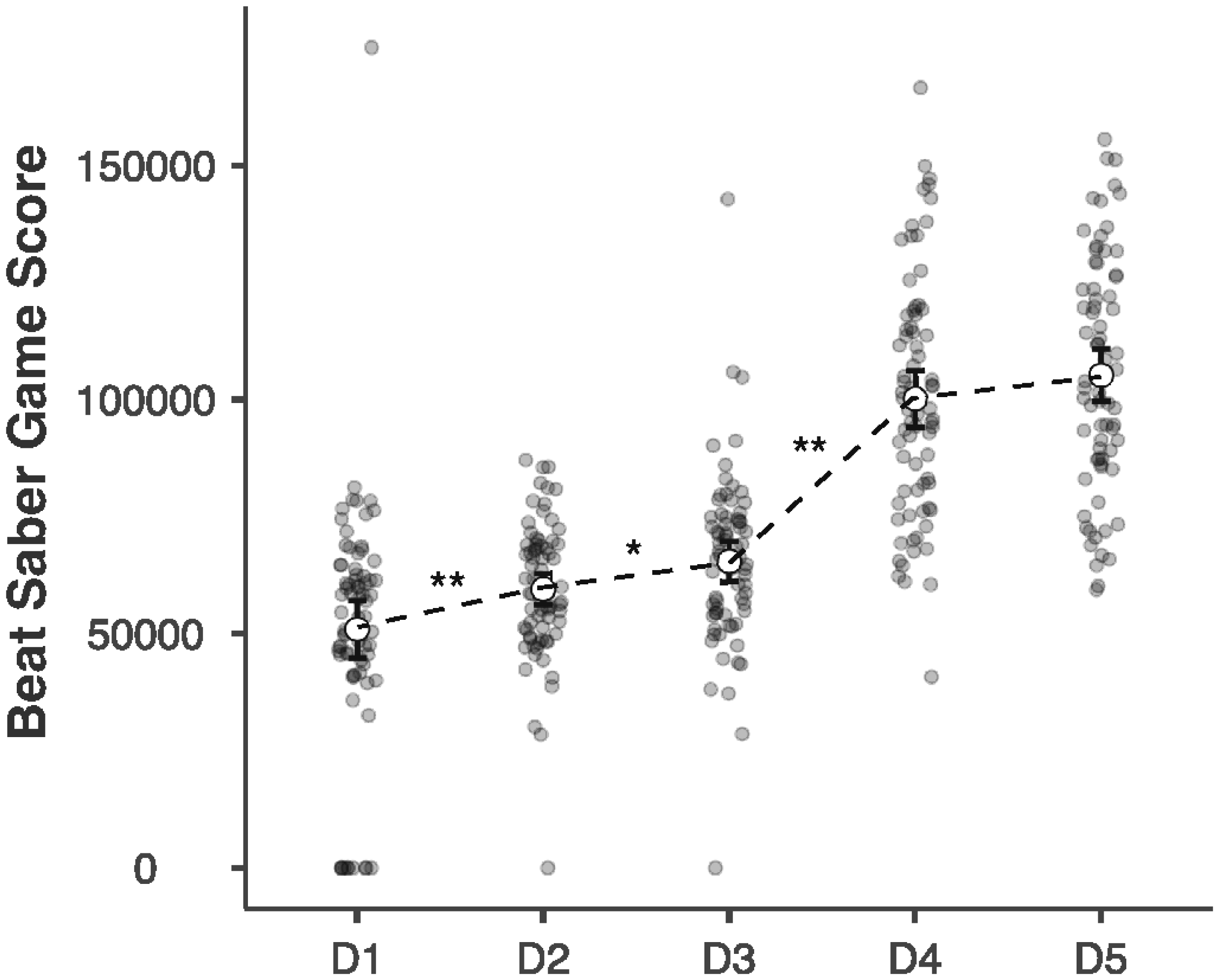
Immersive virtual reality (IVR) provides interactive and engaging environments to stimulate motor learning and neuroplasticity. Combining IVR with transcranial direct current stimulation (tDCS) may further enhance these effects by modulating activity in targeted brain areas. We investigated the effects of a 5-day IVR game-training (Beat Saber game for PS4) alone or combined with sham or anodal tDCS over the left posterior parietal cortex, a key structure for visuospatial processing and motor coordination. Seventy-four healthy participants were randomly assigned to one of three groups: IVR alone, IVR + anodal tDCS, or IVR + sham tDCS. Participants performed a battery of motor tasks requiring hand–eye coordination (Box and Blocks, Ruler Drop, Trail Making part A, and Plate Tapping tests) before and after training on days 1 and 5 to assess motor performance and transfer effects. Results showed progressive improvements in game performance from day 1 to 4 and significant motor transfer effects across all tasks, regardless of stimulation condition. tDCS did not further enhance motor outcomes, suggesting potential limitations related to stimulation site and/or parameters. Our findings highlight IVR's potential for motor skill development, contributing to the growing body of evidence supporting its use as a versatile and accessible tool for motor learning, research, and rehabilitation. While tDCS did not enhance outcomes in this context, future research should explore alternative protocols to optimize its efficacy in IVR motor training.
Citation: Olívia Morgan Lapenta, Rafael de Albuquerque Lima, Gabriela do Amparo Nogueira, Sabrina Baron, Paulo Sérgio Boggio, Marília Lira da Silveira Coelho. Impact of immersive virtual reality and transcranial direct current stimulation over the parietal cortex on motor response[J]. AIMS Neuroscience, 2026, 13(3): 431-451. doi: 10.3934/Neuroscience.2026019
Immersive virtual reality (IVR) provides interactive and engaging environments to stimulate motor learning and neuroplasticity. Combining IVR with transcranial direct current stimulation (tDCS) may further enhance these effects by modulating activity in targeted brain areas. We investigated the effects of a 5-day IVR game-training (Beat Saber game for PS4) alone or combined with sham or anodal tDCS over the left posterior parietal cortex, a key structure for visuospatial processing and motor coordination. Seventy-four healthy participants were randomly assigned to one of three groups: IVR alone, IVR + anodal tDCS, or IVR + sham tDCS. Participants performed a battery of motor tasks requiring hand–eye coordination (Box and Blocks, Ruler Drop, Trail Making part A, and Plate Tapping tests) before and after training on days 1 and 5 to assess motor performance and transfer effects. Results showed progressive improvements in game performance from day 1 to 4 and significant motor transfer effects across all tasks, regardless of stimulation condition. tDCS did not further enhance motor outcomes, suggesting potential limitations related to stimulation site and/or parameters. Our findings highlight IVR's potential for motor skill development, contributing to the growing body of evidence supporting its use as a versatile and accessible tool for motor learning, research, and rehabilitation. While tDCS did not enhance outcomes in this context, future research should explore alternative protocols to optimize its efficacy in IVR motor training.

| [1] |
Debarnot U, Neveu R, Samaha Y, et al. (2019) Acquisition and consolidation of implicit motor learning with physical and mental practice across multiple days of anodal tDCS. Neurobiol Learn Mem 164: 107062. https://doi.org/10.1016/j.nlm.2019.107062 
|
| [2] |
Tieri G, Morone G, Paolucci S, et al. (2018) Virtual reality in cognitive and motor rehabilitation: facts, fiction and fallacies. Expert Rev Med Devices 15: 107-117. https://doi.org/10.1080/17434440.2018.1425613
|
| [3] |
Demeco A, Zola L, Frizziero A, et al. (2023) Immersive Virtual Reality in Post-Stroke Rehabilitation: A Systematic Review. Sensors 23: 1712. https://doi.org/10.3390/s23031712
|
| [4] |
Ferrea E, Franke J, Morel P, et al. (2022) Statistical determinants of visuomotor adaptation along different dimensions during naturalistic 3D reaches. Sci Rep 12: 10198. https://doi.org/10.1038/s41598-022-13866-y
|
| [5] |
Gerken J, Donchin O, Abel T, et al. (2025) Sense of ownership is linked to the speed of visuomotor adaptation in virtual reality but not to generalization, intermanual transfer, or aftereffects. Sci Rep 15: 18690. https://doi.org/10.1038/s41598-025-03697-y
|
| [6] |
Lefrançois C, Messier J (2019) Adaptation and spatial generalization to a triaxial visuomotor perturbation in a virtual reality environment. Exp Brain Res 237: 793-803. https://doi.org/10.1007/s00221-018-05462-2
|
| [7] |
Slater M, Sanchez-Vives MV (2016) Enhancing our lives with immersive virtual reality. Front Robot AI 3: 74. https://doi.org/10.3389/frobt.2016.00074
|
| [8] |
Sigrist R, Rauter G, Riener R, et al. (2013) Augmented visual, auditory, haptic, and multimodal feedback in motor learning: A review. Psychon Bull Rev 20: 21-53. https://doi.org/10.3758/s13423-012-0333-8
|
| [9] | Ossmy O, Mukamel R (2017) Using virtual reality to transfer motor skill knowledge from one hand to another. J Vis Exp 2017: e55965. https://doi.org/10.3791/55965-v |
| [10] |
Markwell LT, Velten JR, Partridge JA, et al. (2023) Virtual motivation: The psychological and transfer of learning effects of immersive virtual reality practice. J Motor Learn Dev 11: 359-373. https://doi.org/10.1123/jmld.2022-0084
|
| [11] |
Karakoc C, Lucifora C, Massimino S, et al. (2025) Extending Peri-Personal Space in Immersive Virtual Reality: A Systematic Review. Virtual Worlds 4: 5. https://doi.org/10.3390/virtualworlds4010005
|
| [12] |
Tammy Lin JH, Wu DY, Bowman N (2023) Beat Saber as Virtual Reality Exercising in 360 Degrees: A Moderated Mediation Model of VR Playable Angles on Physiological and Psychological Outcomes. Media Psychol 26: 414-435. https://doi.org/10.1080/15213269.2022.2154806
|
| [13] |
Convento S, Bolognini N, Fusaro M, et al. (2014) Neuromodulation of parietal and motor activity affects motor planning and execution. Cortex 57: 51-59. https://doi.org/10.1016/j.cortex.2014.03.006
|
| [14] |
Filimon F (2010) Human Cortical Control of Hand Movements: Parietofrontal Networks for Reaching, Grasping, and Pointing. Neuroscientist 16: 388-407. https://doi.org/10.1177/1073858410375468
|
| [15] |
Pollok B, Keitel A, Foerster M, et al. (2020) The posterior parietal cortex mediates early offline-rather than online-motor sequence learning. Neuropsychologia 146: 107555. https://doi.org/10.1016/j.neuropsychologia.2020.107555
|
| [16] |
Ammann C, Spampinato D, Márquez-Ruiz J (2016) Modulating Motor Learning through Transcranial Direct-Current Stimulation: An Integrative View. Front Psychol 7: 1981. https://doi.org/10.3389/fpsyg.2016.01981
|
| [17] |
Hashemirad F, Zoghi M, Fitzgerald PB, et al. (2016) The effect of anodal transcranial direct current stimulation on motor sequence learning in healthy individuals: A systematic review and meta-analysis. Brain Cogn 102: 1-12. https://doi.org/10.1016/j.bandc.2015.11.005
|
| [18] |
Rivera-Urbina GN, Molero-Chamizo A, Nitsche MA (2022) Discernible effects of tDCS over the primary motor and posterior parietal cortex on different stages of motor learning. Brain Struct Funct 227: 1115-1131. https://doi.org/10.1007/s00429-021-02451-0
|
| [19] | Anderson JR, Singley MK (1993) The identical elements theory of transfer. Rules of the mind . Hillsdale, NJ: Lawrence Erlbaum Associates 193-214. |
| [20] |
Lee TD (1988) Transfer-appropriate processing: A framework for conceptualizing practice effects in motor learning. Adv Psychol 50: 201-215. https://doi.org/10.1016/S0166-4115(08)62557-1
|
| [21] |
Rutkowski S, Adamczyk M, Pastuła A, et al. (2021) Training Using a Commercial Immersive Virtual Reality System on Hand-Eye Coordination and Reaction Time in Young Musicians: A Pilot Study. Int J Environ Res Public Health 18: 1297. https://doi.org/10.3390/ijerph18031297
|
| [22] |
Oldfield RC (1971) The assessment and analysis of handedness: the Edinburgh inventory. Neuropsychologia 9: 97-113. https://doi.org/10.1016/0028-3932(71)90067-4
|
| [23] |
Mathiowetz V, Volland G, Kashman N, et al. (1985) Adult norms for the Box and Block Test of manual dexterity. Am J Occup Ther 39: 386-391. https://doi.org/10.5014/ajot.39.6.386
|
| [24] |
Ferreira S, Raimundo A, Del Pozo-Cruz J, et al. (2024) Validity and reliability of a ruler drop test to measure dual-task reaction time, choice reaction time and discrimination reaction time. Aging Clin Exp Res 36: 61. https://doi.org/10.1007/s40520-024-02726-6
|
| [25] |
Campanholo KR, Romão MA, Machado MDAR, et al. (2014) Performance of an adult Brazilian sample on the Trail Making Test and Stroop Test. Dement Neuropsychol 8: 26-31. https://doi.org/10.1590/S1980-57642014DN81000005
|
| [26] |
Nitsche MA, Cohen LG, Wassermann EM, et al. (2008) Transcranial direct current stimulation: State of the art 2008. Brain Stimul 1: 206-223. https://doi.org/10.1016/j.brs.2008.06.004
|
| [27] |
Luft AR, Buitrago MM (2005) Stages of motor skill learning. Mol Neurobiol 32: 205-216. https://doi.org/10.1385/MN:32:3:205
|
| [28] |
Wolpert DM, Diedrichsen J, Flanagan JR (2011) Principles of sensorimotor learning. Nat Rev Neurosci 12: 739-751. https://doi.org/10.1038/nrn3112
|
| [29] |
Dayan E, Cohen LG (2011) Neuroplasticity subserving motor skill learning. Neuron 72: 443-454. https://doi.org/10.1016/j.neuron.2011.10.008
|
| [30] |
Xu T, Yu X, Perlik AJ, et al. (2009) Rapid formation and selective stabilization of synapses for enduring motor memories. Nature 462: 915-919. https://doi.org/10.1038/nature08389
|
| [31] |
Tombaugh, TN (2004) Trail Making Test A and B: Normative data stratified by age and education. Arch Clin Neuropsychol 19: 203-214. http://doi.org/10.1016/S0887-6177(03)00039-8
|
| [32] | Schmidt RA, Lee TD (2011) Retention and Transfer. Motor Control and Learning: A Behavioral Emphasis . Champagne: Human Kinetics 453-488. |
| [33] |
Michalski SC, Szpak A, Saredakis D, et al. (2019) Getting your game on: Using virtual reality to improve real table tennis skills. PLoS One 14: e0222351. https://doi.org/10.1371/journal.pone.0222351
|
| [34] |
Drew SA, Awad MF, Armendariz JA, et al. (2020) The trade-off of virtual reality training for dart throwing: A facilitation of perceptual-motor learning with a detriment to performance. Front Sports Act Living 2: 59. https://doi.org/10.3389/fspor.2020.00059
|
| [35] |
Markwell LT, Cochran K, Porter JM (2023) Off the shelf: Investigating transfer of learning using commercially available virtual reality equipment. PLoS One 18: e0279856. https://doi.org/10.1371/journal.pone.0279856
|
| [36] |
Wang YC, Magasi SR, Bohannon RW, et al. (2011) Assessing dexterity function: a comparison of two alternatives for the NIH Toolbox. J Hand Ther 24: 313-320. https://doi.org/10.1016/j.jht.2011.05.001
|
| [37] |
Schaffer JE, Sainburg RL (2017) Interlimb differences in coordination of unsupported reaching movements. Neuroscience 350: 54-64. https://doi.org/10.1016/j.neuroscience.2017.03.025
|
| [38] |
Serrien DJ, Ivry RB, Swinnen SP (2006) Dynamics of hemispheric specialization and integration in the context of motor control. Nat Rev Neurosci 7: 160-166. https://doi.org/10.1038/nrn1849
|
| [39] |
Szabo DA, Ujică AR, Ursu O (2021) Testing the eye-hand coordination and reaction speed in children aged between 10–14 years old. Geosport Soc 15: 110-121. https://doi.org/10.30892/gss.1505-077
|
| [40] |
Gerloff C, Corwell B, Chen R, et al. (2006) The role of the human motor cortex in the control of complex and simple finger movement sequences. Brain 121: 1695-1709. https://doi.org/10.1093/brain/121.9.1695
|
| [41] |
Stoykov ME, Corcos DM (2009) A review of bilateral training for upper extremity hemiparesis. Occup Ther Int 16: 190-203. https://doi.org/10.1002/oti.277
|
| [42] |
Del Rossi G, Malaguti A, Del Rossi S (2014) Practice effects associated with repeated assessment of a clinical test of reaction time. J Athl Train 49: 356-359. https://doi.org/10.4085/1062-6059-49.2.04
|
| [43] |
Andersen RA, Cui H (2009) Intention, action planning, and decision making in parietal-frontal circuits. Neuron 63: 568-583. https://doi.org/10.1016/j.neuron.2009.08.028
|
| [44] |
Lapenta OM, Rego GG, Boggio PS (2024) Transcranial electrical stimulation for procedural learning and rehabilitation. Neurobiol Learn Mem 213: 107958. https://doi.org/10.1016/j.nlm.2024.107958
|
| [45] |
Morya E, Monte-Silva K, Bikson M, et al. (2019) Beyond the target area: An integrative view of tDCS-induced motor cortex modulation in patients and athletes. J Neuroeng Rehabil 16: 141. https://doi.org/10.1186/s12984-019-0581-1
|
| [46] |
Qi S, Liang Z, Wei Z, et al. (2022) Effects of transcranial direct current stimulation on motor skills learning in healthy adults through the activation of different brain regions: A systematic review. Front Hum Neurosci 16: 1021375. https://doi.org/10.3389/fnhum.2022.1021375
|
| [47] | Li LM, Uehara K, Hanakawa T (2015) The contribution of interindividual factors to variability of response in transcranial direct current stimulation studies. Front Cell Neurosci 9: 181. https://doi.org/10.3389/fncel.2015.00181 |
| [48] |
Horvath JC, Forte JD, Carter O (2015) Quantitative review finds no evidence of cognitive effects in healthy populations from single-session transcranial direct current stimulation. Brain Stimul 8: 535-550. https://doi.org/10.1016/j.brs.2015.01.400
|
| [49] |
Stagg CJ, Bachtiar V, Johansen-Berg H (2011) The role of GABA in human motor learning. Curr Biol 21: 480-484. https://doi.org/10.1016/j.cub.2011.01.069
|
| [50] |
Medina J, Cason S (2017) No evidence of effectiveness of tDCS on multiple measures of cognition: An updated systematic review and meta-analysis. Cortex 94: 131-144. https://doi.org/10.1016/j.cortex.2017.06.021
|
| [51] |
Kuo MF, Unger M, Liebetanz D, et al. (2008) Limited impact of homeostatic plasticity on motor learning in humans. Neuropsychologia 46: 2122-2128. https://doi.org/10.1016/j.neuropsychologia. 2008.02.023
|
| [52] |
Lapenta OM, Minati L, Fregni F, et al. (2013) Je pense donc je fais: transcranial direct current stimulation modulates brain oscillations associated with motor imagery and movement observation. Front Hum Neurosci 7: 256. https://doi.org/10.3389/fnhum.2013.00256
|
| [53] |
Gray R (2019) Virtual environments and their role in developing perceptual-cognitive skills in sports. Anticipation and Decision Making in Sport . London: Routledge 342-358. https://doi.org/10.4324/9781315146270-19
|
| [54] | Schmidt RA, Lee TD, Winstein C, et al. (2019) Motor Learning: Concepts and Methods. Motor Control and Learning: A Behavioral Emphasis . Champaign: Human Kinetics 319-350. |
| [55] |
Zhang A, Ruitenberg MFL, Warburton M, et al. (2026) Large reaching datasets quantify the impact of age, sex/gender, and experience on motor control. Commun Psychol 4: 16. https://doi.org/10.1038/s44271-025-00383-7
|
| [56] |
Ruitenberg MFL, Koppelmans V, Seidler RD, et al. (2023) Developmental and age differences in visuomotor adaptation across the lifespan. Psychol Res 87: 1710-1717. https://doi.org/10.1007/s00426-022-01784-7
|
Figures(3) / Tables(3)

Olívia Morgan Lapenta, Rafael de Albuquerque Lima, Gabriela do Amparo Nogueira, Sabrina Baron, Paulo Sérgio Boggio, Marília Lira da Silveira Coelho. Impact of immersive virtual reality and transcranial direct current stimulation over the parietal cortex on motor response[J]. AIMS Neuroscience, 2026, 13(3): 431-451. doi: 10.3934/Neuroscience.2026019




 DownLoad: