In recent times, economies have increasingly moved from the use and production of tangible assets to non-physical, intangible assets, such as data, software, and branding. Intangible assets are highly synergetic, scalable, less rivalrous, and appropriable than tangible assets and lead to knowledge spillovers, making them key drivers of productivity. Significant efforts have been devoted to measuring intangible assets in the private sector. However, the healthcare/public sectors have received comparably little attention, despite its importance in healthcare, as shown by the drive towards digitalisation in the recent 10-year health plan for the English National Health Service (NHS). This paper critically reviews the literature on the measurement of intangible assets in the healthcare and public sectors. It answers three questions: What methods are used to measure intangible assets in the healthcare and public sectors, what are the specific challenges of measuring intangible assets in the healthcare or public sector setting, and what would be the effect of including intangible assets in a measure of healthcare productivity? We identified 31 publications and two broad strands of literature: the intellectual capital literature, which uses indicator and survey-based methods to measure intangibles, and the Corrado, Hultens, and Sichel (CHS) framework literature, which uses national account style methods, namely the market purchase price and sum-of-costs approaches. We found that the survey and indicator-based measurements, taxonomy, and methods were not standardised, limiting the comparability of their estimates. The CHS methods were more standardised and comparable but relied on assumptions that may not hold in the public sector. The lack of market prices, market pressures, and the non-financial aims of the public sector make the measurement of intangibles challenging. The effects of these challenges on measurement were, however, generally underexplored except in the case of organisational capital. The effects of including intangible assets in healthcare productivity statistics were also underexplored.
Citation: Christopher Warmington, Adriana Castelli, Anastasia Arabadzhyan. The measurement of intangible assets in the healthcare and public sectors: a scoping review of current knowledge[J]. National Accounting Review, 2026, 8(4): 578-609. doi: 10.3934/NAR.2026024
In recent times, economies have increasingly moved from the use and production of tangible assets to non-physical, intangible assets, such as data, software, and branding. Intangible assets are highly synergetic, scalable, less rivalrous, and appropriable than tangible assets and lead to knowledge spillovers, making them key drivers of productivity. Significant efforts have been devoted to measuring intangible assets in the private sector. However, the healthcare/public sectors have received comparably little attention, despite its importance in healthcare, as shown by the drive towards digitalisation in the recent 10-year health plan for the English National Health Service (NHS). This paper critically reviews the literature on the measurement of intangible assets in the healthcare and public sectors. It answers three questions: What methods are used to measure intangible assets in the healthcare and public sectors, what are the specific challenges of measuring intangible assets in the healthcare or public sector setting, and what would be the effect of including intangible assets in a measure of healthcare productivity? We identified 31 publications and two broad strands of literature: the intellectual capital literature, which uses indicator and survey-based methods to measure intangibles, and the Corrado, Hultens, and Sichel (CHS) framework literature, which uses national account style methods, namely the market purchase price and sum-of-costs approaches. We found that the survey and indicator-based measurements, taxonomy, and methods were not standardised, limiting the comparability of their estimates. The CHS methods were more standardised and comparable but relied on assumptions that may not hold in the public sector. The lack of market prices, market pressures, and the non-financial aims of the public sector make the measurement of intangibles challenging. The effects of these challenges on measurement were, however, generally underexplored except in the case of organisational capital. The effects of including intangible assets in healthcare productivity statistics were also underexplored.

| [1] |
Abdirahman M, Coyle D, Heys R, et al. (2022) Telecoms deflators: a story of volume and revenue weights. Econ Stat 530: 45–63. https://doi.org/10.17863/CAM.77034 doi: 10.17863/CAM.77034
|
| [2] |
Arabadzhyan A, Castelli A, Gaughan J, et al. (2025) Productivity of the English National Health Service 2022/23. Centre for Health Economics, University of York. https://doi.org/10.15124/yao-a3z6-5520 |
| [3] |
Arksey H, O'Malley L (2005) Scoping studies: towards a methodological framework. Int J Soc Res Methodol 8: 19–32. https://doi.org/10.1080/1364557032000119616 doi: 10.1080/1364557032000119616
|
| [4] |
Atkinson AB (2005) The Atkinson review: final report. Measurement of government output and productivity for the national accounts. Palgrave Macmillan, Basingstoke. Available from: https://researchonline.lse.ac.uk/id/eprint/33553. |
| [5] |
Bacchini F, Corrado C, Hao J, et al. (2016) Estimates of intangible investment in the public sector: EU, US, China and Brazil. SPINTAN Working Paper No. 11. https://doi.org/10.12842/SPINTAN-WP-11 |
| [6] |
Barker R, Lennard A, Penman S, et al. (2022) Accounting for intangible assets: suggested solutions. Account Bus Res 52: 601–630. https://doi.org/10.1080/00014788.2021.1938963 doi: 10.1080/00014788.2021.1938963
|
| [7] |
Barth ME (2014) Measurement in financial reporting: the need for concepts. Account Horiz 28: 331–352. |
| [8] |
Başal M, Şarkbay ÖF, Kılıçaslan A (2023) Brand equity in digital marketing: what does it mean in the health sector and how does it affect consumer decisions? E3S Web Conf 402: 13020. https://doi.org/10.1051/e3sconf/202340213020 doi: 10.1051/e3sconf/202340213020
|
| [9] |
Bavdaž M, Bounfour A, Martin J, et al. (2023) Measuring investment in intangible assets. In: Advances in Business Statistics, Methods and Data Collection. Wiley, Hoboken, 79–103. https://doi.org/10.1002/9781119672333.ch5 |
| [10] |
BBC (2024) Improve productivity for more pay, public sector told. BBC News. Available from: https://www.bbc.co.uk/news/articles/c24n10p7e4zo. |
| [11] |
Berger TMM (2018) IPSAS explained: a summary of International Public Sector Accounting Standards. John Wiley & Sons, Chichester. |
| [12] |
Belmonte da Silva R, Fernández Jardón CM, Veiga Avila L (2021) Effects of structural intellectual capital on the innovation capacity of public administration. J Technol Manag Innov 16: 66–78. http://dx.doi.org/10.4067/S0718-27242021000300066 doi: 10.4067/S0718-27242021000300066
|
| [13] |
Bontadini F, Corrado C, Haskel J, et al. (2023) EUKLEMS & INTANProd: industry productivity accounts with intangibles. Sources of growth and productivity trends: methods and main measurement challenges. Luiss Lab of European Economics, Rome. Available from: https://econpapers.repec.org/RePEc: pra: mprapa: 126218. |
| [14] |
Bontadini F, Corrado C, Haskel J, et al. (2026) AI as an innovation in the method of innovation: implications for productivity growth. AEA Pap Proc 116: 36–40. https://doi.org/10.1257/pandp.20261036 doi: 10.1257/pandp.20261036
|
| [15] |
Bontis N (1998) Intellectual capital: an exploratory study that develops measures and models. Manag Decis 36: 63–76. https://doi.org/10.1108/00251749810204142 doi: 10.1108/00251749810204142
|
| [16] |
Chluski A (2023) The influence of relational intellectual capital and information technology on hospital efficiency. In: Proceedings of the 24th European Conference on Knowledge Management, Academic Conferences and Publishing Limited. https://doi.org/10.34190/eckm.24.1.1218 |
| [17] |
Corrado C (2024) Intangible investment: what it is and why it matters. In: Reinsdorf MB, Sheiner L (eds), The Measure of Economies: Measuring Productivity in an Age of Technological Change. University of Chicago Press, Chicago, 89–140. https://doi.org/10.7208/chicago/9780226836348-004 |
| [18] |
Corrado C, Haskel J, Jona-Lasinio C (2017a) Public intangibles: the public sector and economic growth in the SNA. Rev Income Wealth 63: S355–S380. https://doi.org/10.1111/roiw.12325 doi: 10.1111/roiw.12325
|
| [19] |
Corrado C, Haskel J, Jona-Lasinio C (2021) Artificial intelligence and productivity: an intangible assets approach. Oxf Rev Econ Policy 37: 435–458. https://doi.org/10.1093/oxrep/grab018 doi: 10.1093/oxrep/grab018
|
| [20] |
Corrado C, Haskel J, Jona-Lasinio C, et al. (2022) Intangible capital and modern economies. J Econ Perspect 36: 3–28. https://doi.org/10.1257/jep.36.3.3 doi: 10.1257/jep.36.3.3
|
| [21] |
Corrado C, Haskel J, Miranda J, et al. (2017b) Measuring and accounting for innovation in the 21st century. NBER Conference on Research in Income and Wealth. Available from: https://www.nber.org/books-and-chapters/measuring-and-accounting-innovation-twenty-first-century. |
| [22] |
Corrado C, Hulten C, Sichel D (2005) Measuring capital and technology: an expanded framework. In: Corrado C, Haltiwanger J, Sichel D (eds), Measuring Capital in the New Economy. University of Chicago Press, Chicago, 11–46. Available from: http://www.nber.org/chapters/c0202. |
| [23] |
Corrado C, Hulten C, Sichel D (2009) Intangible capital and US economic growth. Rev Income Wealth 55: 661–685. https://doi.org/10.1111/j.1475-4991.2009.00343.x doi: 10.1111/j.1475-4991.2009.00343.x
|
| [24] |
Corrado C, Jäger K, Jona-Lasinio C (2016) Measuring intangible capital in the public sector: SPINTAN manual. https://doi.org/10.12842/SPINTAN-MANUAL |
| [25] |
Dekkers M, Polman F, te Velde R, et al. (2006) Measuring European public sector information resources. Final report of study on exploitation of public sector information – benchmarking of EU framework conditions. Available from: https://interoperable-europe.ec.europa.eu/sites/default/files/document/2014-12/media2575.pdf. |
| [26] |
Diamond I (2025) National Statistician's independent review of the measurement of public services productivity. UK Statistics Authority. Available from: https://uksa.statisticsauthority.gov.uk/publication/national-statisticians-independent-review-of-the-measurement-of-public-services-productivity/. |
| [27] |
Dragomir VD (2024) The impact of intangible capital on firm profitability in the technology and healthcare sectors. Int J Financ Stud 12: 5. https://doi.org/10.3390/ijfs12010005 doi: 10.3390/ijfs12010005
|
| [28] |
Dumay J, Guthrie J, Puntillo P (2015) IC and public sector: a structured literature review. J Intellect Cap 16: 267–284. https://doi.org/10.1108/JIC-02-2015-0014 doi: 10.1108/JIC-02-2015-0014
|
| [29] |
Elena K (2020) Review of methods and tools for intellectual property analysis of public sector entities. J Corp Finance Res 14: 63–89. https://doi.org/10.17323/j.jcfr.2073-0438.14.3.2020.63-89 doi: 10.17323/j.jcfr.2073-0438.14.3.2020.63-89
|
| [30] |
Erickson GS, Rothberg HN (2017) Healthcare and hospitality: intangible dynamics for evaluating industry sectors. Serv Ind J 37: 589–606. https://doi.org/10.1080/02642069.2017.1346628 doi: 10.1080/02642069.2017.1346628
|
| [31] |
Evans JM, Brown A, Baker GR (2015) Intellectual capital in the healthcare sector: a systematic review and critique of the literature. BMC Health Serv Res 15: 556. https://doi.org/10.1186/s12913-015-1234-0 doi: 10.1186/s12913-015-1234-0
|
| [32] |
Fazlagić J, Szczepankiewicz EI (2018) Intellectual capital statement model for counties in Poland. Amfiteatru Econ 20: 732–752. |
| [33] |
Fleckenstein M, Obaidi A, Tryfona N (2023) Data valuation: use cases, desiderata, and approaches. In: Proceedings of the Second ACM Data Economy Workshop. ACM, 48–52. https://doi.org/10.1145/3600046.3600054 |
| [34] |
Garlatti A, Massaro M, Bruni V (2015) Intellectual capital evaluation in a health care organization: a case study. Paper presented at the XIX IRSPM Conference, Birmingham. |
| [35] |
Gastaldi L, Ghezzi A, Lettieri E, et al. (2013) Smart growth of a healthcare system: is ICT an effective lever? In: Proceedings of the 8th International Forum on Knowledge Asset Dynamics, 27–54. |
| [36] |
Heiling J (2025) Digital transformation and the accounting for intangible assets in the public sector. J Public Budg Account Financ Manag 38: 134–155. https://doi.org/10.1108/JPBAFM-09-2024-0177 doi: 10.1108/JPBAFM-09-2024-0177
|
| [37] |
Heys R (2025) New measures of public service productivity: lessons and results from the United Kingdom. Int Product Monit 48: 90–114. |
| [38] |
Krstić B, Bonić L, Radenović T, et al. (2023) Improving profitability measurement: impact of intellectual capital efficiency on return on total employed resources in smart and knowledge-intensive companies. Sustainability 15: 12076. https://doi.org/10.3390/su151512076 doi: 10.3390/su151512076
|
| [39] |
Le Mouel M, Marcolin L, Squicciarini M (2016) Investment in organisational capital: methodology and panel estimates. SPINTAN Working Paper. Instituto Valenciano de Investigaciones Económicas, Valencia. |
| [40] |
Levac D, Colquhoun H, O'Brien KK (2010) Scoping studies: advancing the methodology. Implement Sci 5: 69. https://doi.org/10.1186/1748-5908-5-69 doi: 10.1186/1748-5908-5-69
|
| [41] |
Lytras MD, Ordóñez de Pablos P (2009) Managing, measuring and reporting knowledge-based resources in hospitals. Int J Technol Manag 47: 96–113. https://doi.org/10.1504/IJTM.2009.024116 doi: 10.1504/IJTM.2009.024116
|
| [42] |
Martin J (2019) Measuring the other half: new measures of intangible investment from the ONS. Natl Inst Econ Rev 249: R17–R29. https://doi.org/10.1177/002795011924900111 doi: 10.1177/002795011924900111
|
| [43] |
Martin J (2024) The "F words": why surveying businesses about intangibles is so hard. Rev Income Wealth 70: 934–960. https://doi.org/10.1111/roiw.12666 doi: 10.1111/roiw.12666
|
| [44] |
Martin J, Nakamura L, Soloveichik R (2024) Types of capital and their measurement. ESCoE Discussion Paper. Available from: https://escoe-website.s3.amazonaws.com/wp-content/uploads/2024/11/12162254/ESCoE-DP-2024-14.pdf. |
| [45] |
McKee L, Charles K, Dixon-Woods M, et al. (2013) 'New' and distributed leadership in quality and safety in health care, or 'old' and hierarchical? An interview study with strategic stakeholders. J Health Serv Res Policy 18: 11–19. https://doi.org/10.1177/1355819613484460 doi: 10.1177/1355819613484460
|
| [46] |
Mura M, Lettieri E, Spiller N, et al. (2012) Intellectual capital and innovative work behaviour: opening the black box. Int J Eng Bus Manag 4: 39. https://doi.org/10.5772/54976 doi: 10.5772/54976
|
| [47] |
Nakamura LI (2001) What is the US gross investment in intangibles? (At least) one trillion dollars a year! Working Paper. Economic Research Division, Federal Reserve Bank of Philadelphia, Philadelphia. |
| [48] |
NHS England (2025) NHS Federated Data Platform: revolutionising healthcare operations. Available from: https://digital.nhs.uk/data-and-information/keeping-data-safe-and-benefitting-the-public/powerful-moments/nhs-federated-data-platform-revolutionising-healthcare-operations. |
| [49] |
OECD (2009) Measuring capital: revised manual. OECD, Paris. Available from: https://www.oecd.org/content/dam/oecd/en/publications/reports/2009/09/measuring-capital-oecd-manual-2009_g1ghad98/9789264068476-en.pdf. |
| [50] |
O'Mahony M, Beghelli S, Stokes L (2016) Organisational capital and hospital performance in England. SPINTAN Working Paper No. 12. https://doi.org/10.12842/SPINTAN-WP-12 |
| [51] |
ONS (2024a) Investment in intangible assets in the UK: 2022. Office for National Statistics. Available from: https://www.ons.gov.uk/economy/economicoutputandproductivity/productivitymeasures/bulletins/investmentinintangibleassetsintheuk/2022. |
| [52] |
ONS (2024b) Public service productivity, healthcare, England: financial year ending 2022. Office for National Statistics. Available from: https://www.ons.gov.uk/economy/economicoutputandproductivity/publicservicesproductivity/articles/publicservicesproductivityestimateshealthcare/financialyearending2022#healthcare-productivity. |
| [53] |
ONS (2024c) Measuring NHS experience and satisfaction across the UK. Office for National Statistics. Available from: https://www.ons.gov.uk/peoplepopulationandcommunity/healthandsocialcare/healthcaresystem/articles/measuringnhsexperienceandsatisfactionacrosstheuk/2024-05-30#survey-and-question-design. |
| [54] |
ONS (2025) Public service productivity estimates: sources and methods. Office for National Statistics. Available from: https://www.ons.gov.uk/economy/economicoutputandproductivity/publicservicesproductivity/methodologies/sourcesandmethodsforpublicserviceproductivityestimates. |
| [55] |
Osinski M, Selig PM, Matos F, et al. (2017) Methods of evaluation of intangible assets and intellectual capital. J Intellect Cap 18: 470–485. https://doi.org/10.1108/JIC-12-2016-0138 doi: 10.1108/JIC-12-2016-0138
|
| [56] |
Paoloni N, Mattei G, Dello Strologo A, et al. (2020) The present and future of intellectual capital in the healthcare sector: a systematic literature review. J Intellect Cap 21: 357–379. https://doi.org/10.1108/JIC-10-2019-0237 doi: 10.1108/JIC-10-2019-0237
|
| [57] |
Pastor D, Glova J, Lipták F, et al. (2017) Intangibles and methods for their valuation in financial terms: literature review. Intang Cap 13: 387–410. https://doi.org/10.3926/ic.752 doi: 10.3926/ic.752
|
| [58] |
Peng TJA, Pike S, Roos G (2007) Intellectual capital and performance indicators: Taiwanese healthcare sector. J Intellect Cap 8: 538–556. https://doi.org/10.1108/14691930710774902 doi: 10.1108/14691930710774902
|
| [59] |
Piekkola H, Farčnik D, Redek T (2020) Intangible assets in the public sector: an extended definition and methodological guide. GLOBALINTO Deliverable D7.1. School of Economics and Business. Available from: https://globalinto.eu/wp-content/uploads/2021/06/D-7_1-23-04-2020.pdf |
| [60] |
Pirozzi MG, Ferulano GP (2016) Intellectual capital and performance measurement in healthcare organizations: an integrated new model. J Intellect Cap 17: 320–350. https://doi.org/10.1108/JIC-07-2015-0063 doi: 10.1108/JIC-07-2015-0063
|
| [61] |
Rahman MJ, Liu H (2023) Intellectual capital and firm performance: the moderating effect of auditor characteristics. Asian Rev Account 31: 522–558. https://doi.org/10.1108/ARA-03-2022-0054 doi: 10.1108/ARA-03-2022-0054
|
| [62] |
Ramírez Y (2010) Intellectual capital models in Spanish public sector. J Intellect Cap 11: 248–264. https://doi.org/10.1108/14691931011039705 doi: 10.1108/14691931011039705
|
| [63] |
Ramírez Y, Manzaneque M, Priego AM (2017) Formulating and elaborating a model for the measurement of intellectual capital in Spanish public universities. Int Rev Adm Sci 83: 149–176. https://doi.org/10.1177/0020852315575168 doi: 10.1177/0020852315575168
|
| [64] |
Redek T, Piekkola H, Farčnik D, et al. (2021) Report on the empirical analysis on the role of intangible assets in the public sector. GLOBALINTO Deliverable D7.6. Available from: https://globalinto.eu/report-on-the-empirical-analysis-on-the-role-of-intangible-assets-in-the-public-sector-d7-6/. |
| [65] |
Reinsdorf MB, Sheiner L (eds) (2024) The Measure of Economies: Measuring Productivity in an Age of Technological Change. University of Chicago Press, Chicago. |
| [66] |
Saam M, Weinhardt L, Trottner L (2016) Public ICT investment in reaction to the economic crisis – a case study on measuring IT-related intangibles in the public sector. ZEW Discussion Paper. ZEW – Centre for European Economic Research, Mannheim. https://doi.org/10.2139/ssrn.2884670 |
| [67] |
Scafarto V, Dalwai T, Ricci F, et al. (2023) Digitalization and firm financial performance in healthcare: the mediating role of intellectual capital efficiency. Sustainability 15: 4031. https://doi.org/10.3390/su15054031 doi: 10.3390/su15054031
|
| [68] |
Schulz E, Beckmann L (2016) Hospital performance and intangible investments: the impact of own account organizational capital. SPINTAN Working Paper No. 9. https://doi.org/10.12842/SPINTAN-WP-09 |
| [69] |
Stehrer R, Bykova A, Jäger K, et al. (2019) Industry level growth and productivity data with special focus on intangible assets. wiiw Statistical Report No. 8. Vienna Institute for International Economic Studies, Vienna. Available from: https://euklems.eu/wp-content/uploads/2019/10/Methodology.pdf. |
| [70] |
Stewart T (1997) Intellectual capital: the new wealth of organizations. Nicholas Brealey Publishing, New York. ISBN 978-0385482288 |
| [71] |
Stokes L, Wilkinson D, Bryson A (2016) The role of intangibles in school performance: a case study for England. SPINTAN Working Paper No. 20. https://doi.org/10.12842/SPINTAN-WP-20 |
| [72] |
Subramaniam M, Youndt MA (2005) The influence of intellectual capital on the types of innovative capabilities. Acad Manag J 48: 450–463. https://doi.org/10.5465/amj.2005.17407911 doi: 10.5465/amj.2005.17407911
|
| [73] |
Theodorou P, Theodorou T (2024) Valuation of big data analytics quality and competitive advantage with strategic alignment model: from Greek philosophy to contemporary conceptualization. Data Sci Finance Econ 4: 53–64. https://doi.org/10.3934/DSFE.2024002 doi: 10.3934/DSFE.2024002
|
| [74] |
Tricco AC, Lillie E, Zarin W, et al. (2018) PRISMA extension for scoping reviews (PRISMA-ScR): checklist and explanation. Ann Intern Med 169: 467–473. https://doi.org/10.7326/M18-0850 doi: 10.7326/M18-0850
|
| [75] |
United Nations (2025) System of National Accounts 2025 (pre-edit version). United Nations, New York. Available from: https://unstats.un.org/unsd/nationalaccount/sna2025.asp. |
| [76] |
Van Criekingen K, Bloch C, Eklund C (2022) Measuring intangible assets – a review of the state of the art. J Econ Surv 36: 1539–1558. https://doi.org/10.1111/joes.12475 doi: 10.1111/joes.12475
|
| [77] |
Wall A (2005) The measurement and management of intellectual capital in the public sector: taking the lead or waiting for direction? Public Manag Rev 7: 289–303. https://doi.org/10.1080/14719030500091723 doi: 10.1080/14719030500091723
|
| [78] |
Weale M (2025) New medical treatments, quality improvements and public health measures in the national accounts: the effects of the Diabetes Prevention Programme. Rev Income Wealth 71: e70014. https://doi.org/10.1111/roiw.70014 doi: 10.1111/roiw.70014
|
| [79] |
Whittington G (2015) Measurement in financial reporting: half a century of research and practice. Abacus 51: 549–571. |
| [80] |
Yang C, Lin C (2009) Does intellectual capital mediate the relationship between HRM and organisational performance? Perspective of a healthcare industry in Taiwan. Int J Hum Resour Manag 20: 1965–1984. https://doi.org/10.1080/09585190903142415 doi: 10.1080/09585190903142415
|
| [81] |
Youndt MA, Snell SA (2004) Human resource configurations, intellectual capital, and organizational performance. J Manag Issues 16: 337–360. https://www.jstor.org/stable/40604485 |
 NAR-08-04-024-s001.pdf |
 |
Figures(1) / Tables(5)

Christopher Warmington, Adriana Castelli, Anastasia Arabadzhyan. The measurement of intangible assets in the healthcare and public sectors: a scoping review of current knowledge[J]. National Accounting Review, 2026, 8(4): 578-609. doi: 10.3934/NAR.2026024

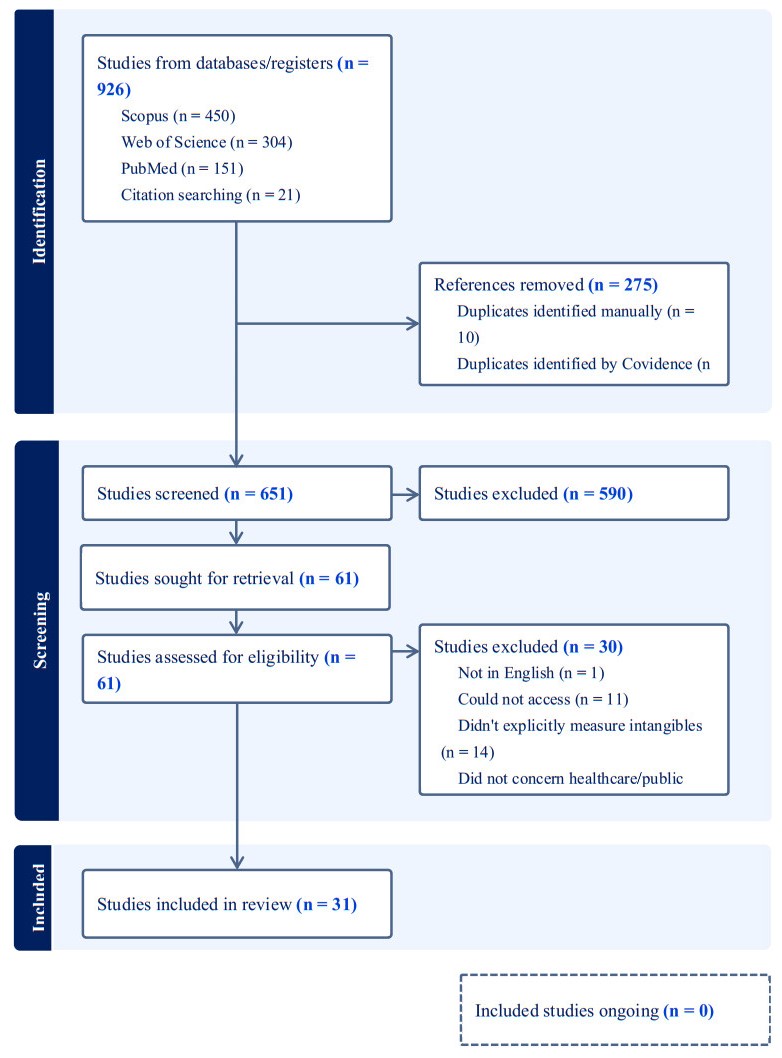
PRISMA diagram




 DownLoad: