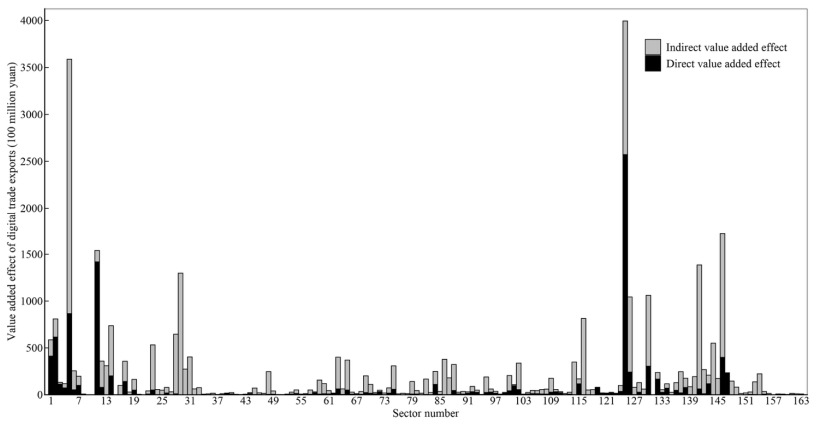
Digital trade exports generate final demand for domestic production, and through intersectoral input-output linkages, induce multiple rounds of intermediate input demand that contribute to domestic value-added. However, researchers have given insufficient attention to the value-added effect driven by digital trade exports via production networks, making it difficult to fully elucidate their value creation process. To address this gap, we combine the 2023 input-output table with multiple data sources, including Custom Trade Statistics and the China Economic Census, to compile a digital economy input-output table that distinguishes digital trade from traditional trade. Second, we construct a digital trade export driven model to quantify the value-added effects of digital trade exports, and decompose them into direct and indirect value-added effects. Finally, we further construct a production network for digital trade exports, identify its core sectors, and employ structural path analysis to trace the paths through which digital trade exports generate value added. The findings indicate that (1) In 2023, the value-added effects of digital trade exports exhibit significant indirect transmission characteristics, with the indirect value-added effect being approximately 2.3 times that of the direct value-added effect. (2) The core hub sectors possess strong bidirectional connectivity, and serve as pivotal nodes in the production network. (3) The core paths through which digital trade exports generate value added involve input linkages among digital manufacturing sectors and linkages from producer services to digital service sectors. By clarifying how production network linkages transmit the value-added effects of digital trade exports, this study provides a theoretical basis and policy insights for the development of digital trade.
Citation: Zimei Huang, Yafei Wang, Mingna Li. Digital trade exports, production networks, and economic growth[J]. National Accounting Review, 2026, 8(4): 553-577. doi: 10.3934/NAR.2026023
Digital trade exports generate final demand for domestic production, and through intersectoral input-output linkages, induce multiple rounds of intermediate input demand that contribute to domestic value-added. However, researchers have given insufficient attention to the value-added effect driven by digital trade exports via production networks, making it difficult to fully elucidate their value creation process. To address this gap, we combine the 2023 input-output table with multiple data sources, including Custom Trade Statistics and the China Economic Census, to compile a digital economy input-output table that distinguishes digital trade from traditional trade. Second, we construct a digital trade export driven model to quantify the value-added effects of digital trade exports, and decompose them into direct and indirect value-added effects. Finally, we further construct a production network for digital trade exports, identify its core sectors, and employ structural path analysis to trace the paths through which digital trade exports generate value added. The findings indicate that (1) In 2023, the value-added effects of digital trade exports exhibit significant indirect transmission characteristics, with the indirect value-added effect being approximately 2.3 times that of the direct value-added effect. (2) The core hub sectors possess strong bidirectional connectivity, and serve as pivotal nodes in the production network. (3) The core paths through which digital trade exports generate value added involve input linkages among digital manufacturing sectors and linkages from producer services to digital service sectors. By clarifying how production network linkages transmit the value-added effects of digital trade exports, this study provides a theoretical basis and policy insights for the development of digital trade.

| [1] |
Acemoglu D, Azar PD (2020) Endogenous production networks. Econometrica 88: 33–82. https://doi.org/10.3982/ECTA15899 doi: 10.3982/ECTA15899
|
| [2] |
Acemoglu D, Carvalho VM, Ozdaglar A, et al. (2012) The network origins of aggregate fluctuations. Econometrica 80: 1977–2016. https://doi.org/10.3982/ECTA9623 doi: 10.3982/ECTA9623
|
| [3] |
Bahari NN, Bahaludin H, Ismail M, et al. (2024) Network, correlation, and community structure of the financial sector of Bursa Malaysia before, during, and after COVID-19. Data Sci Financ Econ 4: 362–387. https://doi.org/10.3934/DSFE.2024016 doi: 10.3934/DSFE.2024016
|
| [4] |
Bajwa FA, Fu J, Bajwa IA, et al. (2025) Digital financial inclusion and its dual impact on economic and environmental outcomes in ASEAN countries. Data Sci Financ Econ 5: 53–75. https://doi.org/10.3934/DSFE.2025004 doi: 10.3934/DSFE.2025004
|
| [5] |
Cheng Z, Yan X (2025) Does digital trade promote digital innovation in enterprises. International Trade Issues: 156–174. |
| [6] |
Defourny J, Thorbecke E (1984) Structural path analysis and multiplier decomposition within a social accounting matrix framework. Econ J 94: 111–136. https://doi.org/10.2307/2232220 doi: 10.2307/2232220
|
| [7] |
Deng Y, Lu M, Zhou X, et al. (2025) Statistical analysis and applications of financial network data in the era of digital intelligence. Data Sci Financ Econ 5: 536–556. https://doi.org/10.3934/DSFE.2025021 doi: 10.3934/DSFE.2025021
|
| [8] |
Geng W, Wu X, Ye P (2022) The impact of digital service trade network on the domestic value added in exports: Evidence from cross-country data. International Trade Issues: 90–110. |
| [9] |
Guo K (2025) China's structural transformation through the lens of evolving production networks. Soc Sci China 206: 97–118. |
| [10] |
IMF, OECD, UNCTAD, WTO (2023) Handbook on Measuring Digital Trade, second edition. https://doi.org/10.1787/ac99e6d3-en |
| [11] |
Jing S, Hu C, Guo Y (2025) The impact of digital trade rules on the resilience of digital services export networks. World Econ Res 137: 119–132. |
| [12] |
Kong X, Lang L, Wang Y (2024) The impact of digital trade on China's economic resilience: Empirical evidence from China's cities. Int Econ Trade Explor 40: 20–39. |
| [13] |
Leontief WW (1936) Quantitative input and output relations in the economic systems of the United States. Rev Econ Stat 18: 105–125. https://doi.org/10.2307/1927837 doi: 10.2307/1927837
|
| [14] |
Leontief W (1970) Environmental repercussions and the economic structure: An input-output approach. Rev Econ Stat 52: 262–271. https://doi.org/10.2307/1926294 doi: 10.2307/1926294
|
| [15] |
Long JB, Plosser C (1983) Real business cycles. J Polit Econ 91: 39–69. https://doi.org/10.1086/261128 doi: 10.1086/261128
|
| [16] |
Miller RE, Blair PD (2022) Input-Output Analysis: Foundations and Extensions. Cambridge University Press, Cambridge. https://doi.org/10.1017/9781108676212 |
| [17] |
Wang Y, Li M (2026) Digital economy input-output table: Compilation methods and China's practice. Stat Res 43: 25–38. https://doi.org/10.19343/j.cnki.11-1302/c.2026.03.002 doi: 10.19343/j.cnki.11-1302/c.2026.03.002
|
| [18] |
Xu J, Xia J (2020) The development of digital trade from the perspective of global value chain: Strategic positioning and China's path. Reform: 58–67. |
| [19] |
Yu H, Yin F (2025) Trade digitization and sustainability of export relationships: From the perspective of supply-demand matching. International Trade Issues: 37–55. |
| [20] |
Zhang T, Zhou Z (2021) Analysis of the structure of trade in value added and identification of its dominant factors from the perspective of international production network: Taking China–U. S. bilateral trade as an example. Stat Res 38: 60–72. |
| [21] |
Zhao C, Yang H (2024) How does digital trade affect the construction of a unified big market: Based on empirical evidence from 272 prefecture-level cities in China. World Econ Res 135: 3–17. |
| [22] |
Zhu H, Zhao Q, Wang C (2022) Research on digital trade-driven consumption upgrading under the background of national unified market construction. Bus Econ Manage, 5–22. |
Figures(1) / Tables(3)

Zimei Huang, Yafei Wang, Mingna Li. Digital trade exports, production networks, and economic growth[J]. National Accounting Review, 2026, 8(4): 553-577. doi: 10.3934/NAR.2026023

The value-added effect of digital trade exports across 163 sectors in 2023




 DownLoad: