The widely used Leontief price model assumes perfect competition, under which producers cannot influence prices. Despite its restrictive assumptions, it offers computational simplicity and serves as a benchmark for evaluating economy-wide price effects of technological change, making it particularly well-suited for policy analysis. In this paper, we developed an alternative calculation of input–output prices incorporating the presence of market power through the estimation of industry-specific markups and allowing for pure profits. By comparing two contrasting pricing scenarios within the input–output framework, perfect competition as a lower bound and monopoly power as an upper bound, the proposed approach expands traditional interindustry price analysis and provides a consistent input–output accounting basis for evaluating price and welfare effects across non-competitive market structures.
Citation: M. Alejandro Cardenete, M. Carmen Lima, Ferran Sancho. Expanding the input–output price equation to alternative market structures[J]. National Accounting Review, 2026, 8(4): 539-552. doi: 10.3934/NAR.2026022
The widely used Leontief price model assumes perfect competition, under which producers cannot influence prices. Despite its restrictive assumptions, it offers computational simplicity and serves as a benchmark for evaluating economy-wide price effects of technological change, making it particularly well-suited for policy analysis. In this paper, we developed an alternative calculation of input–output prices incorporating the presence of market power through the estimation of industry-specific markups and allowing for pure profits. By comparing two contrasting pricing scenarios within the input–output framework, perfect competition as a lower bound and monopoly power as an upper bound, the proposed approach expands traditional interindustry price analysis and provides a consistent input–output accounting basis for evaluating price and welfare effects across non-competitive market structures.

| [1] |
Agencia Tributaria (2021) Cuentas consolidadas del impuesto sobre sociedades. Available from: https://sede.agenciatributaria.gob.es/AEAT/Contenidos_Comunes/La_Agencia_Tributaria/Estadisticas/Publicaciones/sites/sociedadesdc/2021/jrubik7140b36691c82e46fadc420c3e06fbd627eab8a3.html. |
| [2] |
Cardenete MA, Lima MC, Sancho F (2024) A methodology to study price-quantity interactions in input–output modeling: An application to NextGeneration EU funds. Econ Syst Res 37: 244–262. https://doi.org/10.1080/09535314.2024.2337375 doi: 10.1080/09535314.2024.2337375
|
| [3] |
Derrick FW, Scott CE (1993) Businesses and the incidence of sales and use tax. Public Financ Rev 21: 210–226. https://doi.org/10.1177/109114219302100206 doi: 10.1177/109114219302100206
|
| [4] |
Friedman M (1953) Essays on Positive Economics, Chicago: The University of Chicago Press. |
| [5] |
Hicks JR, Allen RGD (1934) A reconsideration of the theory of value. Part Ⅱ. A mathematical theory of individual demand functions. Economica 1: 196–219. https://doi.org/10.2307/2548749 doi: 10.2307/2548749
|
| [6] |
INE (2025) Input–output data for the Spanish economy, 2021. Available from: https://www.ine.es/dyngs/INEbase/operacion.htm?c=Estadistica_C&cid=1254736177058&menu=resultados&idp=1254735576581. |
| [7] |
McElroy K, Siegfried J, Sweeney G (1982) The incidence of price changes in the U.S. economy. Rev Econ Stat 64: 191–203. https://doi.org/10.2307/1924298 doi: 10.2307/1924298
|
| [8] |
McKean JR, Taylor RG (1991) Sensitivity of the Pakistan economy to changes in import prices, profits, taxes and subsidies. Econ Syst Res 3: 187–204. https://doi.org/10.1080/09535319100000016 doi: 10.1080/09535319100000016
|
| [9] |
Melvin J (1979) Short-run price effects of the corporate income tax and implications for international trade. Am Econ Rev 69: 765–774. https://www.jstor.org/stable/1813645 |
| [10] |
Miller RE, Blair PD (2022) Input–Output Analysis: Foundations and Extensions, 3 Eds., New York: Cambridge University Press. https://doi.org/10.1017/9781108676212 |
| [11] |
Moiseev N (2025) Is monopoly truly effective for producers? J Econ Stud 52: 983–1006. https://doi.org/10.1108/JES-03-2024-0129 doi: 10.1108/JES-03-2024-0129
|
| [12] |
Roland-Holst DW, Sancho F (1995) Modelling prices in a SAM structure. Rev Econ Stat 77: 361–371. https://doi.org/10.2307/2109871 doi: 10.2307/2109871
|
| [13] |
Sharify N (2013) Input–output modelling of the effect of implicit subsidies on general prices. Econ Model 33: 913–917. https://doi.org/10.1016/j.econmod.2013.06.011 doi: 10.1016/j.econmod.2013.06.011
|
| [14] |
Villegas P, Delgado MC, Cardenete MA (2024) The economic impact of a tourist tax in Andalusia examined through a price effect model. Appl Econ Lett 31: 96–101. https://doi.org/10.1080/13504851.2022.2128167 doi: 10.1080/13504851.2022.2128167
|
Figures(1) / Tables(2)

M. Alejandro Cardenete, M. Carmen Lima, Ferran Sancho. Expanding the input–output price equation to alternative market structures[J]. National Accounting Review, 2026, 8(4): 539-552. doi: 10.3934/NAR.2026022

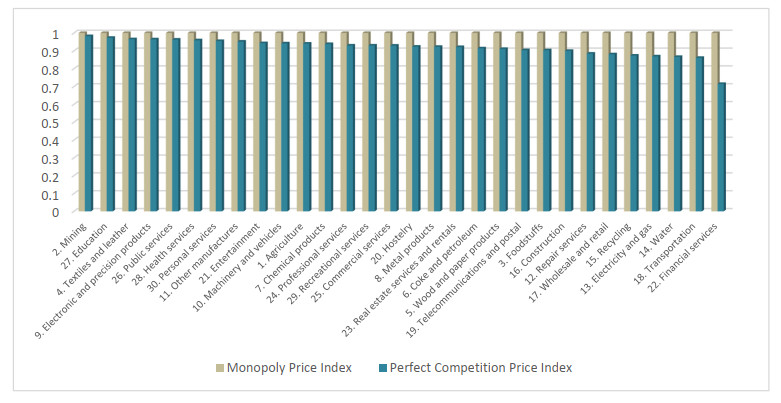
Sectoral price indices ranked under monopoly power versus perfect competition. Source: Own elaboration




 DownLoad: