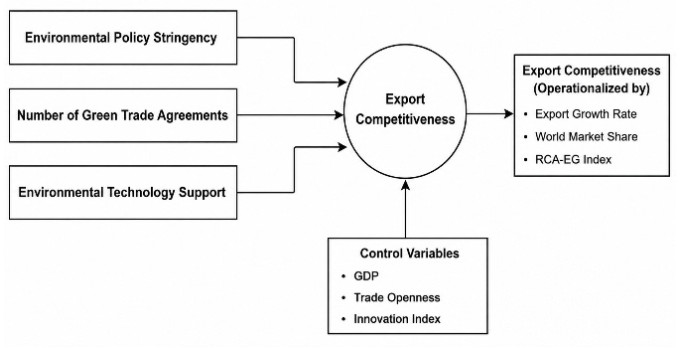
In this study, we examined the relationship between sustainable trade policies and export competitiveness using a balanced panel of 20 countries from 2015 to 2020, comprising 120 country-year observations. Export competitiveness was assessed through three dimensions: export growth, world market share, and revealed comparative advantage in environmental goods (RCA-EG). Sustainable trade policy was represented by Environmental Policy Stringency, Green Trade Agreements, and Environmental Technology Support, while GDP, trade openness, and innovation were incorporated as control variables. Panel-data estimation with country and year fixed effects was employed to account for country-specific heterogeneity and common time-related shocks. Our findings indicated that the three sustainable trade policy instruments did not exhibit statistically significant within-country relationships with the selected measures of export competitiveness during the study period. Their joint effects were also statistically insignificant, suggesting that sustainability-oriented trade policies may not translate immediately into measurable improvements in export performance. The findings emphasize that competitiveness outcomes may depend on longer adjustment periods and complementary structural, technological, and economic conditions. The study contributes cross-country empirical evidence on the multidimensional relationship between sustainable trade policy and export competitiveness and highlights the importance of evaluating policy effects across different dimensions of trade performance.
Citation: Bora Upendra Rao, Baburao Chirra, Nasa Dhanraj, Suhashini A, Sathyanarayana G. Sustainable trade policies and export competitiveness: A cross-country empirical analysis[J]. Innovation Economics, 2026, 1(2): 148-163. doi: 10.3934/InnoEcon2026008
In this study, we examined the relationship between sustainable trade policies and export competitiveness using a balanced panel of 20 countries from 2015 to 2020, comprising 120 country-year observations. Export competitiveness was assessed through three dimensions: export growth, world market share, and revealed comparative advantage in environmental goods (RCA-EG). Sustainable trade policy was represented by Environmental Policy Stringency, Green Trade Agreements, and Environmental Technology Support, while GDP, trade openness, and innovation were incorporated as control variables. Panel-data estimation with country and year fixed effects was employed to account for country-specific heterogeneity and common time-related shocks. Our findings indicated that the three sustainable trade policy instruments did not exhibit statistically significant within-country relationships with the selected measures of export competitiveness during the study period. Their joint effects were also statistically insignificant, suggesting that sustainability-oriented trade policies may not translate immediately into measurable improvements in export performance. The findings emphasize that competitiveness outcomes may depend on longer adjustment periods and complementary structural, technological, and economic conditions. The study contributes cross-country empirical evidence on the multidimensional relationship between sustainable trade policy and export competitiveness and highlights the importance of evaluating policy effects across different dimensions of trade performance.

| [1] |
Antimiani A, Costantini V, Paglialunga E (2023) Fossil fuels subsidy removal and the EU carbon neutrality policy. Energy Econ 119: 106524. https://doi.org/10.1016/j.eneco.2023.106524 doi: 10.1016/j.eneco.2023.106524

|
| [2] |
Brandi C, Schwab J, Berger A, et al. (2020) Do environmental provisions in trade agreements make exports from developing countries greener? World Dev 129: 104899. https://doi.org/10.1016/j.worlddev.2020.104899 doi: 10.1016/j.worlddev.2020.104899
|
| [3] |
Cai Y, Rahman HU, Khan AB, et al. (2025) The role of environmental quality, financial development and institutional quality in sustainable economic growth: Evidence from China. Contemp Econ 19: 312–328. https://doi.org/10.5709/ce.1897-9254.568 doi: 10.5709/ce.1897-9254.568
|
| [4] |
Cima E, Esty DC (2024) Making international trade work for sustainable development: Toward a new WTO framework for subsidies. J Int Econ Law 27: 1–17. https://doi.org/10.1093/jiel/jgae008 doi: 10.1093/jiel/jgae008
|
| [5] |
Copeland BR, Taylor MS (2004) Trade, growth, and the environment. J Econ Lit 42: 7–71. https://doi.org/10.1257/.42.1.7 doi: 10.1257/.42.1.7
|
| [6] |
Costantini V, Mazzanti M (2012) On the green and innovative side of trade competitiveness? Res Policy 41: 132–153. https://doi.org/10.1016/j.respol.2011.08.004 doi: 10.1016/j.respol.2011.08.004
|
| [7] |
Dechezleprêtre A, Sato M (2017) The impacts of environmental regulations on competitiveness. Rev Environ Econ Policy 11: 183–206. https://doi.org/10.1093/reep/rex013 doi: 10.1093/reep/rex013
|
| [8] |
Eskeland GS, Harrison AE (2003) Moving to greener pastures? Multinationals and the pollution haven hypothesis. J Dev Econ 70: 1–23. https://doi.org/10.1016/S0304-3878(02)00084-6 doi: 10.1016/S0304-3878(02)00084-6
|
| [9] |
Fabrizi A, Gentile M, Guarini G, et al. (2024) The impact of environmental regulation on innovation and international competitiveness. J Evol Econ 34: 169–204. https://doi.org/10.1007/s00191-024-00852-y doi: 10.1007/s00191-024-00852-y
|
| [10] |
Frankel JA, Rose AK (2005) Is trade good or bad for the environment? Sorting out the causality. Rev Econ Stat 87: 85–91. https://doi.org/10.1162/0034653053327577 doi: 10.1162/0034653053327577
|
| [11] |
Harrison J (2023) Trade agreements and sustainability: Exploring the potential of global value chain (GVC) obligations. J Int Econ Law 26: 199–215. https://doi.org/10.1093/jiel/jgac057 doi: 10.1093/jiel/jgac057
|
| [12] | Monteiro JA, Trachtman JP (2020) Environmental laws, In: Mattoo A, Rocha N, Ruta M, eds, Handbook of Deep Trade Agreements, Washington DC: World Bank, 279–318. https://doi.org/10.1596/978-1-4648-1539-3_ch11 |
| [13] | OECD/WTO (2022) Aid for Trade at a Glance 2022: Empowering connected, sustainable trade. OECD Publishing. https://doi.org/10.1787/9ce2b7ba-en |
| [14] |
Popov O, Melnikov S, Skachkov O, et al. (2022) Assessment of the level of economies' foreign trade diversification. Contemp Econ 16: 276–296. https://doi.org/10.5709/ce.1897-9254.482 doi: 10.5709/ce.1897-9254.482
|
| [15] |
Porter ME, van der Linde C (1995) Toward a new conception of the environment-competitiveness relationship. J Econ Perspect 9: 97–118. https://doi.org/10.1257/jep.9.4.97 doi: 10.1257/jep.9.4.97
|
| [16] | Ricardo D (1817) On The Principles of Political Economy and Taxation. John Murray |
| [17] |
Scalamonti F (2025) The Italy-MEDA emerging markets partnership: Trade relationships, cross-border operations on firms' equity, and constant market shares analysis. Data Sci Financ Econ 5: 258–292. https://doi.org/10.3934/DSFE.2025012 doi: 10.3934/DSFE.2025012
|
| [18] |
Shapiro JS, Walker R (2018) Why is pollution from US manufacturing declining? The roles of environmental regulation, productivity, and trade. Am Econ Rev 108: 3814–3854. https://doi.org/10.1257/aer.20151272 doi: 10.1257/aer.20151272
|
| [19] | United Nations Conference on Trade and Development (2021) Trade and Environment Review 2021: Trade-climate readiness for developing countries. United Nations. |
| [20] | United Nations (2020) Transforming our world: The 2030 Agenda for Sustainable Development. Available from: https://sdgs.un.org/2030agenda |
| [21] | United Nations Environment Programme (2021) Greening international trade: Pathways forward. United Nations Environment Programme. |
| [22] |
Wang X, Zhang X, Meng D, et al. (2022) The effects of product standards on trade: Quasi-experimental evidence from China. Aust Econ Rev 55: 232–249. https://doi.org/10.1111/1467-8462.12458 doi: 10.1111/1467-8462.12458
|
| [23] | WTO (2022) Trade and Environmental Sustainability: WTO Perspectives. Geneva: World Trade Organization. |
Figures(3) / Tables(4)
Bora Upendra Rao, Baburao Chirra, Nasa Dhanraj, Suhashini A, Sathyanarayana G. Sustainable trade policies and export competitiveness: A cross-country empirical analysis[J]. Innovation Economics, 2026, 1(2): 148-163. doi: 10.3934/InnoEcon2026008




 DownLoad: