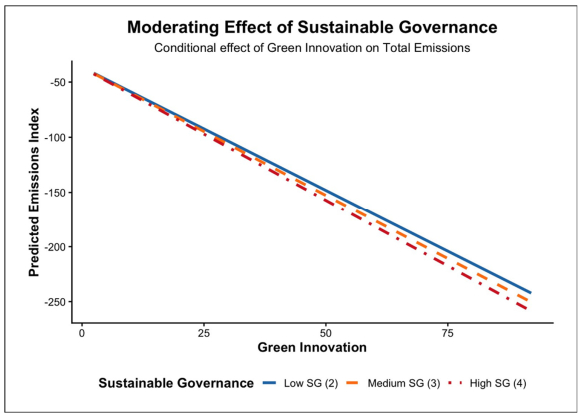
Achieving net-zero emissions requires not only technological innovation but also effective governance mechanisms that can support and enhance corporate sustainability initiatives. While prior studies have examined the individual effects of green innovation and governance practices on environmental performance, limited evidence exists regarding their combined influence on corporate carbon emissions. This study investigated the relationship between green innovation, sustainable governance, and carbon emissions among Euronext-listed firms. Using a panel dataset of 304 companies covering the period 2017–2023, the study employed OLS regression models with industry and year fixed effects and conducted two-step system GMM estimation as a robustness test. The study examined the effects of green innovation and sustainable governance on total, direct (Scope 1), and indirect (Scope 2) carbon emissions while accounting for firm-specific characteristics and potential endogeneity concerns. The results revealed a significant negative association between green innovation and corporate carbon emissions, indicating that firms with stronger green innovation performance tend to exhibit lower levels of total, direct, and indirect emissions. Furthermore, the interaction between green innovation and sustainable governance is negative and statistically significant, suggesting that sustainable governance is associated with a stronger emissions-reducing effect of green innovation. These findings provide evidence that green innovation and sustainable governance function as complementary organizational capabilities that contribute to corporate decarbonization. The study contributes to the sustainable finance and corporate sustainability literature by highlighting the importance of integrating innovation strategies with governance mechanisms to improve environmental performance and accelerate progress toward net-zero objectives. The findings offer practical implications for corporate managers, investors, and policymakers seeking effective pathways to support long-term sustainability and climate-related goals.
Citation: Shih-Wei Wu, Kokulnathan Thangavelu, K B Keerthana. 2026: Green innovation and corporate decarbonization: The moderating role of sustainable governance in Euronext-listed companies, Green Finance, 8(4): 702-724. doi: 10.3934/GF.2026025
Achieving net-zero emissions requires not only technological innovation but also effective governance mechanisms that can support and enhance corporate sustainability initiatives. While prior studies have examined the individual effects of green innovation and governance practices on environmental performance, limited evidence exists regarding their combined influence on corporate carbon emissions. This study investigated the relationship between green innovation, sustainable governance, and carbon emissions among Euronext-listed firms. Using a panel dataset of 304 companies covering the period 2017–2023, the study employed OLS regression models with industry and year fixed effects and conducted two-step system GMM estimation as a robustness test. The study examined the effects of green innovation and sustainable governance on total, direct (Scope 1), and indirect (Scope 2) carbon emissions while accounting for firm-specific characteristics and potential endogeneity concerns. The results revealed a significant negative association between green innovation and corporate carbon emissions, indicating that firms with stronger green innovation performance tend to exhibit lower levels of total, direct, and indirect emissions. Furthermore, the interaction between green innovation and sustainable governance is negative and statistically significant, suggesting that sustainable governance is associated with a stronger emissions-reducing effect of green innovation. These findings provide evidence that green innovation and sustainable governance function as complementary organizational capabilities that contribute to corporate decarbonization. The study contributes to the sustainable finance and corporate sustainability literature by highlighting the importance of integrating innovation strategies with governance mechanisms to improve environmental performance and accelerate progress toward net-zero objectives. The findings offer practical implications for corporate managers, investors, and policymakers seeking effective pathways to support long-term sustainability and climate-related goals.

| [1] |
Albitar K, Borgi H, Khan M, et al. (2023) Business environmental innovation and CO2 emissions: The moderating role of environmental governance. Bus Strateg Environ 32: 1996−2007. https://doi.org/10.1002/bse.3232 doi: 10.1002/bse.3232

|
| [2] |
Alsmadi AA, Al-Omoush KS (2025) Adoption of green banking innovations: Drivers and outcomes. Green Finance 7: 584−609. https://doi.org/10.3934/GF.2025022 doi: 10.3934/GF.2025022
|
| [3] |
Chen C, Pinar M, Román-Collado R (2024) Green innovation and energy efficiency: moderating effect of institutional quality based on the threshold model. Environ Resour Econ 87: 3063−3094. https://doi.org/10.1007/s10640−024−00902−w doi: 10.1007/s10640−024−00902−w
|
| [4] |
Cohen R, Eames PC, Hammond GP, et al. (2022) Briefing: The 2021 Glasgow Climate Pact: Steps on the transition pathway towards a low carbon world. Proc Inst Civ Eng Energy 175: 97−102. https://doi.org/10.1680/jener.22.00011 doi: 10.1680/jener.22.00011
|
| [5] |
Du K, Li P, Yan Z (2019) Do green technology innovations contribute to carbon dioxide emission reduction? Empirical evidence from patent data. Technol Forecast Soc Change 14: 297−303. https://doi.org/10.1016/j.techfore.2019.06.010 doi: 10.1016/j.techfore.2019.06.010
|
| [6] |
Dyck A, Lins KV, Roth L, et al. (2019) Do institutional investors drive corporate social responsibility? International evidence. J Financ Econ 131: 693−714. https://doi.org/10.1016/j.jfineco.2018.08.013 doi: 10.1016/j.jfineco.2018.08.013
|
| [7] |
Gerwing T, Kajüter P, Wirth M (2022) The role of sustainable corporate governance in mandatory sustainability reporting quality: T. Gerwing et al. J Bus Econ 92: 517−555. https://doi.org/10.1007/s11573−022−01092−x doi: 10.1007/s11573−022−01092−x
|
| [8] |
Grumann L, Madaleno M, Vieira E (2024) The green finance dilemma: No impact without risk–a multiple case study on renewable energy investments. Green Finance 6: 457−483. https://doi.org/10.3934/GF.2024018 doi: 10.3934/GF.2024018
|
| [9] |
Han S, Peng D, Guo Y, et al. (2025) Harnessing technological innovation and renewable energy and their impact on environmental pollution in G-20 countries. Sci Rep 15: 2236. https://doi.org/10.1038/s41598-025-85182-0 doi: 10.1038/s41598-025-85182-0
|
| [10] |
Hartikainen H, Järvenpää M, Rautiainen A (2021) Sustainability in executive remuneration−A missing link towards more sustainable firms?. J Clean Prod 324: 129224. https://doi.org/10.1016/j.jclepro.2021.129224 doi: 10.1016/j.jclepro.2021.129224
|
| [11] |
Keerthana KB, Wu SW, Kokulnathan T, et al. (2024) The synergistic effect of green innovation and governance in carbon neutrality: Insights from Japanese companies. Bus Strateg Environ 33: 8055−8066. https://doi.org/10.1002/bse.3922 doi: 10.1002/bse.3922
|
| [12] |
Keerthana KB, Wu SW, Wu ME, et al. (2023) The United States energy consumption and carbon dioxide emissions: a comprehensive forecast using a regression model. Sustainability 15: 7932. https://doi.org/10.3390/su15107932 doi: 10.3390/su15107932
|
| [13] |
Khanra S, Kaur P, Joseph RP, et al. (2022) A resource‐based view of green innovation as a strategic firm resource: Present status and future directions. Bus Strateg Environ 31: 1395−1413. https://doi.org/10.1002/bse.2961 doi: 10.1002/bse.2961
|
| [14] |
Konadu R, Ahinful GS, Boakye DJ, et al. (2022) Board gender diversity, environmental innovation and corporate carbon emissions. Technol Forecast Soc Change 174: 121279. https://doi.org/10.1016/j.techfore.2021.121279 doi: 10.1016/j.techfore.2021.121279
|
| [15] |
Mongo M, Belaïd F, Ramdani B (2021) The effects of environmental innovations on CO2 emissions: Empirical evidence from Europe. Environ Sci Policy 118: 1−9. https://doi.org/10.1016/j.envsci.2020.12.004 doi: 10.1016/j.envsci.2020.12.004
|
| [16] |
Nicolò G, Zampone G, Sannino G, et al. (2022) Sustainable corporate governance and non-financial disclosure in Europe: Does the gender diversity matter?. J Appl Account Res 23: 227–249. https://doi.org/10.1108/JAAR doi: 10.1108/JAAR
|
| [17] |
Opoku A, Danquah RD, Aklashie S, et al. (2026) Digital green finance models for sustainable urban development: Current trends and future perspectives. Green Finance 8: 63−84. https://doi.org/10.3934/GF.2026003 doi: 10.3934/GF.2026003
|
| [18] |
Qureshi MA, Ahsan T, Gull AA (2022) Does country−level eco−innovation help reduce corporate CO2 emissions? Evidence from Europe. J Clean Prod 379: 134732. https://doi.org/10.1016/j.jclepro.2022.134732 doi: 10.1016/j.jclepro.2022.134732
|
| [19] |
Shive SA, Forster MM (2020) Corporate governance and pollution externalities of public and private firms. Rev Financ Stud 33: 1296−1330. https://doi.org/10.1093/rfs/hhz079 doi: 10.1093/rfs/hhz079
|
| [20] |
Sun Y, Gao P, Tian W, et al. (2023) Green innovation for resource efficiency and sustainability: Empirical analysis and policy. Resour Policy 81: 103369. https://doi.org/10.1016/j.resourpol.2023.103369 doi: 10.1016/j.resourpol.2023.103369
|
| [21] |
Takalo SK, Tooranloo HS (2021) Green innovation: A systematic literature review. J Clean Prod 279: 122474. https://doi.org/10.1016/j.jclepro.2020.122474 doi: 10.1016/j.jclepro.2020.122474
|
| [22] |
Tanaka H, Tanaka C (2022) Sustainable investment strategies and a theoretical approach of multi−stakeholder communities. Green Finance 4: 329−346. https://doi.org/10.3934/GF.2022016 doi: 10.3934/GF.2022016
|
| [23] |
Töbelmann D, Wendler T (2020) The impact of environmental innovation on carbon dioxide emissions. J Clean Prod 244: 118787. https://doi.org/10.1016/j.jclepro.2019.118787 doi: 10.1016/j.jclepro.2019.118787
|
| [24] |
Valdivieso-Uvidia JM, Expósito-Langa M, Belso-Martínez JA (2025) Green innovation and sustainable performance: The mediating role of sustainability orientation in cluster environments. Green Finance 7: 520−544. https://doi.org/ 10.3934/GF.2025020 doi: 10.3934/GF.2025020
|
 GF-08-04-025-s001.pdf |
 |
Figures(1) / Tables(8)

Shih-Wei Wu, Kokulnathan Thangavelu, K B Keerthana. 2026: Green innovation and corporate decarbonization: The moderating role of sustainable governance in Euronext-listed companies, Green Finance, 8(4): 702-724. doi: 10.3934/GF.2026025





 DownLoad: