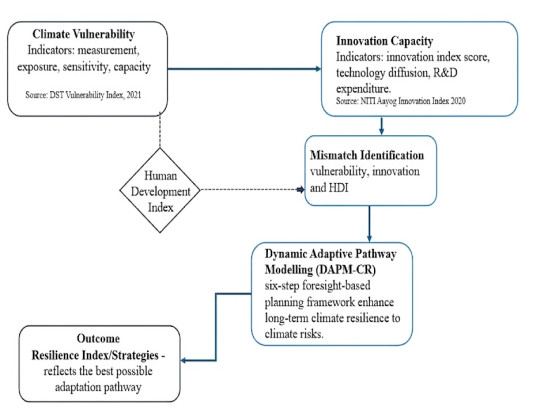
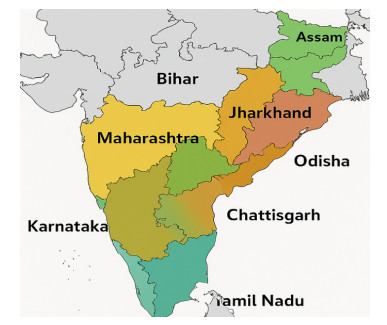
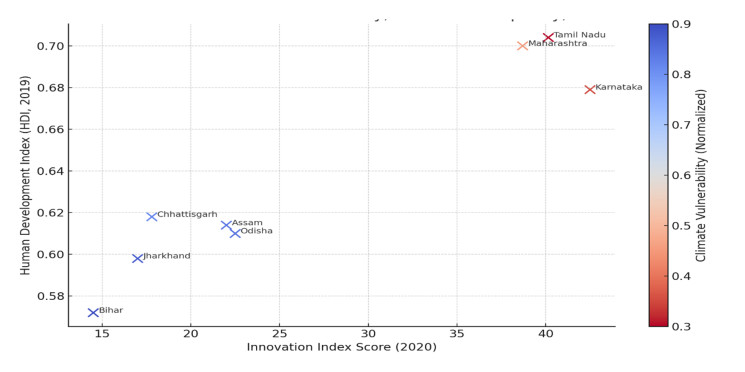
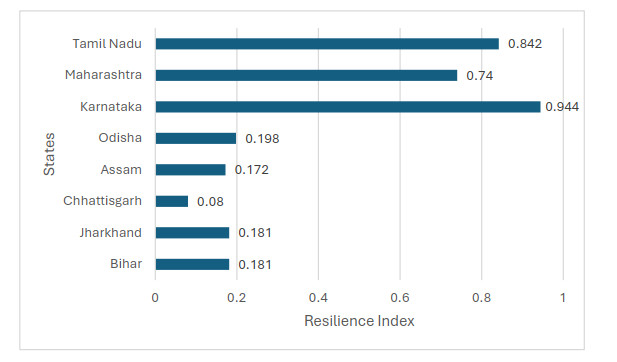
Climate change poses uneven risks across Indian states and amplifies exposure to climate hazards. In this study, we examined climate-related regional risk by analyzing data from eight representative Indian states to capture the mismatch between climate vulnerability and innovation capacity. For the study, the Dynamic Adaptive Pathway Modeling for Climate Resilience (DAPM-CR) framework was proposed as an integrated analytical framework for assessing climate resilience. The analysis drew on secondary data from the NITI Aayog India Innovation Index, the Department of Science and Technology's Climate Vulnerability Assessment, Human Development Index indicators, and state-level R&D statistics. We integrated climate vulnerability, innovation, human development, and R&D indicators to assess regional disparities in climate resilience across eight representative Indian states. The DAPM-CR framework was developed to integrate climate vulnerability and innovation capacity and identify adaptive pathways for strengthening state climate resilience. The study contributes to the literature by providing evidence on the spatial mismatch between climate vulnerability and innovation capacity. The findings revealed that Bihar, Jharkhand, Chhattisgarh, Assam, and Odisha exhibit low climate resilience, low innovation capacity, and low human development. In contrast, Karnataka, Maharashtra, and Tamil Nadu demonstrated stronger innovation ecosystems for climate resilience. The study demonstrates how integrating innovation capacity with climate vulnerability assessment can strengthen adaptive climate resilience. The Composite Resilience Index revealed that states like Tamil Nadu and Karnataka benefit from large-scale renewable energy projects to enhance resilience. Thus, the proposed framework can be extended to other Indian states to provide insights into the requirement for spatially equitable resilience strategies.
Citation: Sheeja Krishnakumar, Simon Grima, Kiran Sood, Rekha R Nair. Strategies for climate resilience in Indian states: Addressing innovation-vulnerability mismatch[J]. Green Finance, 2026, 8(4): 675-701. doi: 10.3934/GF.2026024
Climate change poses uneven risks across Indian states and amplifies exposure to climate hazards. In this study, we examined climate-related regional risk by analyzing data from eight representative Indian states to capture the mismatch between climate vulnerability and innovation capacity. For the study, the Dynamic Adaptive Pathway Modeling for Climate Resilience (DAPM-CR) framework was proposed as an integrated analytical framework for assessing climate resilience. The analysis drew on secondary data from the NITI Aayog India Innovation Index, the Department of Science and Technology's Climate Vulnerability Assessment, Human Development Index indicators, and state-level R&D statistics. We integrated climate vulnerability, innovation, human development, and R&D indicators to assess regional disparities in climate resilience across eight representative Indian states. The DAPM-CR framework was developed to integrate climate vulnerability and innovation capacity and identify adaptive pathways for strengthening state climate resilience. The study contributes to the literature by providing evidence on the spatial mismatch between climate vulnerability and innovation capacity. The findings revealed that Bihar, Jharkhand, Chhattisgarh, Assam, and Odisha exhibit low climate resilience, low innovation capacity, and low human development. In contrast, Karnataka, Maharashtra, and Tamil Nadu demonstrated stronger innovation ecosystems for climate resilience. The study demonstrates how integrating innovation capacity with climate vulnerability assessment can strengthen adaptive climate resilience. The Composite Resilience Index revealed that states like Tamil Nadu and Karnataka benefit from large-scale renewable energy projects to enhance resilience. Thus, the proposed framework can be extended to other Indian states to provide insights into the requirement for spatially equitable resilience strategies.

| [1] |
Adger WN (2006) Vulnerability. Global Environ Chang 16: 268–281. https://doi.org/10.1016/j.gloenvcha.2006.02.006 doi: 10.1016/j.gloenvcha.2006.02.006

|
| [2] |
Alharbi SS, Al Mamun M, Boubaker S, et al. (2023) Green finance and renewable energy: Worldwide evidence. Energ Econ 118: 106499. https://doi.org/10.1016/j.eneco.2022.106499 doi: 10.1016/j.eneco.2022.106499
|
| [3] |
Al-Maadid A, Ben Ali MS, Mohammed KS (2025) The effect of climate risk on the human development index. Enviro Sustain Indi 27: 100757. https://doi.org/10.1016/j.indic.2025.100757 doi: 10.1016/j.indic.2025.100757
|
| [4] |
Archibugi D, Coco A (2005) Measuring technological capabilities at the country level: A survey and a menu for choice. Res Policy 34: 175–194. https://doi.org/10.1016/j.respol.2004.12.002 doi: 10.1016/j.respol.2004.12.002
|
| [5] |
Argyroudis SA, Mitoulis SA, Chatzi E, et al. (2021) Digital technologies can enhance climate resilience of critical infrastructure. Clim Risk Manag 35: 100387. https://doi.org/10.1016/j.crm.2021.100387 doi: 10.1016/j.crm.2021.100387
|
| [6] | Bahadur AV, Ibrahim M, Tanner T, The resilience renaissance? Unpacking resilience for tackling climate change and disasters. SCR Discussion Paper, 2015. Available from: https://hdl.handle.net/20.500.12413/2368. |
| [7] |
Balachandra P (2011) Modern energy access to all in rural India: An integrated implementation strategy, Energy Policy, 39: 7803-7814. https://doi.org/10.1016/j.enpol.2011.09.026 doi: 10.1016/j.enpol.2011.09.026
|
| [8] | Béné C, Wood RG, Newsham A, et al, Resilience: New utopia or new tyranny? IDS Working Paper, 2012. Available from: https://doi.org/10.1111/j.2040-0209.2012.00405.x. |
| [9] |
Brenkert AL, Malone EL (2005) Modelling vulnerability and resilience to climate change: A case study of India and Indian states. Climatic Change 72: 57–102. https://doi.org/10.1007/s10584-005-5930-3 doi: 10.1007/s10584-005-5930-3
|
| [10] |
Brullo T, Barnett J, Waters E, et al. (2024) The enablers of adaptation: A systematic review. Npj Clim Action 3: 40. https://doi.org/10.1038/s44168-024-00128-y doi: 10.1038/s44168-024-00128-y
|
| [11] | Bureau of Energy Efficiency (2023) Energy efficiency in industry: India's path forward. Ministry of Power, Government of India. |
| [12] |
Callahan CW (2025) Present and future limits to climate change adaptation. Nat Sustain 8: 336–342. https://doi.org/10.1038/s41893-025-01519-7 doi: 10.1038/s41893-025-01519-7
|
| [13] | Council on Energy, Environment and Water (CEEW) (2021) Climate vulnerability index: Mapping exposure and adaptive capacity across indian districts. |
| [14] |
Chapagain PS, Banskota T, Shrestha S, et al. (2025) Studies on adaptive capacity to climate change: A synthesis of changing concepts, dimensions, and indicators. Hum Soc Sci Commun 12: 331. https://doi.org/10.1057/s41599-025-04453-3 doi: 10.1057/s41599-025-04453-3
|
| [15] |
Cheng J, Jiang Y (2024) How can carbon markets drive the development of renewable energy sector? Empirical evidence from China. Data Sci Financ Econ 4: 249–269. https://doi.org/10.3934/DSFE.2024010 doi: 10.3934/DSFE.2024010
|
| [16] | Climate Change Exposure Index (XDI) (2020) XDI report: India climate vulnerability rankings. |
| [17] | Dasgupta P, Roy J, Chakravarty S (2021) Climate change and India's adaptation strategy. Curr Sci 120: 321–329. |
| [18] |
Debnath S, Mishra A, Mailapalli DR, et al. (2021) Identifying the most promising agronomic adaptation strategies to close the rainfed rice yield gap in future: A model-based assessment. J. Water Clim Change 12: 2854–2874. https://doi.org/10.2166/wcc.2021.094 doi: 10.2166/wcc.2021.094
|
| [19] | Department of Science and Technology, Climate vulnerability assessment for adaptation planning in India using a common framework. Government of India, 2021. Available from: https://dst.gov.in/sites/default/files/Full%20Report%20%281%29.pdf. |
| [20] | Department of Science and Technology (DST), Science, technology, and innovation policy draft 2020. Government of India, 2020. Available from: https://dst.gov.in/pdfimageupload/science-technology-and-innovation-policy-2020?utm_source = chatgpt.com. |
| [21] |
Ikram M, Sadki JE (2024) Resilient and sustainable green technology strategies: A study of Morocco's path toward sustainable development. Sustain Futures 8: 100327. https://doi.org/10.1016/j.sftr.2024.100327 doi: 10.1016/j.sftr.2024.100327
|
| [22] | Indian Council of Agricultural Research (ICAR) (2021) Climate-resilient agriculture: Innovations and technology adoption in India. |
| [23] | Intergovernmental Panel on Climate Change (IPCC) (2022) Sixth assessment report: Impacts, adaptation and vulnerability. |
| [24] | International Energy Agency (IEA) (2022) India energy outlook. |
| [25] |
Jat RK, Meena VS, Durgude S, et al. (2025a) Bridging the gap: Challenges and adoption of climate-resilient agriculture technologies in agricultural landscapes across agro-climatic zones of Bihar, India. Front Sustain Food Syst 8: 1504388. https://doi.org/10.3389/fsufs.2024.1504388 doi: 10.3389/fsufs.2024.1504388
|
| [26] |
Kumar A, Mohanasundari T (2025) Assessment of livelihood vulnerability to climate change among tribal communities in Chhindwara and Dhar districts, Central India. Sci Rep 15: 8843. https://doi.org/10.1038/s41598-025-90769-8 doi: 10.1038/s41598-025-90769-8
|
| [27] |
Markard J, Raven R, Truffer B (2012) Sustainability transitions: An emerging field of research and its prospects. Res Policy 41: 955–967. https://doi.org/10.1016/j.respol.2012.02.013 doi: 10.1016/j.respol.2012.02.013
|
| [28] | Mehta S, Kedia S, Roy A (2020) Strengthening subnational innovation systems in India. Centre for Policy Research Working Paper Series. |
| [29] | Ministry of New and Renewable Energy (MNRE) (2023) Annual report 2022–2023. Government of India. |
| [30] | Ministry of New and Renewable Energy (MNRE) (2024) National report on solar energy development. |
| [31] |
Monie SW, Gustafsson M, Önnered S, et al. (2025) Renewable and integrated energy system resilience-A review and generic resilience index. Renew Sust Energ Rev 215: 115554. https://doi.org/10.1016/j.rser.2025.115554 doi: 10.1016/j.rser.2025.115554
|
| [32] |
Nelson DR, Adger WN, Brown K (2007) Adaptation to environmental change: Contributions of a resilience framework. Annu Rev Env Resour 32: 395–419. https://doi.org/10.1146/annurev.energy.32.051807.090348 doi: 10.1146/annurev.energy.32.051807.090348
|
| [33] | NITI Aayog (2020) India's strategy for electric vehicle adoption and policy recommendations. |
| [34] | NITI Aayog (2021) India innovation index 2020. |
| [35] | Organisation for Economic Co-operation and Development (OECD) (2011) Towards Green Growth, Paris: OECD Publishing. https://doi.org/10.1787/9789264111318-en |
| [36] | Pelling M (2011) Adaptation to Climate Change: From Resilience to Transformation, 1 Eds., London: Routledge, 224. https://doi.org/10.4324/9780203889046 |
| [37] | Ramanan R, Atal innovation mission: Fostering innovation for sustainable development. NITI Aayog, 2016. Available from: https://www.niti.gov.in/atal-innovation-mission-fostering-innovation-sustainable-development (accessed 27 April 2025). |
| [38] |
Ran J, MacGillivray BH, Gong Y, et al. (2020) The application of frameworks for measuring social vulnerability and resilience to geophysical hazards within developing countries: A systematic review and narrative synthesis. Sci Total Environ 711: 134486. https://doi.org/10.1016/j.scitotenv.2019.134486 doi: 10.1016/j.scitotenv.2019.134486
|
| [39] |
Revi A, Satterthwaite D, Fernando A, et al. (2014) Towards transformative adaptation in cities: The IPCC's fifth assessment. Environ Urban 26: 11–28. https://doi.org/10.1177/0956247814523539 doi: 10.1177/0956247814523539
|
| [40] | Roy J, Tschakert P, Waisman H (2022) Sustainable development, in poverty eradication and reducing inequalities, IPCC Special Report on Global Warming of 1.5℃, Cambridge and New York: Cambridge University Press, 445–538. https://doi.org/10.1017/9781009157940.007 |
| [41] |
Shehadeh A, Alshboul O, Arar M (2024) Enhancing urban sustainability and resilience: Employing digital twin technologies for integrated WEFE nexus management to achieve SDGs. Sustainability 16: 1–28. https://doi.org/10.3390/su16177398 doi: 10.3390/su16177398
|
| [42] |
Sovacool BK, Hess DJ (2017) Ordering theories: Typologies and conceptual frameworks for socio-technical change. Soc Stud Sci 47: 703–750. https://doi.org/10.1177/0306312717709363 doi: 10.1177/0306312717709363
|
| [43] | Tanner TM, Bahadur AV, Moench M (2015) Challenges for resilience policy and practice. Overseas Development Institute (ODI). |
| [44] | The Energy and Resources Institute (TERI) (2021) Climate resilience and adaptation: Implementation of SAPCCs in India. |
| [45] |
Tran NT, Nguyen TD, Nguyen M, et al. (2025) Climate vulnerability and green innovation: A cross-country analysis. J Open Innov: Technol Mar Complex 11: 100548. https://doi.org/10.1016/j.joitmc.2025.100548 doi: 10.1016/j.joitmc.2025.100548
|
| [46] | World Intellectual Property Organisation (WIPO) (2022) Global innovation index 2022: What is the future of innovation-driven growth? World Intellectual Property Organisation. |
| [47] |
Zupancic N (2022) Systematic literature review: Inter-relatedness of innovation, resilience and sustainability-major, emerging themes and future research directions. Discov Sustain 3: 28. https://doi.org/10.1007/s43615-022-00187-5 doi: 10.1007/s43615-022-00187-5
|
 GF-08-04-024-s001.xlsx |
 |
Figures(4) / Tables(13)

Sheeja Krishnakumar, Simon Grima, Kiran Sood, Rekha R Nair. Strategies for climate resilience in Indian states: Addressing innovation-vulnerability mismatch[J]. Green Finance, 2026, 8(4): 675-701. doi: 10.3934/GF.2026024





 DownLoad: