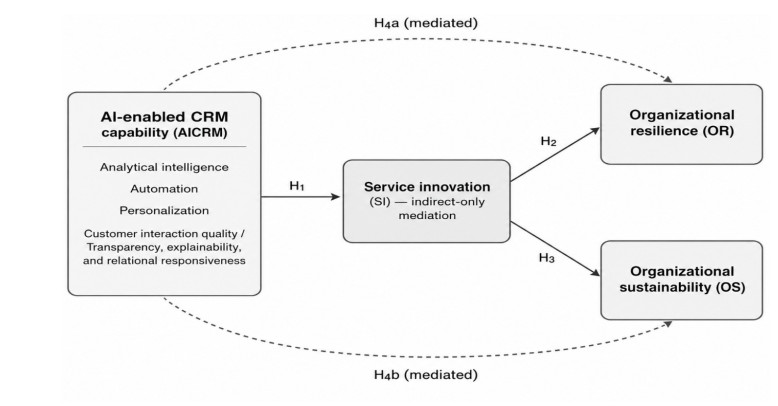
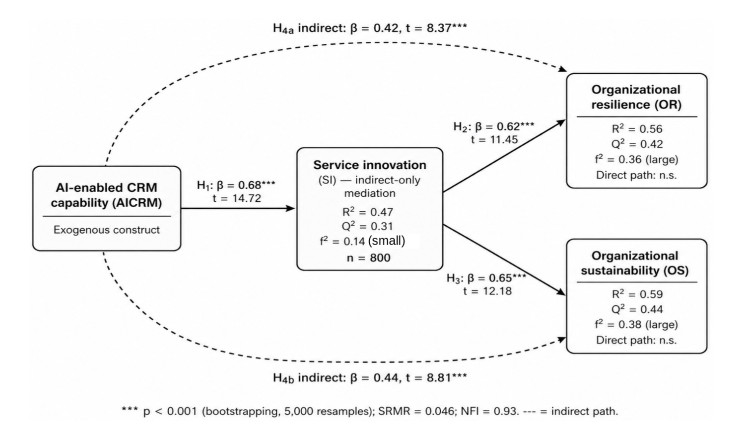
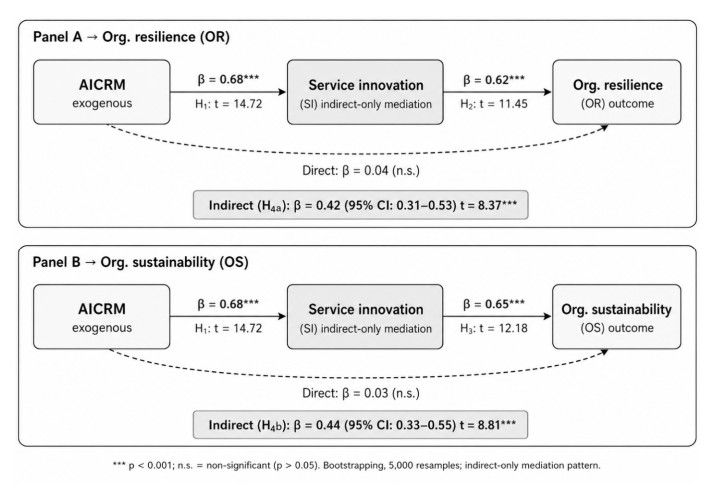
Digital transformation and the green-finance agenda are increasingly intertwined, yet the organizational mechanism connecting digital capability to sustainability-oriented banking practice remains under-specified. Drawing on dynamic-capabilities and sustainable-banking research, we analyzed a pooled sample of 800 financial-services practitioners in Taiwan. Partial least squares structural equation modeling showed a strong positive association between perceived AI-enabled customer relationship management (CRM) capability and service innovation; service innovation was positively associated with perceived organizational resilience and organizational sustainability. After service innovation entered the model, the direct effects of AI-CRM capability for both outcomes were non-significant, yielding an indirect-only mediation pattern. The results therefore located the estimated organizational association of AI-CRM with resilience and sustainability in service innovation rather than in the technology. We did not establish temporal causality and did not measure carbon emissions, energy use, or ESG-disclosure quality. Our contribution is correspondingly specific: We identified an organizational micro-foundation through which responsible AI-CRM use is associated with sustainability-oriented financial-service practice. In green-finance terms, the argument is positioned at the level of organizational micro-foundations rather than measured environmental outcomes.
Citation: Kuo Ming Chu, Hui Chun Chan. AI-enabled CRM capability, service innovation, and sustainable banking outcomes: A digital green-finance perspective from Taiwan[J]. Green Finance, 2026, 8(3): 649-674. doi: 10.3934/GF.2026023
Digital transformation and the green-finance agenda are increasingly intertwined, yet the organizational mechanism connecting digital capability to sustainability-oriented banking practice remains under-specified. Drawing on dynamic-capabilities and sustainable-banking research, we analyzed a pooled sample of 800 financial-services practitioners in Taiwan. Partial least squares structural equation modeling showed a strong positive association between perceived AI-enabled customer relationship management (CRM) capability and service innovation; service innovation was positively associated with perceived organizational resilience and organizational sustainability. After service innovation entered the model, the direct effects of AI-CRM capability for both outcomes were non-significant, yielding an indirect-only mediation pattern. The results therefore located the estimated organizational association of AI-CRM with resilience and sustainability in service innovation rather than in the technology. We did not establish temporal causality and did not measure carbon emissions, energy use, or ESG-disclosure quality. Our contribution is correspondingly specific: We identified an organizational micro-foundation through which responsible AI-CRM use is associated with sustainability-oriented financial-service practice. In green-finance terms, the argument is positioned at the level of organizational micro-foundations rather than measured environmental outcomes.

| [1] |
Akter S, Hossin MA, Sajib S, et al. (2023) A framework for AI-powered service innovation capability: Review and agenda for future research. Technovation 125: 102768. https://doi.org/10.1016/j.technovation.2023.102768 doi: 10.1016/j.technovation.2023.102768

|
| [2] |
Akter S, Wamba SF, Mariani M, et al. (2021) How to build an AI climate-driven service analytics capability for innovation and performance in industrial markets? Ind Market Manag 97: 258–273. https://doi.org/10.1016/j.indmarman.2021.07.014 doi: 10.1016/j.indmarman.2021.07.014
|
| [3] |
Allui A, Rashdeh Z (2024) Strategic innovation and organizational sustainability in the context of external changes in government plans. IBIMA Bus Rev, 344392. https://doi.org/10.5171/2024.344392 doi: 10.5171/2024.344392
|
| [4] |
Barney JB (1991) Firm resources and sustained competitive advantage. J Manage 17: 99–120. https://doi.org/10.1177/014920639101700108 doi: 10.1177/014920639101700108
|
| [5] |
Berraies S, Hamza KA, Chtioui R (2020) Distributed leadership and exploratory and exploitative innovations: Mediating roles of tacit and explicit knowledge sharing and organizational trust. J Knowl Manag 25: 1287–1318. https://doi.org/10.1108/JKM-04-2020-0311 doi: 10.1108/JKM-04-2020-0311
|
| [6] |
Bharti SS, Prasad K, Sudha S, et al. (2023) Customer acceptability towards AI-enabled digital banking: A PLS-SEM approach. J Financ Serv Mark 28: 779–793. https://doi.org/10.1057/s41264-023-00241-9 doi: 10.1057/s41264-023-00241-9
|
| [7] | BIS (Bank for International Settlements) (2021) Artificial intelligence and machine learning in financial services: Market developments and financial stability implications. Basel: Bank for International Settlements. |
| [8] |
Blommerde T (2023) Service innovation capability: A systematic literature review and research agenda. Serv Ind J 43: 1197–1227. https://doi.org/10.1080/02642069.2023.2249830 doi: 10.1080/02642069.2023.2249830
|
| [9] | Brislin RW (1986) The wording and translation of research instruments, In: Lonner W.J. & Berry J.W., Field Methods in Cross-Cultural Research, Thousand Oaks: Sage Publication, 8: 137–164. |
| [10] | Bu Y, Quach S, Thaichon P (2022) Artificial intelligence (AI)-empowered customer relationship managemen, Artificial Intelligence for Marketing Management, 1 Eds, London: Routledge, 18. https://doi.org/10.4324/9781003280392-11 |
| [11] |
Feliciano-Cestero MM, Ameen N, Kotabe M, et al. (2023) Is digital transformation threatened? A systematic literature review. J Bus Res 157: 113546. https://doi.org/10.1016/j.jbusres.2022.113546 doi: 10.1016/j.jbusres.2022.113546
|
| [12] |
Forcadell FJ, Aracil E, Úbeda F (2019) The influence of innovation on corporate sustainability in the international banking industry. Sustainability 11: 3210. https://doi.org/10.3390/su11113210 doi: 10.3390/su11113210
|
| [13] | FSC (Financial Supervisory Commission, Taiwan) (2023) Core principles and policy guidance for the use of artificial intelligence in the financial industry. Taipei: Financial Supervisory Commission. |
| [14] |
Garrido-Moreno A, Martín-Rojas R, García-Morales VJ (2024) The key role of innovation and organizational resilience in improving business performance. Int J Inform Manage 77: 1–20. https://doi.org/10.1016/j.ijinfomgt.2024.102777 doi: 10.1016/j.ijinfomgt.2024.102777
|
| [15] | Hair JF, Hult GTM, Ringle CM, et al. (2021) A Primer on Partial Least Squares Structural Equation Modeling (PLS-SEM), 3 Eds, Thousand Oaks: Sage Publication, 384. |
| [16] |
Henseler J, Ringle CM, Sarstedt M (2016) Testing measurement invariance of composites using partial least squares. Int Market Rev 33: 405–431. https://doi.org/10.1108/IMR-09-2014-0304 doi: 10.1108/IMR-09-2014-0304
|
| [17] |
Hoehle H, Scornavacca E, Huff S (2012) Three decades of research on consumer adoption and utilization of electronic banking channels: A literature analysis. Decis Support Syst 54: 122–132. https://doi.org/10.1016/j.dss.2012.04.010 doi: 10.1016/j.dss.2012.04.010
|
| [18] |
Hussain S, Rasheed A, ur Rehman S (2024) Driving sustainable growth: Exploring the link between financial innovation, green finance and sustainability performance: Banking evidence. Kybernetes 53: 4678–4696. https://doi.org/10.1108/K-05-2023-0918 doi: 10.1108/K-05-2023-0918
|
| [19] | Islam MS, Rubel MRB, Hasan MM (2023) Environmental and social performance of the banking industry in Bangladesh: Effect of stakeholders' pressure and green practice adoption. Sustainability 15: 8665. |
| [20] |
Khan HHA, Ahmad N, Yusof NM, et al. (2024) Green finance and environmental sustainability: A systematic review and future research avenues. Environ Sci Pollut R 31: 9784–9794. https://doi.org/10.1007/s11356-023-31809-6 doi: 10.1007/s11356-023-31809-6
|
| [21] |
Kock N (2015) Common method bias in PLS-SEM: A full collinearity assessment approach. Int J E-Collab 11: 1–10. https://doi.org/10.4018/ijec.2015100101 doi: 10.4018/ijec.2015100101
|
| [22] |
Königstorfer F, Thalmann S (2020) Applications of artificial intelligence in commercial banks—A research agenda for behavioral finance. J Behav Exp Financ 27: 100352. https://doi.org/10.1016/j.jbef.2020.100352 doi: 10.1016/j.jbef.2020.100352
|
| [23] |
Kumar P, Sharma SK, Dutot V (2023) Artificial intelligence (AI)-enabled CRM capability in healthcare: The impact on service innovation. Int J Inform Manage 69: 1–15. https://doi.org/10.1016/j.ijinfomgt.2022.102598 doi: 10.1016/j.ijinfomgt.2022.102598
|
| [24] |
Lengnick-Hall CA, Beck TE, Lengnick-Hall ML (2011) Developing a capacity for organizational resilience through strategic human resource management. Hum Resour Manage R 21: 243–255. https://doi.org/10.1016/j.hrmr.2010.07.001 doi: 10.1016/j.hrmr.2010.07.001
|
| [25] |
Levy S, Hino H (2016) Emotional brand attachment: A factor in customer–bank relationships. Int J Bank Mark 34: 136–150. https://doi.org/10.1108/IJBM-06-2015-0092 doi: 10.1108/IJBM-06-2015-0092
|
| [26] |
Li J, Jin X (2024) The impact of artificial intelligence adoption intensity on corporate sustainability performance. Sustainability 16: 9350. https://doi.org/10.3390/su16219350 doi: 10.3390/su16219350
|
| [27] |
Mainardes EW, Rosa CAdeM, Nossa SN (2020) Omnichannel strategy and customer loyalty in banking. Int J Bank Mark 38: 799–822. https://doi.org/10.1108/IJBM-07-2019-0272 doi: 10.1108/IJBM-07-2019-0272
|
| [28] |
Mainardes EW, Coutinho ARS, Alves HMB (2023) The influence of the ethics of E-retailers on online customer experience and customer satisfaction. J Retail Consum Serv 70: 103171. https://doi.org/10.1016/j.jretconser.2022.103171 doi: 10.1016/j.jretconser.2022.103171
|
| [29] |
Manser Payne EH, Peltier J, Barger VA (2021) Enhancing the value co-creation process: Artificial intelligence and mobile banking service platforms. J Res Interact Mark 15: 68–85. https://doi.org/10.1108/JRIM-10-2020-0214 doi: 10.1108/JRIM-10-2020-0214
|
| [30] |
Mogaji E, Soetan TO, Kieu TA (2021) The implications of artificial intelligence on the digital marketing of financial services to vulnerable customers. Australas Mark J 29: 235–242. https://doi.org/10.1016/j.ausmj.2020.05.003 doi: 10.1016/j.ausmj.2020.05.003
|
| [31] |
Mohammad WMW, Wasiuzzaman S (2021) Environmental, social and governance (ESG) disclosure, competitive advantage and performance of firms in Malaysia. Clean Environ Syst 2: 100015. https://doi.org/10.1016/j.cesys.2021.100015 doi: 10.1016/j.cesys.2021.100015
|
| [32] |
Nizam E, Ng A, Dewandaru G, et al. (2019) The impact of social and environmental sustainability on financial performance: A global analysis of the banking sector. J Multinatl Financ M 49: 35–53. https://doi.org/10.1016/j.mulfin.2019.01.002 doi: 10.1016/j.mulfin.2019.01.002
|
| [33] |
Ozay D, Jahanbakht M, Shoomal A, et al. (2024) Artificial intelligence (AI)-based CRM: A comprehensive bibliometric and systematic literature review. Enterp Inf Syst-UK 18. https://doi.org/10.1080/17517575.2024.2351869 doi: 10.1080/17517575.2024.2351869
|
| [34] |
Ozay D, Jahanbakht M, Wang S (2025) What resources are needed for effective AI implementation in CRM, and does it actually enhance performance? Electron Commer R A 74: 101552. https://doi.org/10.1016/j.elerap.2025.101552 doi: 10.1016/j.elerap.2025.101552
|
| [35] |
Padmavathy C, Balaji MS, Sivakumar VJ (2012) Measuring effectiveness of customer relationship management in Indian retail banks. Int J Bank Mark 30: 246–266. https://doi.org/10.1108/02652321211236888 doi: 10.1108/02652321211236888
|
| [36] |
Prieto-Sandoval V, Jaca C, Santos J, et al. (2019) Key strategies, resources, and capabilities for implementing circular economy. Corp Soc Resp Env Ma 26: 1473–1484. https://doi.org/10.1002/csr.1761 doi: 10.1002/csr.1761
|
| [37] |
Proksch D, Rosin AF, Stubner S, et al. (2024) The influence of a digital strategy on the digitalization of new ventures. J Small Bus Manage 62: 1–29. https://doi.org/10.1080/00472778.2021.1883036 doi: 10.1080/00472778.2021.1883036
|
| [38] |
Roy SK, Tehrani AN, Pandit A, et al. (2025). AI-capable relationship marketing: Shaping the future of customer relationships. J Bus Res 192: 115309. https://doi.org/10.1016/j.jbusres.2025.115309 doi: 10.1016/j.jbusres.2025.115309
|
| [39] |
Sekhon H, Ennew C, Kharouf H, et al. (2014) Trustworthiness and trust: Influences and implications. J Market Manag-UK 30: 409–430. https://doi.org/10.1080/0267257X.2013.842609 doi: 10.1080/0267257X.2013.842609
|
| [40] |
Shankar A, Rishi B (2020) Convenience matter in mobile banking adoption intention? Australas Mark J 28: 273–285. https://doi.org/10.1016/j.ausmj.2020.06.008 doi: 10.1016/j.ausmj.2020.06.008
|
| [41] |
Teece DJ (2007) Explicating dynamic capabilities: The nature and microfoundations of (sustainable) enterprise performance. Strategic Manage J 28: 1319–1350. https://doi.org/10.1002/smj.640 doi: 10.1002/smj.640
|
| [42] |
van Esterik-Plasmeijer PWJ, van Raaij WF (2017) Banking system trust, bank trust, and bank loyalty. Int J Bank Mark 35: 97–111. https://doi.org/10.1108/IJBM-12-2015-0195 doi: 10.1108/IJBM-12-2015-0195
|
| [43] |
Wu WY, Nguyen PT (2019) The antecedents of dynamic service innovation capabilities. Int J Innov Manag 23: 1–30. https://doi.org/10.1142/s136391961950066x doi: 10.1142/s136391961950066x
|
| [44] |
Zhao X, Lynch JG, Chen Q (2010) Reconsidering Baron and Kenny: Myths and truths about mediation analysis. J Consum Res 37: 197–206. https://doi.org/10.1086/651257 doi: 10.1086/651257
|
| [45] |
Zhou X, Tang X, Zhang R (2020) Impact of green finance on economic development and environmental quality: A study based on provincial panel data from China. Environ Sci Pollut R, 27: 19915–19932. https://doi.org/10.1007/s11356-020-08383-2 doi: 10.1007/s11356-020-08383-2
|
| [46] |
Zia A, Alotaibi A (2024) Navigating the customer experience landscape: Unraveling the dynamics of AI-driven chatbot services. J Compr Bus Admin Res 1: 113–123. https://doi.org/10.47852/bonviewJCBAR42023726 doi: 10.47852/bonviewJCBAR42023726
|
 GF-08-03-023-s001.pdf |
 |
Figures(3) / Tables(6)

Kuo Ming Chu, Hui Chun Chan. AI-enabled CRM capability, service innovation, and sustainable banking outcomes: A digital green-finance perspective from Taiwan[J]. Green Finance, 2026, 8(3): 649-674. doi: 10.3934/GF.2026023





 DownLoad: