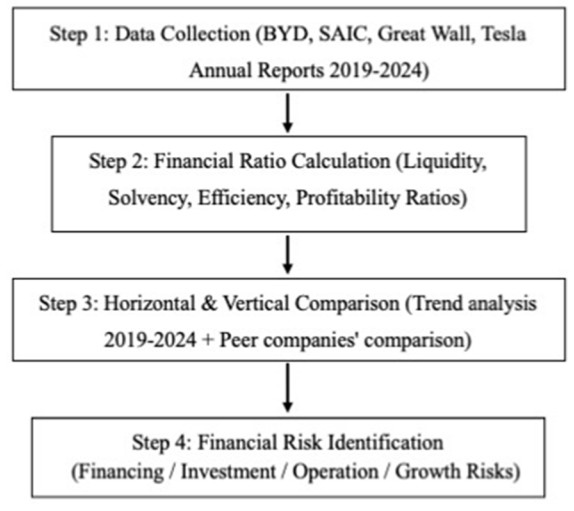
China plans to peak CO2 emissions before 2030 and achieve carbon neutrality before 2060. Under this "dual carbon" strategic goal, the new energy vehicle (NEV) market continues to expand, and financial risks are becoming increasingly prominent. In this paper, we took BYD as a case study and analyzed its financial risks from four dimensions, financing, investment, operation, and growth, using financial ratio analysis and horizontal comparison with SAIC Motor, Great Wall Motor, and Tesla over the period 2019-2024. The results revealed that (1) BYD's current ratio declined from 0.99 in 2019 to 0.75 in 2024, while its quick ratio fell from 0.75 to 0.51 over the same period, indicating deteriorating short-term solvency. (2) The cash ratio improved from 0.12 in 2019 to 0.31 in 2024, suggesting strengthening immediate payment capacity. (3) BYD's debt-to-asset ratio remained high, rising from 68.00% in 2019 to 74.6% in 2024, exceeding the industry average of approximately 60%, reflecting significant long-term solvency risk. (4) Net cash flow from investing activities was consistently negative from 2019 to 2024, reaching -1,291 billion yuan in 2024, indicating insufficient investment-related cash liquidity. (5) Accounts receivable turnover increased substantially from 2.74 times in 2019 to 12.52 times in 2024, while inventory turnover improved modestly from 4.12 to 6.03 times, though both remained below peer levels. To mitigate these risks, we proposed measures, including optimizing the capital structure, strengthening investment benefit analysis, improving accounts receivable and inventory management, and increasing R&D investment.
Citation: Wenming Cao, Min Hong, He Yuan, Pierre Failler. Financial risk analysis and control of new energy vehicle companies——Taking BYD Company as an example[J]. Green Finance, 2026, 8(3): 535-555. doi: 10.3934/GF.2026019
China plans to peak CO2 emissions before 2030 and achieve carbon neutrality before 2060. Under this "dual carbon" strategic goal, the new energy vehicle (NEV) market continues to expand, and financial risks are becoming increasingly prominent. In this paper, we took BYD as a case study and analyzed its financial risks from four dimensions, financing, investment, operation, and growth, using financial ratio analysis and horizontal comparison with SAIC Motor, Great Wall Motor, and Tesla over the period 2019-2024. The results revealed that (1) BYD's current ratio declined from 0.99 in 2019 to 0.75 in 2024, while its quick ratio fell from 0.75 to 0.51 over the same period, indicating deteriorating short-term solvency. (2) The cash ratio improved from 0.12 in 2019 to 0.31 in 2024, suggesting strengthening immediate payment capacity. (3) BYD's debt-to-asset ratio remained high, rising from 68.00% in 2019 to 74.6% in 2024, exceeding the industry average of approximately 60%, reflecting significant long-term solvency risk. (4) Net cash flow from investing activities was consistently negative from 2019 to 2024, reaching -1,291 billion yuan in 2024, indicating insufficient investment-related cash liquidity. (5) Accounts receivable turnover increased substantially from 2.74 times in 2019 to 12.52 times in 2024, while inventory turnover improved modestly from 4.12 to 6.03 times, though both remained below peer levels. To mitigate these risks, we proposed measures, including optimizing the capital structure, strengthening investment benefit analysis, improving accounts receivable and inventory management, and increasing R&D investment.

| [1] |
Ahmed MU, Qays MO, Lachowicz S, et al. (2025) Optimizing ev battery charging using fuzzy logic in the presence of uncertainties and unknown parameters. Electronics 15: 177. https://doi.org/10.3390/electronics15010177 doi: 10.3390/electronics15010177

|
| [2] |
Ballinger B, Stringer M, Schmeda-Lopez DR, et al. (2019) The vulnerability of electric vehicle deployment to critical mineral supply. Appl Energy 255: 113844. https://doi.org/10.1016/j.apenergy.2019.113844 doi: 10.1016/j.apenergy.2019.113844
|
| [3] |
Bartram SM, Brown GW, Waller W (2015) How important is financial risk. J Financial Quant Anal 50: 801-824. https://doi.org/10.1017/S0022109015000216 doi: 10.1017/S0022109015000216
|
| [4] |
Cheng J, Jiang Y (2024) How can carbon markets drive the development of renewable energy sector? Empirical evidence from china. Data Sci Financ Econ 4: 249–269. https://doi.org/10.3934/dsfe.2024010 doi: 10.3934/dsfe.2024010
|
| [5] |
Chi Y, Yan M, Pang Y, et al. (2022) Financial risk assessment of photovoltaic industry listed companies based on text mining. Sustainability 14: 12008. https://doi.org/10.3390/su141912008 doi: 10.3390/su141912008
|
| [6] |
De Jesus Silva Dos Santos DL, Dos Santos GC (2025) Technological convergence in financial auditing: A systematic literature review. Data Sci Financ Econ 5: 440–465. https://doi.org/10.3934/dsfe.2025018 doi: 10.3934/dsfe.2025018
|
| [7] |
Deng Y, Lu M, Zhou X, et al. (2025) Statistical analysis and applications of financial network data in the era of digital intelligence. Data Sci Financ Econ 5: 536–556. https://doi.org/10.3934/dsfe.2025021 doi: 10.3934/dsfe.2025021
|
| [8] |
Fang Y, Fu C, Hashemishahraki S (2025) From oil spills to electric thrills: Byd's rise and the market dynamics powering automaker stocks. China Financ Rev Int 1-41. https://doi.org/10.1108/cfri-02-2025-0078 doi: 10.1108/cfri-02-2025-0078
|
| [9] |
Gatzert N, Heidinger D (2019) An empirical analysis of market reactions to the first solvency and financial condition reports in the european insurance industry. J Risk Insur 87: 407–436. https://doi.org/10.1111/jori.12287 doi: 10.1111/jori.12287
|
| [10] |
Hannan MA, Azidin FA, Mohamed A (2012) Multi-sources model and control algorithm of an energy management system for light electric vehicles. Energ Convers Manage 62: 123–130. https://doi.org/10.1016/j.enconman.2012.04.001 doi: 10.1016/j.enconman.2012.04.001
|
| [11] |
Li Z, Huang H, Ouyang Z (2026) Assessing the effectiveness of green credit policy implementation: Evidence from chinese listed companies. Int Rev Financ Anal 117: 105269. https://doi.org/10.1016/j.irfa.2026.105269 doi: 10.1016/j.irfa.2026.105269
|
| [12] |
Liu D, Xiong Y, Wang L, et al. (2025a) Corporate carbon risk and green m & as. Res Int Bus Financ 75: 102714. https://doi.org/10.1016/j.ribaf.2024.102714 doi: 10.1016/j.ribaf.2024.102714
|
| [13] |
Liu Y, Zhou X (2025b) Policy drive and market competition: A comparative study on financial risks of new energy vehicle companies. Account Market Organ 1: 1–10. https://doi.org/10.71204/ket1wf21 doi: 10.71204/ket1wf21
|
| [14] |
Ongel A, Loewer E, Roemer F, et al. (2019) Economic assessment of autonomous electric microtransit vehicles. Sustainability 11: 648. https://doi.org/10.3390/su11030648 doi: 10.3390/su11030648
|
| [15] |
Purves N, Niblock SJ, Sloan K (2015) On the relationship between financial and non-financial factors. Agr Financ Rev 75: 282–300. https://doi.org/10.1108/afr-04-2014-0007 doi: 10.1108/afr-04-2014-0007
|
| [16] |
Qays MO, Ahmad I, Habibi D, et al. (2026) State of charge estimation of ev secondary battery pack using hybrid hedge feedforward feedback‐based gated recurrent unit to extend lifespan. Battery Energy 5. https://doi.org/10.1002/bte2.70073 doi: 10.1002/bte2.70073
|
| [17] |
Valaskova K, Kliestik T, Svabova L, et al. (2018) Financial risk measurement and prediction modelling for sustainable development of business entities using regression analysis. Sustainability 10: 2144. https://doi.org/10.3390/su10072144 doi: 10.3390/su10072144
|
| [18] |
Xu W, Mo W (2024) Institutional unlocking or technological unlocking? The logic of carbon unlocking in the new energy vehicle industry in china. Energy Policy 195: 114369. https://doi.org/10.1016/j.enpol.2024.114369 doi: 10.1016/j.enpol.2024.114369
|
| [19] |
Zhang K, Hong M, Liu W (2026) Climate policy uncertainty and corporate mergers and acquisitions. Int Rev Econ Financ 105: 104839. https://doi.org/10.1016/j.iref.2025.104839 doi: 10.1016/j.iref.2025.104839
|
Figures(1) / Tables(16)

Wenming Cao, Min Hong, He Yuan, Pierre Failler. Financial risk analysis and control of new energy vehicle companies——Taking BYD Company as an example[J]. Green Finance, 2026, 8(3): 535-555. doi: 10.3934/GF.2026019





 DownLoad: